ABSTRACT (original article): The approximate path synthesis of four-bar linkages with symmetric coupler curves is presented. This includes the formulation of a polynomial optimization problem, a characterization of the maximum number of critical points, a complete numerical solution by homotopy continuation, and application to the design of straight line generators. Our approach specifies a desired curve and finds several optimal four-bar linkages with a coupler trace that approximates it. The objective posed simultaneously enforces kinematic accuracy, loop closure, and leads to polynomial first order necessary conditions with a structure that remains the same for any desired trace leading to a generalized result. Ground pivot locations are set as chosen parameters, and it is shown that the objective has a maximum of 73 critical points. The theoretical work is applied to the design of straight line paths. Parameter homotopy runs are executed for 1440 different choices of ground pivots for a thorough exploration. These computations found the expected linkages, namely, Watt, Evans, Roberts, Chebyshev, and other previously unreported linkages which are organized into a 2D atlas using the UMAP algorithm. ABSTRACT (original article): Aravind Baskar, Mark Plecnik, Jonathan D. Hauenstein (2023), Finding straight line generators through the approximate synthesis of symmetric four-bar coupler curves, Mechanism and Machine Theory, 188, 105310, ISSN 0094-114X. https://doi.org/10.1016/j.mechmachtheory.2023.105310
Keywords optimization, straight line generators, four - bar mechanisms
Introduction
Introduction
The synthesis of four-bar linkages has been of interest to engineers since the 1800s due to their simple architecture and rich design space which is known to be of 9 dimensions. The advent of homotopy continuation techniques [1,2] and the work of Wampler et al. [3] in 1992, who solved the exact path synthesis of four-bar linkages, have led to renewed interest in the area. Other works have focused on approximate path synthesis using local methods and search-based methods [4–6]. Advances in homotopy continuation using monodromy-based methods [7–10] and increased computational power in general have allowed for complete solutions to approximate synthesis problems in four-bars [11–13]. This notebook addresses a subcase of approximate synthesis, namely the synthesis of four-bars that generate symmetric coupler curves approximating straight lines. A four-bar produces a symmetric coupler only if certain geometric constraints are placed on its dimensions, which have been outlined in [14–16]. In this notebook, we present an algebraic derivation of these constraints from first principles. Symmetric four-bars are particularly interesting from the observation that many special straight line generators such as the Watt linkage, the Evans linkage, the Roberts linkage, the Chebyshev linkage, and the Chebyshev lambda linkage produce symmetric curves [17]. Closed-loop mechanisms that approximate straight lines are useful in designing a variety of applications, including walking and hopping machines [18–20], linear haptic interfaces [21], origami-based mechanisms [22] and deployable linkages [23]. Historically, these linkages have been used to convert rotary motion to linear motion in steam engines, such as the Watt linkage. Many techniques have been presented in the literature to design straight-line generating linkages, including the use of four-bars. Vidosic et al. [24] presented a method using the Ball–Burmester point in curvature theory, while Nolle et al. [25] used optimization to report unknown four-bar linkages. McGarva [26] presented a catalogue of such linkages using a search of the design space of four-bars. Despite these works, the question of complete exploration of the design space of four-bars remains.
In this notebook, we thoroughly explore the space of symmetric four-bar linkages through a combination of grid-search and optimization. All potential minima in certain polynomial optimization problems can be found by solving for the roots of first-order necessary conditions of optimality leading to a comprehensive search. The symmetry conditions reduce the 9-dimensional design space of four-bar linkages to 7 dimensions, and choosing the ground pivot positions reduces it further to 3 dimensions. The optimization problem is solved to search for straight line generators for different choices of ground pivots, resulting in the discovery of several novel geometries, including the well-known straight line generators [17]. The linkage designs, 274 in number, are organized into an atlas using the UMAP machine learning algorithm [27] for easy access by engineers searching for these linkages.
Mathematical formulation of four-bars
Mathematical formulation of four-bars
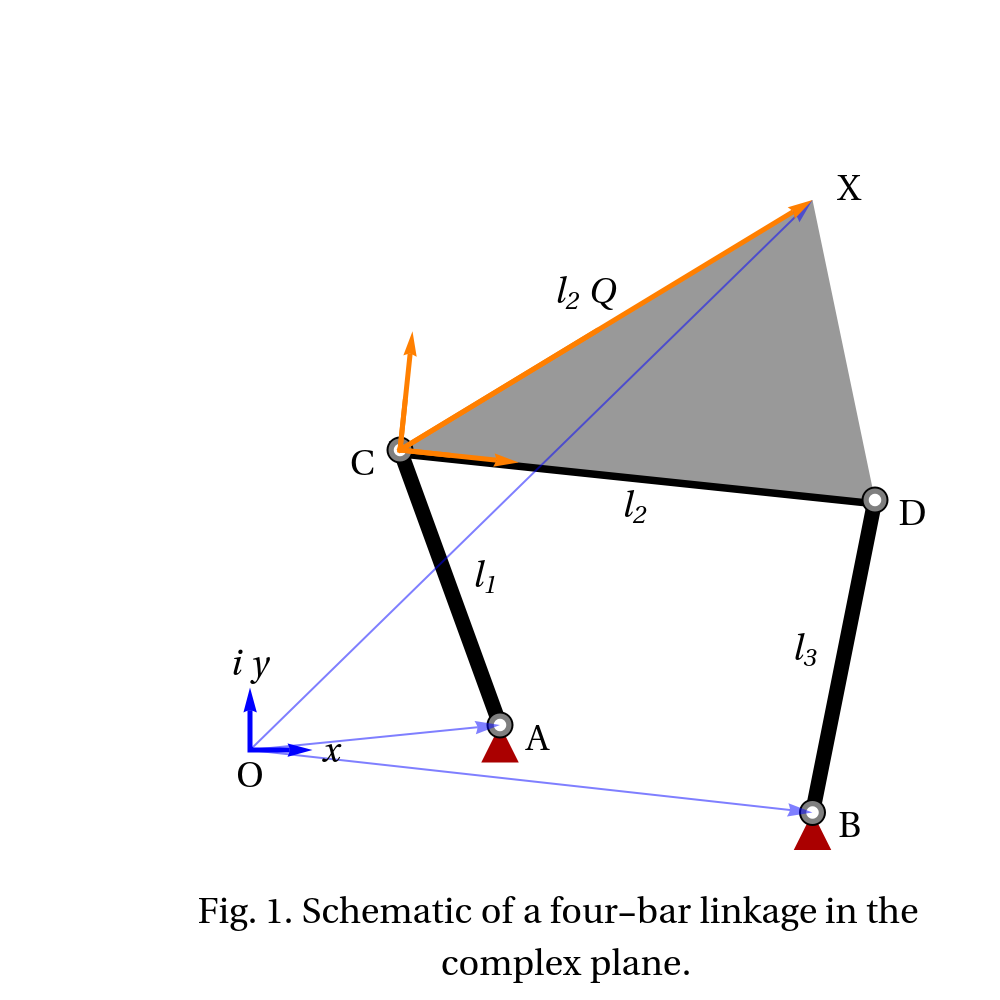
Consider a planar four-bar linkage as shown in Fig. 1 in the complex plane. Let and represent the two fixed pivots of the mechanism, respectively. For representing vector variables such as the fixed pivots, isotropic coordinates [28] are used here. Hence, additional variables and denoting the conjugate variables of and , respectively, are introduced. This is an alternative approach to the Cartesian framework in order to gain certain advantages [28] during the mathematical formulation stage as well as in the solution technique that follows. Let , , and be the real variables which denote the positive lengths of the three moving links as shown. Let , , and be the respective angular displacements of these links measured counter-clockwise from the positive -axis. The coupler trace point (normalized by the coupler base length ) is represented in the local frame of the coupler as 𝑄 and its conjugate counterpart . In other words, is a stretch-rotation that transforms real length into local complex coordinates of the trace point. The design architecture variables of the four-bar linkage are summarized as . Let and its conjugate denote the locus of the trace point of interest in the global frame.We introduce rotation operators in 2D, namely, =,k=1,2,3. The vector loop equations are formulated via the left and right dyads, respectively, as:
A
B
A
c
B
c
A
B
𝑙
1
𝑙
2
𝑙
3
𝜙
1
𝜙
2
𝜙
3
x
𝑙
2
𝑄
c
Q
𝑙
2
d=𝐴,,𝐵,,,,,𝑄,
𝐴
c
𝐵
c
𝑙
1
𝑙
2
𝑙
3
Q
c
X
X
c
Φ
k
ϕ
k
In[]:=
Leq = A + l1 Φ1 + l2 Q Φ2 - X;Req = B + l3 Φ3 + l2 (Q-1) Φ2 - X;
The rotation operators are not design specifications for path synthesis applications, hence it is desirable to eliminate them early in the formulation. In order to do so, the complex conjugate equations must also be considered in the isotropic coordinates framework, namely,
In[]:=
Leqc = Ac + l1 + l2 Qc - Xc;Reqc = Bc + l3 + l2 (Qc-1) - Xc;
-1
Φ1
-1
Φ2
-1
Φ3
-1
Φ2
The conjugate of a rotation operator is its reciprocal from its definition. From the four equations above, all three rotation operators can be eliminated via polynomial resultants sequentially in order to obtain a scalar coupler trace equation given by:
fX,,d=0
𝑋
c
In[]:=
f=Factor[Resultant[Numerator[Together[Resultant[Leq,Leqc,Φ1]]],Numerator[Together[Resultant[Req,Reqc,Φ3]]],Φ2]][[-1]];
As is well known for four-bar linkages, this equation is a sextic equation in plane of circularity 3. It comprises of 16 distinct monomial terms in , namely,
X,
X
c
In[]:=
#[[1]]
X
#[[2]]
Xc
Out[]=
{,,Xc,,,,Xc,,X,X,XXc,X,,,Xc,1}
3
X
3
Xc
3
X
2
Xc
3
X
3
X
2
X
3
Xc
2
X
2
Xc
2
X
2
X
3
Xc
2
Xc
3
Xc
2
Xc
in which the coefficient of the leading term is equal to 1.
3
X
3
()
X
c
In[]:=
Coefficient[f, ]
3
X
3
Xc
Out[]=
1
The tri-circularity nature of the plane curve can be easily verified by observing that the equation is of the following form in : +(X+m0)+X+n1X+n0+.....The first three terms of this sum are extracted from the coupler equation and shown below through some algebraic manipulation:
X,
X
c
3
X
3
()
X
c
2
X
2
()
X
c
m0
c
X
c
X
c
n0
c
2
X
X
c
2
X
c
f(X,)=0
X
c
In[]:=
Simplify[Values[CoefficientRules[Numerator[Together[f/.{X X/w,Xc Xc/w}]],{w}]]][[-3;;-1]]//Reverse
Out[]=
{,(Ac(-2+Qc)X-Bc(1+Qc)X+A(-2+Q)Xc-B(1+Q)Xc),XXc(-(-1+Qc)+Qc-Bc(A(-2+Q)-B(1+Q))(1+Qc)XXc+Xc(-QX-QcX+(-2+Q+Qc)X+(Q+Qc-2QQc)X+Xc+2ABXc-QXc+QXc)+AcX(2BcX+(A(-2+Q)-B(1+Q))(-2+Qc)Xc))}
3
X
3
Xc
2
X
2
Xc
2
Ac
2
X
2
Bc
2
X
2
l3
2
l3
2
l1
2
l2
2
A
2
A
2
B
Four-bar linkages that share an identical coupler locus occur as Roberts cognate triplets in the four-bar design space (see [14, pp. 168-176]). These are different from Roberts straight line linkage which is a specific four-bar linkage attributed to the same person. For a design =𝐴,,𝐵,,,,,𝑄,, its other two cognates can be expressed as:
𝒅
1
𝐴
c
𝐵
c
𝑙
1
𝑙
2
𝑙
3
Q
c
In[]:=
d1={A,Ac,B,Bc,l1,l2,l3,Q,Qc};d2=B,Bc,A+Q(B-A),Ac+Qc(Bc-Ac),l2 ,l3 ,l1 ,,d3=A+Q(B-A),Ac+Qc(Bc-Ac),A,Ac,B,Bc,l3,l1,l2,(Q-1),(Qc-1)
1/2
((1-Q)(1-Qc))
1/2
((1-Q)(1-Qc))
1/2
((1-Q)(1-Qc))
-1
(1-Q)
-1
(1-Qc)
1/2
(Q Qc)
1/2
(Q Qc)
1/2
(Q Qc)
-1
Q
-1
(Qc)
Out[]=
B,Bc,A+(-A+B)Q,Ac+(-Ac+Bc)Qc,l2,
(1-Q)(1-Qc)
,l3(1-Q)(1-Qc)
,l1(1-Q)(1-Qc)
,1
1-Q
1
1-Qc
Out[]=
A+(-A+B)Q,Ac+(-Ac+Bc)Qc,A,Ac,B,Bc,l3,
QQc
,l1QQc
,l2QQc
,-1+Q
Q
-1+Qc
Qc
In our computational experiment, we restrict the model to four-bars that generate symmetric coupler curves. We do this for two reasons. First, much of the straight line linkages reported in the literature [17] such as Watt, Evans, Roberts, and Chebyshev linkages generate symmetric coupler curves about some axis of symmetry in the plane. Second, the inclusion of additional conditions on the design variables to this effect simplifies the model significantly and enables faster computations.
Symmetric coupler curves
Symmetric coupler curves
The following derives the necessary and sufficient conditions for a four-bar linkage to generate symmetric coupler curves. While some of these conditions can be found in the literature, we present a direct proof here via analytical geometry and symbolic algebraic analysis.
Since we are working with isotropic coordinates, the first step is to derive the equation of axis of symmetry in isotropic coordinates. Following the isotropic coordinates convention, where is the imaginary unity, points on a generic line (axis of symmetry) in the complex plane satisfy:
Since we are working with isotropic coordinates, the first step is to derive the equation of axis of symmetry in isotropic coordinates. Following the isotropic coordinates convention
P=p+q
(P,)
P
c
In[]:=
LineSym = Kc P + K Pc + c /. {Kc};
-1
K
Note that denotes any unit vector ) represented in isotropic coordinates along the normal to the axis of symmetry, and is a real parameter such that for any point on the symmetric axis. If is any point in the plane, then its symmetric reflection about the axis defined above is:
K
Kisoftheform,=
κ
K
c
-1
K
c
c=-D-K
-1
K
D
c
D
(X,)
X
c
{Xm,Xmc}= ,;
-c-K Xc
-1
K
-c- X
-1
K
K
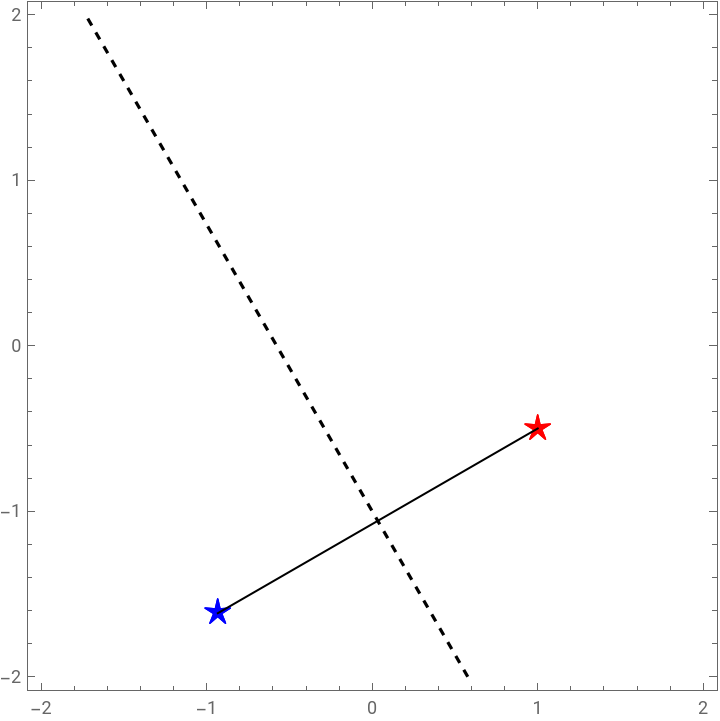
For example, let us consider a symmetric line in plane. In Isotropic coordinates, it can be written as -P++Pc+1=0. Let us consider a point in plane whose mirror point about the said line is to be found:
3
p+q+1=03
2
2
3
2
2
(1,-1/2)
In[]:=
{Xm,Xmc}/.K+,c1,X1-0.5,Xc1+0.5
3
2
2
Out[]=
{-0.933013-1.61603,-0.933013+1.61603}
In[]:=
ShowContourPlot
3
p+q+1==0,{p,-2,2},{q,-2,2},ContourStyle{Dashed,Black},ListPlot[{{1,-0.5}},PlotMarkers{"★",Scaled[0.05]},PlotStyleRed],ListPlot[{{-0.933013,-1.61603}},PlotMarkers{"★",Scaled[0.05]},PlotStyleBlue],Graphics[{Black,Line[{{1,-0.5},{-0.933013,-1.61603}}]}]Out[]=
Summary of four-bar linkages that generate symmetric coupler curves
Summary of four-bar linkages that generate symmetric coupler curves
Optimization model for approximating desired curves using symmetric four-bar coupler curves
Optimization model for approximating desired curves using symmetric four-bar coupler curves
This system of 3 equations in 3 unknowns has a polynomial structure that is invariant to the desired curve being specified following the same reasoning as before. In particular, the total degree of this polynomial system is 648, which forms a trivial upper bound of the number of critical points of the objective function:
One can compute tighter bounds such as a 3-homogeneous Bézout bound [28] of 163 and the BKK bound [28] of 73. This is confirmed by explicitly solving a randomly chosen generic system using NSolve.
The number of roots found matches with the upper bound of BKK. Hence, all system of polynomial equations under this parametric structure admits a maximum of 73 isolated roots that can be computed swiftly using NSolve.
Design of experiments for approximating a straight line segment
Design of experiments for approximating a straight line segment
For exhibiting these 274 linkages, we used the manifold learning technique UMAP [28], a nonlinear dimensional reduction tool to allow us to visualize higher dimensional data in 2D. Using the ground-pivots and the link dimensions to represent each four-bar linkage and setting the hyper-parameters of UMAP, namely, min_dist=0.05 and n_neighbors=10, Fig. 5 is produced as a lower dimensional embedding. It shows bunches of coupler curves which are organized into bins, colored and labeled distinctly, by inspection based on the results of UMAP. The coupler curves within each bin are plotted on the same axis to scale. Some of these coupler curves correspond to popular straight line generating four-bars such as Watt, Evans, Roberts and Chebyshev linkages and their cognates. Additionally, we found a lot of variants of these popular linkages as well as other previously unreported linkages as shown in Fig. 6 with representative examples colored and labeled according to the bin to which they belong in Fig. 5. Our computational approach produced hundreds of linkages that serve as a useful atlas for designers.
Visualization code,
Visualization code,
Package file can be downloaded here: https://curate.nd.edu/show/bg257d30h7p
Visualization
Visualization
The catalogue of 274 four-bar linkages which approximate straight lines are exhibited in the following along with the UMAP embedding using Wolfram Mathematica Manipulate environment [30]:
Conclusion
Conclusion
This work considered an optimization of polynomial objective functions to arrive at a catalog of four-bar linkages which generate symmetric coupler curves approximating a straight line segment. Linkages which approximate straight lines are useful in various applications including walking machines, origami-based mechanisms, and deployable structures. The mathematical model is restricted to one particular class of four-bars which generate symmetric coupler curves to reduce the computational challenges associated with solving a generic system. Conditions are derived for a generic four-bar linkage to generate symmetric coupler curves through an algebraic analysis. The synthesis equations are formulated by incorporating these conditions for symmetry and an optimization problem is formulated as a sum of squares loss function with the ground pivots of the linkage specified. By varying the choice of ground pivots, a total of 1440 polynomial optimization problems are solved to find all possible minima (at most 73 for each problem) which correspond to distinct four-bar linkage designs. This process rediscovered the classical approximate straight line generators along with additional designs substantially different from the classical linkages, which affirms the validity of our approach. The 1440 problems in total resulted in 274 approximate straight line generators which are organized into a 2D atlas using UMAP. This atlas serves as a reference for mechanical designers seeking more straight line options for machine design and robotics.
Figures code
Figures code
Fig. 1 source code
Fig. 1 source code
Fig. 3 source code
Fig. 3 source code
Bibliography
Bibliography
[1] D.J. Bates, J.D. Hauenstein, A.J. Sommese, C.W. Wampler, Numerically solving polynomial systems with Bertini, SIAM, Philadelphia, 2013.
[2] A. Morgan, A. Sommese, A homotopy for solving general polynomial systems that respects m-homogeneous structures, Appl. Math. Comput. 24 (2) (1987) 101–113.
[3] C. Wampler, A. Morgan, A. Sommese, Complete solution of the nine-point path synthesis problem for four-bar linkages, J. Mech. Des. 114 (1) (1992) 153–159.
[4] F.T.S. Marín, A.P. González, Global optimization in path synthesis based on design space reduction, Mech. Mach. Theory 38 (6) (2003) 579–594.
[5] A. Kunjur, S. Krishnamurty, A robust multi-criteria optimization approach, Mech. Mach. Theory 32 (7) (1997) 797–810.
[6] J. Cabrera, A. Simon, M. Prado, Optimal synthesis of mechanisms with genetic algorithms, Mech. Mach. Theory 37 (10) (2002) 1165–1177.
[7] A. Baskar, M. Plecnik, Synthesis of six-bar timed curve generators of Stephenson-type using random monodromy loops, J. Mech. Robotics 13 (1) (2021) 011005.
[8] J.D. Hauenstein, S.N. Sherman, Using monodromy to statistically estimate the number of solutions, in: 2nd IMA Conference on Mathematics of Robotics (2020), Vol. 21, Springer Proceedings in Advanced Robotics, 2022, pp. 37–46.
[9] M.M. Plecnik, R.S. Fearing, Finding only finite roots to large kinematic synthesis systems, J. Mech. Robotics 9 (2) (2017) 021005.
[10] J.D. Hauenstein, L. Oeding, G. Ottaviani, A.J. Sommese, Homotopy techniques for tensor decomposition and perfect identifiability, J. Reine Angew. Math. (Crelles J.) 2019 (753) (2019) 1–22.
[11] A. Baskar, C. Hills, M. Plecnik, J.D. Hauenstein, Estimating the Complete Solution Set of the Approximate Path Synthesis Problem for Four-bar Linkages Using Random Monodromy Loops, in: ASME International Design Engineering Technical Conferences & Computers and Information in Engineering Conference, American Society of Mechanical Engineers, 2022, pp. IDETC2022–90402.
[12] A. Baskar, M. Plecnik, J.D. Hauenstein, Computing saddle graphs via homotopy continuation for the approximate synthesis of mechanisms, Mech. Mach. Theory 176 (2022) 104932.
[13] A. Baskar, M.M. Plecnik, Computing all solutions to a discretization-invariant formulation for optimal mechanism design, in: 2021 International Conference on Robotics and Automation, May 30- June 5, Xi’an, China, 2021.
[14] R. Hartenberg, J. Denavit, Kinematic Synthesis of Linkages, McGraw-Hill, New York, 1964.
[15] D.-M. Lu, W.-M. Hwang, Spherical four-bar linkages with symmetrical coupler-curves, Mech. Mach. Theory 31 (1) (1996) 1–10.
[16] A.K. Natesan, Kinematic Analysis and Synthesis of Four-Bar Mechanisms for Straight Line Coupler Curves (Ph.D. thesis), Rochester Institute of Technology, 1994.
[17] H. Nolle, Linkage coupler curve synthesis: A historical review—I. developments up to 1875, Mech. Mach. Theory 9 (2) (1974) 147–168.
[18] W.D. Shin, W. Stewart, M.A. Estrada, A.J. Ijspeert, D. Floreano, Elastic-actuation mechanism for repetitive hopping based on power modulation and cyclic trajectory generation, IEEE Trans. Robot. (2022).
[19] D.W. Haldane, Robotic vertical jumping agility via series-elastic power modulation, Science Robotics 1 (1) (2016) eaag2048.
[20] A. Baskar, C. Liu, M.M. Plecnik, J.D. Hauenstein, Designing rotary linkages for polar motions, in: 2021 IEEE/RSJ International Conference on Intelligent Robots and Systems, September 27- October 1, Prague, Czech Republic, 2021.
[21] M. Joinié-Maurin, L. Barbé, O. Piccin, J. Gangloff, B. Bayle, R. Rump, Design of a linear haptic display based on approximate straight line mechanisms, in: 2010 IEEE/RSJ International Conference on Intelligent Robots and Systems, IEEE, 2010, pp. 5048–5053.
[22] T.G. Nelson, T.K. Zimmerman, S.P. Magleby, R.J. Lang, L.L. Howell, Developable mechanisms on developable surfaces, Science Robotics 4 (27) (2019) eaau5171.
[23] S. Lu, D. Zlatanov, X. Ding, R. Molfino, A new family of deployable mechanisms based on the hoekens linkage, Mech. Mach. Theory 73 (2014) 130–153.
[24] J. Vidosic, D. Tesar, Selection of four-bar mechanisms having required approximate straight-line outputs Part I. The general case of the ball-burmester point, J. Mech. 2 (1) (1967) 23–44.
[25] H. Nolle, K. Hunt, Optimum synthesis of planar linkages to generate coupler curves, J. Mech. 6 (3) (1971) 267–287.
[26] J.R. McGarva, Rapid search and selection of path generating mechanisms from a library, Mech. Mach. Theory 29 (2) (1994) 223–235.
[27] L. McInnes, J. Healy, J. Melville, UMAP: Uniform manifold approximation and projection for dimension reduction, 2018, arXiv preprint arXiv:1802.03426.
[28] C.W. Wampler, Isotropic Coordinates, Circularity, and Bezout Numbers: Planar Kinematics From a New Perspective, in: International Design Engineering Technical Conferences and Computers and Information in Engineering Conference, vol. 2A: 24th Biennial Mechanisms Conference, 1996, V02AT02A073.
[29] G.R. Grimmett, D.R. Stirzaker, Probability and Random Processes, third ed., Oxford University Press, New York, 2001.
[30] Wolfram Research Inc., Mathematica, Version 13.2.0.0, Champaign, IL, 2023.
CITE THIS NOTEBOOK
CITE THIS NOTEBOOK
Finding straight line generators through approximate synthesis of symmetric four-bar coupler curves
by Aravind Baskar
Wolfram Community, STAFF PICKS, July 7, 2023
https://community.wolfram.com/groups/-/m/t/2953728
by Aravind Baskar
Wolfram Community, STAFF PICKS, July 7, 2023
https://community.wolfram.com/groups/-/m/t/2953728