Transformations of Complex, Dual, and Hyperbolic Numbers
Transformations of Complex, Dual, and Hyperbolic Numbers

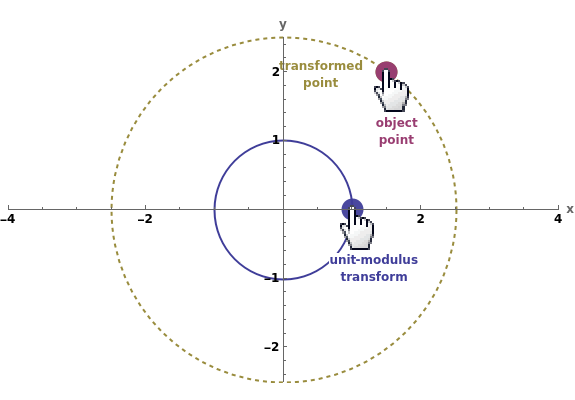
This Demonstration compares the multiplicative transformation properties on the plane of complex, dual, and hyperbolic numbers. These number types share the form , where and are real numbers and has the defining characteristics: =-1 for complex numbers, =0 for dual numbers, and =+1 for hyperbolic numbers. Their conjugates share the form =x-βy and their modulus the form z. The figure shows, for the selected number type,
x,y
z=x+βy
x
y
β
2
β
2
β
2
β
*
z
*
z
1. a transform point on its unit-modulus locus (in blue),
2. an object point in the plane (in red), and
3. the point resulting from their multiplicative transform on its trajectory (in brown).
In the complex plane, multiplying by a unit-modulus transform produces a rotation about the origin; in the dual plane, it produces a translation in the pure dual direction, and in the hyperbolic plane, a traversal of an hyperbola that passes through the object point.
Details
Details
Hyperbolic numbers (sometimes called split-complex numbers) are useful for measuring distances in the Lorentz space-time plane (see G. Sobczyk, "The Hyperbolic Number Plane," The College Mathematics Journal, 26(4), 1995 pp. 268–280).
External Links
External Links
Permanent Citation
Permanent Citation
Fred Klingener
"Transformations of Complex, Dual, and Hyperbolic Numbers"
http://demonstrations.wolfram.com/TransformationsOfComplexDualAndHyperbolicNumbers/
Wolfram Demonstrations Project
Published: March 7, 2011