Chapter 5-Circular Motion—Gravitation
5-1 to 5-3 Uniform Circular Motion
5-1 to 5-3 Uniform Circular Motion
1. (I) A child sitting 1.20 m from the center of a merry-go-round moves with a speed of 1.10m·-1s. Calculate {a} the centripetal acceleration of the child and {b} the net horizontal force exerted on the child (mass=22.5 kg).
1. (I) A child sitting 1.20 m from the center of a merry-go-round moves with a speed of . Calculate {a} the centripetal acceleration of the child and {b} the net horizontal force exerted on the child (mass=22.5 kg).
1.10m·
-1
s
View possible formulas for centripetal acceleration:
In[]:=
AssociationMap[FormulaData][FormulaLookup["CentripetalAcceleration"]]
Out[]=
{CentripetalAcceleration,RotationSpeed},{CentripetalAcceleration,AngularVelocity},{CentripetalAcceleration,AngularVelocity,Diameter},{CentripetalAcceleration,AngularVelocity,OrbitDistance},{CentripetalAcceleration,OrbitSpeed},{CentripetalAcceleration,OrbitSpeed,Diameter},{CentripetalAcceleration,OrbitSpeed,Radius},{CentripetalAcceleration,RotationRate},{CentripetalAcceleration,RotationRate,Diameter},{CentripetalAcceleration,RotationRate,OrbitDistance},{CentripetalAcceleration,RotationSpeed,Diameter},{CentripetalAcceleration,RotationSpeed,OrbitDistance}
a
2
v
r
a
r
2
ω
a
1
2
d
2
ω
a
2
ω
d
o
a
2
v
d
o
a
2
2
v
d
a
2
v
r
a
2
n
r
a
d
2
n
a
2
n
d
o
a
2
2
v
d
a
2
v
d
o
I will use the formula CentripetalAcceleration with RotationSpeed.
Get data for the formula:
In[]:=
FormulaData[{"CentripetalAcceleration","RotationSpeed"}]
Out[]=
a
2
v
r
The table has lots of helpful information:
In[]:=
FormulaData[{"CentripetalAcceleration","RotationSpeed"},"QuantityVariableTable"]
Out[]=
symbol | description | physical quantity | dimensions |
a | centripetal acceleration | Acceleration | {{LengthUnit,1},{TimeUnit,-2}} |
r | radius | Radius | {LengthUnit,1} |
v | tangential speed | Speed | {{LengthUnit,1},{TimeUnit,-1}} |
Formula Classes
Formula Classes
I wonder what classes this formula is in.
In[]:=
FormulaData[{"CentripetalAcceleration","RotationSpeed"},"Classes"]
Out[]=
{Physics,{Physics,Mechanics}}
I wonder what other formulas are in the classes:
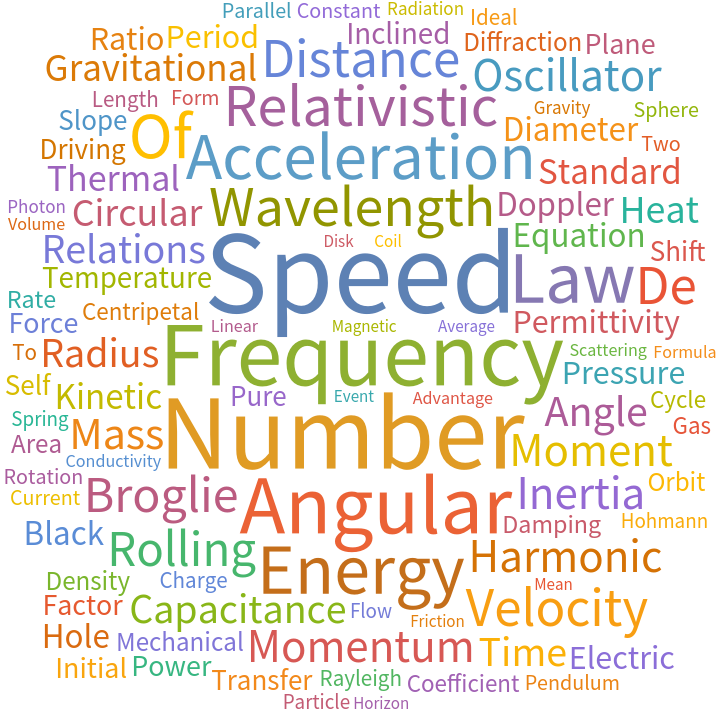
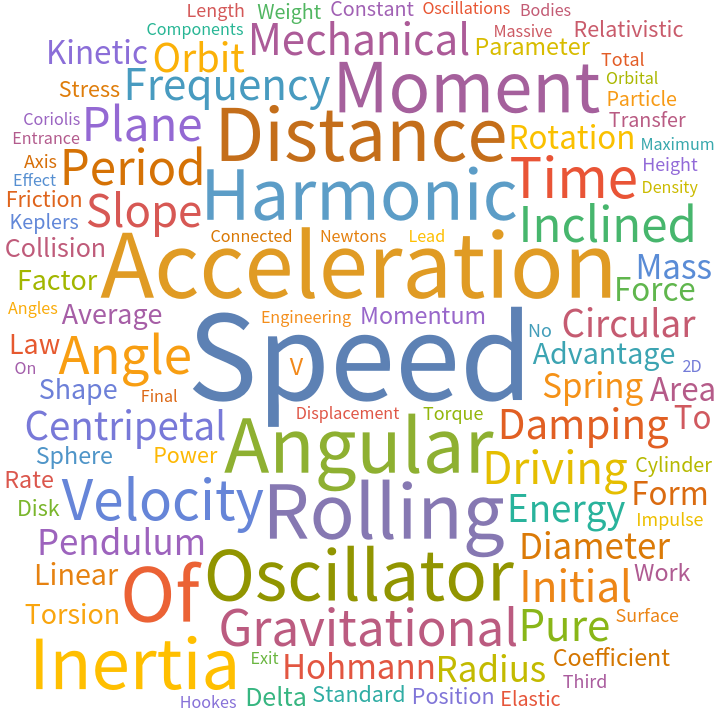
Make a word cloud for each class:
In[]:=
PersistResourceFunction["FromCamelCase"]
Out[]=
Success


In[]:=
WordCloud[Flatten[TextWords[FromCamelCase[#]]&/@Flatten[FormulaLookup["Physics"]]]]
Out[]=
In[]:=
WordCloud[Flatten[TextWords[FromCamelCase[#]]&/@Flatten[FormulaLookup[{"Physics","Mechanics"}]]]]
Out[]=
using the formula for part a
using the formula for part a
part b
part b
Notes
Notes
I reworded the question.
The original question was
A child sitting 1.20 m from the center of a merry-go-round moves with a speed of . Calculate (a) the centripetal acceleration of the child and (b) the net horizontal force exerted on the child (mass=22.5 kg).
1.10m/s
I think scientific notation is universally better to use than the oblique stroke / for division. For example , written in scientific notation, and , written with the oblique stroke for division, are equivalent. However, I would like to mention that scientific notation requires less parentheses and often leads to less confusion. Scientific notation is a powerful way to cover complicated cases whereas division is not. For example, here are several things scientific notation can do that you can't do very well with the / marker or not at all.
1.10m·
-1
s
1.10m/s
The zeroeth exponent. . This has the value 1 except for when you have . I guess you could write m/m, but I think is easier to understand.
0
m
0
0
0
m
The plus one exponent. For example has the value 1.
1
m
In[]:=
0
0
Out[]=
Indeterminate
In[]:=
-1
2
100
Out[]=
10
In[]:=
()
-1
2
100
Out[]=
10
In[]:=
-c
b
a
Out[]=
-c
b
a
In[]:=
-c
b
a
()
-c
b
a
Out[]=
True
In[]:=
-
-d
c
b
a
-
-d
c
b
a
Out[]=
True
I wrote down some more of my thoughts on the benefits of this. The files were too large but I made them available in a Google Photos link.
I wrote down some more of my thoughts on the benefits of this at https://photos.app.goo.gl/yWMGanjf6bZ7AMh58 and https://photos.app.goo.gl/dPKd678dtDfkTd3n6.
3. (I) A horizontal force of 310 N is exerted on a 2.0-kg ball as it rotates (at arm's length) uniformly in a horizontal circle of radius 900 mm. Calculate the speed of the ball.
3. (I) A horizontal force of 310 N is exerted on a 2.0-kg ball as it rotates (at arm's length) uniformly in a horizontal circle of radius 900 mm. Calculate the speed of the ball.
Initial work
Initial work
Notes and comments
Notes and comments
I reworded this problem slightly to use millimeters in place of millimeters to be in accordance with NIST SP 811 Chapter 7 Section 9 Choosing SI Prefixes. The original wording was
A horizontal force of 310 N is exerted on a 2.0-kg ball as it rotates (at arm’s length) uniformly in a horizontal circle of radius 0.90 m. Calculate the speed of the ball.
There is a discrepancy here in that when I say 900 mm I have three significant figures but 0.90 m has only two significant figures. I changed this to 900 mm even though there was a discrepancy because it realistic to measure something to nearest millimeter instead of to the nearest centimeter, which is the practice in metric architecture and CAD where all dimensions are in millimeters. If this discrepancy is to be avoided, the problem should solved with something like 9.0E2 mm. If 3 significant figures were known, as is the case for 900 mm, I would write 9.00E2 mm.
There is one other thing with this that I think should be changed which instead of saying a 2.0-kg ball, something like a ball of mass 2.0 kg is better. This is explained in NIST SP 811 Chapter 7 Section 2 Space between numerical value and unit symbol.
In summary, I would revise the question to something like this:
A horizontal force of 310 N is exerted on a ball of mass 2.0 kg as it rotates (at arm’s length) uniformly in a horizontal circle of radius 900 mm. Calculate the speed of the ball.
5. (II) A 0.55-kg ball, attached to the end of a horizontal cord, is revolved in a circle of radius
5. (II) A 0.55-kg ball, attached to the end of a horizontal cord, is revolved in a circle of radius