Trending topics and pseudoscience during a pandemic in a latin american country: What are people talking about?
Trending topics and pseudoscience during a pandemic in a latin american country: What are people talking about?
Introduction
Introduction
Although we may think that the logical emotional state in a pandemic is panic, we normally do not always check out for data about this. The trust in the Government, for example, may vary depending on the country and how much its population can trust their central powers and their health system. In this scenario, Peru turns out to be an interesting country. The south-american republic entered into quarantine sooner than their latin-american peers, but, with time, the wrong-doings of previous Governments rised through this emergency state. Peru does not invest in science and technology as much as it should, and its population is usually unaware of what peruvian science has done in the past. In this excercise, I tried to analyze what peruvians are talking about and, if possible, how much trust peruvians have in science. As a part-time science communicator, this data should be able to tell me which topics should be explained in the future. Disinformation turns out to be dangerous in this era.
Methodology
Methodology
For this work, I used Wolfram Cloud. I decided to use Twitter data, mainly because of its accesebility. However, it should be noted that Twitter is not the most popular social network in Peru. Peruvians still prefer Facebook rather than other sources of information and most of the false data has been sent via WhatsApp. This is a huge limitation in this work. However, I hope this can give an insight and be a stepping stone on understanding peruvian and other latin american populations and their need in scientific information. For connecting to Twitter, I used:
In[]:=
twitter=ServiceConnect["Twitter"]
Out[]=
ServiceObject

Noisy words can be reduced with a specific function. However, these words just take in account the english language. Latin-america is mainly a spanish-speaking country, so a stepword list had to be created. Google offers a list of spanish stepwords, and this is the list it managed to create:
In[]:=
stepsp=List[él,ésta,éstas,éste,éstos,última,últimas,último,últimos,a,añadió,aún,actualmente,adelante,además,afirmó,agregó,ahí,ahora,al,algún,algo,alguna,algunas,alguno,algunos,alrededor,ambos,ante,anterior,antes,apenas,aproximadamente,aquí,así,aseguró,aunque,ayer,bajo,bien,buen,buena,buenas,bueno,buenos,cómo,cada,casi,cerca,cierto,cinco,comentó,como,con,conocer,consideró,considera,contra,cosas,creo,cual,cuales,cualquier,cuando,cuanto,cuatro,cuenta,da,dado,dan,dar,de,debe,deben,debido,decir,dejó,del,demás,dentro,desde,después,dice,dicen,dicho,dieron,diferente,diferentes,dijeron,dijo,dio,donde,dos,durante,e,ejemplo,el,ella,ellas,ello,ellos,embargo,en,encuentra,entonces,entre,era,eran,es,esa,esas,ese,eso,esos,está,están,esta,estaba,estaban,estamos,estar,estará,estas,este,esto,estos,estoy,estuvo,ex,existe,existen,explicó,expresó,fin,fue,fuera,fueron,gran,grandes,ha,había,habían,haber,habrá,hace,hacen,hacer,hacerlo,hacia,haciendo,han,hasta,hay,haya,he,hecho,hemos,hicieron,hizo,hoy,hubo,igual,incluso,indicó,informó,junto,la,lado,las,le,les,llegó,lleva,llevar,lo,los,luego,lugar,más,manera,manifestó,mayor,me,mediante,mejor,mencionó,menos,mi,mientras,misma,mismas,mismo,mismos,momento,mucha,muchas,mucho,muchos,muy,nada,nadie,ni,ningún,ninguna,ningunas,ninguno,ningunos,no,nos,nosotras,nosotros,nuestra,nuestras,nuestro,nuestros,nueva,nuevas,nuevo,nuevos,nunca,o,ocho,otra,otras,otro,otros,para,parece,parte,partir,pasada,pasado,pero,pesar,poca,pocas,poco,pocos,podemos,podrá,podrán,podría,podrían,poner,por,porque,posible,próximo,próximos,primer,primera,primero,primeros,principalmente,propia,propias,propio,propios,pudo,pueda,puede,pueden,pues,qué,que,quedó,queremos,quién,quien,quienes,quiere,realizó,realizado,realizar,respecto,sí,sólo,se,señaló,sea,sean,según,segunda,segundo,seis,ser,será,serán,sería,si,sido,siempre,siendo,siete,sigue,siguiente,sin,sino,sobre,sola,solamente,solas,solo,solos,son,su,sus,tal,también,tampoco,tan,tanto,tenía,tendrá,tendrán,tenemos,tener,tenga,tengo,tenido,tercera,tiene,tienen,toda,todas,todavía,todo,todos,total,tras,trata,través,tres,tuvo,un,una,unas,uno,unos,usted,va,vamos,van,varias,varios,veces,ver,vez,y,ya,yo,algún,alguna,algunas,alguno,algunos,ambos,ampleamos,ante,antes,aquel,aquellas,aquellos,aqui,arriba,atras,bajo,bastante,bien,cada,cierta,ciertas,cierto,ciertos,como,con,conseguimos,conseguir,consigo,consigue,consiguen,consigues,cual,cuando,dentro,desde,donde,dos,el,ellas,ellos,empleais,emplean,emplear,empleas,empleo,en,encima,entonces,entre,era,eramos,eran,eras,eres,es,esta,estaba,estado,estais,estamos,estan,estoy,fin,fue,fueron,fui,fuimos,gueno,ha,hace,haceis,hacemos,hacen,hacer,haces,hago,incluso,intenta,intentais,intentamos,intentan,intentar,intentas,intento,ir,la,largo,las,lo,los,mientras,mio,modo,muchos,muy,nos,nosotros,otro,para,pero,podeis,podemos,poder,podria,podriais,podriamos,podrian,podrias,por,porqué,porque,primero,puede,pueden,puedo,quien,sabe,sabeis,sabemos,saben,saber,sabes,ser,si,siendo,sin,sobre,sois,solamente,solo,somos,soy,su,sus,también,teneis,tenemos,tener,tengo,tiempo,tiene,tienen,todo,trabaja,trabajais,trabajamos,trabajan,trabajar,trabajas,trabajo,tras,tuyo,ultimo,un,una,unas,uno,unos,usa,usais,usamos,usan,usar,usas,uso,va,vais,valor,vamos,van,vaya,verdad,verdadera,verdadero,vosotras,vosotros,voy,yo,usted,ustedes,tú,rt]
Stepwords had to be made into strings, and, after that, they had to be counted. The following code was used:
In[]:=
stepspStep1=ToString/@stepsp;stepspAsString=StringJoin[Riffle[stepspStep1," "]]
In[]:=
stepsspAsWordcount=WordCounts[stepspAsString]
Twitter data had to be retrieved. And then, it had to be processed. Twitter data was also converted intro a string and, after that, it was counted. The folowing code was used:
In[]:=
result2 = twitter["TweetSearch", "Query" "<<QUERY>>", MaxItems 1000]; pret = Normal[result2[[All," Text"]]]; t = ToLowerCase /@ pret; tt = ToString /@ t;ttAsString = StringJoin[Riffle[tt, " "]]; CleanttAsString = StringDelete[ttAsString, Shortest["@" ~~ __ ~~ " "]]; shortTwitter = WordCounts[CleanttAsString]; shortList = KeyComplement[{shortTwitter, stepsspAsWordcount}]; WordCloud[shortList]
The following hashtags and words were used for this analysis:
◼
"#CoronavirusEnPeru": Meaning "Coronavirus in Peru". This hashtag has been widely used in the peruvian Twitter community to comment about the different situations occuring during this pandemic.
◼
"#CovidEnPeru": Meaning "Covid in Peru". This hashtag has been widely used in the peruvian Twitter community to comment about the different situations occuring during this pandemic.
◼
"ciencia": Meaning "science". This word has been being used a lot as of late.
◼
"cientificos": Meaning "scientists". Scientists have been widely discused in the country.
◼
"creado": Meaning "created". As of late, multiple conspiracy theories have made their way into discussions. By searching "created", it is possible to check out for pseudoscientific activity.
◼
"laboratorio": Meaning "laboratory". Since the spread of pseudoscientific news, the theory of COVID-19 originating from laboratories has spread. Without a doubt, something to look up on, since this will modify the general public views on laboratories.
◼
"vacuna": Meaning "vaccine". The vaccine for COVID-19 is also widely discused in the country, specially after the claim of one peruvian scientists who is trying to develop one.
◼
"gobierno": Meaning "government". Government is in the main spotlight since most of the policies and orders are coming from there. How much do people trust their government or what is the general opinion about their government's performance?
Results and discussion
Results and discussion
Following the methodology described before, these are the WordClouds resulting from the analysis:
#CoronavirusEnPeru
#CoronavirusEnPeru
In[]:=
result2=twitter["TweetSearch","Query""#CoronavirusEnPeru",MaxItems1000];pret=Normal[result2[[All,"Text"]]];t=ToLowerCase/@pret;tt=ToString/@t;ttAsString=StringJoin[Riffle[tt," "]];CleanttAsString=StringDelete[ttAsString,Shortest["@"~~__~~" "]];shortTwitter=WordCounts[CleanttAsString];shortList=KeyComplement[{shortTwitter,stepsspAsWordcount}];WordCloud[shortList]
Out[]=
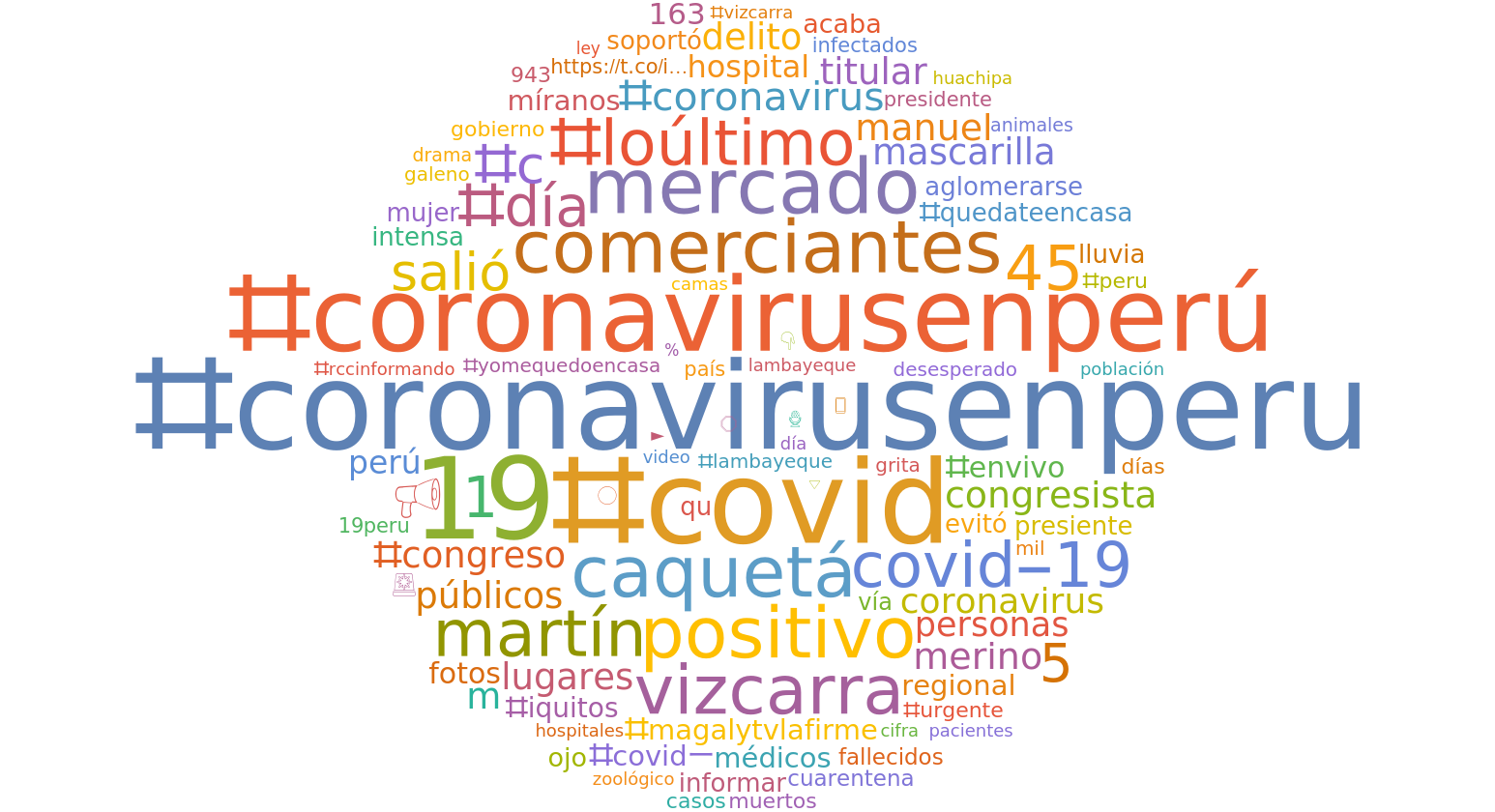
At first glance, #CoronavirusEnPeru contains mainly news covering the pandemic. The number of infected cases is not widely discussed, whereas the number of deaths presents a greater size. Recently, prisoners have been asking for help, since their spaces are saturated. This problem has been the main concern for peruvian population. The name of the prison and the word "underhumane" appear frequently in this graph. A lot is being discussed about the Government, lately, according to this wordcloud.
#CovidEnPeru
#CovidEnPeru
In[]:=
result2=twitter["TweetSearch","Query""#CovidEnPeru",MaxItems1000];pret=Normal[result2[[All,"Text"]]];t=ToLowerCase/@pret;tt=ToString/@t;ttAsString=StringJoin[Riffle[tt," "]];CleanttAsString=StringDelete[ttAsString,Shortest["@"~~__~~" "]];shortTwitter=WordCounts[CleanttAsString];shortList=KeyComplement[{shortTwitter,stepsspAsWordcount}];WordCloud[shortList]
Out[]=
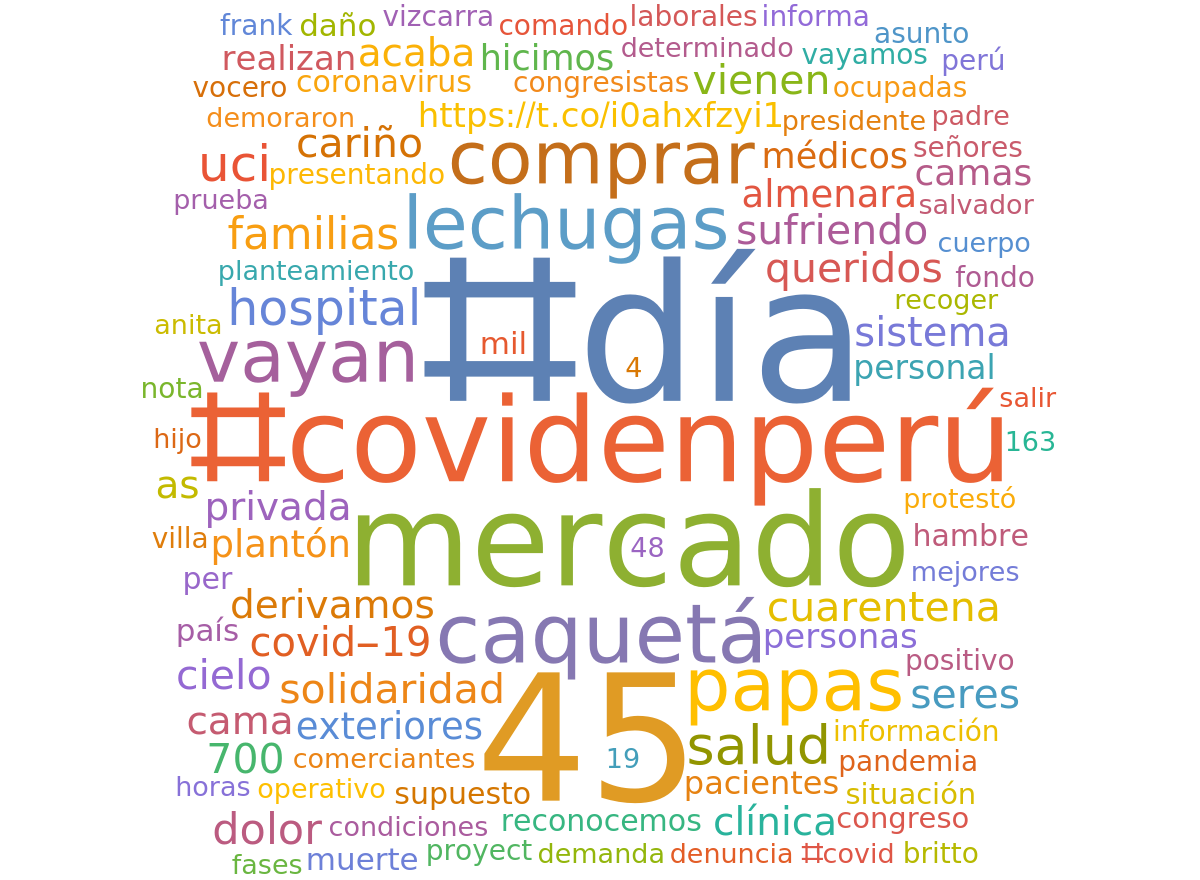
#CovidEnPeru shows words mostly related with cooperation, family and solidarity. Words about pain and suffering are also present in this query. It is interesting to highlight that, maybe, this is the hashtag that most peruvians use. Words like "loved ones", "suffering", "pain" and "love" are present in this wordcloud. The names of some hospitals are also widely mentiones.
"vacuna"
"vacuna"
"Vacuna" shows an interest in vaccine for coronaviurs. Discussions are about desinformation in this aspect, medicine and universities. Certain institutions and certain countries are featured here. It also seems that an influencer is featured in this wordcloud. This influencer has been advising people to not get vaccine shots.
Creado
Creado
The word "creado" is surrounded by this discussions. Words mention scientists, specially virologists, certain countries that have been accused of creating the virus and the mention of the Nobel Prize, since some Nobel-prize winners have declared that COVID-19 is an invented virus (already dismissed by peer-reviewed biology studies). Laboratories are also shown in the WordCloud, probably since the theory stablishes that the virus was created in a laboratory. HIV also appears here, since a lot of conspiracy theories declare that COVID-19 is the result of experiments with the HIV virus.
Laboratorio
Laboratorio
Since a lot is being talked about the supposed laboratory-origins of COVID-19, it is not surprising to find some references to this theory when searching for the word "laboratory". It is interesting how the word "provocated" is featured in this wordcloud, along some hashtags that are used to discuss conspiracy theories. It is also possible to see that the topic of prisoners is also featured here.
Dios
Dios
Since Peru is a catholic country, searching for the word "God" was important to understand how is faith being used during this quarantine. It is interesting how the word "horrible" is featured below the main query, indicating that people are probably describing their experience in quarantine as horrible. Words like "blesings", "lord", "fears" and "thanks" are also featured here. The word "pandemic" seems to have been connected to the word "god" in these tweets.
Ciencia
Ciencia
Science is a recurring topic these days, and it has been widely discussed in the media in all Latin America. Discussions in Argentina seem to have entered this analysis, hence the predominance of words like "peluquerías", "cambiando" and "simón", refering to a specific person. The word "God" appears in this wordcloud, which is interesting. Other chemicals also appear here, such as "remdesivir"and "acetato", chemical used fro the fabrication of masks. Interesting is the apperence of the word "mujeres" ("women"), which is probably the result of the divulgation of the work of women in science.
Científicos
Científicos
Scientists are under the spotlight because of their important work these days. The word "God" also appears in this WordCloud, suggesting again the faith of users speaking about scientists. The word "Government" also appears in this WordCloud, suggesting, probably, discussions about Governments role in the scientists' work. It's interesting also how the words "sociales" and "faltaran" are also featured here. "Sociales" may appear because of a discussion about social scientists' role in the pandemic. On the other hand, "faltaran" makes reference to the idea that scientists may lack this days, suggesting a proyjection for the next days in this pandemic.
Government is being critically analyzed each passing week in this quarantine preiod. At first glance, it is possible to see that "government" is the most panlatinamerican query in this analysis. Most used words in different countries are being used, and a lot of latin american president surnames can be found. Topics like "economy", "security" and "social" can also be found. Quarantine is also being discusses, when reading words like "house", "control" and "meassures". There are concerns for "criminal" and "hunger" among the words appearing in this wordcloud.
Conclussions
Conclussions
◼
Peru is facing a difficult emotional challenge during this pandemic. Worries in the population could be picked from the presented wordcloud. Nevertheless, its interesting how positive words such as "solidarity" and "love" could appear in certain wordclouds.
◼
Pseudoscience is present in the discussions among spanish-speaking Twitter users. Certain theories like the laboratory-origin of COVID-19 or certain so-called medicines appeared in the dicussion. Nobel-prize winners are also present in the WordClouds since their pseudoscientific affirmations.
◼
Data is always changing in this search querys, because of how fast people are commenting on recent events. It was possible to appreciate the evolution of trending words running every code again in several times a day, but further coding should be done to elaborate such an analysis.
◼
There is a special interest in science and the scientific labor. Certain words that are not usually used in the common jargon made an appearence in the wordclouds, such as "biotech" or the name of a widely-spread scientific journal.
◼
Laboratories are not being discussed in a way that could benefit scientific reputation. People's perception of laboratories are of shady, virus-making spaces, instead of discussing the benefits of laboratories for the country. Overall, laboratories are still dark places in people's imaginary, and this should be adressed in future scientific communication initiatives.