Physics is at the heart of cooking and baking.
Consider the physical transformations that happen in the kitchen, from the melting of butter to the browning of bread. It’s everyday applications of the principles of physics—shaping ingredients into meals by mastering heat, energy and matter.
Explore the physics of food with Wolfram|Alpha.
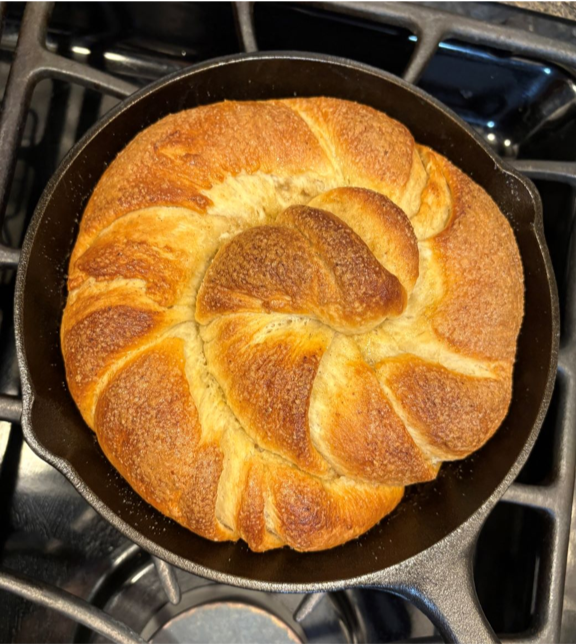
Maillard reaction browning of cardamom bread baked in cast iron
Heat transfer
Heat transfer
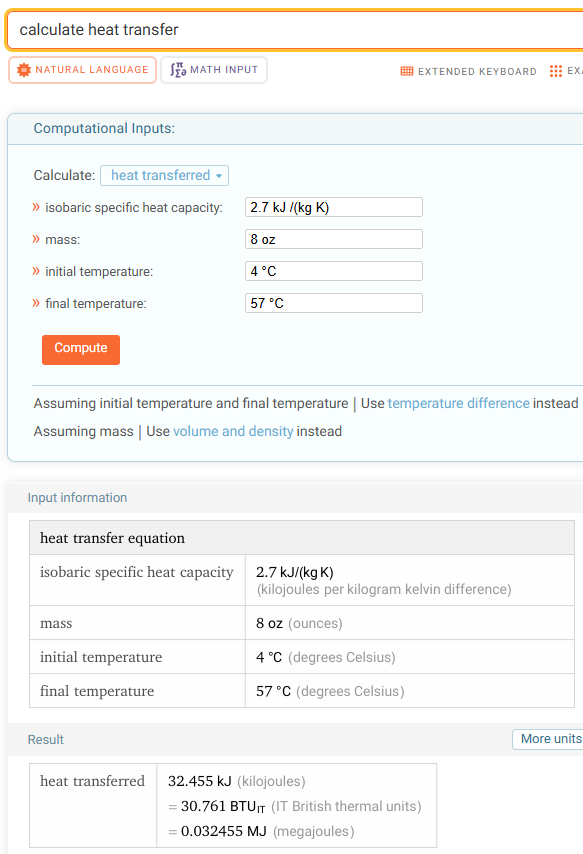
Using the heat transfer equation, Wolfram|Alpha can calculate the thermal energy absorbed by an 8 oz refrigerated steak cooked to medium rare.
The specific heat capacity of beef loin above freezing is approximately 2.7 kJ /(kg K). With an initial temperature of 4°C and a final temperature of 57°C, the steak absorbs about 32 kJ of heat—meaning that 32 kJ of energy are required to go from a raw, refrigerated state to a delicious medium-rare tenderloin steak:
Maillard reaction
Maillard reaction
We can credit the Maillard reaction for the golden hue of fresh baked bread and the dark brown color and deep, toasted flavor of roasted coffee.
It’s a chemical reaction between amino acids and reducing sugars that browns foods and imparts a distinctive flavor. The Maillard reaction is influenced by temperature—the higher the temperature, the faster the reaction. We can model the Maillard reaction in Wolfram|Alpha using the Arrhenius equation.
The pre-exponential factor, also known as the frequency factor, indicates the frequency of attempted molecular collisions in the dough. In our model, molecules attempt productive collisions 42,000 times per second. This would be the maximum possible reaction rate if the activation energy barrier did not exist.
Activation energy is the energy required for the Maillard reaction to proceed. It is specific to the types of sugars and proteins in the dough. In bread baking, typical activation energies for Maillard reactions—particularly for crust browning—range from 60 to 110 kJ/mol, depending upon the ingredients and moisture conditions.
The Maillard reaction generally begins at 120°C and accelerates as the temperature increases. In this example, I use a baking temperature of 180°C:
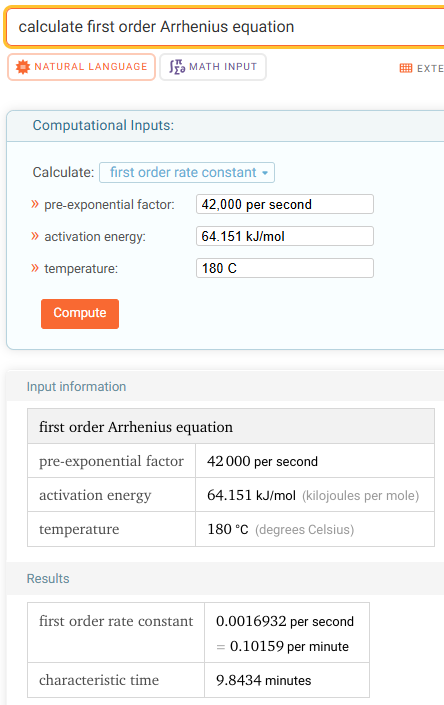
Because the activation energy barrier is large, Wolfram|Alpha calculates that the reaction rate significantly slows to 0.0016932 per second, resulting in characteristic browning time of 9.8 minutes. This indicates that about 60% of the bread browning is complete at 10 minutes.
A small change in oven temperature can affect browning. If a crust is not browning quickly enough, the chef may increase the oven temperature from 180°C to 190°C to speed up the reaction. As an alternative, the chef could extend the baking time while maintaining the same temperature to allow more Maillard reaction to occur.
Liquid surface tension
Liquid surface tension
We know that oil and water don’t mix. Why not? It’s due to surface tension.
The cohesive forces between molecules in a liquid are shared with neighboring molecules on all sides, but those molecules on the surface of the liquid have no molecules above them. Therefore, they are more strongly attracted to their neighboring molecules on and below the surface. This inward net force causes the molecules on the surface to contract and resist being stretched or broken.
The addition of an emulsifier helps create a stable emulsion between two immiscible liquids, such as oil and water. Emulsifier molecules are amphiphilic. One end is hydrophilic (interacts favorably with water), and the other end is hydrophobic (interacts favorably with oil). When added to a mixture, these molecules position themselves at the oil–water boundary, lowering the interfacial tension and forming a protective layer around oil droplets.
Whisking, blending or shaking supplies the shear force needed to break the oil in the mixture into droplets. The emulsifier coats the surface of the droplets, reducing their tendency to merge back together and stabilizing the emulsion.
Mayonnaise, vinaigrette, aioli, toum and hollandaise sauce are examples of emulsions. For mayonnaise and hollandaise sauce, the lecithin and proteins in egg yolks act as the emulsifiers. Mustard often is the emulsifier used to keep oil suspended in a vinaigrette dressing. Garlic is the emulsifier in both a traditional aioli and toum.
The average values for surface tension at an oil–water interface are 0.03–0.05 Newtons per meter (N/m). As a comparison, water has a higher surface tension of 0.0728 N/m. That’s why raindrops can more readily form rounded beads.
Use Wolfram|Alpha to calculate the surface tension of 30µm oil droplets in an oil-water interface:
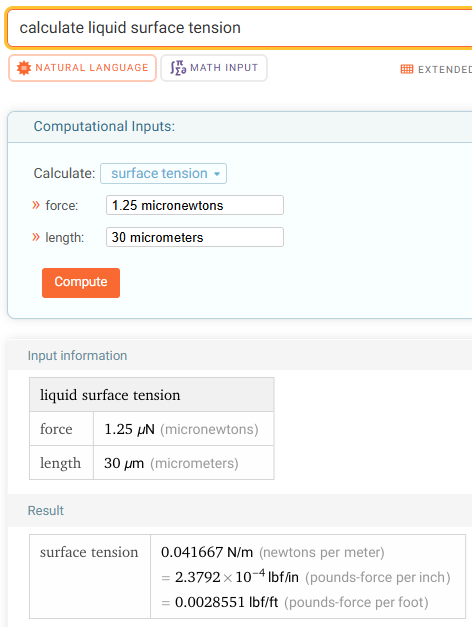
Surface tension will try to undo your emulsion by pulling the oil droplets back together. For emulsion stability, add the oil very slowly to create small droplets and vigorously whisk, blend or shake the mixture.
Viscosity
Viscosity
Viscosity is the measure of a fluid’s resistance to flow. Kinematic viscosity is determined by how fast molecules can move over one another with no external force involved—only gravity. Larger molecules take longer because they have further to go. Therefore, fluid density is important in the calculation for kinematic viscosity.
Honey is viscous due to its high sugar and low water content. Using measurement data for fluid density and dynamic viscosity of a commercially available bottled honey (see Sources below), Wolfram|Alpha can calculate the kinematic viscosity of honey at varying temperatures.
First calculate the honey’s kinematic viscosity at 22°C:
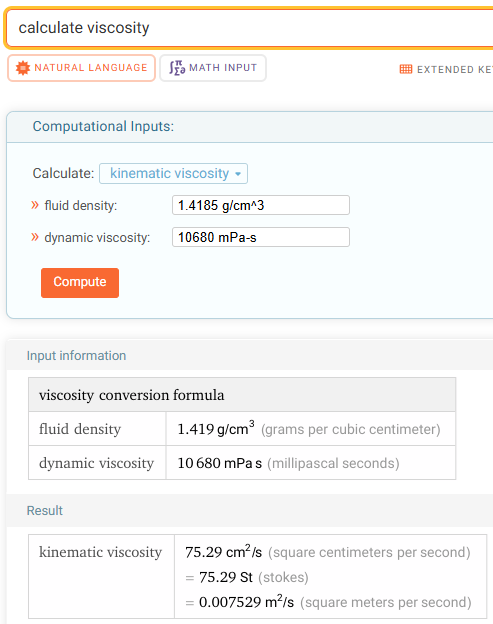
Next calculate at 26°C:
As expected, as honey is warmed, its kinematic viscosity drops significantly.
Laplace number
Laplace number
The Laplace number is useful for analyzing the flow of foods that can form droplets. In technical terms, it compares surface tension to the viscous forces in a fluid. A high Laplace number means surface tension is stronger than viscous forces, and a low Laplace number means viscosity is dominant.
Calculate the Laplace number for a 1cm drop of room-temperature honey:
Food density values are available in the Wolfram Knowledgebase:
Using FormulaData in Wolfram Language and measured viscosity values (see Sources below), calculate Laplace numbers for a 1cm drop of ketchup, honey and maple syrup at room temperature:
Create a bar chart comparing the values:
Of the three, maple syrup has the highest Laplace number, although it is low compared with other fluids. This Laplace number means that maple syrup is viscous-dominated, but surface tension is more pronounced in maple syrup than in honey and ketchup. It flows more easily and forms droplets more quickly. Surface tension effects like beading are more evident with maple syrup.
The extremely low Laplace number for ketchup demonstrates what we all know. It’s thick, slow and stubbornly will not flow without our help. Because ketchup is a non-Newtonian fluid, its viscosity changes when we apply force, such as thumping on the side or bottom of a glass ketchup bottle.
Food elasticity
Food elasticity
A food’s elasticity describes how force (stress) deforms a food (strain) and how it “bounces back” to its original shape once the stress is removed. Think of bread dough springing back after you poke it. Too much force permanently deforms the food.
The Young’s modulus formula in Wolfram|Alpha can calculate this linear relationship between stress and strain. This example shows how the elasticity of steak changes during cooking.
The initial height of a 4cm x 4cm cube of raw steak is 30mm. A 200g weight is placed on top, and the height changes to 26mm, for a compression (deformation) of 4mm. The resulting elastic modulus for the raw steak is 9.375 kilopascals (kPa):
Next, put a 200g weight on a steak that has been cooked medium-well. The height changes to 28mm, and the deformation has been halved to 2mm. The elastic modulus for the cooked steak is 18.75 kPa, twice that of the raw steak:
As the steak cooks, the proteins denature (unfold) and form a new bond network. This new, more rigid network contributes to the increase in the elastic modulus, which means the steak is more resistant to deformation. Other contributors include water loss and muscle fiber contraction during cooking.
Freezing point depression
Freezing point depression
Freezing point depression occurs when adding a substance—like sugar or salt—lowers the temperature at which a liquid freezes. The milk or cream used to make ice cream is mostly water. Adding sugar interferes with crystal formation in the liquid so that the ice cream does not freeze solid. Otherwise, we couldn’t scoop the ice cream for our waffle cones and hot fudge sundaes. Fats and proteins in the mixture have only a minor effect on the freezing point.
Wolfram|Alpha can calculate the freezing point depression for a soft two-ingredient ice cream using the cryoscopic constant of water and the solution molality for the ice cream recipe (see Sources below). The van ‘t Hoff factor is 1, since the sugar (glucose) in the mixture does not dissociate into separate particles. If you are adding salt to a liquid, the van ‘t Hoff factor would be 2, because the sodium chloride dissociates into two separate particles in the solution.
Wolfram|Alpha calculates that the ice cream begins to freeze at –1.54°C, rather than 0°C, which should help make it smooth and scoopable. If you want even softer ice cream, increase the sugar content. This will raise the solution’s molality and lower the freezing point further.
Volume fraction
Volume fraction
Have you ever guessed the number of jelly beans or candies in a jar? There’s no need to guess with Wolfram|Alpha:
Because the jelly beans and candies are disordered, they occupy about 64% of the volume of the jar. The rest is the space between. This is called “random close packing.”
With this 64% volume fraction, Wolfram|Alpha can calculate the approximate number of other foods, such as the number of rice kernels, that could fit in the jar.
Use the capsule Surface entity in Wolfram Language to calculate the volume of a long-grain rice kernel:
Long-grain rice kernels are 6-8mm long and three to four times longer than their width. Therefore, a kernel’s radius would be about 1mm:
Use this kernel volume and the 64% volume fraction to estimate the number of rice kernels in the 1L jar:
Coming soon: Diffusion distance
Coming soon: Diffusion distance
The formula for diffusion distance is coming soon to Wolfram|Alpha. Diffusion distance is a useful culinary formula for predicting how deeply brines and marinades will penetrate food.
Using the associated diffusion constants (see Sources below), we can compare how far a marinade will diffuse into beef muscle tissue versus fat tissue in 12 hours:
Beef muscle tissue
Beef muscle tissue
Beef fat tissue
Beef fat tissue
Water constitutes about 75% of muscle tissue, versus only 10% of fat tissue. This explains why the marinade will penetrate significantly deeper into muscle than fat.
Excess fat on a piece of meat can inhibit the marinade from reaching the muscle tissue. Consider trimming some of the fat, scoring the meat (making shallow cuts), or cutting it into smaller pieces for more surface area.
Sources
Sources
◼
◼
Dynamic, Absolute, and Kinematic Viscosity – Definitions & Conversions, The Engineering Toolbox, 2025
◼
◼
◼
Kinetics of the diffusion of sodium chloride in chicken breast (pectoralis major) during curing, Journal of Food Engineering, April 2007
◼
Modelling of browning kinetics of bread crust during baking, LWT - Food Science and Technology, July 1995
◼
Modelling the browning of bakery products during baking: a review, Ukrainian Food Journal, Volume 11, Issue 2, 2022
◼
◼
◼
◼
◼
◼
◼
◼
◼
CITE THIS NOTEBOOK
CITE THIS NOTEBOOK
Modeling food physics with Wolfram|Alpha from Maillard reactions to emulsions
by Gay Wilson
Wolfram Community, STAFF PICKS, December 12, 2025
https://community.wolfram.com/groups/-/m/t/3590142
by Gay Wilson
Wolfram Community, STAFF PICKS, December 12, 2025
https://community.wolfram.com/groups/-/m/t/3590142