Rémy Sigrist wrote the paper “The Kochawave curve, a variant of the Koch curve,” so I thought I’d try it out.
KochwavePoints[n_Integer?NonNegative]:=Module[{ω=Exp[IPi/3],steps=4^n,z,uk,vk},z=ConstantArray[0,steps+1];Do[uk=DigitCount[k,4,1];vk=DigitCount[k,4,2];z[[k+2]]=z[[k+1]]+(1+ω)^uk/ω^(2vk),{k,0,steps-1}];Transpose[{Re[z/3^n],Im[z/3^n]}]];KochwaveCurve[n_Integer?NonNegative]:=Line[KochwavePoints[n]];
In[]:=
kp=KochwavePoints[6];Graphics[{EdgeForm[{Thin,Black}],Cyan,Polygon[Append[kp,{0,0}]]},PlotRange->All,AspectRatio->Automatic,ImageSize->800]
Out[]=
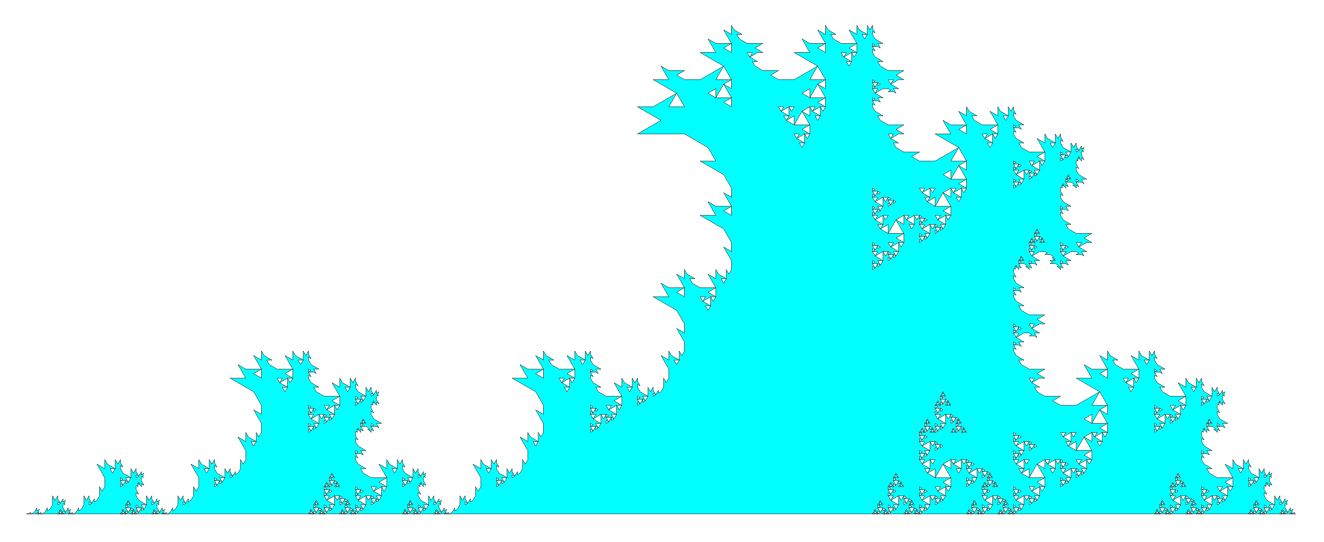
A simpler method, but something goes wrong with the last segment:
In[]:=
Graphics@KochCurve2,{1,0},,30°,{1,-150°},{1,120°}
3
3
Out[]=
A method to get KochCurve working correctly:
In[]:=
Graphics@KochCurve5,{1,0},,30°,{1,-150°},{1,120°},{1/100000,0}
3
3
Out[]=
Benoit Mandelbrot was born Nov 20, 1924. For his 101st birthday, I’ll be giving a free online talk about fractals at 11AM Chicago time. There are thousands of fractals written in the Wolfram Language, so I’ll be highlighting about a hundred of them.
In[]:=
ResourceFunction["SchmidtArrangements"][-3,"MinCurvature"->0,"MaxCurvature"->10,"Color"->{"ColorSaul",{2,1,1}},"Transparency"->"Increasing","Filter"->Rectangle[{-2.1,-Sqrt[3.0]-0.1},{2.1,2*Sqrt[3.0]+0.1}],PlotRange->{{-2,2},{0,Sqrt[3.0]}},ImageSize->Large]
Out[]=
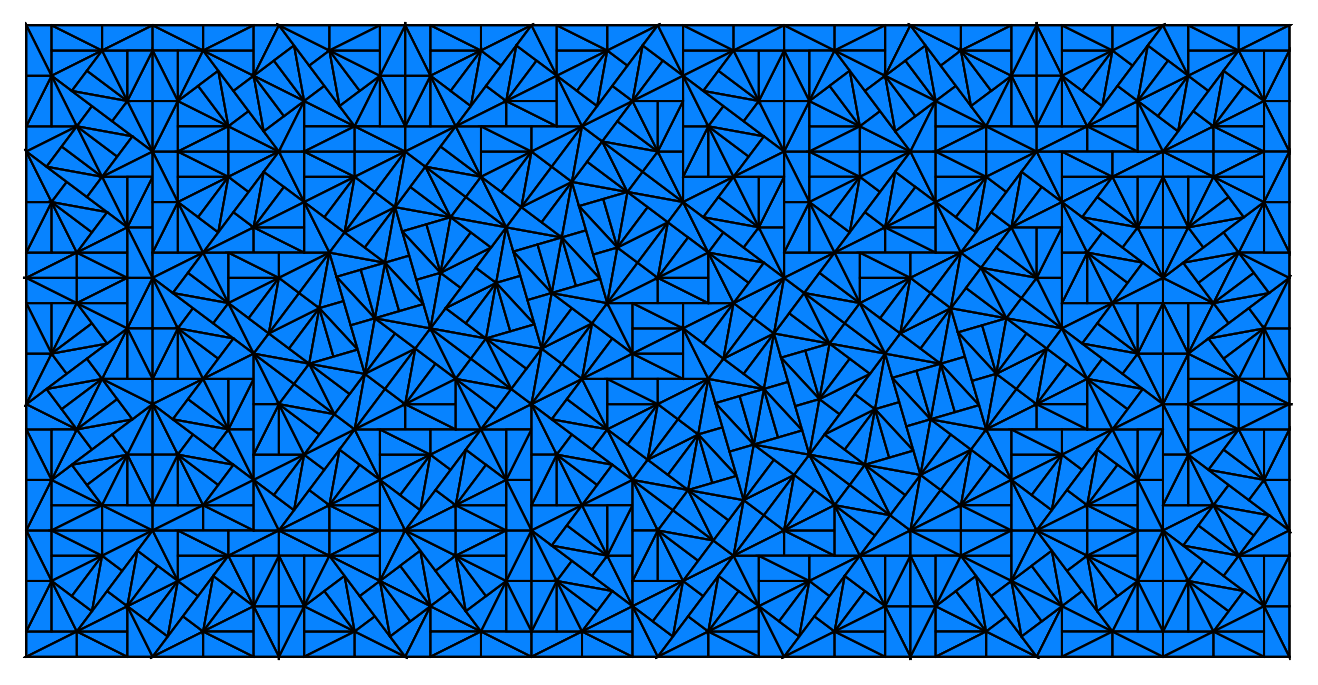
And the Pinwheel fractal:
In[]:=
ResourceFunction["AlgebraicSubstitutionTiling"]["Pinwheel",4,{"N","Start"->{{{0,0},{0,1},{2,1}},{{2,1},{2,0},{0,0}}}}]
Out[]=
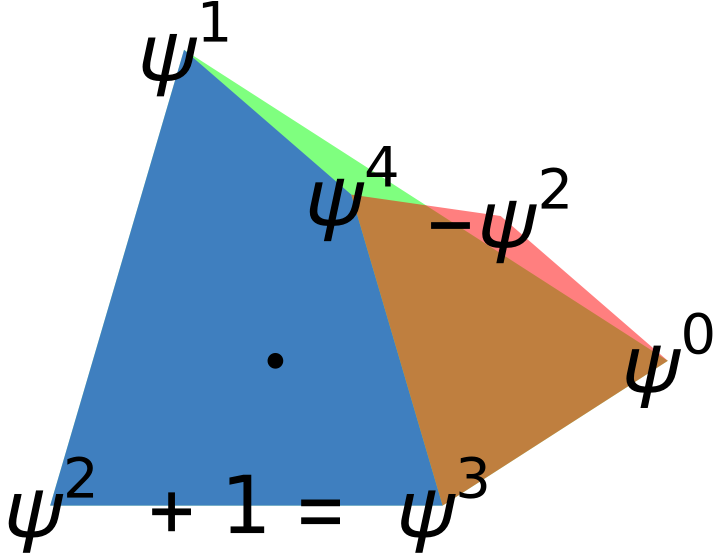
Or the supergolden triangle built from the PsiQuad fractal. If you find a complex solution of +1=, then the powers of the value give the vertices of a substitution system. It’s a self-generating fractal.
2
ψ
3
ψ
In[]:=
{ψ,ψn,ψp}=x/.Solve[x^2+1==x^3];ψvals=ReIm/@{,,,,,-};ψtext={"","","","","","-"};pols={{1,2,3,4},{2,3,4,5},{5,4,1,6}};Graphics[{Opacity[.5],MapIndexed[{Hue[#2[[1]]/3],Polygon[ψvals[[#1]]]}&,pols],Opacity[1],Table[Style[Text[ψtext[[n]],ψvals[[n]]],40],{n,1,6}],Style[Text["+ 1 =",Mean[ψvals[[{3,4}]]]],40],Disk[{0,0},.02]}]
0
ψp
1
ψp
2
ψp
3
ψp
4
ψp
2
ψp
0
ψ
1
ψ
2
ψ
3
ψ
4
ψ
2
ψ
Out[]=
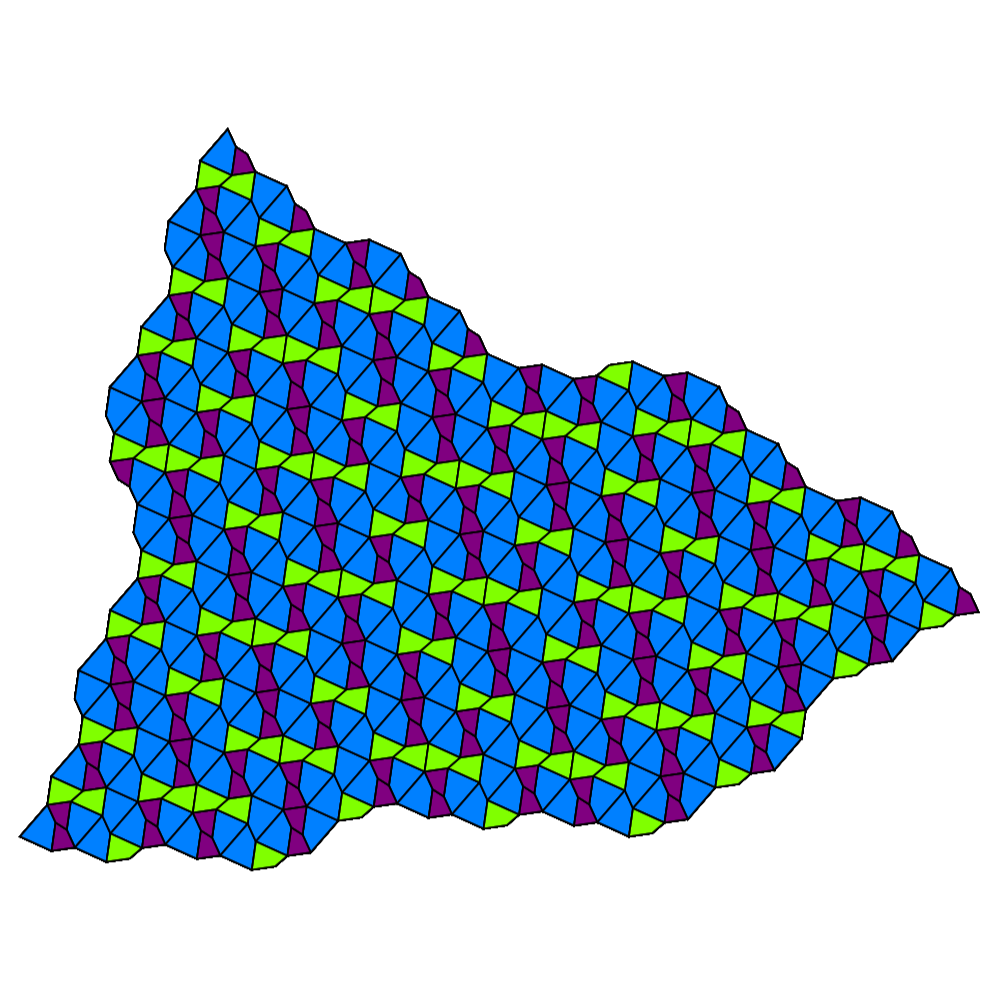
These lead to the supergolden fractal triangle:
In[]:=
ResourceFunction["AlgebraicSubstitutionTiling"]["PsiQuad",16,{"N","ImageSize"{600,410}}]
Out[]=
The supergolden ratio is an infinite sum of its own reciprocal powers:
Leading to the supergolden triangle nautilus spiral:
For these and more, come to my free online talk about fractals at 11AM Chicago time on Thursday, 20 November.
CITE THIS NOTEBOOK
CITE THIS NOTEBOOK
The Kochawave curve and other fractals
by Ed Pegg
Wolfram Community, STAFF PICKS, November 19, 2025
https://community.wolfram.com/groups/-/m/t/3577688
by Ed Pegg
Wolfram Community, STAFF PICKS, November 19, 2025
https://community.wolfram.com/groups/-/m/t/3577688