Gershgorin Circle Theorem
Gershgorin Circle Theorem


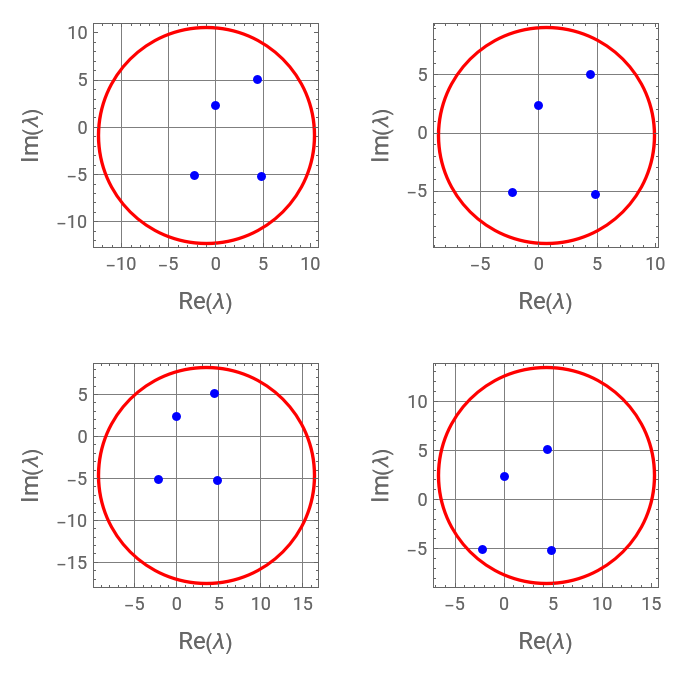
This Demonstration illustrates how the Gershgorin circle theorem can be used to bound the eigenvalues of an matrix . The theorem states that the eigenvalues of must lie in circles defined in the complex plane that are centered on the diagonal elements of with radii determined by the row-norms of , that is, = and ={z∈:|z-|≤}. If of the circles form a connected region disjoint from the remaining circles, then the region contains exactly eigenvalues.
n×n
A
A
i
A
r
i
A
r
i
n
∑
j=1,j≠i
a
ij
i
a
ii
r
i
k
i
ℛ
n-k
ℛ
k
You can select a random matrix or a special matrix that has at least one disjoint Gershgorin circle. The elements of the random matrix, as well as some elements of the special matrix, can be changed by selecting a pseudorandom number generator from the dropdown menu. You can see either the separate Gershgorin circles with the eigenvalues or a plot that superimposes all the circles.
4×4
4×4
References
References
[1] B. Noble, Applied Linear Algebra, New Jersey: Prentice–Hall, 1969.
External Links
External Links
Permanent Citation
Permanent Citation
Housam Binous, Brian G. Higgins
"Gershgorin Circle Theorem"
http://demonstrations.wolfram.com/GershgorinCircleTheorem/
Wolfram Demonstrations Project
Published: April 6, 2012