Every-day 2D objects can be depicted using functions with various parameters, so that humans can recognize them. Is it possible to alter the parameters of these functions to make the depicted objects unrecognizable, and what are the factors that dictate whether a person can recognize an everyday object?
Introduction
Introduction
This experiment aims to discover whether symmetry in objects is a factor affecting whether a person can recognize them. But what makes symmetry important in object recognition?
Symmetries are generally important in evolutionary biology due to their abundance in nature and their role in the development of various species. They are models of development in the natural world. From animals, plants, and microorganisms most species have a specific type of symmetry (rotational, reflection, radial, etc). Humans imitate the symmetries they embody and observe in their environment, incorporating them into their creations and technologies. Symmetry is a universal mathematical concept expressed in ancient art and civilization internationally, predating written language. It reflects humanity’s innate geometric intuition, shaping how we think, create, and perceive the world.
Symmetry also reduces cognitive load, as the brain can process mirrored information more quickly and with fewer resources. Neurologically, the human brain processes symmetrical patterns efficiently, engaging areas in the extrastriate visual cortex, enabling quick and effective recognition.
The conclusion is that objects which present symmetry are more easily recognizable by humans. This is also the hypothesis of this experiment.
Experiment
Experiment
To test the hypothesis described above, two different 2D objects are depicted using functions, one symmetrical and one asymmetrical. The symmetrical object is a house, presenting reflectional symmetry, and the other one is a ship.
The test includes the following steps: Show the objects to multiple people and ask them what is depicted. Note the answers as “YES” if they guessed correctly and “NO” if not. Then, alter the numerical data of the functions and repeat the experiment using different participants.
The two objects shown to the participants are the following:
In[]:=
Show[Plot[{-Abs[x]+3},{x,-1.0068522329782,1.0068522329782}],Plot[{-x^101},{x,-1.3167,0.5}],Plot[{x^101},{x,-0.5,1.3163}],Plot[y=2,{x,-1,1}],PlotRange->Full,AspectRatio->Automatic,Axes->False]
Out[]=

In[]:=
Show[Plot[{0.5Abs[x]-1.5},{x,-2,2},PlotRange->{{-3,3},{-2,5}},Axes->False,AspectRatio->1],Plot[{y=-0.5},{x,-2,2}],Plot[y=0,{x,0,2}],Plot[{-x+2},{x,0,2}],ParametricPlot[{0,y},{y,-0.5,2}]]
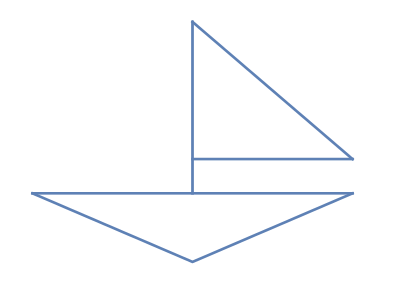
To change the numerical data in the functions, manipulative graphs of the functions will be created. Using these graphs, the objects are shown to different participants, changing one part of the data at a time. We note the responses for the number of parameters changed each time. Each shape is described by 6 parameters.
Manipulate[Show[Plot[y=a,{x,-4,4}],Plot[-0.5x-2,{x,-4,2.66}],Plot[0.5x-2,{x,-2.66,4}],Plot[2x+2,{x,-2.66,0}],Plot[-2x+2,{x,0,2.66}],PlotRange->Full,AspectRatio->1],{a,-1,0},{b,}]
Manipulate[Show[Plot[{a*Abs[x]+b},{x,-1.0068522329782,1.0068522329782}],Plot[{c*x^d},{x,-1.3167,0.5}],Plot[{x^e},{x,-0.5,1.3163}],Plot[y=f,{x,-1,1}],PlotRange->Full,AspectRatio->Automatic,Axes->False],{a,-2,-1},{b,0,3},{c,-2,-1},{d,11,101},{e,11,101},{f,0,2}]
Out[]=


In[]:=
Manipulate[Show[Plot[{a*Abs[x]+b},{x,-2,2},PlotRange->{{-3,3},{-2,5}},Axes->False,AspectRatio->1],Plot[{y=c},{x,-2,2}],Plot[y=d,{x,0,2}],Plot[{e*x+f},{x,0,2}],ParametricPlot[{0,y},{y,-0.5,2}]],{a,0.1,0.5},{b,-3,-1.5},{c,-1,-0.5},{d,-1,0},{e,-2,-1},{f,0,2}]
Out[]=
Results
Results
As expected, every participant was able to recognize the inital objects depicted without any altered data. For one parameter changed, we can see the recognition rate drop. After we change more parameters and show the objects to the participants, the recognition rate is lower. Generally, if we alter more parameters the object becomes more and more unrecognizable. It is important to note that in the symmetrical shape the object becomes unrecognizable after changing 5 out of 6 parameters, while in the asymmetrical object becomes unrecognizable after changing 3 parameters.
Conclusions
Conclusions
If we analyze the results it is noted that in the symmetrical shape, the number of numerical data that needs to be altered in order for the object to become unrecognizable is less than that of the asymmetrical one. This means that the hypothesis which says that the human brain reacts “better” to symmetrical stimuli is confirmed. It is easier for a person to recognize a symmetrical shape with some alterations, than it is an asymmetrical one.
Bibliography
Bibliography
[1] Y. Sasaki, W. Vanduffel, T. Knutsen, C. Tyler, R. Tootell, Symmetry activates extrastriate visual cortex in human and nonhuman primates, Proc. Natl. Acad. Sci. U.S.A., https://doi.org/10.1073/pnas.0500319102 (2005).
[2] Duval, R. (1999). Representation, Vision and Visualization: Cognitive Functions in Mathematical Thinking. Basic Issues for Learning. Proceedings of the Annual Meeting of PME-NA 21, 1, 3-26.
[3] Stevens, P. (1985). Handbook of regular patterns: An introduction to symmetry in two dimensions. Massachusetts: The MIT Press.
[4] Pauline Audurier; Vincent D. Costa; Robert M. Friedman, Neurophysiology of Symmetry Processing in Macaque Visual Cortex, Journal of Vision September 2024, Vol.24, 711. doi:https://doi.org/10.1167/jov.24.10.711
CITE THIS NOTEBOOK
CITE THIS NOTEBOOK
Mathematical artworks and symmetry- what affects human object recognition
by Myrto Terpsiadou
Wolfram Community, STAFF PICKS, December 31, 2024
https://community.wolfram.com/groups/-/m/t/3348005
by Myrto Terpsiadou
Wolfram Community, STAFF PICKS, December 31, 2024
https://community.wolfram.com/groups/-/m/t/3348005