A ThorLabs Quantum Optics Educational Kit was setup to study quantum entanglement in a lab environment in an effort to eventually create the physical correlates of Multiway Diagrams. During the Winter School period, it was possible to generate and measure invisible 805 nm entangled photons pumped from a 405 nm laser into a BBO type I crystal. Three experiments using single photon SPAD detectors were performed to verify when entanglement photons were created, and when entanglement disappeared when one of the beams were blocked.
The motivation for this effort is two fold: 1. The tremendous variety of Multiway diagram generated by equations using the QuantumToMultiwaySystem using the EvolutionEventsGraphStructure in previous studies, and 2. The remarkable quantum probability agreement in calculations using QuantumToMultiwaySystem with the EvolutionGraph option and the simple calculations using MatrixPower. This study will continue on two fronts: 1. With the Educational Kit update which using two BBO Type I crystals (instead of one BBO Type II crystal) to create polarization type entanglement for doing Bell type studies, and 2. An effort to extend theoretical agreement between quantum measurement calculations when using other Multiway Digram options generating more complex output..
Probability equivalence between QuantumToMultiwaySystem (EvolutionGraph) with MatrixPower
Probability equivalence between QuantumToMultiwaySystem (EvolutionGraph) with MatrixPower
This examples below show that QuantumToMultiwaySystem using the Evolution Graph option gives the same results with MatrixPower.
This first example use t = 0, 2, and 4 where t = 0 represent the initial state. We look at t = 4.
In[]:=
AbsoluteTimingTableWith{α=1},QuantumToMultiwaySystem<|"Operator"-> (α)
{1,1}
,
{1,-I}
,"Basis"->{{1,0},{0,1}}|>,{1,1},t,"EvolutionGraph","IncludeStatePathWeights"->True,VertexLabels->"VertexWeight",{t,{0,2,4}}Out[]=
0.044936,
,

,
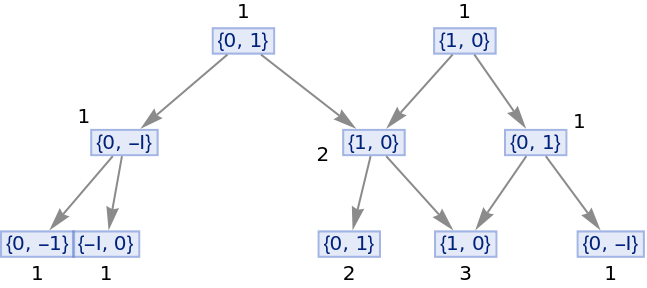
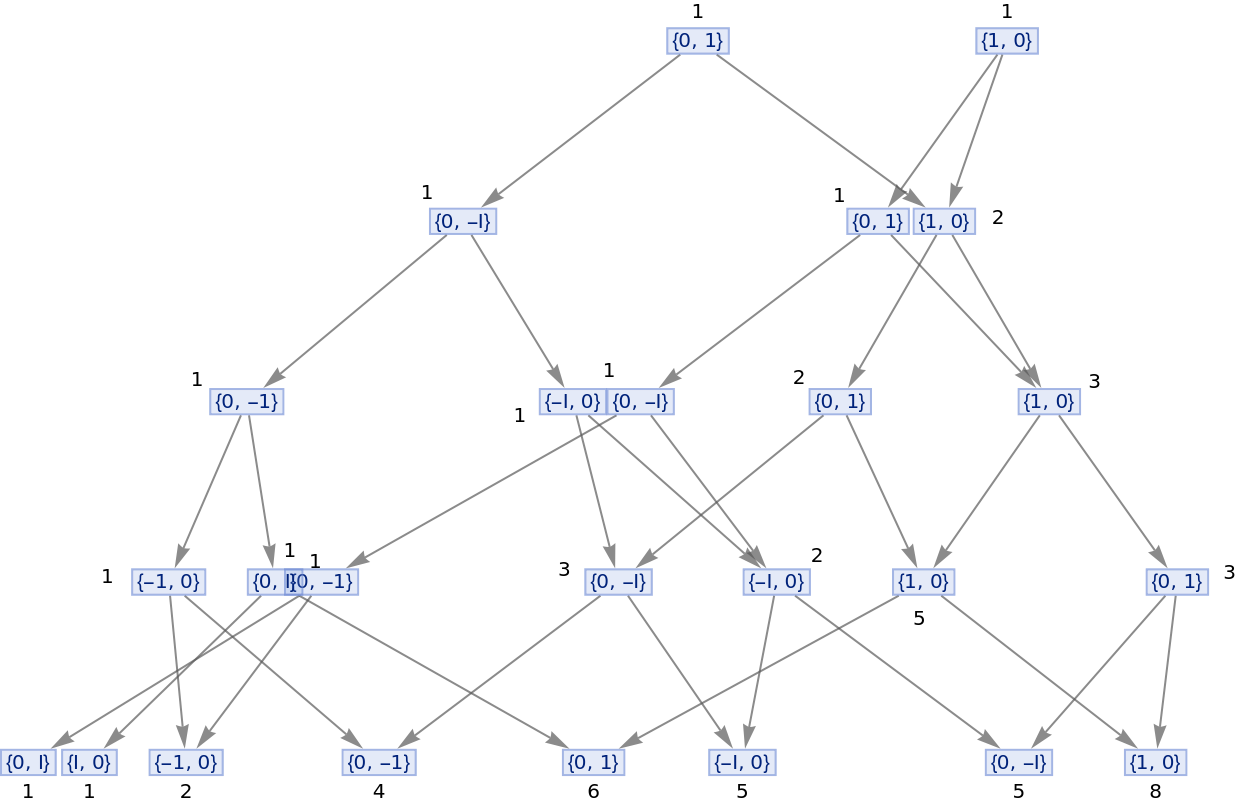
We look at the the results of t = 0, 2 and 4 and compare with MatrixPower. We start by adding the t = 0 results into a final state which is the initial state {1, 1}. We see below that the result for MatrixPower is the same.
In[]:=
(1{1,0}+1{0,1})
Out[]=
{1,1}
In[]:=
Table[MatrixPower[{{1, 1}, {1, -I}}, t, {1, 1}], {t, {0}}]
Out[]=
{{1, 1}}
Below we see that t = 2 gives 5 states; and that adding them gives the same results as with MatrixPower:
In[]:=
{0,-1}+{-I,0}+2{0,1}+3{1,0}+{0,-I}
Out[]=
{3-,1-}
In[]:=
Table[MatrixPower[{{1,1},{1,-I}},t,
{1,1}
]
,{t,{2}
}
]Out[]=
{{3-,1-}}
We look at the the results of t = 4 and again adding the 8 states gives the same result of MatrixPower:
In[]:=
1{0,I}+1{I,0}+2{-1,0}+4{0,-1}+6{0,1}+5{-I,0}+5{-0,-I}+8{1,0}
Out[]=
{6-4,2-4}
In[]:=
Table[MatrixPower[{{1,1},{1,-I}},t,
{1,1}
]
,{t,{4
}
}
]Out[]=
{{6-4,2-4}}
Building, installing, and making first measurements with the ThorLab Quantum Educational Optics Kit
Building, installing, and making first measurements with the ThorLab Quantum Educational Optics Kit
This section shows the initial results of making measurements with the Quantum Educational Optics kit. Three experiments are described below. These experiments are designed by Thor Labs to be used in the Educational Quantum Optics Kit. It should be said that working in a lab in the dark with invisible yet power beams is not easy. Any mistakes and errors are due to my misunderstandings during the exciting and sometimes frustrating exploration and learning process.
Experiment 1: Conclusion
Experiment 1: Conclusion
It is not possible to perform single photon experiments with an attenuated laser beam. The lab notes say “No manner how dense the attenuation, the g2(0) correlation value is be 1 because the assumption of evenly spaced photons is not correct from laser statistics. To do single photon experiments, a special single photon sources must be created.” This will be done with a type I BBO crystal as we will do in the next experiments.
Comment: This experiment is based on only just starting to work with the Quantum Optics Kit for less than couple of weeks.
Comment: This experiment is based on only just starting to work with the Quantum Optics Kit for less than couple of weeks.
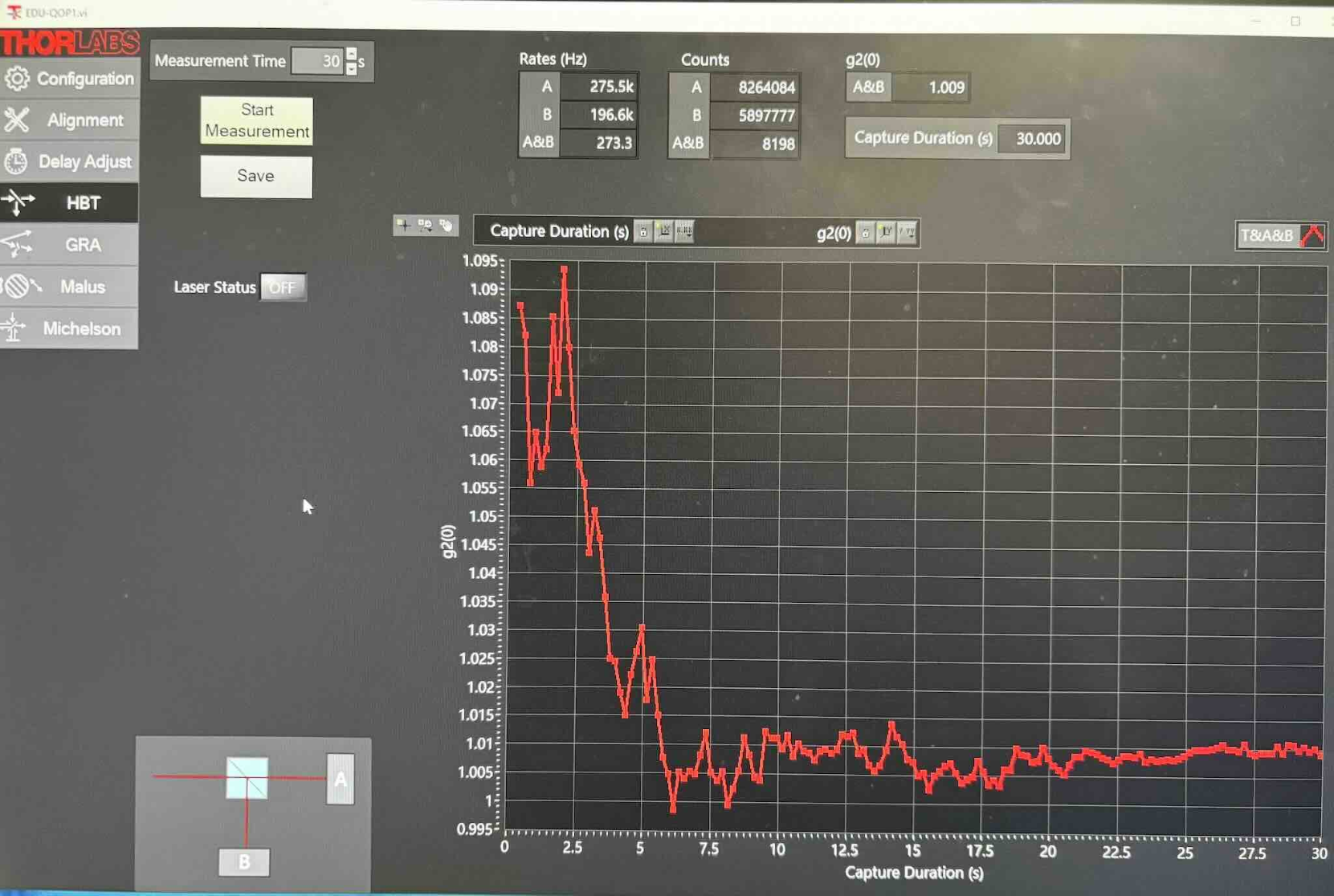
In this first experiment, a helium-neon laser is attenuated with a ND (neutral density) filter, divided will a beam splitter, and measured by detectors A and B. The A&B channel g2(0) correlation is measured for 30 seconds and the correlation is 1.009. Looking at the the rates, we have about about 472 khz for both detectors.
Conclusion: Over the 1 meter path length, we can calculated the average photon numbers as n = ( 1m/(3 x m/sec) )x 4.72 x Hz = 0.16 photons. However, we are getting 1.009 instead of 0.16 photons. So single photons cannot be split and the assumptions of the calculations are incorrect.
Conclusion: Over the 1 meter path length, we can calculated the average photon numbers as n = ( 1m/(3 x
8
10
6
10
Experiment 1a
Experiment 1a
Experiment 1b
Experiment 1b
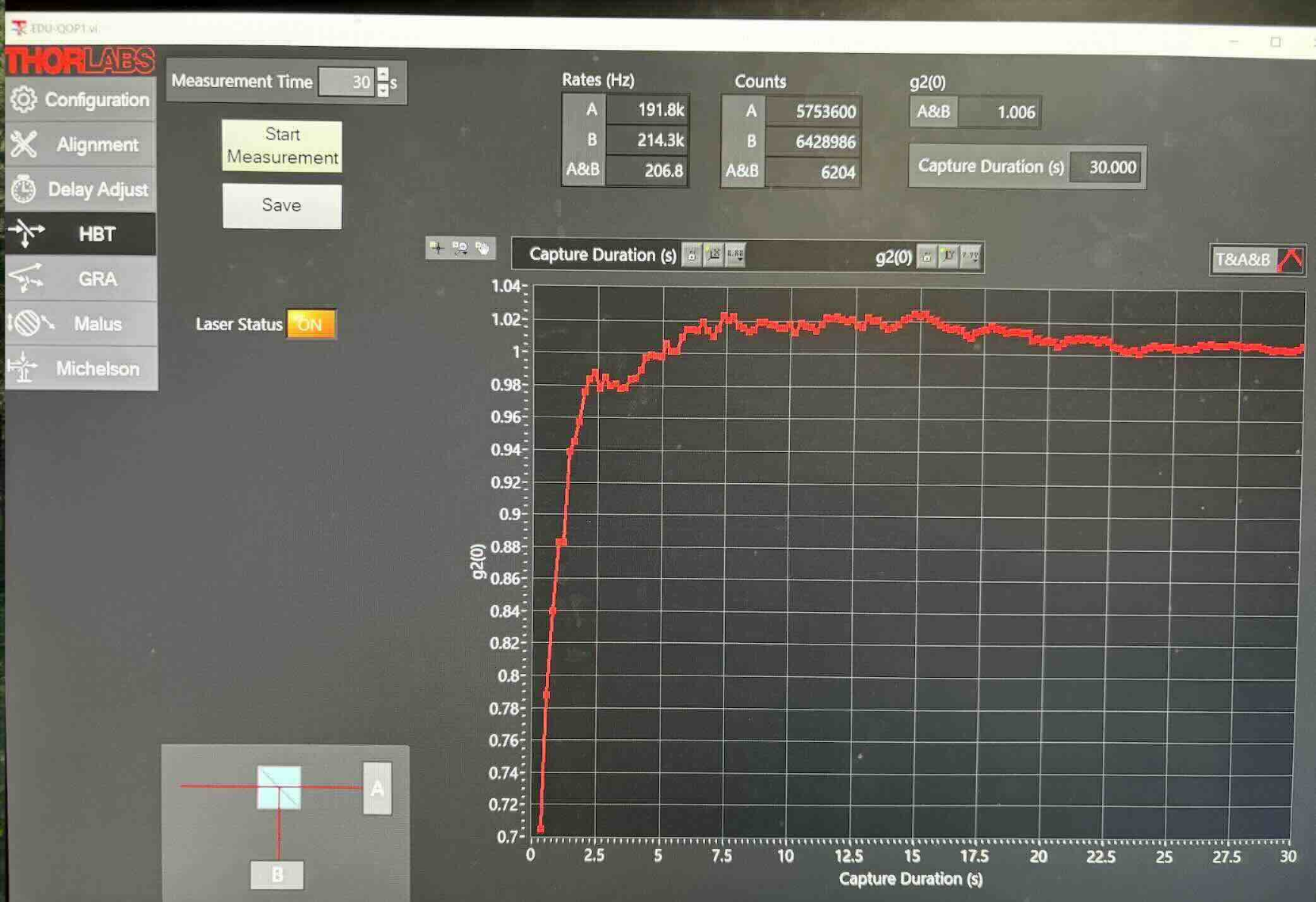
The initial state of the beam can be different but the results of the experiment are the same. The g(2) levels are similar 1.009 and 1.006 as in the experiment manual.
Experiment 2 (Lab Exp. 4)
Experiment 2 (Lab Exp. 4)
This is the first single photon counting using the BBO crystal based on the Grangier-Roger-Aspect Experiment (The GRA experiment). The BBO crystal sends one stream to the T detector and the other steam to detector A and B through a beam splitter. There is definitely some coincidence occurring between detectors T & A (20) and T & B (46). More adjustment with be able improved the Correlation levels. Trigger features are not used yet.
Experiment #3 (Lab Exp 4) shown below
Experiment #3 (Lab Exp 4) shown below
The HBT (Hadbury, Brown, and Twiss) experiment with one Arm of the Pair Source ( the T beam) is blocked. It can be seen that the coincidence is lost and the T&A & T&B counts go to zero. (This is an example of an experimental proof.)
Concluding remarks
Concluding remarks
These are just the first efforts as the updates of the Quantum Optics kit which allow polarization entanglement to be started to be set up next month. This new extension will use two fused BBO type I crystals to generated entanglement much more easily than with type II crystals. With this infrastructure in place, and some additional understand of QuantumToMultiway, it will hopefully be possible to come full circle from theory to experiment. Finally, I would like see Mathematica code to be able to be easily used within the Quantum Optics kit enable users to design experiments. (It looks like some initial efforts have already been made in this area.)
Keywords
Keywords
◼
Quantum Entanglement Educational Experiment Kit
◼
QuantumToMultiwaySystem and Matrix Power
◼
QuantunToMultiway and Multiway Diagrams
Acknowledgments
Acknowledgments
◼
To my mentors Hatem Elshatlawy and Xerses Arsiwalla over the years,
◼
to Jonathan Gorard, our QuantumToMultiway author,
◼
to Max Piskunov and Nikolay Murzin for enabling continuous values extension in QuantumToMutiway,
◼
to all the numerous dedicated Wolfram School support people to make all the schools possible,
◼
to Stephen Wolfram who created this New Kind of Science,
◼
to Takashi Yoneyama and Patricia who support all the efforts in the lab.
References
References
◼
[ThorLabs EDU-QOP1(M) Quantum Optics KIt User Guide]
◼
[The Mathematica Manual for the relationship between MatrixPower and QuantumToMultiway]
CITE THIS NOTEBOOK
CITE THIS NOTEBOOK
Entanglement on quantum optics kit towards creating physical correlates of multiway diagrams
by Mark Merner
Wolfram Community, STAFF PICKS, January 16, 2025
https://community.wolfram.com/groups/-/m/t/3357787
by Mark Merner
Wolfram Community, STAFF PICKS, January 16, 2025
https://community.wolfram.com/groups/-/m/t/3357787