Goal: String substitution is a simplified one dimensional system for the Wolfram physics model. The goal of this project is to generate a string substitution system that can be interpreted as a quantum teleportation phenomenon, investigate its causal structure, and identify the signature of quantum effects in the structure. The motivation behind it is to bridge Wolfram fundamental physics framework to the frontier of applied quantum mechanics.
Main Results: Usually, measurement under different basis requires us to define new foliation of a multiway system. However, by customizing the Knuth-Bendix completion map in the default foliation, I found a very simple method to perform Bell measurement on string substitution systems . This method can also be generalized into a measurement on other bases as long as we can express them in terms of a superposition of computational basis states. After generating an initial string state that is entangled, I implement this Bell completion technique and show that quantum teleportation indeed occurs. After that, I investigate the causal multiway graph associated with this process and discuss some quantum signatures like the change of causal structure after measurement and the availability of new states that were previously impossible before the measurement.
Future Work: In this project, I have demonstrated quantum teleportation in string substitution systems without incorporating quantum phase between different eigenstates. In the Wolfram model, quantum amplitude and quantum phase originated from different aspects of the multiway system. Quantum amplitudes correspond to the state's path weights whereas the phase is related to the coordinates in branchial space. If we include quantum phase in the teleportation model, we would be able to distinguish all four Bell states during teleportation. Furthermore, since string substitution system is a simplified model for the hypergraph multiway system in the Wolfram model, exploring quantum teleportation in a hypergraph multiway system would be a natural extension to this project.
Alice and Bob are friends living in the future era when quantum technology is already ubiquitous. One weekend, Bob wants to send Alice a secret message. In the quantum world, a unit of information is called qubit (quantum bit). In contrast to a classical bit that takes value either 0 or 1, a qubit can be both 0 and 1 at the same time - a property known as superposition. To send his message to Alice, Bob decided to encrypt his message into a qubit. One option for Bob to send the qubit to Alice is by using a quantum channel - communication channel that can maintain qubit in superposition. The process of sending a message through a (quantum) channel can be illustrated by the following string substitution system.
A = Alice, B = Bob, C = Message, X = Channel
ResourceFunction["MultiwaySystem"][{"BC""CB","XC""CX","AC""CA"},"AXBC",4,"StatesGraph"]
Out[]=

The goal is to move the message’s qubit C from the last letter to the first. Since information transfer is limited by the speed of light, C can only move one step at a time. Unfortunately, a quantum channel service is still expensive for Bob. So, Bob and Alice agree to perform a quantum teleportation protocol instead. Using this protocol, Bob can “teleport” his message to Alice provided that they already share a pair of qubits having a special property known as entanglement. If Alice and Bob share an entangled qubits, their bit values would be correlated no matter how far apart they are from each other. For example, if Bob has a bit value of 0, Alice bit would also be 0, and if Bob has a bit value of 1 Alice bit would also be 1. Naively, one might think that an entangled state can be used to “teleport” message faster than light as shown in the following string substitution system. However, this is actually not the case for a reason that will be elaborated below.
String substitution system demonstrating entanglement non-local effect
ResourceFunction["MultiwaySystem"][{"A""B","B""C"},"AXXBC",3,"EvolutionCausalGraph"]
Out[]=
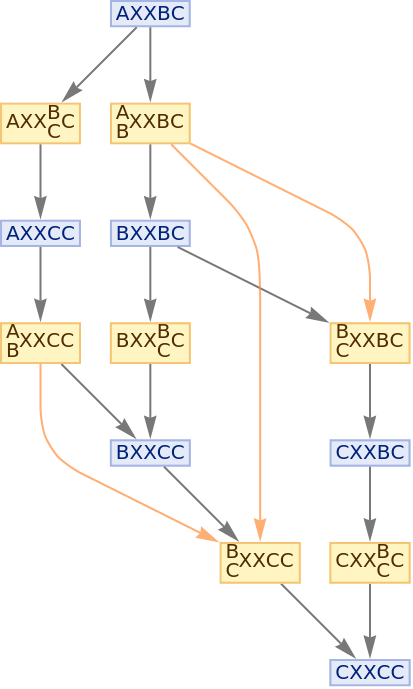
The blue box represents the string and the yellow box represents updating events that act on the string above it. Also, the orange arrow represents causal connection between different updating events (see "Multiway Causal Graph”). Note that C can arrive on Alice’s side only by virtue of correlation between A and B (as well as B and C). In other words, A is not directly correlated with C (e.g. there is no rule like AC). Given the rule associated with the above graph, it is straightforward to see that Alice can receive the message after exactly three steps regardless of how far apart Alice and Bob are (i.e. no matter how many X there are between A and B). One may then (incorrectly) interpret the above graph as an indication that entanglement can be used to teleport message faster than light. But actually, this graph is not a realistic model of quantum mechanics. For one, it violates no-cloning theorem which states that an arbitrary quantum state can not be copied. We can see this easily because the final state has three C’s whereas we only have one in the beginning. If C is an arbitrary qubit state, then indeed we have violated no-cloning theorem in this model. How does quantum teleportation really work, then?
How Quantum Teleportation Works
How Quantum Teleportation Works
In order to understand quantum teleportation, a little mathematics seems inevitable. Let’s start with notation. In standard notation of quantum mechanics, when a qubit is in state 0, we write its state as |0〉 and if its state is 1, we write its state to be |1〉 . Previously, I mentioned the concept of entangled state. By this notation, an example of entangled state are the so called Bell states. The first bit is kept by Alice and the second bit is kept by Bob. If the states of Alice and Bob qubits is given by , their qubits would be in the same state wherever they are on the universe. If Alice qubit is 0, then Bob qubit is also 0. And if her qubit is 1, his qubit is also 1. Alice and Bob can also prepare a different kind of entangled state that would make their qubits to be always the opposite of each other. If they prepare this state instead of the previous one, when Alice’s state is 0, Bob’s state is guaranteed to be 1 and vice versa. Both of these entangled states can be used as a resource for quantum teleportation. But, without any loss of generality, we assume Alice and Bob shares . One way they can prepare this state is by starting from and then send their qubits to this quantum circuit. We also assume that Bob’s message can be encoded into a qubit in the following superposition state, where α and β are coefficients proportional to the probability of the qubit to be in state 0 and 1 respectively. Then, the whole three qubits state of Alice and Bob can be written as By a little of algebra, one can express the above equation into a superposition of Bell states.Readers are encouraged to verify this equation. Since Bob has two qubits, he can then perform a Bell measurement on his qubits. In this type of measurement, he would obtain one among four possible outcomes {, }, which means the state of the two qubits possessed by Bob would be entangled after the measurement. Consequently, the state of Alice’s qubit would “collapse” into one of the states in parenthesis depending on Bob’s measurement outcome. For example, if Bob measure , Alice qubit state would collapse into (α|0〉+β|1〉). Note that after the measurement, entanglement between Alice and Bob qubit pair has been “transferred” to Bob’s qubit and his message. In returns, the information about α and β has been “teleported” from Bob to Alice! However, in order for Alice to obtain the correct state, Bob must send his measurement result through “classical” communication channel (e.g. telephone, internet) to Alice, so that Alice can decide what operation she needs to do to change her qubit into Bob’s original message. Since classical communication channel is required, this protocol can not teleport a message faster than light. But, in this way, Bob can make sure that Alice receives his message correctly without violating the no-cloning theorem, since the original qubit’s message are no longer identical with after Bob has performed his measurement.
〉=|00〉±|11〉
±
Bell
1
|〉
Bell
1
〉=|01〉±|10〉
±
Bell
2
|〉
Bell
1
|00〉
|Message〉=α|0〉+β|1〉
|Initial〉=|〉|Message〉=α|000〉+α|110〉+β|001〉+β|111〉
Bell
1
|Initial〉=(α|0〉+β|1〉)|〉+(α|0〉-β|1〉)|〉+(β|0〉+α|1〉)|〉+(β|0〉-α|1〉)|〉
1
2
+
Bell
1
1
2
-
Bell
1
1
2
+
Bell
2
1
2
-
Bell
2
±
Bell
1
±
Bell
2
|〉
+
Bell
1
1
2
|Message〉=α|0〉+β|1〉
Project Result: Quantum Teleportation with String
Project Result: Quantum Teleportation with String
This project is motivated by Wolfram Physics Project, a quest to find the fundamental law of physics based on hypergraph transformation rules. String substitution system is a simplified one dimensional toy model of the hypergraph multiway system in the Wolfram model. Therefore, finding quantum teleportation in string system is actually a preliminary investigation to the same phenomenon in a more general hypergraph setting. So, how can we simulate quantum teleportation in string substitution system? The basic idea is to introduce a notation where we replace 0 with A and 1 with B. But, since a string does not have a natural sign (±) assigned, we immediately face some difficulties:
◼
How can we generate superposition and entanglement?
◼
How can we perform Bell measurement?
◼
Since string substitution system has a fixed rule, how can we combine initial state generation and Bell measurement into a single substitution rule without their corresponding rules interfering with each other?
In this project, I managed to find a string substitution rule that can solve all these three problems simultaneously. The rule consist of two parts: initial state generation and Bell completion map.
String substitution rules to simulate quantum teleportation
rule={"D""AXA","D""BXB","C""A","C""B"};InitialState="DC";BellCompletion={"BA""AA","AA""BA","BA""BB","BB""BA","AB""AA","AA""AB","AB""BB","BB""AB"};
In defining the variables above, one can translate back to the usual quantum mechanics notation by transforming A and BThe variable ”InitialState” simply defines the initial string of our system. Meanwhile, “rule” specifies the rule to generate the state required for quantum teleportation () from the initial string. The letter “D” denotes an “origin” state from which we create by DAXA and DBXB. The reason why I use a new character to define the origin state is such that “rule” and “BellCompletion” do not interfere when we merge them together into a single substitution rule (e.g. not creating a new unwanted branch). The letter “X” denotes spatial separation between Alice and Bob. The letter “C” represents the qubit that we want to teleport. The rule CA and CB just means that C can be expressed in terms of a superposition of the string basis A and B. The superposition coefficient can be controlled by writing the corresponding rule several times as will be discussed later. The variable “BellCompletion” represents the process of Bell measurement which also will be discussed in more detail later.
|0〉
|1〉.
|Initial〉
|〉
Bell
1
Drawing evolution graph of string substitution system defined above
(*Functiontodrawthegraphwithannotation*)DrawGraph[]:=Module{a,b,c},(*Selectingtheverticestobecolored*)EvolVertexList=VertexList[ResourceFunction["MultiwaySystem"][Join[rule,BellCompletion],InitialState,4,"EvolutionGraph"]];TeleportInitState=FilterRules[EvolVertexList,2];BellVertex1=Map[3#&,Flatten[StringCases[FilterRules[EvolVertexList,3]/.Rule[a_,b_]b,{__~~"AA",__~~"BB"}]]];BellVertex2=Map[3#&,Flatten[StringCases[FilterRules[EvolVertexList,3]/.Rule[a_,b_]b,{__~~"AB",__~~"BA"}]]];stripMetadata[expression_]:=If[Head[expression]===Rule,Last[expression],expression];(*ColoringBellVertex1*)a=GraphResourceFunction["MultiwaySystem"][Join[rule,BellCompletion],InitialState,3,"EvolutionGraph","IncludeStatePathWeights"True,VertexLabels"VertexWeight"],;(*ColoringBellVertex2*)b=Grapha,VertexShapeFunctionAlternatives@@BellVertex2TextFramedStyle[stripMetadata[#2],Hue[0,1,0.1]],BackgroundDirective[Opacity[.6],Hue[1/3,1,1,.5]],,#1,{0,0}&;(*Coloringtheinitialteleportationstate*)c=Graphb,VertexShapeFunctionAlternatives@@TeleportInitStateTextFramedStyle[stripMetadata[#2],Hue[0,1,0.1]],,#1,{0,0}&(*Runthefunction*)DrawGraph[]
Out[]=
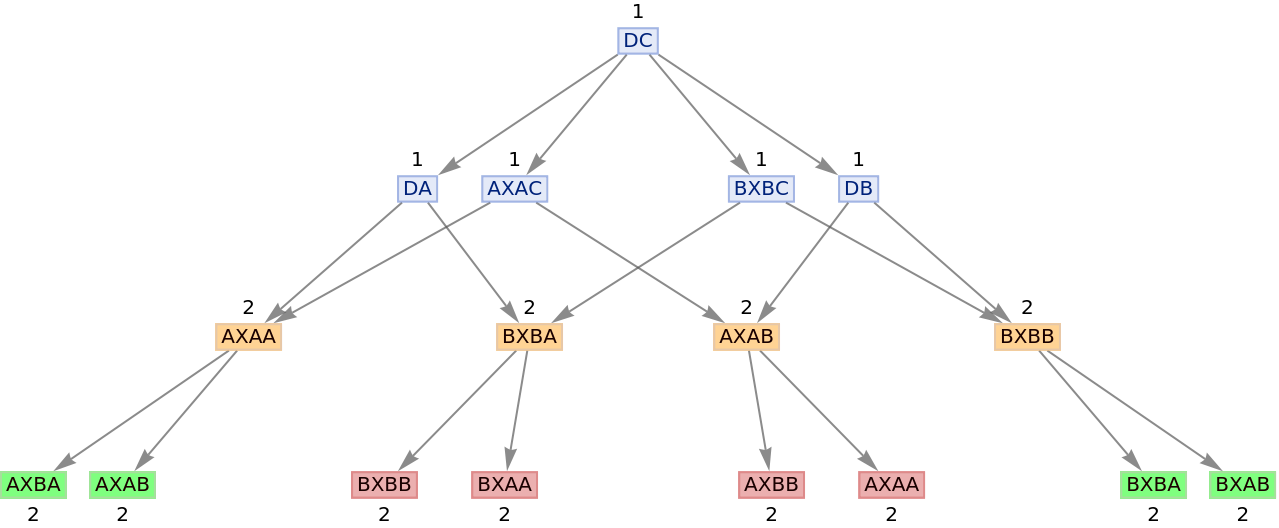
Each downward path in the above graph represents a possible history of string transformation. The number below/above each string correspond to state’s path weight, which counts the number of possible path one can go from initial state “DC” to the corresponding string. Thus, the bigger the weight, the higher probability of obtaining the state. Then, we can understand quantum superposition in this model by looking at states and their associated weights in each layer. For example, the strings on the orange layer actually represent an initial state for teleportation protocol with 0 replaced by A and 1 replaced by B as we can see below.
Under the orange layer are the states after Bell measurement. If we consider the states in green and red separately, we may factorize each of them into,
Thus, Alice qubit state after Bell measurement is proportional to (A±B). Indeed, the system simulates a teleportation of qubit where α = β = 1. To control the state we want to teleport, we just need to rewrite the rules “C” ”A” α times and “C” ”B” β times. For example, if Bob wants to teleport 2 |0〉+ 3 |1〉 to Alice, then we just do,
|Initial〉=2(AAA±AAB±BBA±BBB)=2(AA±BB)(A±B)
Under the orange layer are the states after Bell measurement. If we consider the states in green and red separately, we may factorize each of them into,
|Green〉=2(AAB±ABA±BAB±BBA)=2(A±B)(AB±BA)
|Red〉=2(AAA±ABB±BBB±ABB)=2(A±B)(AA±BB)
Thus, Alice qubit state after Bell measurement is proportional to (A±B). Indeed, the system simulates a teleportation of qubit where α = β = 1. To control the state we want to teleport, we just need to rewrite the rules “C” ”A” α times and “C” ”B” β times. For example, if Bob wants to teleport 2 |0〉+ 3 |1〉 to Alice, then we just do,
Controlling the superposition of the message’s qubit
rule={"D""AXA","D""BXB","C""A","C""A","C""B","C""B","C""B"};DrawGraph[]
Increasing spatial separation between Alice and Bob
Now that we have seen the above string substitution system works properly, let’s go deeper. The evolution of the string can be divided into two phases, initial state preparation (up to the orange layer) and Bell measurement (the green and red layer). Let’s consider the causal multiway graph for the initial state preparation.
Causal multiway graph of initial state preparation
By the absence of orange arrows between any of the yellow boxes, we can infer that each updating events are causally independent. Thus, the paths in the multiway graph - which represent the possible system’s histories - do not interact with one another. They nevertheless generate an entangled state that can be causally connected due to their common ancestry in the multiway system. “Entanglement map” of states in a given multiway system is illustrated by its branchial graph.
Branchial graph of the initial state
By imposing a measurement, we introduce causal relations between updating events in different branches. The final form of the multiway causal graph would be determined by our choice of measurement. In general, different choices of measurements correspond to different “layering” of the multiway system (see quantum measurement). In the quantum formalism of Wolfram model, measurement is imposed by inducing Knuth-Bendix completion between events that exist in the same layer. In constructing the string substitution system above, we have used the default layering which correspond to computational basis measurement frame. However, in our case, we need to perform Bell measurement to carry out the teleportation protocol. It is not at all clear how can one defines layering that corresponds to a Bell basis measurement frame in a string system. However, I managed to solve this problem by customizing the Knuth-Bendix completion map on a default layering instead of customizing the system’s layering itself. Thus, I define the following Bell completion map.
Definition of Bell completion map
An illustration of Bell completion map
Note that AA and BB as well as AB and BA are not perceived to be equivalent. There is a nice interpretation for this completion map, namely we are collapsing the system’s state into either a superposition of AA and BB or superposition of AB and BA. And this is exactly what the Bell measurement does! The exciting part is that this way of thinking can be generalized into making measurements on any basis as long as we can express the basis in terms of superposition of computational basis states! If we impose the Bell completion map onto our initial state preparation, we generate quantum teleportation string system demonstrated earlier. Additionally, the final causal multiway graph turns into a beautiful and symmetric network.
Causal multiway graph after Bell completion
In contrast with before the measurement, we now observe causal connections between different branches in the multiway causal graph! The fact that a measurement process induces significant changes toward the causal structure is a generic feature of quantum formalism in the multiway system. It has the interpretation that measurement is inherently disruptive to the system. More remarkably, the states shown in red (AXBA, BXAA, BXAB, and AXBB) are supposed to be impossible without the measurement process because the state of Alice and Bob qubit pair must be either AA or BB. However, after the Bell completion, AB and BA states become available. This is because the entanglement between Alice and Bob qubit pair has been exchanged with the information about the message qubit state. This indicates that there is a non-local information exchange between Alice and Bob. It is plausible that we are witnessing a signature of quantum effects in this teleportation model that distinguishes it from classical communication. As a remark, this quantum signature is somewhat similar to the quantum interference effect discussed here. But actually, the initial hypothesis was that we would observe updating events that occur on Alice induced by measurement done by Bob, which would clearly demonstrate non-local quantum information transfer between them. But, this model shows that what is happening is more subtle than that, because the information being transferred to Alice does not manifest itself in terms of updating events, but it is related to the transfer of path weights of the message qubit.
Now that Alice and Bob have done teleportation protocol, Alice can decode Bob’s secret message. It turns out that the message is “Thank you all for reading!”.
Now that Alice and Bob have done teleportation protocol, Alice can decode Bob’s secret message. It turns out that the message is “Thank you all for reading!”.