The traditional approach to teaching algebra often relies heavily on rote memorization and abstract reasoning, which can be challenging for many high school students. This paper explores the benefits of incorporating visual aids and interactive tools into algebra lessons. By leveraging technology and real-world applications, educators can create a more engaging and comprehensive learning experience for students. The use of interactive plots, real-world data, and educational games not only makes algebra more accessible but also demonstrates its relevance in everyday life.
The absolute value of a real number is a fundamental concept in mathematics, especially in algebra . It represents the "distance" of a number from zero on the number line, regardless of its sign . Mathematically, the absolute value of a number is denoted by . The absolute value function is piecewise - defined, making it a vital tool for solving equations and inequalities that involve both positive and negative values of a variable .
a
a
Definition:
The absolute value of of a real number is the non-negative value of without regard to its sign.
The absolute value of
a
a
a
|a|=
|
|
Absolute value means only how far a number is from zero
The absolute value has the following fundamental properties
The absolute value has the following fundamental properties
◼
Non-negativity
|a|≥0
◼
Positive-definiteness
|a|0
a0
◼
Multiplicativeness
=
ab
a
b
◼
Preservation of division
a
b
a
b
◼
Symmetry
=
a
-a
◼
Subaddivity
+||
a+b
≤
a
b
◼
Triangle inequality
+||
a-b
≤
a-c
c-b
◼
a
2
|
2
a
Absolute value and Mathematica
Absolute value and Mathematica
1
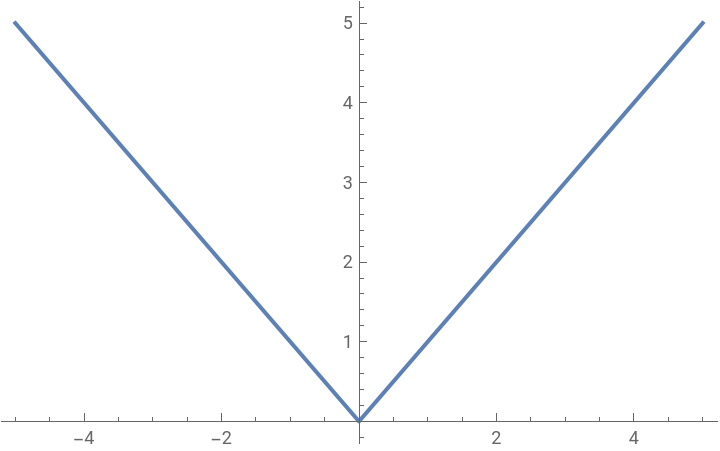
.The graph of | x |
In[]:=
Plot[Abs[x],{x,-5,5}]
Out[]=
2
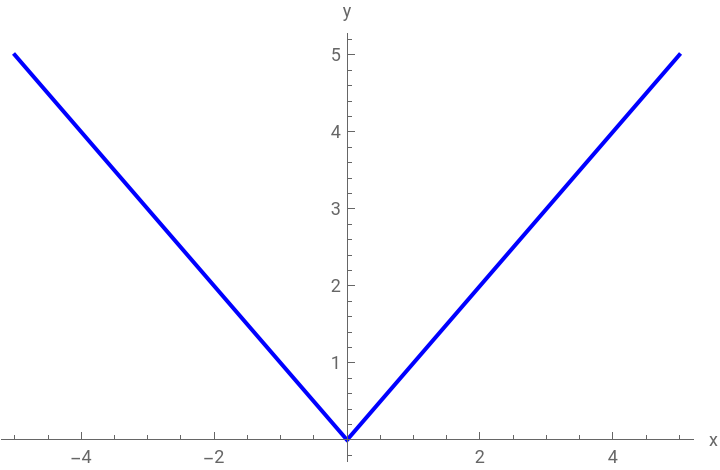
.The definition of the absolute function
In[]:=
f[x_]:=
|
In[]:=
f[x]
Out[]=
|
In[]:=
Plot[f[x],{x,-5,5},PlotLegends->"|x| ",AxesLabel->{"x","y"},PlotRange->All,PlotStyle->Blue]
Out[]=
|x| |
3
. Solving equations containing absolute value
For real numbers A and B, an equation of the form, with , will have solutions when or . If , the equation has no solution.
|A|B
B≥0
AB
A-B
B<0
|A|B
Equations with one absolute value
Equations with one absolute value
Example 1
Example 1
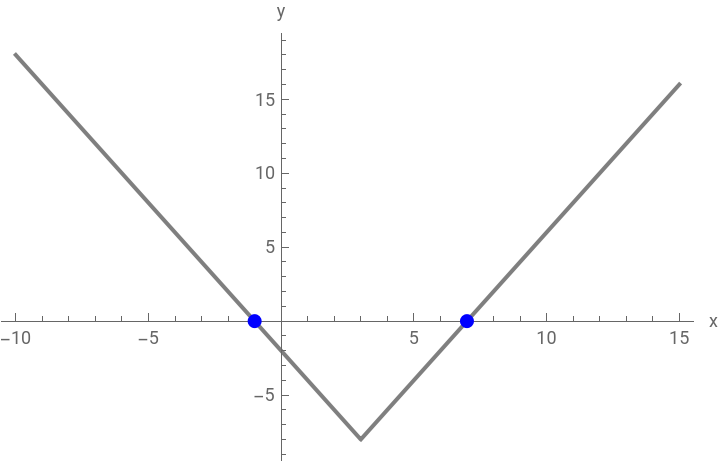
Let' s try to solve the following equation
|2x-6|8
In[]:=
f[2x-6]
Out[]=
|
In[]:=
sol=Solve[Abs[2x-6]==8,x]

Out[]=
{{x-1},{x7}}
In[]:=
Plot[Abs[2x-6]-8,{x,-10,15},PlotLegends->"|2x - 6| - 8",AxesLabel->{"x","y"},PlotRange->All,PlotStyle->Gray,Epilog->{Blue,PointSize[Large],Point[{x,Abs[2x-6]-8}/.sol]}]
Out[]=
|2x - 6| - 8 |
Example 2
Example 2
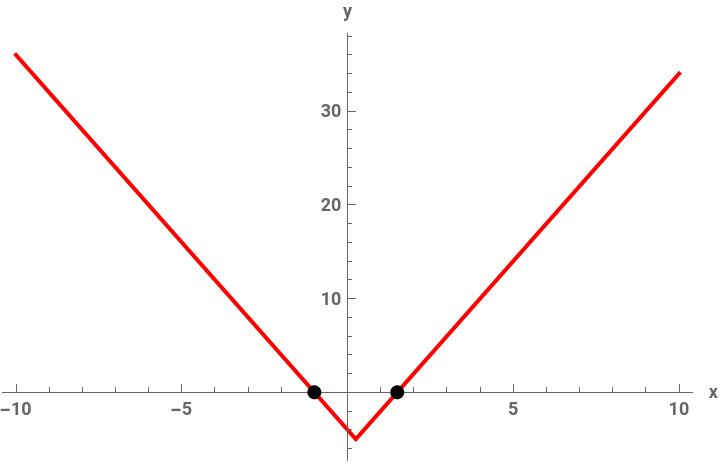
Solve the absolute value equation : .
|1-4x|+813
In[]:=
f[1-4x]
Out[]=
|
In[]:=
sol1=Solve[Abs[1-4x]+8==13,x]
Out[]=
{x-1},x
3
2
In[]:=
Plot[Abs[1-4x]-5,{x,-10,10},AxesLabel->{"x","y"},PlotLegends->"|1 - 4x| - 5",LabelStyle->Directive[Bold],PlotStyle->Red,Epilog->{Black,PointSize[Large],Point[{x,Abs[1-4x]-5}/.sol1]}]
Out[]=
|1 - 4x| - 5 |
Equations with two absolute values
Equations with two absolute values
For any algebraic expressions, and , if , then : or .
u
v
u||v
uv
u-v
Example 3
Example 3
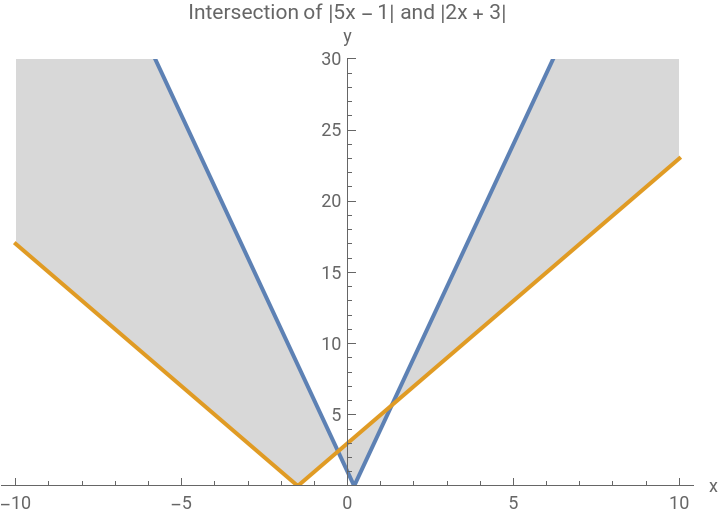
|5x-1||2x+3|
In[]:=
Solve[Abs[5x-1]==Abs[2x+3],x]
Out[]=
x-,x
2
7
4
3
In[]:=
Plot[{Abs[5x-1],Abs[2x+3]},{x,-10,10},PlotLegends->{"|5x - 1|","|2x + 3|"},AxesLabel->{"x","y"},PlotLabel->"Intersection of |5x - 1| and |2x + 3|",Filling->{1->{2}},FillingStyle->LightGray,PlotRange->{0,30}]
Out[]=


Absolute value equations with no solutions
Absolute value equations with no solutions
As we are solving absolute value equations it is important to be aware of special cases . An absolute value is defined as the distance from 0 on a number line, so it must be a positive number . When an absolute value expression is equal to a negative number, we say the equation has no solution .
Example 4
Example 4
Solve Inequalities Containing Absolute Values
Solve Inequalities Containing Absolute Values
Writing Solutions to Absolute Value Inequalities
Example 5
Example 5
Example 6
Example 6
Example 7
Example 7
CITE THIS NOTEBOOK
CITE THIS NOTEBOOK
Visualizing absolute value: interactive tools for high school Algebra
by Athanasios Paraskevopoulos
Wolfram Community, STAFF PICKS, October 19, 2023
https://community.wolfram.com/groups/-/m/t/3052556
by Athanasios Paraskevopoulos
Wolfram Community, STAFF PICKS, October 19, 2023
https://community.wolfram.com/groups/-/m/t/3052556