Quantum theory stands as one of humanity’s most successful and fascinating scientific achievements. It has withstood an immense variety of experimental tests and continues to push the boundaries of our understanding of the universe. Scientists have relentlessly explored its limits, either attempting to falsify it on extreme scales or extending its applications to novel domains (e.g., the debate around whether Schrödinger’s cat truly constitutes a quantum system).
But what exactly is quantum theory? At its core, quantum theory describes the behavior of systems on microscopic scales, such as nanometers, and even mesoscopic scales, extending to tens of micrometers. This framework has given rise to revolutionary technologies like lasers, transistors, LEDs, atomic clocks, MRI machines, semiconductors, superconductors, and advanced sensors. Furthermore, it lays the foundation for emerging technologies still in development, such as quantum computing—a field where scientists are actively addressing numerous challenges to realize its full potential.
Quantum theory applies to both massive particles (like atoms) and light particles (photons), and is often studied within the broader framework of quantum field theory. Focusing on massive particles, one encounters the famous Schrödinger equation. Its solutions, known as wave functions, are mathematical entities that encode everything we can observe about a quantum system using current technology, and potentially phenomena yet to be discovered with future advancements.
The Schrödinger equation, a partial differential equation (PDE), is not just a tool for prediction but also a mathematical masterpiece. Techniques from calculus and numerical methods like finite element methods (FEMs) play a crucial role in solving it. Despite its utility, the true meaning of the wave function remains a subject of philosophical and scientific debate. Schools of thought range from the Copenhagen interpretation to speculative ideas like parallel worlds. While the debate continues, quantum theory remains an unparalleled tool for understanding nature.
Recent years have seen a growing interest in developing “toy models” to replicate certain quantum features, such as epistemic models, which provide partial insights into quantum behavior. Yet, the elegance and predictive power of quantum theory surpass alternative approaches. Mastering its mathematical intricacies not only provides intellectual satisfaction but also opens doors to transformative technologies, as evidenced by quantum computing—a concept born from foundational discussions in quantum mechanics.
This year, UNESCO has recognized the International Year of Quantum, a celebration of quantum science and its profound impact. At Wolfram Research, we are proud to contribute to this celebration by offering integrated computational tools that empower both researchers and enthusiasts to explore quantum phenomena. From wave-like behavior to quantum information and open quantum systems, our tools provide a comprehensive platform for discovery. Additionally, we are pioneering the convergence of quantum technologies with AI, equipping users with the power of two cutting-edge advancements: quantum and artificial intelligence.
Stay tuned for more insights into our tools and join us in celebrating the International Year of Quantum. Together, let’s explore the limitless horizons of the quantum world. Here’s a sneak peek at our next topic: What is quantization?
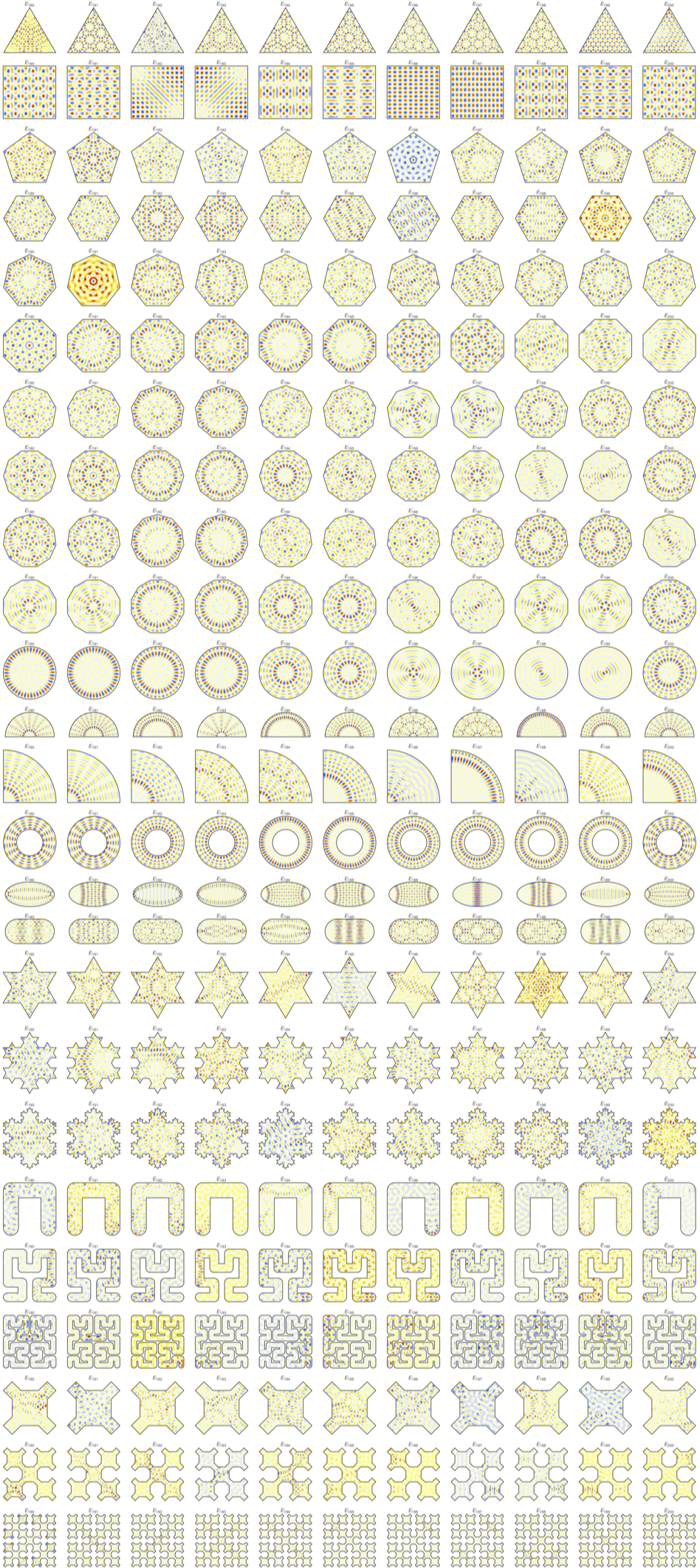
(Click the image below for full size)
(Click the image below for full size)
Appendix (codes)
Appendix (codes)
The below code in an example of how I generated GIF and those eigenstates. This specific example is for snowflake, but you can replace ℛ with any other 2D region. Keep in mind that MaxCellMeasure in NDEigensystem depends on the overall size of the system. Set it at a value such that the details of geometry should be visible and important, given a mesh with that size.
In[]:=
rt[φ_,p0_][line_]:=({{Cos[φ],Sin[φ]},{-Sin[φ],Cos[φ]}}.(#-p0)+p0)&/@linesnowFlake[o_]:=Polygon[(#-{1/2,Sqrt[3]/6})&/@With[{l=KochCurve[o][[1]]},Join[rt[Pi,{1/2,0}][l],rt[-Pi/3,{0,0}][l],rt[Pi/3,{1,0}][l]]]]
ℛ=snowFlake[2];{vals,funs}=NDEigensystem[{-Laplacian[u[x,y],{x,y}],DirichletCondition[u[x,y]0,True]},u[x,y],{x,y}∈ℛ,200,Method{"Eigensystem"{"Arnoldi","MaxIterations"10^6},"PDEDiscretization"{"FiniteElement",{"MeshOptions"{"MaxCellMeasure"0.001}}}}];imgs=Table[Show[ContourPlot[Evaluate@funs〚i〛,{x,y}∈ℛ,PlotLabel"\!\(\*SubscriptBox[\(E\), \("<>ToString[i]<>"\)]\)",Frame->False,Axes->False,PlotPoints100,ColorFunction"SunsetColors",AspectRatioAutomatic,PlotRange->All,ContourStyleNone,MaxRecursion0],Graphics[{FaceForm[],EdgeForm[Black],ℛ}]],{i,Length[vals]}];Export[NotebookDirectory[]<>"Snowflake2.GIF",imgs]
CITE THIS NOTEBOOK
CITE THIS NOTEBOOK
Understanding quantum theory: a gateway to the microscopic world and beyond
by Mohammad Bahrami
Wolfram Community, STAFF PICKS, January 29, 2025
https://community.wolfram.com/groups/-/m/t/3367267
by Mohammad Bahrami
Wolfram Community, STAFF PICKS, January 29, 2025
https://community.wolfram.com/groups/-/m/t/3367267