Preprint/Working Draft
This document is a preprint and working draft intended for community feedback.
It has not been peer-reviewed and has not been formally published.
© 2026 - Donald Airey. All rights reserved.
This work is intended for submission to a peer-reviewed journal.
Public posting of this draft does not constitute prior publication and does not waive the author’s right to publish a revised version.
This document is a preprint and working draft intended for community feedback.
It has not been peer-reviewed and has not been formally published.
© 2026 - Donald Airey. All rights reserved.
This work is intended for submission to a peer-reviewed journal.
Public posting of this draft does not constitute prior publication and does not waive the author’s right to publish a revised version.
Gravity and Cosmic Expansion from the Parabolic Metric Evolution of a Complex Manifold
Gravity and Cosmic Expansion from the Parabolic Metric Evolution of a Complex Manifold
A Kinematic Origin of Gravity and Cosmic Expansion
Overview
Overview
This notebook presents a framework in which gravity and cosmological expansion arise from a single kinematic mechanism associated with the parabolic metric evolution of a complex manifold. In this picture, cosmic expansion and gravitational attraction are not separate phenomena but complementary manifestations of a universal background acceleration. By treating physical interactions bilocally rather than through a local spacetime metric, the model produces a unified description of gravitational dynamics across galactic and cosmological scales while naturally accounting for the observed expansion of the universe.
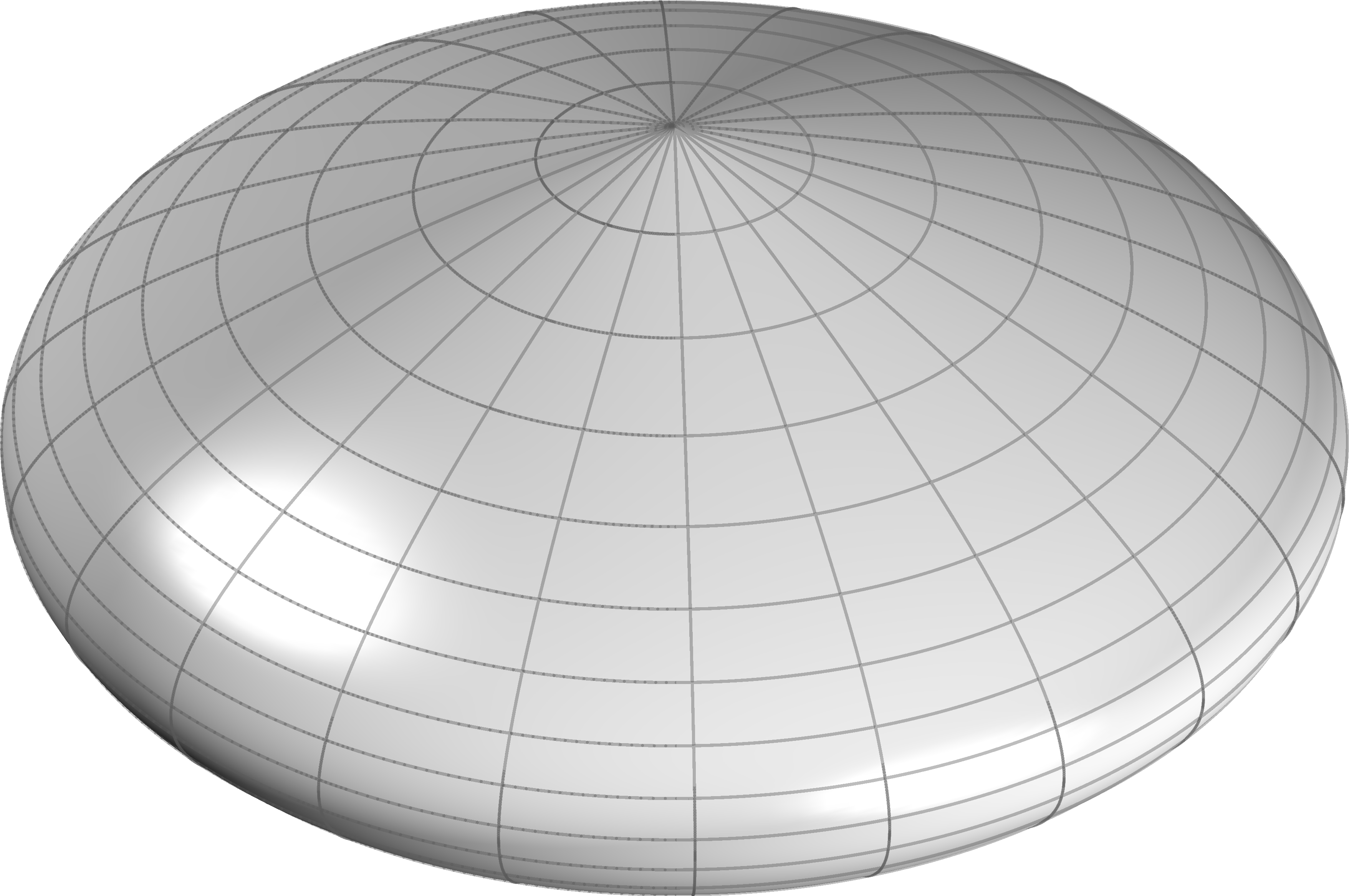
Figure 1. Parabolic metric manifold representing the global spatial extent of the universe generated by constant manifold acceleration. The manifold forms a closed geometry; circular cross-sections correspond to spatial slices at fixed epoch. The red ring marks the present spatial slice.
L(t)
Technical Abstract
Technical Abstract
A universal background acceleration is derived from the parabolic metric evolution of a complex manifold and used to determine the motion of test masses embedded in the expanding geometry. The resulting bilocal acceleration law produces inward relative acceleration between masses while preserving global expansion, yielding gravitational behavior without invoking spacetime curvature.
The dynamics remain consistent with the Newtonian Poisson equation and predict a cosmic mean baryon density in close agreement with observational estimates. A single acceleration scale governs systems across galactic and cosmological regimes. Within this framework, gravitational attraction and cosmic expansion arise from the same kinematic mechanism, eliminating the need for dark matter or dark energy and thereby unifying gravitational and cosmological dynamics.
Setup and Definitions
Setup and Definitions
We work with a real evolution parameter, , used only to label events along an embedded history. Time itself is represented by an imaginary manifold coordinate .
t∈ℝ
τ
Assumptions and Scope
Assumptions and Scope
◼
Geometry: Complex manifold with one imaginary temporal coordinate, , and one real spatial coordinate; no local metric tensor or infinitesimal line element is assumed.
τ
◼
Dynamics: Constant real acceleration and initial velocity define the induced spatial extent and the instantaneous expansion rate .
A
V
0
L(t)
H(t)
◼
Distance: Separations are defined bilocally between ordered event pairs via =+ with no mixed terms.
2
Δ𝑠
2
()
0
Δs
2
()
1
Δs
◼
Causality: The manifold geometry determines the causal structure; the bilocal null condition defines the causal domain.
◼
Propagation: Massless particles are assumed to propagate at or sufficiently near the null bilocal condition =0.
2
Δ𝑠
◼
Units: Symbolic work is dimensionless; SI units are applied only for numerical insertion.
Environment Cleanup
Environment Cleanup
Typesetting Rules
Typesetting Rules
Geometric Conventions
Geometric Conventions
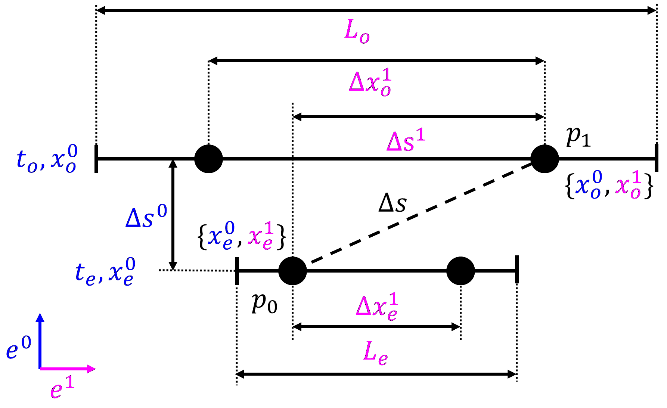
Figure 2. Bilocal separation geometry on a complex manifold. Two events are identified: an emission event, , at , and an observation event, at . The temporal separation, , is defined by integrating the imaginary tangent scale along the parameter interval between and . The spatial separation is defined by the comoving distance Δ less one half of the expansion between and .
p
e
,
0
x
e
1
x
e
p
o
,
0
x
o
1
x
o
0
Δs
t
e
t
o
1
Δs
1
x
o
t
e
t
o
Axioms of the Complex Manifold
Axioms of the Complex Manifold
We proceed from the following axioms, which define the geometric and kinematic structure of the manifold.
Axiom 1 (Imaginary Time)
Axiom 1 (Imaginary Time)
Evolution along the manifold history is parameterized by an imaginary coordinate , defined in terms of a real parameter by
τ
t
τ(t)=t
In[]:=
τ[t_]=t
Out[]=
t
The parameter t serves solely to label events along the embedded history and does not represent a physical time coordinate.
Axiom 2 (Real Space)
Axiom 2 (Real Space)
Spatial coordinates and spatial separations are real-valued, directly measurable quantities defined by a positive-definite spatial metric.
Axiom 3 (Imaginary Velocity)
Axiom 3 (Imaginary Velocity)
The generator of evolution along the manifold history is a purely imaginary tangent vector. Spatial distance arises from metric-mediated integration of this generator, yielding real, positive-definite intervals and rendering instantaneous velocity unobservable.
Axiom 4 (Real Acceleration)
Axiom 4 (Real Acceleration)
The manifold history is subject to a constant real acceleration intrinsic to its geometry. This acceleration is the sole source of the imaginary velocity’s evolution and induces real spatial evolution.
A
Complex Geometric Evolution
Complex Geometric Evolution
Given the complex temporal coordinate and intrinsic acceleration , we introduce the velocity scale governing evolution in the imaginary sector. This scale mediates the conversion of imaginary evolution into real spatial evolution.
A
Imaginary Velocity
Imaginary Velocity
Differentiating Axiom 1 gives the relation between the manifold parameter and the real evolution parameter ,
τ
t
∂τ
∂t
Define the complex temporal velocity as the integral of the constant real acceleration along the imaginary temporal direction,
A
v(t)≡∫Aτ=At=(At-)
∂τ
∂t
V
0
where is the manifold expansion rate at .
V
0
t=0
In[]:=
v[t_]=Simplify∫Aτ[t]t-
∂
t
V
0
Out[]=
(-+At)
V
0
Velocity can be observed only indirectly through the real spatial evolution induced by the manifold geometry. Velocity is imaginary and absolute.
Real Spatial Evolution
Real Spatial Evolution
Real spatial evolution is the projection of imaginary kinematic evolution onto the spatial manifold. The velocity generates evolution along the manifold history parameterized by the imaginary coordinate , while observable spatial extent is defined between slices labeled by the real parameter t.
v
τ
The spatial extent is therefore
L(t)≡∫v(t)τ=v(t)t=t-
∂τ
∂t
V
0
A
2
t
2
Evaluating this expression yields
In[]:=
L[t_]=∫v[t]τ[t]t
∂
t
Out[]=
V
0
A
2
t
2
The constant of integration is omitted from the extent formula because it does not affect the evolution and does not yet enter the quantities considered here.
L
0
Emergent Acceleration Scale
Emergent Acceleration Scale
Differentiating the induced spatial extent twice yields a constant real deceleration,
2
d
2
dt
In[]:=
∂
{t,2}
Out[]=
-A
This uniform deceleration governs all spatial separations and is fixed by the bilocal construction. The parabolic form of L(t) is therefore intrinsic. The manifold expands at initial rate , decelerates under A, halts, and ultimately reverses. The resulting structure both expands from and collapses into a geometric singularity.
V
0
Hubble Function
Hubble Function
We define the Hubble function as the ratio of velocity to spatial extent (expansion per unit distance),
H(t)≡
v(t)
L(t)
In[]:=
H[t_]=Simplify
v[t]
L[t]
Out[]=
2(-At)
V
0
t(-2+At)
V
0
The Hubble function thus characterizes expansion per unit separation within the bilocal geometry.
Bilocal Metric Formula
Bilocal Metric Formula
We introduce the fundamental bilocal interval used throughout the construction. No local line element is assumed; distance is defined only between ordered pairs of events.
On the two-dimensional manifold, an invariant separation is assigned between an emission event and an observation event by the quadratic composition of orthogonal temporal and spatial components,
p
e
p
o
Temporal Separation
Temporal Separation
Spatial Separation
Spatial Separation
Solving for the emission-slice separation yields
The midpoint form is the unique linear bilocal separation that is invariant under exchange of the emission and observation events.
Metric Formula
Metric Formula
Substituting the temporal and spatial components yields the explicit bilocal metric formula.
Null Bilocal Path
Null Bilocal Path
Redshift Substitution
Redshift Substitution
Redshift is introduced through the scaling of the induced spatial extent,
The cosmological distance–redshift relation follows analytically from the bilocal kinematics. No metric ansatz is assumed, no field equations are solved, and no numerical integration is performed.
Causal Horizon
Causal Horizon
The ratio of this horizon to the spatial extent of the manifold is constant:
The particle horizon is always twice the spatial extent and, therefore, the entire manifold is in causal contact at every epoch. Causality in this geometry is global rather than local: no region of space lies outside the bilocal causal domain of any other.
This has direct cosmological consequences. At last scattering, the surface of last scattering is already causally connected across the full manifold. No super-horizon equilibration and no early accelerated expansion are required. Uniform background radiation is therefore the observational signature of a geometry in which the particle horizon always exceeds the expansion scale, ensuring that all regions of the sky were in causal contact at the time of emission.
Local Bound Dynamics
Local Bound Dynamics
Local Reduction
Local Reduction
The bilocal framework assigns invariant separations only to ordered event pairs and does not define infinitesimal intervals. A local description is obtained by considering finite temporal intervals short enough that the background expansion does not change appreciably.
In this regime, the bilocal construction induces a real spatial evolution governed by a constant deceleration.
Baryonic Acceleration
Baryonic Acceleration
Adopting the convention that inward acceleration is negative,
Fundamental Plane
Fundamental Plane
A circular orbit is sustained when the inward radial acceleration equals the required centripetal acceleration,
Solving for the enclosed baryonic mass
Substitution yields the maximal supported baryonic mass,
Acceleration Scale
Acceleration Scale
The resulting best-fit value is
This value defines the universal acceleration scale governing both local gravity and cosmological evolution.
Geometric Signature
Geometric Signature
Supernova Luminosity Distance
Supernova Luminosity Distance
The Pantheon+ compilation of 1,701 Type Ia supernovae (Brout et al., The Pantheon+ Analysis: Cosmological Constraints from 1701 Type Ia Supernovae) provides standardized distance moduli, redshifts, and full statistical and systematic covariance spanning local to cosmological scales. It represents the current state of the art in supernova cosmology, with consistent calibration, selection treatment, and systematic modeling.
Distance and Covariance
Distance and Covariance
Distance Modulus
Distance Modulus
with the PME luminosity distance given analytically by
The corresponding theoretical distance modulus is
This closed-form relation enables direct evaluation of predicted distance moduli at each observed redshift, without numerical integration or series expansion.
Data Ingestion
Data Ingestion
Initial Conditions
Initial Conditions
and the generalized chi-square statistic is computed using the full STAT+SYS covariance matrix,
Sanity Check
Sanity Check
In the PME framework, the Hubble constant is not an independently fitted parameter, but a derived kinematic quantity fixed by the manifold’s initial conditions. Once the parameters governing the manifold evolution are specified, the present-epoch expansion rate follows uniquely.
The imaginary character and negative sign arise from the geometrical structure of the tangent vector on the complex manifold, in which all velocities are imaginary and directed inward. The magnitude of this quantity corresponds to the physically inferred expansion rate. The resulting value lies within the range of independent, local, and largely geometric determinations of the Hubble constant, providing a consistency check on the inferred manifold parameters.
The Hubble constant is a prediction, not an input.
Comparison with Observations
Comparison with Observations
Figure 5. Pantheon+SH0ES distance moduli with PME (red) and spatially flat FLRW (blue) predictions evaluated on the same absolute calibration. Lower panel shows residuals relative to each model.
χ² Comparison
χ² Comparison
However, the difference is structural, not numeric. In FLRW, the expansion history is governed primarily by free density parameters. In PME, the same large-scale behavior is a direct consequence of the manifold kinematics.
CMB Angular Scale
CMB Angular Scale
Definition of the Acoustic Angular Scale
Definition of the Acoustic Angular Scale
The angular scale of a physical feature is defined by the ratio of its arc length to the transverse radius subtending that arc:
Transverse Circumference
Transverse Circumference
Substitution yields
Recombination Microphysics
Recombination Microphysics
The sound horizon depends on the epoch at which photons decouple from the baryon–photon plasma. In the present framework, this epoch is not imposed but determined from the Thomson scattering history along the manifold evolution. Recombination is defined operationally by the peak of the photon visibility function.
Baryon Density
Baryon Density
The corresponding Newtonian gravitational acceleration is
so that
Inserting the initial conditions yields
Photon Density
Photon Density
The photon contribution to the cosmic mass–energy density follows from the thermodynamic properties of a blackbody radiation field at the temperature of the cosmic microwave background (CMB). The present CMB temperature is
For a photon gas in thermal equilibrium, the photon number density is
The mean photon energy for a blackbody spectrum is
The product of the number density and the mean energy gives the photon energy density
The corresponding mass–equivalent density is
Using the measured CMB temperature and fundamental constants yields
This value represents the present-day photon contribution to the cosmic mass–energy density. Although small compared with the baryonic density, it supplies the radiation component that determines the thermodynamic state of the early baryon–photon plasma used to compute the pre-recombination sound speed.
Electron Number Density
Electron Number Density
The free electron number density is therefore
The Recfast++ output is imported and interpolated, and the resulting function is used to evaluate the electron density as a function of time.
Thomson Scattering Rate
Thomson Scattering Rate
Photons in the primordial plasma scatter from free electrons through Thomson scattering. The scattering rate is determined by the electron number density and the Thomson cross section.
The Thomson scattering rate is
Thomson Optical Depth
Thomson Optical Depth
The Thomson optical depth is obtained by integrating the scattering rate along the photon trajectory. The optical depth at time t is
Visibility Function
Visibility Function
Time of Recombination
Time of Recombination
Baryon Photon Momentum Ratio
Baryon Photon Momentum Ratio
Having determined the recombination epoch, we now know the duration over which acoustic oscillations could propagate in the tightly coupled baryon–photon plasma. The physical scale of these oscillations is set by the sound speed of the plasma, which depends on the relative inertia of the baryon and photon components. This dependence is quantified by the baryon–photon momentum ratio.
The baryon–photon momentum ratio is defined as
Speed of Causality
Speed of Causality
The causal horizon determines the maximum distance a particle could traverse while following a null path. Differentiating this horizon with respect to time yields the limiting propagation speed permitted by the geometry, which we define as the speed of causality.
Speed of Sound
Speed of Sound
Sound Horizon
Sound Horizon
Angular Scale
Angular Scale
The characteristic angular scale of the acoustic peaks in the cosmic microwave background is set by the ratio of the physical sound horizon at recombination to the distance from the observer to the surface of last scattering. The sound horizon represents the maximum distance acoustic waves could propagate in the baryon–photon plasma prior to recombination, while the distance to the surface of last scattering determines how that physical scale is projected onto the sky.
This value follows directly from the causal dynamics of the Parabolic Expansion Model. No parameters were adjusted to reproduce the CMB observations; the acoustic scale emerges as a prediction of the model’s kinematics.
Acceleration Flux Theory
Acceleration Flux Theory
The field language used below therefore refers only to this emergent local limit and should not be interpreted as fundamental. The underlying dynamics are bilocal and kinematic, while the familiar notion of a local acceleration field represents a derived description applicable only within sufficiently small neighborhoods.
Acceleration Flux Density
Acceleration Flux Density
The homogeneous component reflects the global manifold acceleration determined by the bilocal kinematics, while the concentrated component arises from the redistribution of this background acceleration by baryonic matter.
Local Flux Postulate
Local Flux Postulate
In the local bound regime, redistribution of the universal acceleration scale obeys a Gauss-type conservation law,
or equivalently,
This relation expresses conservation of acceleration flux under redistribution by matter.
Under spherical symmetry this redistribution reproduces the familiar inverse-square form,
The total inward acceleration governing local motion is therefore
This expression provides the direct link between the global manifold deceleration and the effective local gravitational dynamics observed in bound systems.
The Gauss-type flux relation arises as the local limit of the bilocal manifold construction. When separations are restricted to sufficiently small neighborhoods, the conserved background acceleration defined on the manifold projects into a local field whose flux redistribution is constrained by the baryonic mass distribution.
In this framework, momentum change does not arise from forces acting between distant bodies. Instead, it reflects the interaction of mass with a conserved acceleration flux whose local density and direction are determined by baryonic redistribution. Matter reorganizes the background acceleration field into spatial gradients, and the resulting flux structure governs the evolution of motion within the local bound regime.
Momentum
Momentum
Momentum is not treated as a primitive quantity and is not exchanged through forces acting between bodies. Instead, momentum change is the local, measurable response of mass to an ambient acceleration flux structure. This reframing removes the need for action at a distance while preserving the empirical content of Newtonian dynamics.
Operationally, momentum retains its standard definition,
This relation is not interpreted as a force law. Rather, it expresses how mass couples to the ambient acceleration flux encoded in the bilocal geometry. Momentum change therefore arises from redistribution of acceleration flux under relational constraints, not from instantaneous action at a distance and not from dynamical changes of the geometry itself.
From this perspective, gravitational dynamics can be viewed as the redistribution of a conserved acceleration flux within the manifold. Matter does not generate gravitational fields in the conventional sense; instead, it constrains how the universal background acceleration is locally concentrated. The familiar inverse-square law therefore emerges as the spherically symmetric solution of a flux redistribution process rather than as a fundamental force law. In the local reduction regime this description reproduces the empirical content of Newtonian gravity, while its origin in bilocal manifold kinematics provides the underlying physical mechanism.
Conclusion
Conclusion
Matter does not generate gravitational acceleration, nor does it deform spacetime. Instead, baryonic structure redistributes an ambient background acceleration scale, concentrating flux and producing spatial gradients. In the local bound regime this redistribution yields an inhomogeneous acceleration component obeying a Gauss-type constraint that reproduces the familiar inverse-square behavior associated with Newtonian gravity. The resulting local acceleration,
arises without invoking forces, potentials, or nonlocal interactions.
Within this framework, momentum is not exchanged through forces acting between distant bodies. Momentum change is the local, observable response of mass to a structured acceleration flux. Newton’s second law is retained operationally but reinterpreted: it describes how matter couples to an existing background acceleration scale rather than how bodies exert forces upon one another. Conservation of momentum follows from conservation of acceleration flux under redistribution, replacing action–reaction pairs with flux balance.
This construction resolves a long-standing conceptual tension in classical gravity. Newton’s laws successfully describe motion but provide no physical account of how gravitational influence is transmitted. Acceleration Flux Theory supplies that missing mechanism while preserving the empirical content of Newtonian dynamics. In doing so it also exposes the limitation of Newton’s first law: inertial motion is not fundamental but an approximation that neglects a universal background acceleration. Objects at rest do not remain at rest; they evolve under a persistent kinematic acceleration scale whose effects appear once acceleration is treated as primary.
Gravity therefore emerges not as a force and not as geometry, but as the organized redistribution of a conserved background acceleration scale. The same kinematic structure that governs cosmic expansion also governs local attraction, unifying gravitational phenomena across scales without additional assumptions or dark sectors. Acceleration Flux Theory thus provides a physically intelligible, local, and deterministic foundation for gravity—one that resolves several longstanding conceptual difficulties, including action at a distance, dynamical spacetime curvature, and the separation between cosmic expansion and local gravitational attraction, while remaining fully compatible with observed dynamics.