CITE THIS NOTEBOOK: Limits to growth simplified and GDP by Sangdon Lee. Wolfram Community OCT 24 2022.
CITE THIS NOTEBOOK: Limits to growth simplified and GDP by Sangdon Lee. Wolfram Community OCT 24 2022.
Introduction
Introduction
◼
The book titled "Limits To Growth (LTG)" is the most important contribution from System Dynamics discipline. The book simulated the exponential economic and exponential population growths within finite supply of non-renewable resource. The book showed that exponential economic growth can not last forever and the economic development is the primary driving factor. The LTG was based on the work of Jay Forrester and his students at MIT who developed the SD model and wrote a book called, World Dynamics.
◼
The SD model analyzed the feedback loops among 5 factors; population, economic development, unrenewable resource, pollution, and food. The book described the inevitable fact that economy can not grow exponentially forever and thus economy will reach its limits. The primary driving factor is the exponential economic growth that will (1) increase food supply which will support population growth and at the same time (2) will produce pollution that will increase deaths, and (3) deplete unrenewable resource which will reduce available food.
◼
I developed a very simple model to understand the limits to growth without complex feedback loops, just a simple stock and flow. I called it X_UDC (undiscovered, discovered, and consumed resource) . What I observed is that it takes only one doubling time to deplete the half of the total resource due to the astounding compound growth.
◼
Dr. Albert Bartlett provided very compelling implications of unending growth on economies, population, and resource.
◼
The average growth rate of GDP in the United States is about 3.14 percent from 1948 until 2022. Annual growth rate of 3.14% indicates that the GDP will double every 23 years.
Summary
Summary
◼
If the global economy grow at 3% per year, then it will take only 24 years (i.e., one doubling time) to consume the remaining 50% of the unrenewable resource, even if we discover new resource or develop new technology so that the remaining resource is doubled. Compounding economic growth is not feasible!
◼
Doubling time = 72 / growth rate in %
◼
e.g., 72/3 = 24 years. 72/2.88=25 years
◼
Typical responses to the above observation (assuming the doubling time is 25 years)
◼
Response 1: We can discover more resource so we will have plentiful of resource.
◼
Even if we discover more resource, let’s say 100% more so that the remaining resource is doubled from 100 to 200, it will take only 2 doubling time to consume the newly discovered resource, that is 25+25=50 years.
◼
initial value of undiscovered resource is double from 100 to 200
◼
Response 2: We will develop new technologies that will increase the resource usage efficiency (e.g., new lithium battery technology will use 50% less than current technology.
◼
Even if we develop new technology, let’s say 100% more efficiency so that the remaining resource is doubled , it will take only 2 doubling time to consume the unrenewable resource, that is 25+25=50 years.
Description
Description
◼
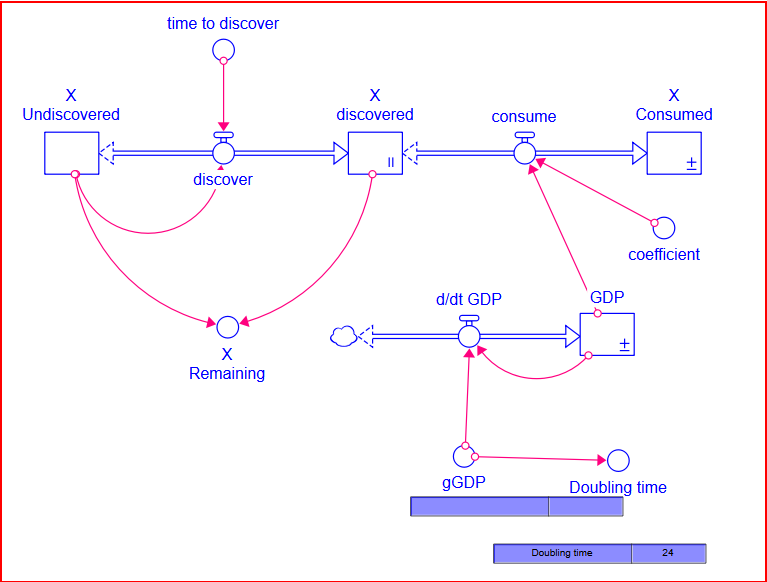
Unrenewable resource are compartmentalized into 3 stages: undiscovered, discovered, and consumed resource
◼
X_UDC(undiscovered, discovered, consumed)
◼
“xU” is undiscovered resource. Note that there is “no” inflow to the undiscovered resource, that is unrenewable resource is only depleted.
◼
“xD” is discovered resource. It takes time (and efforts) to discover resource.
◼
“xC” is consumed resource. We discover additional resource and consume them via economic development.
◼
I assume that GDP will consume a fraction of resource and the “coefficient” is a conversion factor; “coefficient*GDP”
◼
X_Remaining is the sum of undiscovered and discovered resource
◼
GDP will grow 2.88% per year (gGDP) and will consume a fraction of discovered resource (resource usage “coefficient”)
◼
GDP’[t]=0.0288*GDP[t], GDP[0]==1
◼
I used 2.88% as a GDP growth for easy, which indicates that GDP will double every 25 years. Initial GDP value is set at 1.
◼
The “coefficient” is set at 0.01, The remaining resource will be consumed as a function of GDP
◼
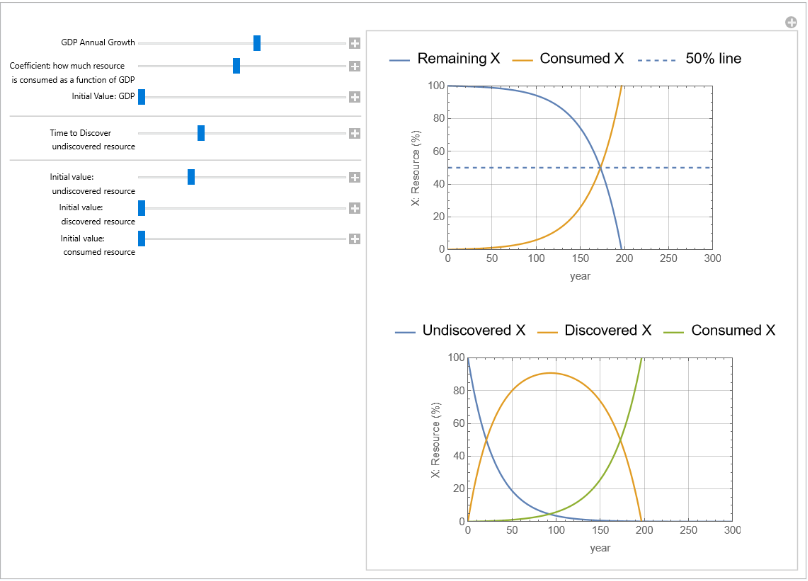
The smaller value of resource usage “coefficient” will prolong the remaining resource (e.g., the initial value of 0.01 is changed to 0.005, a 50% reduction). However, once the remaining resource reach 50%, it takes only one doubling time to consume the remaining 50% resource
Modeling
Modeling
In[]:=
psol=ParametricNDSolve[{tMaxS=400;(*xUisundiscoveredresource.Ittakestime(andefforts)todiscoverresouces.Wecannotdiscovertheresoucesinstantly*)xU'[t]-xU[t]/timeToDiscover,(*xDisdiscoveredresource.Wediscoveradditionalresourceandconsumethemviaeconomicdevelopment*)(*IassumethatGDPwillconsumeafractionofresourceandthe"coefficient"isaconversionfactor;"coefficient*GDP"*)xD'[t]+xU[t]/timeToDiscover-coefficient*GDP[t],(*xCisconsumedresouces*)xC'[t]+coefficient*GDP[t],(*xRemainingisthesumofundiscoveredanddiscoveredresource*)xRemaining[t]==xU[t]+xD[t],(*GDPwillgrowannualwiththerateofgGDP*)GDP'[t]gGDP*GDP[t],xU[0]xU0,xD[0]xD0,xC[0]xC0,GDP[0]GDP0},{xU,xD,xC,xRemaining,gGDP},{t,0,tMaxS},{coefficient,gGDP,timeToDiscover,GDP0,xU0,xD0,xC0}];
Simulating
Simulating
◼
With the initial values or settings, the remaining resource becomes 50% at the year 175 and 25 years later, the remaining 50% of resource is consumed completely. Even though 50% of resource remain, it takes only 1 doubling time (e.g, 25 years) to consume the remaining resources.
◼
Typical Response 1: We can discover more resource so we will have plentiful of resource.
◼
initial value of undiscovered resource is double from 100 to 200
◼
Typical Response 2: We will develop new technologies that will increase the resource usage efficiency (e.g., new lithium battery technology will use 50% less than current technology.
◼
the “coefficient” is reduced from 0.01 to 0.005, a 50% reduction.
tMaxG=300;Manipulate[Row@{Show[Plot[{Evaluate[{xRemaining[coefficient,gGDP,timeToDiscover,GDP0,xU0,xD0,xC0][t],xC[coefficient,gGDP,timeToDiscover,GDP0,xU0,xD0,xC0][t],GDP[coefficient,gGDP,timeToDiscover,GDP0,xU0,xD0,xC0][t]}/.psol]},{t,0,tMaxG},PlotLegendsPlaced[{"Remaining X","Consumed X"},Above],PlotRange{{0,tMaxG},{0,100}},GridLinesAutomatic,FrameTrue,FrameLabel{"year","X: Resource (%)"},ImageSize300],Plot[0.5*100,{t,0,tMaxG},PlotLegendsPlaced[{"50% line"},Above],PlotRange{{0,tMaxG},{0,100}},GridLinesAutomatic,FrameTrue,FrameLabel{"year","X: Resource (%)"},ImageSize300,PlotStyleDashed]],Plot[Evaluate[{xU[coefficient,gGDP,timeToDiscover,GDP0,xU0,xD0,xC0][t],xD[coefficient,gGDP,timeToDiscover,GDP0,xU0,xD0,xC0][t],xC[coefficient,gGDP,timeToDiscover,GDP0,xU0,xD0,xC0][t],xRemaining[coefficient,gGDP,timeToDiscover,GDP0,U0,xD0,xC0][t],GDP[coefficient,gGDP,timeToDiscover,GDP0,xU0,xD0,xC0][t]}/.psol],{t,0,tMaxG},PlotLegendsPlaced[{"Undiscovered X","Discovered X","Consumed X"},Above],PlotRange{{0,tMaxG},{0,100}},GridLinesAutomatic,FrameTrue,FrameLabel{"year","X: Resource (%)"},ImageSize300]},{{gGDP,0.0288,"GDP Annual Growth"},0.0,0.05,0.001},{{coefficient,0.01,"Coefficient: how much resource \n is consumed as a function of GDP"},0.001,0.02,0.001},{{GDP0,1.0,"Initial Value: GDP"},1.0,5.0,1.0},Delimiter,{{timeToDiscover,30,"Time to Discover \n undiscovered resource"},0,100,10},Delimiter,{{xU0,100,"Initial value:\n undiscovered resource"},0,400,100},{{xD0,0,"Initial value:\n discovered resource"},0,100,10},{{xC0,0,"Initial value:\n consumed resource"},0,100,10},ControlPlacementLeft]
Out[]=
Appendix
Appendix
◼
doubling time
◼
every 25 years, consumption is doubled, then the growth rate should be.....