The Multiway Systems of Dynkin Diagrams
Sam Whittington
City, University of London
https://github.com/SamWhittington
Sam Whittington
City, University of London
https://github.com/SamWhittington
The main goal of this project is to build and examine the Multiway systems built from the algebraic relations encapsulated within the Dynkin diagram of a Lie algebra, or more broadly from the generalised Cartan matrix of a generalised Kac-Moody algebra.
Motivation
Motivation
Symmetry in Physics
Symmetry in Physics
Since Einstein’s formulations of Relativity and the evolution of Quantum Mechanics in the 20th century, symmetry has played a fundamental role in physics. On both the celestial scales of General Relativity and the close to infinitesimal scales of Quantum Mechanics, symmetry is most elegantly described by one unifying mathematical concept, that of Lie groups. Lie groups have had so much success in encapsulating the laws of physics affording to their interpretation as continuous differentiable manifolds equipt with a group theoretic internal structure. For example, the Lie group known as the Poincaré Group plays an invaluable role in special relativity through encapsulating all the spacetime isometries of the continuous differentiable manifold of Minkowski spacetime.
Whether the success of Lie Groups within the more abstract concepts of quantum physics is due to elements of the fundamental quantum nature of our universe being approximated as continuous manifold, or whether Lie Groups are a concept for understanding that our three dimensional minds can interpret into the quantum nature of the universe has been largely a philosophical question. Albeit a philosophical question that can be eventually answered by further research in fundamental theoretical physics, hopefully the research I outline below and more generally the research within the Wolfram Physics Project can shed light on these questions.
Either way, the most notable use of Lie groups at the quantum scales are within the formulation of the Standard Model of Particle Physics. These Lie groups arise as gauge groups, for example in the standard model this is which on a high level describes the interaction of the QCD and Electroweak interactions. In other contexts can describe the certain behaviours of spin-1/2 particles and that of photons for example. More detail on this topic can be found in [1].
A major project within 20th century mathematics was to completely classify finite Lie groups. A rather effective way of this classification arose from examining the tangent space to the Lie group at its identity. Sophus Lie’s third theorem showed that by examining this vector space of the Lie groups differentiable manifold structure that we can always define a duality to another mathematical structure known as the Lie algebra.
Whilst originally studied in their relation to Lie group, Lie algebras and their properties have been a fruitful area of research in their own right both in pure mathematics and theoretical physics. In the latter, Lie algebras have been essential in formulating string theories, WZW-theories and gauge theories in general. It is thought that they may physically play a more fundamental role, rather than simply being a redundancy in the mathematics of describing them, especially within a discrete spacetime setting [1]. This makes them an interesting object of study within their own right, especially with regards to the Wolfram physics project.
Whether the success of Lie Groups within the more abstract concepts of quantum physics is due to elements of the fundamental quantum nature of our universe being approximated as continuous manifold, or whether Lie Groups are a concept for understanding that our three dimensional minds can interpret into the quantum nature of the universe has been largely a philosophical question. Albeit a philosophical question that can be eventually answered by further research in fundamental theoretical physics, hopefully the research I outline below and more generally the research within the Wolfram Physics Project can shed light on these questions.
Either way, the most notable use of Lie groups at the quantum scales are within the formulation of the Standard Model of Particle Physics. These Lie groups arise as gauge groups, for example in the standard model this is
SU(3)SU(2)U(1)
SU(2)
U(1)
A major project within 20th century mathematics was to completely classify finite Lie groups. A rather effective way of this classification arose from examining the tangent space to the Lie group at its identity. Sophus Lie’s third theorem showed that by examining this vector space of the Lie groups differentiable manifold structure that we can always define a duality to another mathematical structure known as the Lie algebra.
Whilst originally studied in their relation to Lie group, Lie algebras and their properties have been a fruitful area of research in their own right both in pure mathematics and theoretical physics. In the latter, Lie algebras have been essential in formulating string theories, WZW-theories and gauge theories in general. It is thought that they may physically play a more fundamental role, rather than simply being a redundancy in the mathematics of describing them, especially within a discrete spacetime setting [1]. This makes them an interesting object of study within their own right, especially with regards to the Wolfram physics project.
This Project’s Aims
This Project’s Aims
The aim of this project is to begin to examine how Lie algebras, and ultimately Lie groups, are to be interpreted and represented within the Wolfram Model. An obvious starting point is from the Dynkin diagrams of finite dimensional Lie algebras. From these simple Dynkin diagrams, as we shall see, the entire structure of the Lie algebra can be recovered through first acting with a subgroup of isometries that describes both the Lie group and Lie algebra.
This sub group of isometries is known as the Weyl group of the algebra, and as we shall see the action of this group on a given algebra results in a multiway system unique to that Lie algebra. In other words, in this project we shall create and examine multiway systems associated with the set of symmetries of the Lie algebra, and in all finite examples in which Lie’s third theorem is applicable, this is identically the finite symmetry group of the associated Lie group represented as a multiway system.
This sub group of isometries is known as the Weyl group of the algebra, and as we shall see the action of this group on a given algebra results in a multiway system unique to that Lie algebra. In other words, in this project we shall create and examine multiway systems associated with the set of symmetries of the Lie algebra, and in all finite examples in which Lie’s third theorem is applicable, this is identically the finite symmetry group of the associated Lie group represented as a multiway system.
Background
Background
Lie Algebras
Lie Algebras
A Lie algebra, , is a vector space associated with a bilinear map which is accessed though the bilinear operation known as the Lie bracket of the Lie algebra. The Lie bracket acts as , taking elements of to elements within . i.e. .
The Lie bracket possesses the following three properties:
g
gg
g
(x,y)[x,y]
g
g
[· ,· ]:ggg
The Lie bracket possesses the following three properties:
◼
Bilinearity
[ax+by,z]a[x,z]+b[y,z];[z,ax+by]a[z,x]+b[z,y]
g
◼
Alternativity
[x,x]0
g
◼
The Jacobi Identity
[x,[y,z]]+[z,[x,y]]+[y,[z,x]]0
g
Using these properties of the Lie algebra and a given generating set of elements of the algebra, all elements of the algebra may be recovered. However, it is often practically impossible to construct the entire Lie algebra using the above relations alone. For example, if we were to take an infinite dimensional Lie algebra then we’d have to apply the above and infinite amount of times and hence this construction of Lie algebras has only used for some basic non-trivial algebras. It is much more common to study the symmetries and relations of generating elements of the Lie algebra through its representation theory in a certain basis - one particular representation, the adjoint representation, proves very useful in classifying and studying Lie algebras - this is sketched out in the following subsection.
Dynkin Diagrams
Dynkin Diagrams
As mentioned in the introduction, a major interest for mathematicians was to classify the Lie algebras, especially those which have an dual Lie group interpretation. As Lie algebras are fundamentally vector spaces, one method of doing this was to look at the algebras in certain useful basis, and generating the rest of the algebras elements by operating on these basis. One particularly interesting category of Lie algebras to fundamental theoretical physics are the simple and semisimple algebras, which we shall define more precisely below. Simple algebras are of particular interest to physicists as they include the complexified , and series vital to construct gauge and quantum theories, semisimple algebras are essential in the mathematical construction of relativity and more complex gauge theories included in the standard model and beyond. A semisimple algebra, is composed of a direct sum of simple Lie algebras. We may describe through an operation in the adjoint representation called the adjoint action on a special maximally commuting Abelian subalgebra of known as the Cartan Subalgebra of . The adjoint action on elements of the Cartan subalgebra, , is diagonalizable by virtue of being maximally commuting, so that all operators in are also simultaneously diagonalizable, hence calling ’s linear functions we may write {x∈g|[h,x]α(h)x for all h∈h}.This expression means we can essentially represent all elements of as eigenvectors of the Lie bracket, and from these we can define relations on all the remaining elements of . This is done through a so called root space decomposition,,where the “roots” are simply the eigenvectors of the eigenvalue , which will be simply donated as from this point onwards and is the set of all . The rest of the algebras generators can be found from this decomposition. For more details please refer to [2] in which, unlike here, no details are omitted. Below are the complete classification of the finite simple Lie algebra using the methods mentioned above in terms of these associated graphs known as Dynkin diagrams:
so(n)
sl(n)
sp(2n)
g
g
g
h
g
ad(h)
ad(h)
h
α
g
α
h
g
gh⊕
⊕
α∈Φ
g
α
α(h)
α
Φ
α
◼
Finite
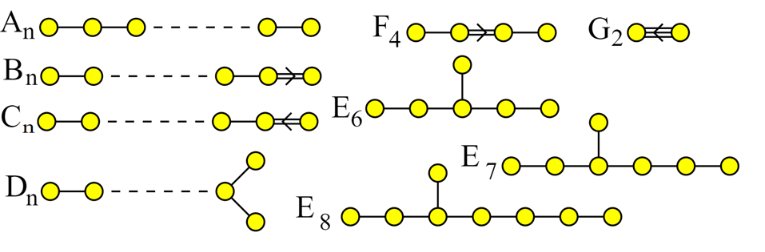
Each node on these Dynkin represent a basis vector of denoted as in which where is equal to the rank of the Lie algebra, which is clearly identical to the total amount of nodes on the Dynkin diagram.
The above all represent Lie algebras in which is a finite system of roots. Conversely by defining a root vector which is form by the negative of the sum over all , where is the Coxeter number of the root we form the following infinite dimensional algebras
Φ
α
i
i∈{1,⋯,r}
r
The above all represent Lie algebras in which
Φ
α
0
n
i
α
i
n
i
◼
Affine
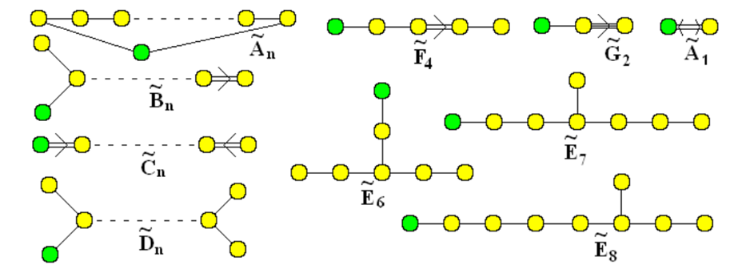
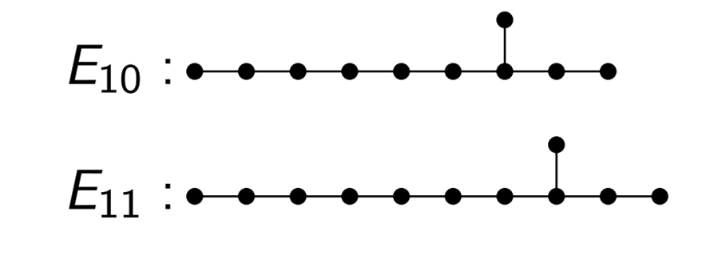
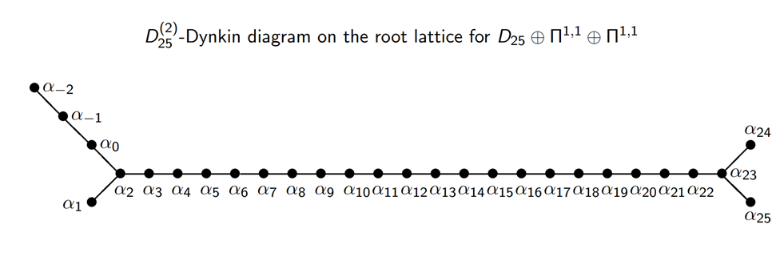
We may also define the following extension procedure in terms of the Dynkin diagram to continue this series [3]. E10, E11 and D25 below all have relevance in string theory along with other Lorentzian Kac-Moody algebras
◼
Dynkin Diagrams associated to infinite dimensional Lorentzian Kac-Moody algebras (a generalization of Lie algebras)
The vital point throughout this subsection is that all the above semisimple Lie algebras can be reconstructed entirely though their root systems as presented compactly in their Dynkin diagrams. We shall see in the next subsection how this is explicitly done through action of the Weyl group, and in turn we’ll see how this root system and the symmetry of the Lie algebra it encodes can be represented naturally as a multiway system.
Weyl Group
Weyl Group
We are almost at the position to show the results from this project, the final element before doing this is a description of the Weyl group. Simply put we may reflect in hyperplanes orthogonal to them to recover this corresponding part of the isometry group of the algebra. This is done the Weyl group’s action as follows (v)v-2α,where is the vector we are reflecting in this hyperplane. The main result here is that for a finite Lie algebra, the simple root system generates a finite from action of the Weyl group only, whereas for an infinite dimensional Lie algebra, such as the affine and Lorentzian examples above, will produce infinite dimensional and hence infinite dimensional Multiway systems. It is important to note, that in the Multiway systems produced, the initial elements are always and the rules are generated from the Weyl group elements from these simple roots.
α
i
s
α
(α,v)
(α,α)
v
Φ
Φ
α
i
Multiway Systems from Dynkin Diagrams
Multiway Systems from Dynkin Diagrams
We will now examine the results of looking at the Multiway systems from applying the action of the Weyl group to both finite and affine Dynkin diagrams. For the full list of results corresponding to the finite and affine Dynkin diagrams please download the attached notebook at the bottom of this post, which also contains full source code for the functions to reproduce these Multiway systems.
Using NestGraph we can generate the states graph of a given algebra that we know for
α
i
PA[x_,y_]:=Total[xy];(*Innerproduct*)SimpleRootsA[r_]:=Table[UnitVector[r+1,i]-UnitVector[r+1,i+1],{i,1,r}];(*Simpleroots*)W[ai_,j_]:=j-2(PA[ai,j]/PA[ai,ai])ai;(*Weylreflections*)WeylReflectionsGraph[r_,n_,options___]:=With[{simpleRoots=root@@@SimpleRootsA[r]},NestGraph[Function[reflectedRoot,root@@W[List@@#,List@@reflectedRoot]&/@simpleRoots],simpleRoots,n,options]];WeylReflectionsGraph[2,3,GraphLayout"SpringElectricalEmbedding",VertexLabelsAutomatic]
Out[]=
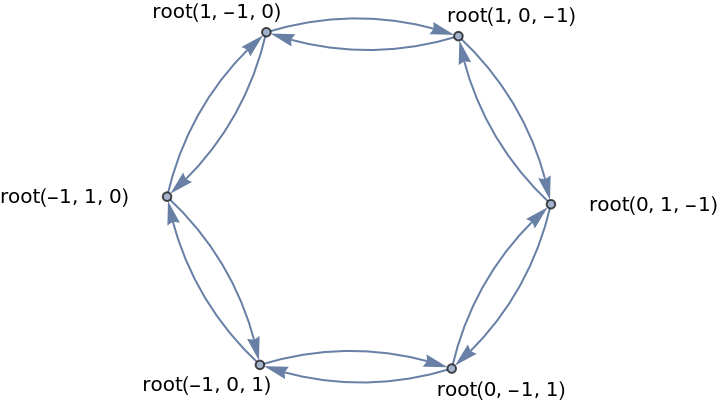
The above is a simple example of the algebra, this states graph is equivalent to the Cayley graph of the algebra. Vertex on the graph represents a root of , and the edges represent the action of the Weyl group. The fact that there are two edges coming from each vertex represents that we’re working with a rank-2 algebra, each vertex corresponding to a different generator from the Weyl group.
We can see how the following states diagram has evolved to this final state as follows
A
2
α
A
2
We can see how the following states diagram has evolved to this final state as follows
Into the Infinite
Into the Infinite
Which grows until infinite, after 13 evaluations it looks like this
But after 30 evaluations we see a larger pattern emerging
Conclusion and Future Research
Conclusion and Future Research
The research presented here constitutes the first stage in a project to examine how multiway systems may exhibit well known symmetrical structure described by the isometry groups of Lie groups and their associated Lie algebras. At the level presented above we already have the interesting results of connections between the Multiway graph and the Coxeter diagram represented as a branchial graph at certain evolution - this purely mathematical connection should be explored in more detail. However, the most interesting and fruitful future research will come from exploring the connections of these systems to physical systems. For example, representation theory of Lie algebras can explain particle patterns within the standard model, how can this description be described in terms of the above multiway systems in which encode these same algebra’s data?
The future direction of this project can be roughly split into the following three paths
The future direction of this project can be roughly split into the following three paths
◼
Physical - building theories/ exploring quantum behaviour from the models
◼
Computations - Complete the software for general root systems as a Mathematica package to be found here - https://github.com/SamWhittington/WeylMultiwaySystem
◼
Mathematical - Decompositions: What happens for natural decomposing infinite dimensional systems such as the below?
Keywords
Keywords
◼
Lie Algebras
◼
Kac-Moody algebras
◼
Symmetry
Acknowledgment
Acknowledgment
Mentor: Max Piskunov
I’d like to thank all the organises for WWS2021, especially my mentor Max for all the useful conversations we’ve had throughout.
References
References
◼
[1] Rovelli, Carlo. “Gauge is more than mathematical redundancy.” One Hundred Years of Gauge Theory. Springer, Cham, 2020. 107-110.
◼
[2] Humphreys, James E. “Representation Theory.” Introduction to Lie Algebras and Representation Theory. Springer, New York, NY, 1972. 107-144.
◼
[3] Fring, Andreas, and Samuel Whittington. “n-Extended Lorentzian Kac–Moody algebras.” Letters in Mathematical Physics (2020): 1-22.
◼
[4] Lusztig, George. “Cells in affine Weyl groups, IV.” J. Fac. Sci. Univ. Tokyo Sect. IA Math 36.2 (1989): 297-328.