An interesting phenomenon is currently taking place. For perhaps the first time in decades, mainstream media, cultural commentators, and Ivy-League academics have all been debating a classic of the Western canon: The Odyssey. This unique confluence was sparked by the release of Christopher Nolan’s newest blockbuster, which adapted the epic to the screen. The film has sparked debate about the poem--and about translation itself-- after Nolan cited Emily Wilson’s 2017 translation as one of his touchstones in production. This public discourse raises an important question that professors, readers, and students of history have been asking for generations: what makes for a good translation? Entire fields and long careers have been dedicated to exploring an answer, and it is still left open.
This cultural moment felt like a great opportunity where two of my personal interests could align: the humanities and computer science. Today, we have access to some of the most powerful computational tools, and we can use these to provide additional layers of description to text and history. So in light of this, I decided to test how the Wolfram Language could be used to compare translations and sharpen our understanding of their differences.
I have chosen to look at four different English translations of Homer’s Odyssey: Butcher & Lang’s 1879 translation (referred to as Lang in this post), Samuel Butler’s 1900 translation, Robert Fagles’ 1996 verse translation, and Emily Wilson’s 2017 work. In each of the sections that follow, I explore a different textual variable and measure how these translations stack up. My goal here is not to determine which translation is best (no number can do that), but to use a new approach in order to contribute to this ancient debate.
1 - The Emotional Arc
1 - The Emotional Arc
Our first leg of the journey explores text sentiment. The emotional register and tone across a text is a key quality that influences the character of the work, so comparing this across translations can be informative.
So how does each translation actually shape the emotional arc of the story?
Using the Classify[] function and the built-in “Sentiment” classifier in the Wolfram Language we can capture this. The operation assigns an emotional valence (positive, negative, or neutral) to each sentence, and then tracks how that valence moves across the narrative. We can also get a read on how well the functions themselves work. Since we already know The Odyssey’s emotional shape empirically, we can watch whether the computer recovers this. The alignment or misalignment of the computer’s rendering can give us an indication for how well things are working at a computational level.
Comparing Sentiment:
Comparing Sentiment:
Using the functions defined above, we can convert the outputs of Classify[Sentiment] to integers: positive = +1 negative = -1 neutral = 0We then smooth the raw sentence-by-sentence values with a moving average of radius r (each point becomes the average of itself and its r neighbours on either side; a lower r produces more local detail, a higher r yields a smoother arc). We can plot these mean values on a normalized narrative scale and get a general path of the emotional arc. Since the arc is smoothed, it will rarely reach close to +1 or -1. However, the narrative-level swings are preserved. **It is worth noting here that the Classify[“Sentiment”] model was trained on modern data. This means it will likely be more perceptive to Fagles and Wilson’s contemporary language than Butler or Lang’s older-English. For this reason, one should be careful interpreting the absolute magnitude of the data, and instead focus on the general shape of the arc (where it rises and falls).**
Here we plot the emotional valence of each translation over the entire poem, and the two most intriguing results are hidden in what the graph doesn’t show.
In[]:=
compareSentiment["full",150]
Out[]=
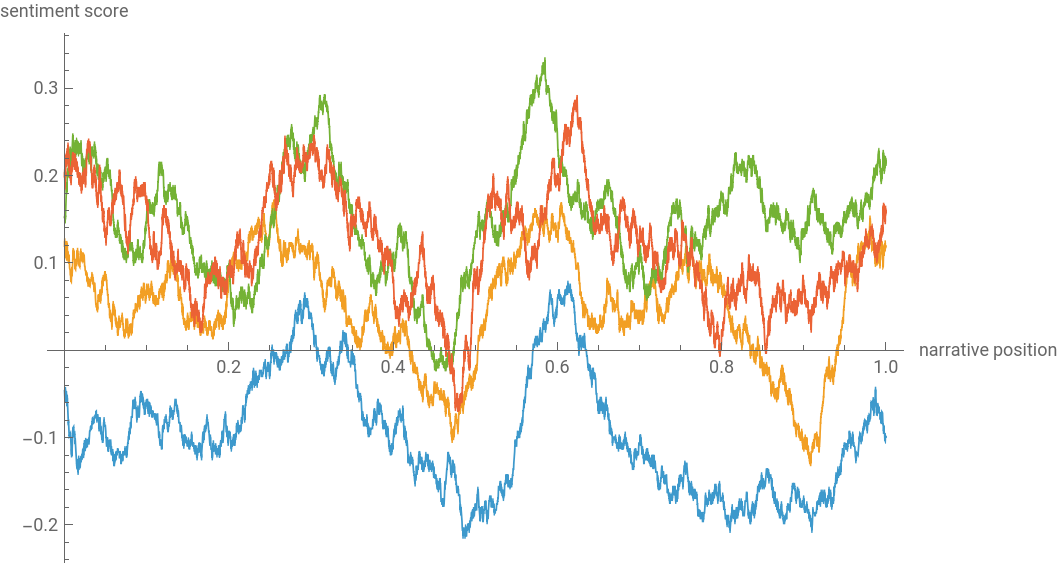


Looking at the paths of each translation, one quickly notices that they maintain essentially the same shape. This may seem to make for a boring graph, but the fact that there are few sharp differences in the trajectories brings us to our two important insights:First, it indicates that the emotional arc of The Odyssey is robust to translation. The emotional architecture is deep enough to survive, whether rendered in Lang’s Victorian prose or Fagles’ modern poetic verse. We may know this empirically, but here we can test it computationally. Second, the fact that our tool recovers a sameness that we expect is a positive control. Had the sentiment classifier picked up three wildly different arcs, we should be suspicious of the tool itself. The similarity we see across the paths is both a testament to the robustness of the story against translation and a real (but subtle) validation of the method.
2 - Stylistic Differences
2 - Stylistic Differences
We now arrive at style, another key component in any piece of writing. Interpreting style can be tricky for a computer (the concept can be pretty abstract), but by setting up proxies for style we can begin to get at an important question:
How does each translator differ in their stylistic choices?
We will examine two of these metrics in this analysis section. The first is adjective-density, which we can use as a proxy for ornateness and colour. The second is verb-noun balance, which we can use as a proxy to assess active or descriptive lean.
Adjective Density:
Adjective Density:
How much does a translation lean on modifiers to colour and elaborate its prose?
A higher adjective ratio suggests a more ornate and embellished style, while a lower one suggests plainer and more direct prose.
The adjective-density score is a simple ratio, calculated as the number-of-adjectives to the number-of-total-words. Importantly, the total word count does not include stop words (like, he, she, the, as, a) in order to provide a more accurate ratio. The average adjective-ratio is calculated across chunks of consecutive sentences, and is then plotted on a normalized narrative scale.
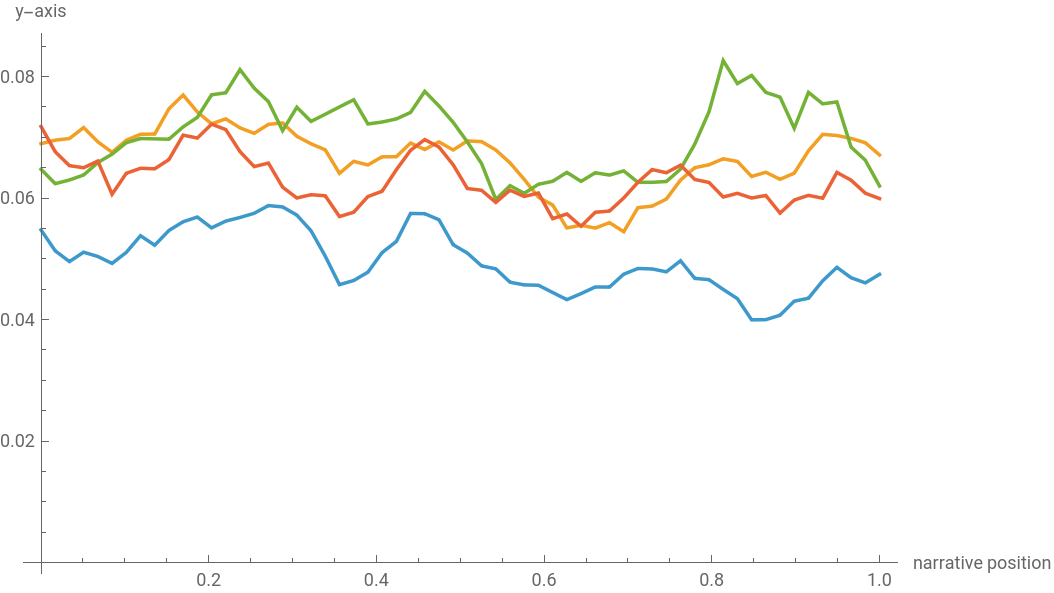
Here we model the adjective-to-total word ratio across narrative position. We can see clearly that Butler’s translation employs the least amount of adjectives and Fagles’ the most. Lang and Wilson sit somewhere in the middle and overlap throughout.
In[]:=
plotSeries[adjCache]
Out[]=


*Mean and standard-deviation of the adjective-ratio for each translation*
In[]:=
adjTable
Out[]=

That data here tells an interesting story. Once again, we notice that each of the four paths maintains a near-identical shape. This indicates that the underlying story swings between more and less ornate sections in a way that is robust to each translator’s style and creative license. For example, notice that around (0.5) on the narrative axis, all four translations drop in adjective density (this likely corresponds with Odysseus’ arrival back on Ithaca and a shift to more action around this scene).
But there are also still differences in magnitude. Fagles has the highest score with a mean of 0.07, while Butler is the very lowest with a mean of 0.049. Lang and Wilson track close to similar, with Lang’s mean score only slightly higher.
So using adjective-density as a proxy for ornateness, we can see clear differences. Fagles employs descriptive qualifiers and embellishments at an average rate ~40% higher than Butler and ~10% higher than Lang and Wilson! By this metric, Fagles’ translation is the most ornate and Butler’s the least ornate, with Lang and Wilson’s falling in the middle.
We will come back to these findings later, as they tell an important part of a bigger story.
Verb-Noun Balance:
Verb-Noun Balance:
How active is a translator’s writing? How much of a translation is doing, and how much is describing?A verb-heavy text suggests prose driven on action, while a noun-heavy text suggests prose built on description.The verb-noun balance is calculated using a simple scoring function [(verbs - nouns) / (verbs + nouns)] in order to limit the outputs to a (-1, +1) scale and easily observe the tilt of the translations. The sentence scores are binned and averaged, then plotted over a normalized narrative scale. Interpreting the results is straightforward: 0 = perfect balance > 0 = verbs outnumber nouns < 0 = nouns outnumber verbs
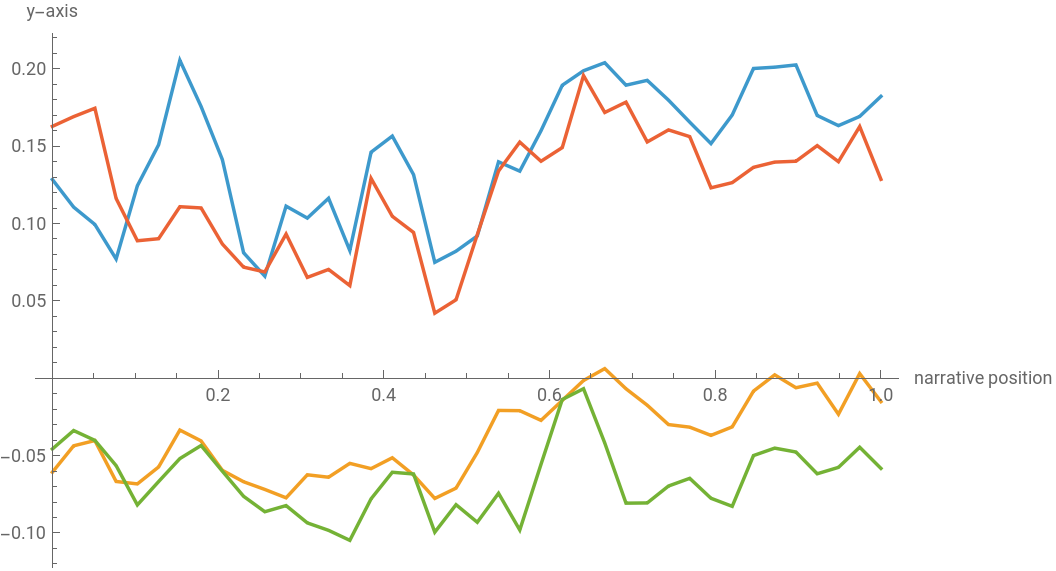
We plot this data for each translation across the narrative scale. Fagles and Lang group together as noun-heavy, while Butler and Wilson group together as verb-heavy.
In[]:=
plotSeries[vnCacheSmooth]
Out[]=
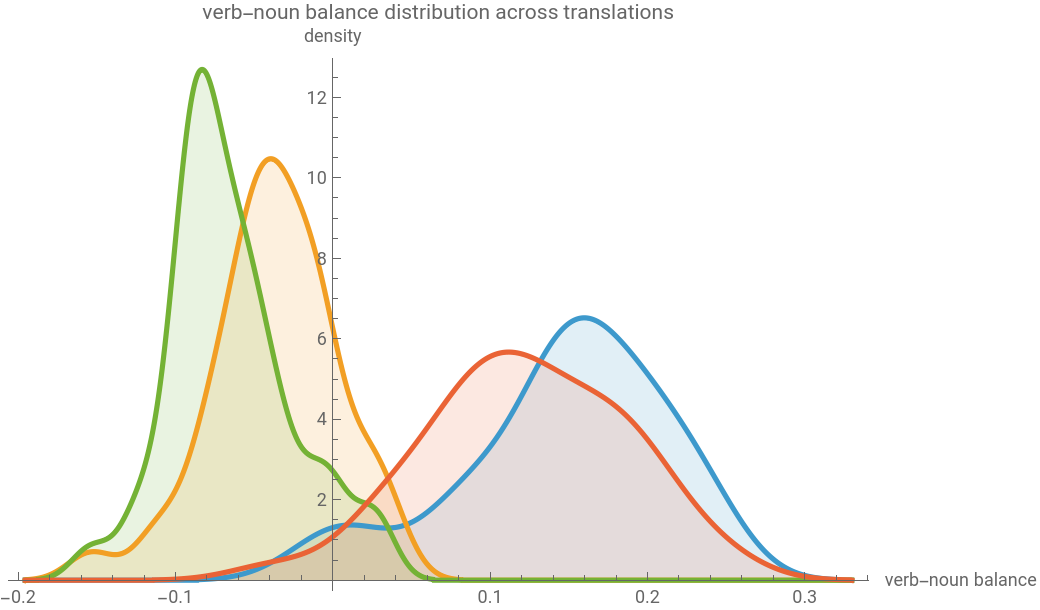
The same groupings persist when modelled as a distribution.
In[]:=
verbNounHist
Out[]=


*Mean and standard-deviation of verb-noun scores*
In[]:=
vnTable
Out[]=
In the verb-noun balance plots, we again see a familiar pattern. Dips and rises track well across translations, indicating that regardless of translator, the action we would expect from certain scenes is maintained. For example, take a look at the narrative position around (0.5): all the translations swing verb-heavy at this position. (Also notice that this is the same narrative position we saw the translations dip in their adjective density!)
The groupings in this test are much more obvious. Fagles and Lang both write noun-heavy and their sentences are also more consistent, which is shown by the distribution plot. Wilson and Butler both write verb-heavy and have a wider spread in their scores. But to get a sense for how these differences actually manifest on the page, we can pull the scores from the distributions and get direct a ratio by working backwards from our scoring function:
The groupings in this test are much more obvious. Fagles and Lang both write noun-heavy and their sentences are also more consistent, which is shown by the distribution plot. Wilson and Butler both write verb-heavy and have a wider spread in their scores. But to get a sense for how these differences actually manifest on the page, we can pull the scores from the distributions and get direct a ratio by working backwards from our scoring function:
*low ratio and high ratio calculated from converting balance scores +-1 standard-deviation from mean*
The differences are significant. For every 100 nouns, Butler will use 134 verbs on average and Wilson will use 127. Fagles will only use 88 and Lang only 93. That means compared to Fagles and Lang, Butler is using ~50% more verbs and Wilson ~40% more verbs, in order to tell the same story!
From this, we can get an indication of how each of these translators writes. Butler and Wilson prefer prose that drives the narrative forward with action, while Lang and Fagles lean more heavily on description to move the plot. A patient and attentive reader may sense this on their own, but here we can get quantitative evidence for the same stylistic difference.
From this, we can get an indication of how each of these translators writes. Butler and Wilson prefer prose that drives the narrative forward with action, while Lang and Fagles lean more heavily on description to move the plot. A patient and attentive reader may sense this on their own, but here we can get quantitative evidence for the same stylistic difference.
Continued Interpretation:
Continued Interpretation:
The more complete story emerges when these two style-metrics are taken in pair. The interesting result is that these computational findings converge with the independent observations of readers and the translators’ own stated intent.
Our results place Butler’s translation as leaning more verb-heavy and maintaining a lower adjective density throughout. Butler makes explicit that his interpretation aims to be clear, plain, and easily legible to the common English reader. He strips his prose of the Victorian flourish intentionally to accommodate shifting tastes, as one review described. Lang and Fagles are placed as near twins in both metrics, leaning noun-heavy to neutral and employing a higher concentration of adjectives and descriptive language. Lang maintains an ornate Victorian language throughout his text and defends his choice of, “a somewhat antiquated prose” in his own preface! Similarly, Fagles attempted to translate the story in modern, poetic verse, incorporating more description and ornateness as a result. Finally, Wilson is something of a mix, leaning verb-heavy and action driven, but still exhibiting adjective density and ornateness between Butler and Fagles. In her own introduction, Wilson rejects the idea that Homer “must be rendered in grand, ornate, rhetorically elevated English” and a narrative pace “that could match its stride to Homer’s nimble gallop”. But importantly, she also chose to write in iambic pentameter, a constraint which could explain why she is more ornate than Butler even though she chose a similar plain-language route.
Our results place Butler’s translation as leaning more verb-heavy and maintaining a lower adjective density throughout. Butler makes explicit that his interpretation aims to be clear, plain, and easily legible to the common English reader. He strips his prose of the Victorian flourish intentionally to accommodate shifting tastes, as one review described. Lang and Fagles are placed as near twins in both metrics, leaning noun-heavy to neutral and employing a higher concentration of adjectives and descriptive language. Lang maintains an ornate Victorian language throughout his text and defends his choice of, “a somewhat antiquated prose” in his own preface! Similarly, Fagles attempted to translate the story in modern, poetic verse, incorporating more description and ornateness as a result. Finally, Wilson is something of a mix, leaning verb-heavy and action driven, but still exhibiting adjective density and ornateness between Butler and Fagles. In her own introduction, Wilson rejects the idea that Homer “must be rendered in grand, ornate, rhetorically elevated English” and a narrative pace “that could match its stride to Homer’s nimble gallop”. But importantly, she also chose to write in iambic pentameter, a constraint which could explain why she is more ornate than Butler even though she chose a similar plain-language route.
3- Repetition and Diversity
3- Repetition and Diversity
Finally, we land on repetition and diversity.
How often does a translator reuse the same words and phrases?
This may seem like an unimportant question, but exploring it properly can give us insight into two important qualities of a translation: phrase repetition and lexical diversity.
The Homeric-tradition began orally. Bards would sing the epic from memory, and repeated phrases and formulas assisted in this method of retelling. It was from these original performances that we got our first written transcripts, and much of this repetition is still present (anyone who has read the story recently will likely recognizes phrases like “rosy-fingered Dawn” or “grey-eyed Athena” which appear again and again). So a live debate among translators of Homer is over exactly how much of this repetition should be preserved. Additionally, just as in any piece of writing, the breadth of vocabulary the author draws from affects its impression and character. By testing repetition at the scale of single words and multi-word phrases, we can get an idea of how each translator compares in both of these aspects.
Phrase Repetition:
Phrase Repetition:
How much does each translator reuse epithets and phrases?
To answer this, we use n-gram repetition as a proxy. The function we defined counts the fraction of strings of length n that are repeated, and this test looks at n-grams up to 6 words long. We plot these in a table to show the exact fraction at each n, and a visual to show the relative difference between translations, where the repeat rate is normalized by the mean of all four translations.
Of curse, Homeric formula is quite complicated and this measure is by no means perfect, but the results still contain valuable insights that can point us in the direction of deeper study:
Lang reuses phrases the most of all the translators, regardless of size. Fagles reuses short strings less than Butler, but reuses longer strings more. Wilson reuses strings of all lengths the least of all translators.
Table of exact repeat-rate for strings of size n, ranging from 1 to 6.
Again the findings here converges with the literature. Butcher & Lang deliberately modelled their English on the repetitive, formulaic cadence of the King James Bible, so their scoring highest in phrase-repetition independently recovers what the translators themselves said they would do.
However, Wilson and Butler produce some surprise. Given their plain-prose approach, we might expect them to be more repetitive than Fagles’ poetic translation, but the data here says that Butler and Wilson most aggressively rewrite Homer’s repeated phrases. A possible hypothesis is that verbatim repetition reads as clumsy in modern prose but elegant in a poetic verse, so plainness actually drives the dissolution of direct reuse and could explain the difference between these translations and Fagles’.
However, Wilson and Butler produce some surprise. Given their plain-prose approach, we might expect them to be more repetitive than Fagles’ poetic translation, but the data here says that Butler and Wilson most aggressively rewrite Homer’s repeated phrases. A possible hypothesis is that verbatim repetition reads as clumsy in modern prose but elegant in a poetic verse, so plainness actually drives the dissolution of direct reuse and could explain the difference between these translations and Fagles’.
Lexical Diversity:
Lexical Diversity:
How broad and diverse of a vocabulary does each translation employ?
Once again we can seek an answer by looking at n-gram repetition, only this time limiting n to 1. Our function samples 5, 1000-word chunks of random text from each translation and then calculates the average ratio of distinct words to total words. We perform this sampling 100 times and plot the results as a smoothed histogram.
Importantly, because we are doing analysis on a specific chunk size, we cannot interpret the outputs in absolute terms (there is some confounding between string length and repeat-rate). However, the shape and relative position of the distributions is reliable; varying chunk size still produces the same ordering of translators and the same spread, only centred on a different mean. This relative difference is very useful for us in comparing the translations at hand.
The results of the plot are fairly clear. Fagles and Wilson appear to draw on a measurably wider vocabulary, while Butler and Lang are more limited.
Fagles’ and Wilson’s distributions sit clearly apart and only exhibit any overlap with Butler and Lang at the very tail. Fagles’ and Wilson’s vocabulary appears genuinely richer from this analysis, and the separation between the translators appears larger than any noise in the model.
Continued Interpretation:
Continued Interpretation:
Phrase repetition and lexical diversity observed together can also give interesting insight into these translations.
Butler and Lang use almost the exact same size vocabulary, but Butler dissolves directly repeated phrases while Lang preserves them the most of any translator here. The same pattern is true of Wilson and Fagles, just on the higher end. Both exhibit almost-equally high lexical diversity, but Wilson dissolves verbatim repetition the most aggressively while Fagles preserves them.
This is important for two reasons. First, vocabulary and phrase repetition exist on separate axes, and one choice does not determine the other. Second, it shows that all four translations are a distinct profile, and each will render a genuinely different experience; Lang’s low lexical diversity and high repetition will read different than Wilson’s high lexical-diversity and low repetition. This gives a solid starting point to start questioning and evaluating each translation deeper.
4 - What Makes for a Good Translation?
4 - What Makes for a Good Translation?
So after all of this study, which of these translations is the best? I still cannot say.
There is no number or graph here that can tell us which translation we should read or which one is the best. But what it can do is show us how four different translators, making four different sets of choices, tell the same ancient story. It can give us a map for these differences and how they appear in the text, and it can give a new language, a precise quantitative one, for analysing them. It points us back to the text itself and to the enduring debate, but with better questions and different insights.
This exact debate is taking place right now, and uniquely, far outside of the academic circles one tends to find it. The sharp disagreement surrounding Nolan’s blockbuster and the translations that he drew on won’t be settled with any amount of computation. But perhaps it can give those having the debate, whether students, scholars, or movie-goers, a slightly sharper way to see what is actually happening on the page.
CITE THIS NOTEBOOK
CITE THIS NOTEBOOK
Computational methods for the classics: comparing translations of The Odyssey
By Eli Crowder
Wolfram Community, STAFF PICKS, August 21, 2026
https://community.wolfram.com/groups/-/m/t/3785551
By Eli Crowder
Wolfram Community, STAFF PICKS, August 21, 2026
https://community.wolfram.com/groups/-/m/t/3785551