Aquatic foods are featured in culinary traditions around the world. Also known as “blue foods,” they include aquatic animals, plants and algae. My focus here is on sea vegetables (the preferred name for seaweed in culinary nomenclature) and a few bivalves (clams, mussels and oysters). Food safety is a priority for me and most consumers when buying and preparing aquatic foods. That’s why we introduced . instructs the LLM to act as the food safety manager at a high-profile restaurant. The LLM reviews recipes according to the U.S. FDA’s Hazard Analysis and Critical Control Point (HACCP) guidelines. An important step in the HACCP process is to identify critical control points (CCPs). These are specific steps in the production or processing of food where control can be applied to prevent, eliminate or reduce food safety hazards. With , the LLM reviews your recipe, and the Wolfram Language returns the recipe with the food safety risks highlighted and explained.
Sea Vegetables
Sea Vegetables
Magnesium is an important mineral in muscle and nerve function, as well as bone and heart health. I knew that nuts are a good source of magnesium, but I was surprised to discover that sea vegetables contain comparable amounts:
In[]:=
seaVegNames={"dulse","kombu","nori","kelp seaweed","irishmoss seaweed"};seaVegInterpret=AssociationThread[seaVegNames,Map[Interpreter["Food"][#]&,seaVegNames]];magnesDataSeaVeg=;magnesDataSeaVegSorted=SortBy[magnesDataSeaVeg,#["RelativeMagnesiumContent"]&];seaVegLabels=Keys[magnesDataSeaVegSorted];seaVegChart=BarChart;nutNames={"almonds","Brazil nuts","cashews","peanuts"};nutInterpret=AssociationThread[nutNames,Map[Interpreter["Food"][#]&,nutNames]];magnesDataNuts=;magnesDataNutSorted=SortBy[magnesDataNuts,#["RelativeMagnesiumContent"]&];nutLabels=Keys[magnesDataNutSorted];nutChart=BarChart;GraphicsRow[{seaVegChart,nutChart},ImageSize->800]
Out[]=
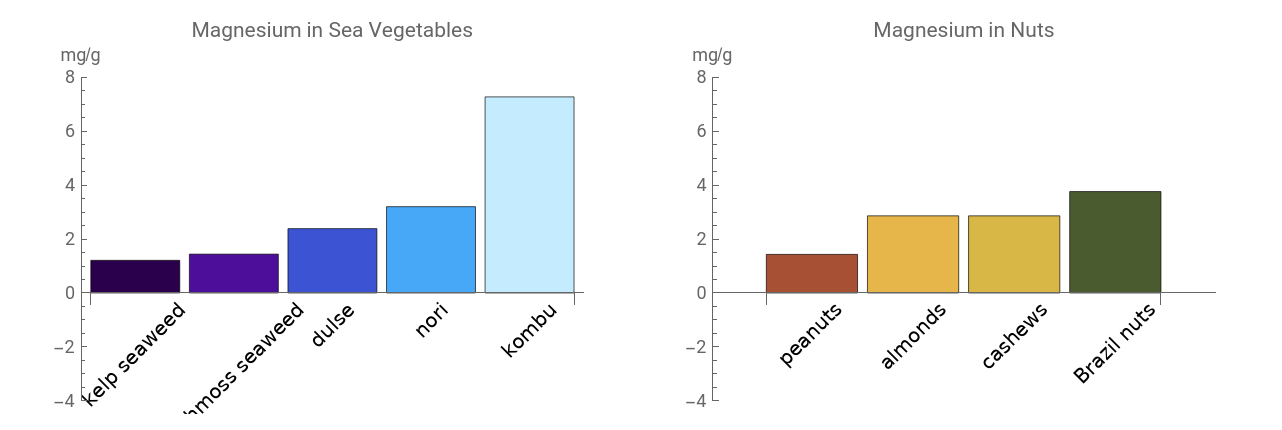
There are three major types of seaweed: red algae, brown algae and green algae. Porphyra and Pyropia, each a genus of red algae, are used to produce nori (in Japanese cuisine) and gim (in Korean cuisine). Palmaria palmata, commonly known as dulse, also is a red algae. Dried dulse flakes can be sprinkled over salads or soups as a flavorful garnish.
In[]:=
redAlgae=Interpreter["Species"][{"porphyra","pyropia","palmaria palmata"}];EntityValue[redAlgae,{"Phylum","Genus"},"PropertyAssociation"]//
Out[]=
Phylum | Genus |
Nori-Wrapped Salmon Rolls
Nori-Wrapped Salmon Rolls
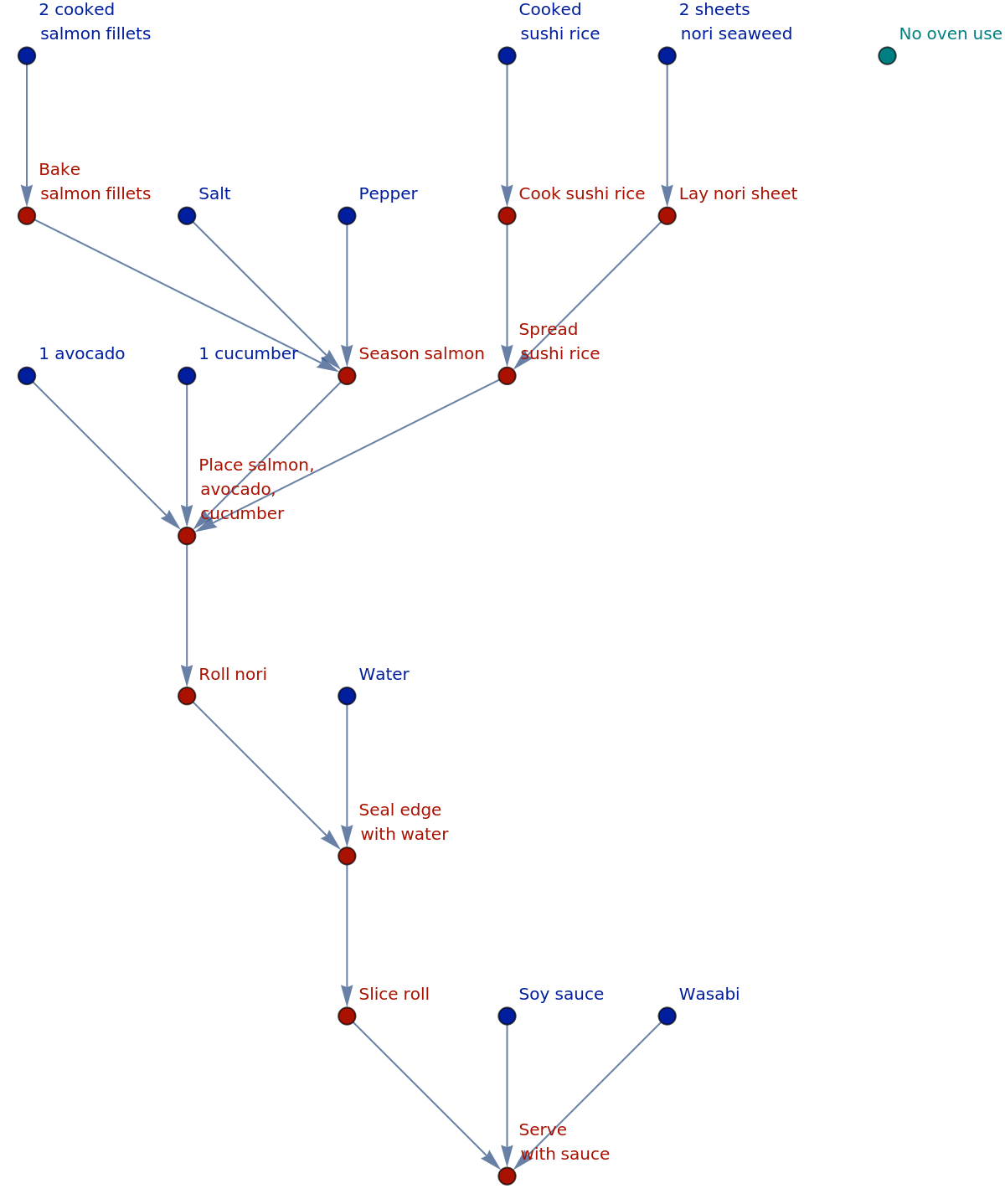
Turning to recipes with sea vegetables, I used to visualize the preparation of these nori-wrapped salmon rolls:
In[]:=
Out[]=
Bivalves
Bivalves
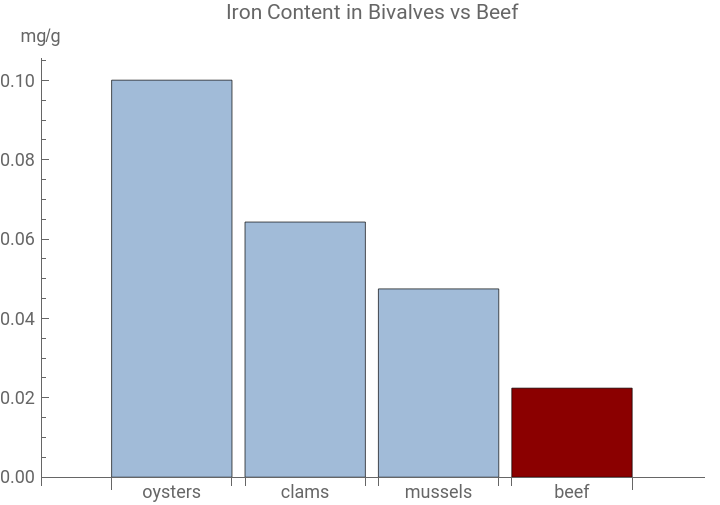
Bivalves are a type of mollusk that have two hinged shells. Bivalves are rich in vitamins, minerals and protein. In fact, mussels, clams and oysters contain more iron per gram than red meat. I used the Wolfram Language to illustrate this surprising fact:
In[]:=
bivalvesAndBeefNames={"clams","mussels","oysters","beef"};bivalvesAndBeefInterpret=AssociationThread[bivalvesAndBeefNames,(Interpreter["Food"][#1]&)/@bivalvesAndBeefNames];ironData=;ironDataSorted=ReverseSortBy[ironData,#["RelativeIronContent"]&];bivalveLabels=Keys[ironDataSorted];customColors=;BarChartironDataSorted,
Out[]=
Clam Chowder
Clam Chowder
I used to advise on safely preparing clam chowder with fresh clams:
In[]:=
Oysters on the Half Shell
Oysters on the Half Shell
CITE THIS NOTEBOOK
CITE THIS NOTEBOOK
Under the sea: nutrition and recipe risk analysis of aquatic foods
by Gay Wilson
Wolfram Community, STAFF PICKS, May 9, 2024
https://community.wolfram.com/groups/-/m/t/3173360
by Gay Wilson
Wolfram Community, STAFF PICKS, May 9, 2024
https://community.wolfram.com/groups/-/m/t/3173360