Introduction
Introduction
One of the great dreams of modern science, mathematics, and computation is a complete Theory of Everything (TOE): a theory that describes the fundamental structure of reality and, in principle, allows the evolution of the universe to be computed from its initial conditions. Achieving this would be an extraordinary intellectual milestone.
But it immediately raises a deeper question. At the most fundamental level, conscious beings seek to move away from suffering and toward happiness, well-being, or fulfillment. If conscious life is part of the universe, should a truly complete theory also help us understand how such trajectories are possible, including the possibility of collective human flourishing?
Ancient spiritual philosophies address precisely these questions. The Upaniṣads, in particular, make far-reaching claims about the nature of reality, consciousness, liberation, and the conditions for a peaceful and fulfilled life. Are these merely philosophical speculations, or could they somehow capture consequences of the same deeper reality that a future Theory of Everything would describe mathematically?
This essay explores that possibility.
The growth of scientific theories
The growth of scientific theories
A Theory of Everything (TOE) is usually understood as a final, coherent physical framework in which all fundamental interactions and all fundamental entities arise from one common set of principles.
A useful way to understand the growth of science is to see each successful theory as a limited case of a deeper and broader theory. Schematically, we may write scientific theories as:
T
1
T
2
T
3
Here ⊂ means that is recovered from under suitable limiting conditions, approximations, or boundary assumptions.
T
1
T
2
T
1
T
2
For example,
Newtonianmechanics⊂Relativisticmechanics
Newtonian mechanics works extremely well when velocities are much smaller than the speed of light, v ≪ c, and gravitational fields are weak. But when velocities become comparable to , or when gravity becomes very strong, Newtonian physics reveals its limitations and has to be replaced by special and general relativity.
c
For a particle of rest mass m moving at speed v, special relativity gives the kinetic energy below, where c is the speed of light and :
0<=v<c
K=m-1
2
c
1
1-
2
v
2
c
Expanding this expression about reveals the Newtonian formula as its leading term:
v=0
In[]:=
kineticEnergy=m-1;Series[kineticEnergy,{v,0,5}]
2
c
1
1-
2
v
2
c
Out[]=
m
2
v
2
3m
4
v
8
2
c
6
O[v]
The first term is the familiar Newtonian kinetic energy. The next term is a relativistic correction. Its ratio to the Newtonian term is , which is small when v is much smaller than c. Alternatively, we can take the formal limit while holding m and v fixed:
3v^2/(4c^2)
c->Infinity
In[]:=
Limit[kineticEnergy,c∞,Assumptionsm>0&&v∈]
Out[]=
m
2
v
2
In this example, the broader theory both recovers the older formula and identifies the corrections that delimit its usefulness.
Similarly,
Geometricaloptics⊂Waveoptics⊂Maxwellianelectromagnetism
Geometrical optics treats light as rays, but this is only an approximation valid when the wavelength of light is very small compared with the objects it interacts with. Wave optics explains diffraction and interference, while Maxwell’s theory goes deeper by identifying light itself as an electromagnetic wave.
Another example is:
Classicalthermodynamics⊂Statisticalmechanics
Thermodynamics speaks of pressure, temperature, entropy, and heat at the macroscopic level. Statistical mechanics explains these quantities as collective behavior arising from enormous numbers of microscopic particles.
Likewise,
Classicalelectrodynamics⊂Quantumelectrodynamics
Classical electrodynamics describes electromagnetic fields as continuous classical fields. Quantum electrodynamics goes deeper by treating electromagnetic interactions in terms of quantum fields, photons, virtual processes, and probability amplitudes.
Thus, scientific progress often has the structure
()⊂()⊂()⊂⋯
T
1
T
2
T
3
where denotes the domain of phenomena explained by theory . Each new theory enlarges the domain of explanation. It also explains why the earlier theory worked, why it failed outside its proper range, and what hidden assumptions were being made.
()
T
i
T
i
In this sense, a deeper theory often absorbs the older theory, places it in context, and reveals the boundary of its validity. This is the sense in which Newtonian physics becomes a limiting sector of relativity, classical physics becomes a limiting sector of quantum physics, and any future Theory of Everything would be expected to contain our present theories as approximate shadows of a more complete structure.
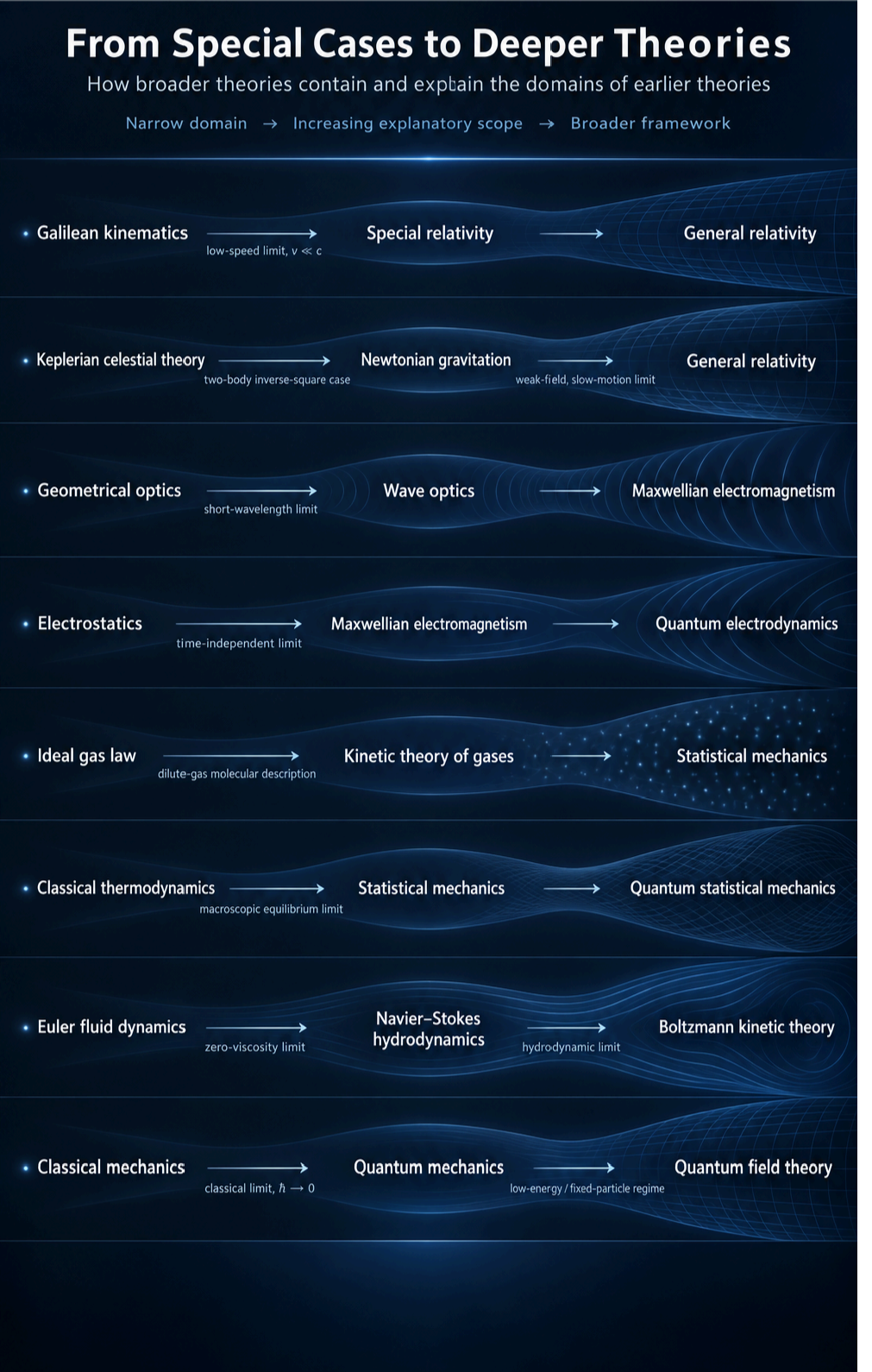
Figure 1: Earlier physical theories as limiting cases of broader frameworks.
Current unification theories
Current unification theories
If the history of science is a sequence of increasingly broader theories, a natural question arises: Can this sequence eventually terminate in one framework that contains all known physical theories? A successful unification theory would not merely place gravity, quantum mechanics, electromagnetism, and particle physics side by side. It would explain why each of them appears in a particular range of scales, energies, and conditions, and how their familiar equations emerge as approximations of a deeper structure.
Schematically, the goal is something like:
fundamental
limits,approximations,coarsegraining
⟶
1
2
3
initialandboundarydata
⟶
If such a framework were made mathematically complete and computationally usable, it could in principle generate the effective laws needed at every level. At very high energies it might produce quantum gravity; at lower energies it might reduce to the Standard Model; at larger scales it could yield atomic physics, chemistry, thermodynamics, fluid dynamics, and the ordinary mechanics of daily life. The motion of a planet, the flow of air, the operation of an electronic device, and the behavior of matter would then be different computational sectors of the same underlying theory.
The modern approaches discussed in this section pursue this goal in very different ways. None has yet become a complete and experimentally confirmed Theory of Everything, but each explores a possible route toward the same grand objective: a unified structure from which the known laws of nature can be derived, scaled, and ultimately computed.
1. String theory and M-theory
1. String theory and M-theory
String theory proposes that the smallest objects in nature are tiny vibrating strings rather than dimensionless points. Different patterns of vibration appear as different particles, much as different notes can come from the same musical string. One vibration behaves like the graviton, the hypothetical quantum particle of gravity, while others can correspond to particles and force fields. M-theory is conjectured to provide a deeper framework relating the five superstring theories. Together, string theory and M-theory can place gravity and particle physics within a single mathematical structure. The main difficulty is that they allow an enormous number of possible ways to compactify the extra dimensions, with no unique choice yet known to reproduce our universe. They nevertheless remain the most developed broad framework for combining quantum gravity with the other fundamental forces. [1]
2. Loop quantum gravity
2. Loop quantum gravity
Loop quantum gravity begins with Einstein’s idea that gravity is the geometry of spacetime. It then asks whether space itself may be made of tiny quantum units rather than being perfectly smooth. These units are represented by networks of links and nodes called spin networks. In this picture, areas and volumes can occur only in certain discrete amounts, somewhat like the fixed energy levels of an atom. The changing history of a spin network is described by a structure called a spin foam. It has produced interesting ideas about black holes and the early universe, including models in which the Big Bang singularity is replaced by a quantum bounce. Its main limitation is that it quantizes gravity but does not automatically unite gravity with all the forces of the Standard Model. [2]
3. Asymptotic safety
3. Asymptotic safety
Asymptotic safety asks whether gravity can remain an ordinary quantum field theory even at extremely high energies. The usual problem is that calculations in quantum gravity produce more and more uncontrollable infinities. This approach suggests that the strength of gravity may settle into a stable pattern as the energy becomes very large. At that stable point, the theory would no longer generate endlessly new and independent parameters. Only a finite amount of experimental information might then be needed to determine the complete high-energy theory. Asymptotic safety may provide a consistent quantum theory of gravity and matter, but it does not by itself explain why all forces should be parts of one unified structure. [3]
4. Noncommutative geometry
4. Noncommutative geometry
Noncommutative geometry tries to describe gravity and the Standard Model as two parts of one generalized geometry. Ordinary geometry describes the familiar four-dimensional spacetime in which we live. The theory adds a very small internal geometrical space to every point of ordinary spacetime. The combined space is written schematically as
totalgeometry=ordinaryspacetime×internalgeometry
The ordinary part describes gravity, while the internal part helps encode particles, forces, and the Higgs field. In this picture, some features of particle physics arise from geometry instead of being inserted as unrelated ingredients. The approach has successfully reproduced much of the mathematical form of the Standard Model coupled to gravity. However, it has not yet supplied a complete and experimentally confirmed quantum theory of gravity. [4]
5. The Wolfram physics project
5. The Wolfram physics project
The Wolfram Physics Project proposes that the universe may grow from very simple computational rules. Its starting point is a network of abstract elements and connections, called a hypergraph. A rule repeatedly replaces one small part of the network with another,
H
t
H
t+1
The large-scale network produced after many updates is interpreted as physical space. The causal relations among the updates may generate the structure that we experience as spacetime. When several updates are possible, all of the possible histories form a branching multiway system, which the project connects with quantum mechanics. A condition called causal invariance requires different allowed update orders to lead to the same large-scale causal structure. The hope is that relativity, quantum mechanics, particles, and forces may all emerge from the behavior of one simple underlying rule. The model can be explored directly through computation and Wolfram Language. It has not yet derived the full and exact Standard Model, selected a unique rule for our universe, or produced decisive experimental predictions, but it offers a distinctive computational approach to fundamental physics. [5]
Other important approaches include causal set theory, causal dynamical triangulations, group field theory, twistor theory, and causal fermion systems. Although these programs begin from very different mathematical ideas, they share the same broad ambition: to recover all known physical theories as limiting or effective descriptions of one deeper framework. In its strongest form, the goal is not merely to explain the laws of nature, but to make the entire hierarchy of physical behavior, from fundamental interactions to everyday phenomena, systematically computable. [6]
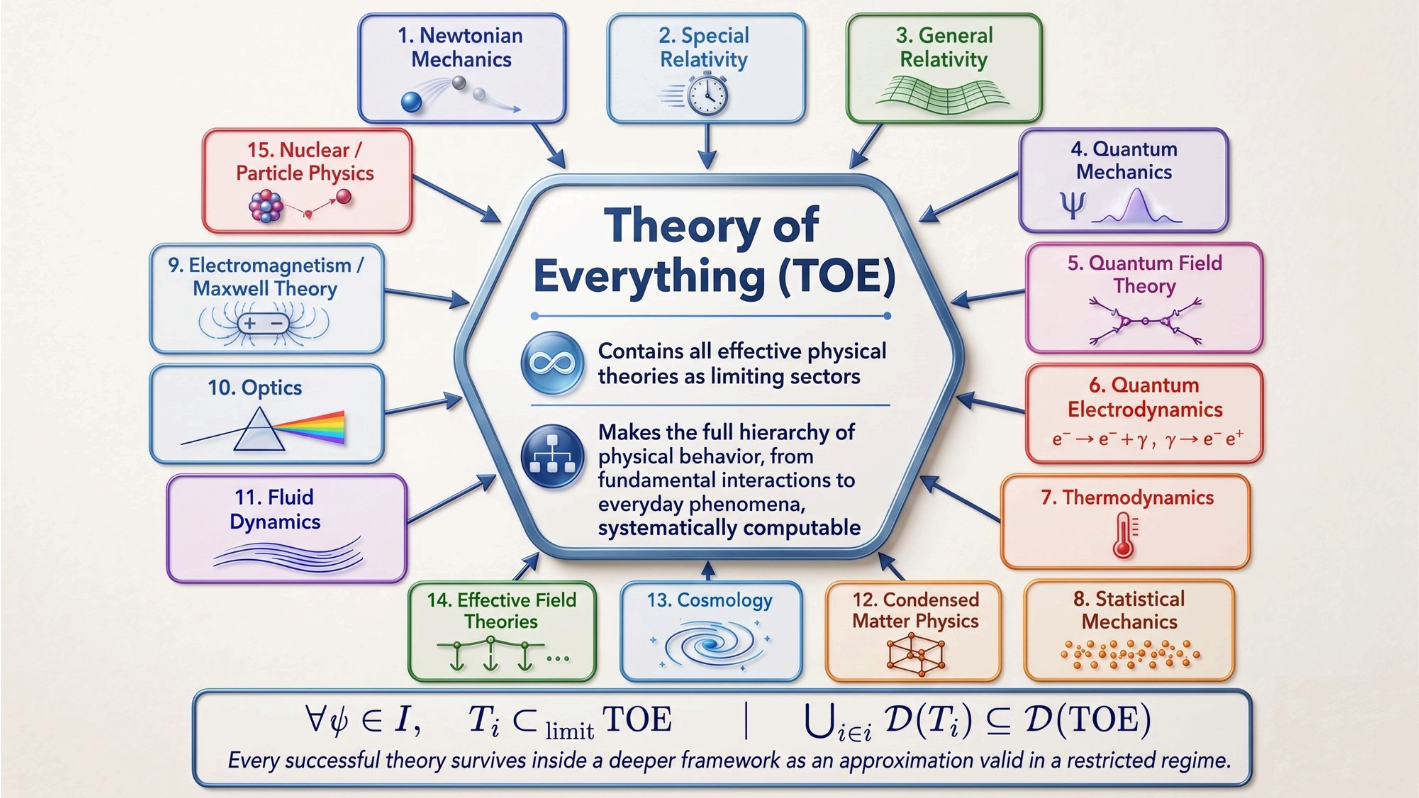
Figure 2: A Theory of Everything as a unifying framework containing established physical theories as limiting sectors.
Extending the state space to conscious agents
Extending the state space to conscious agents
Current unification programs aim primarily at physical all-inclusiveness. They seek a common framework for particles, fields, forces, spacetime, quantum theory, and gravitation, so that every physical structure arises within one coherent formal system. This is an essential goal, but it is not yet all-inclusiveness in the strongest sense.
The universe contains not only physical structures, but also conscious agents: human beings, birds, other animals, and, more generally, every conscious life form capable of experiencing its surroundings and acting within them. Such agents do not merely undergo physical evolution; through their actions they alter experiments, boundary conditions, ecosystems, technologies, and historical outcomes. A theory that unifies all physical structures while leaving conscious agency outside its explanatory domain may therefore be physically comprehensive, yet still ontologically incomplete.
A genuinely all-inclusive Theory of Everything must include both the physical world and the conscious agents embedded within it.
A Theory of Everything is usually imagined as a final law of evolution for the universe. In its most compressed form, it may be written as
However, most scientific theories are not used in this absolute form. They are used conditionally:
A formal definition of an agent
A formal definition of an agent
The set of all agents is therefore
The degree of rationality, linguistic ability, self-reflection, or freedom may differ greatly between species of life, but these differences concern the complexity of agency, not the basic presence or absence of agency.
An agent does not merely occupy the physical state of the universe. Through action, it can modify the effective conditions under which that state evolves. A more complete dynamical structure is therefore
For several agents acting simultaneously, the total intervention may be represented by
where the aggregation map Φ allows the actions of different agents to reinforce, oppose, coordinate with, or constrain one another.
Examples
Examples
The falling apple
The falling apple
Suppose an apple falls from a tree. A local mechanical model predicts its motion by
Consider an apple released from rest three meters above the ground. We neglect air resistance and take the gravitational acceleration to be 9.81 meters per second squared. In one scenario, the apple reaches the ground and remains there. In the other, a child catches it at a height of 1.2 meters and holds it there. Both scenarios use the same mechanical framework. They differ in the contact conditions included in the model.
We represent contact by an idealized event: the velocity is set to zero, and a supporting force then balances gravity. The variable supported switches from 0 to 1 at contact. NDSolveValue evolves the equations, while WhenEvent applies this change. All numerical heights and times below are in meters and seconds.
The physical law remains valid, but it does not by itself determine the actual event unless the agent and the intervention are included.
Figure 3: An agent's intervention changes the outcome without invalidating the underlying physical law.
Quantum measurement
Quantum measurement
Quantum mechanics predicts probabilities relative to a chosen experimental setup:
If the agent chooses a different measurement basis or apparatus, the probability distribution changes. The theory remains correct, but it is conditional on an agent-selected setup. A final TOE cannot merely predict what happens after the measurement context is fixed; it must also include the agent who fixes it.
Climate evolution
Climate evolution
Atmospheric physics may describe how greenhouse gases affect temperature, but the actual future climate also depends on the coordinated actions of conscious agents. Schematically, [7]
Thus, physical laws define a space of possible trajectories, while the coordinated actions of conscious agents help select which trajectory becomes actual.
Completeness of a TOE
Completeness of a TOE
A non-agentic TOE may be represented schematically as
whereas an agent-embedded TOE requires the richer structure
The issue of free will enters naturally at this point. If free will is real, then an agent's action is not reducible to the prior physical state alone and becomes a genuine causal input into the unfolding of the world. If free will is denied, the TOE must still explain how conscious experience, beliefs, intentions, values, and decisions arise from physical states and produce action. In either case, conscious agents cannot be ignored.
Therefore, agent embedding is not a sentimental addition to physics. It follows from the logic of prediction. Scientific theories often work by fixing the agent, excluding the agent, or treating the agent as an external boundary condition. A true Theory of Everything cannot do this finally. It must include conscious life within the everything it claims to describe.
Must predict the purpose
Must predict the purpose
A satisfactory Theory of Everything should not merely reproduce the physical structure of the universe; it should also be capable of accounting for the possible trajectories of conscious agents within it. Conscious experience has an evaluative dimension: states can be experienced as suffering, dissatisfaction, fulfillment, peace, or well-being. Conscious agents therefore have reasons to move away from persistently adverse states and toward conditions in which their existence becomes increasingly coherent, wholesome, and satisfying. A complete theory should be able to explain how such trajectories are possible and what principles govern them.
This does not require the theory to predict that the universe will automatically evolve toward universal happiness. Physical evolution may permit conflict, suffering, disorder, and many other outcomes. The stronger and more useful requirement is that, when the theory is simulated under appropriately chosen initial conditions and interventions, it should admit realizable trajectories in which conscious agents can progressively approach stable and mutually compatible forms of well-being.
Figure 4: A complete Theory of Everything should encompass physical structure, possible conscious trajectories, and realizable paths toward flourishing.
Philosophies as embeddings
Philosophies as embeddings
Many of the world’s major spiritual philosophies appear to point conscious life in a similar direction: away from suffering, uncontrolled desire, fear, selfishness, and conflict, and toward peace, compassion, liberation, and fulfillment.
Sanātana Dharma is especially interesting in this context because of the Upaniṣads, the philosophical culmination of the Vedic tradition and a foundation of Vedānta. They ask questions closely related to those of a Theory of Everything: What is ultimate reality? What is the Self? What is the relation between consciousness and reality? And what follows when that reality is understood?
A recurring Upaniṣadic theme is that deeper knowledge of reality transforms conscious existence. The Bṛhadāraṇyaka Upaniṣad 1.3.28 prays:
“असतो मा सद्गमय । तमसो मा ज्योतिर्गमय । मृत्योर्माऽमृतं गमय ।”
“Lead me from the unreal to the real, from darkness to light, from death to immortality.” [8]
The Īśa Upaniṣad connects insight into unity directly with freedom from suffering:
“तत्र को मोहः कः शोक एकत्वमनुपश्यतः”
“For one who sees unity, what delusion, what illusion or anxiety can remain?” (Īśa Upaniṣad 7) [9]
The Kaṭha Upaniṣad speaks of “lasting peace,” while the Taittirīya Upaniṣad associates realization of Brahman with bliss and freedom from fear. The Bhagavad Gita similarly describes realized sages as “सर्वभूतहिते रताः” (sarvabhūtahite ratāḥ), devoted to the welfare of all beings. [10-12]
Other traditions develop their own rich and distinct accounts of the nature of reality, the human condition, and the ultimate goal of life. Buddhism places the problem of suffering at the center of its analysis and describes a path toward its cessation; the Dhammapada 204 calls contentment the greatest wealth and Nibbāna (Sanskrit: Nirvāṇa) the highest bliss. Christianity places love, reconciliation, and communion with God at the heart of spiritual life; Jesus’ teaching “Blessed are the peacemakers” is one concise expression of that orientation. Islam likewise develops a comprehensive vision of submission to God, moral life, and ultimate fulfillment; Qur’an 13:28 states that hearts find peace in the remembrance of God. Thus, each contains a developed account of how conscious life can move away from suffering, disorder, alienation, or conflict and toward a more peaceful, fulfilled, and harmonious state. [13-15]
What an embedding would mean
What an embedding would mean
A spiritual philosophy might be understood as an embedding of a deeper Theory of Everything. By this I do not mean that it contains the full theory in disguised form. A complete TOE may describe an enormous underlying structure: physical law, consciousness, causation, possible histories, and the relations among all of these. A philosophy could preserve only a small but crucial part of that structure, namely the part relevant to conscious life.
Such an embedding would therefore not need to reproduce the mathematics of the underlying theory. It would need to preserve some of its important consequences: what kinds of states conscious beings can occupy, which transformations move them toward suffering or well-being, how their actions affect other conscious beings, and whether there exist stable trajectories toward liberation, peace, or fulfillment. In this sense, the philosophy would be a compressed representation of the larger reality, preserving the features most important for guiding conscious existence.
A precise mathematical example is provided by Markov-chain lumping: under suitable conditions, grouping detailed states gives a smaller Markov model that remains valid for every initial distribution. Consider the following constructed four-state system. The entry in row i and column j of micro is the probability of moving from state i to state j in one step. We observe only the group containing the state: A = {1, 2} or B = {3, 4}. The matrix projection adds the probabilities within each group. The matrix macro is the proposed two-state transition model.
From either state in A, the probability of remaining in A is 3/4. From either state in B, the probability of moving into A is 1/4. Thus the next-group probabilities do not depend on the hidden distinction between states within the same group. The essential consistency check is:
This equality says that two procedures agree: first evolve the full system and then group its states, or first group its states and then evolve the smaller system. Repeated multiplication gives P^n C = C Q^n for every nonnegative integer n. The line in the plot comes from the grouped four-state model; the markers come from the two-state model. They coincide.
This illustrates the mathematical possibility behind the proposed philosophical analogy: a partial description might preserve selected consequences of a deeper reality without reproducing its full structure.
The Upaniṣads are particularly interesting from this perspective because they connect their account of how one should live with claims about what reality ultimately is. Peace, freedom from fear, unity, and liberation are not presented merely as desirable moral ideals. They are described as consequences of seeing the Self, other beings, and ultimate reality correctly. If those claims reflect genuine features of the underlying structure of reality, then the Upaniṣadic worldview could be interpreted as preserving, in philosophical form, some of the consequences that a deeper TOE would eventually have to explain.
Figure 5: Philosophical traditions as partial embeddings of a deeper reality, guiding conscious life toward flourishing.
How could such knowledge arise?
How could such knowledge arise?
This raises a natural question: how could a philosophy contain correct consequences of a TOE without its human originator first discovering the complete theory?
In many theistic traditions, the internal answer is revelation from a being known as God. If God is defined as omniscient, then God knows every fact about reality and therefore, in the terminology of this essay, possesses the complete TOE. A human teacher would not need to receive that entire structure, only the part relevant to conscious life.
A child need not understand electromagnetism, physiology, and electrical engineering to benefit from the instruction, “Do not touch that exposed wire.” A small piece of knowledge can preserve a practically crucial consequence of a much deeper theory.
Likewise, a philosophy could in principle preserve important consequences of the structure of reality without containing the complete structure itself.
This does not establish that any revelation is genuine, that an omniscient God exists, or that any particular philosophy is such an embedding. The narrower point is that humanity need not first discover the complete mathematical TOE before possessing reliable knowledge about the direction of conscious life. Ancient spiritual traditions may therefore be worth examining not as primitive physical theories, but as possible claims about the part of reality most directly relevant to conscious existence.
Closing remarks
Closing remarks
In this essay, I have explored a possible connection between a future Theory of Everything and the philosophical insights of the Upaniṣads, with similar questions also appearing in other spiritual traditions. The central suggestion is that such philosophies may be understood as embeddings of certain consequences of a deeper Theory of Everything: not complete descriptions of reality, but partial maps of the aspects most relevant to conscious life.
If this perspective is even partly correct, then discovering these life-relevant consequences may be as important as discovering the complete mathematical theory itself. A Theory of Everything may tell us what reality is and how it evolves; its deepest significance for conscious beings may lie in revealing how life can move away from suffering and toward lasting, mutually compatible flourishing.
In that sense, the search for a Theory of Everything and the ancient search for how to live may ultimately be two approaches to different parts of the same underlying reality.
References
References
[1] Joseph Polchinski, String Theory, Vols. 1 and 2 (Cambridge University Press, 1998). https://doi.org/10.1017/CBO9780511816079; https://doi.org/10.1017/CBO9780511618123.
[2] Abhay Ashtekar and Jerzy Lewandowski, "Background Independent Quantum Gravity: A Status Report," Classical and Quantum Gravity 21 (2004), R53-R152. https://doi.org/10.1088/0264-9381/21/15/R01.
[3] Martin Reuter, "Nonperturbative Evolution Equation for Quantum Gravity," Physical Review D 57 (1998), 971-985. https://doi.org/10.1103/PhysRevD.57.971.
[4] Ali H. Chamseddine, Alain Connes, and Matilde Marcolli, "Gravity and the Standard Model with Neutrino Mixing," Advances in Theoretical and Mathematical Physics 11 (2007), 991-1089. https://doi.org/10.4310/ATMP.2007.v11.n6.a3.
[5] Stephen Wolfram, "A Class of Models with the Potential to Represent Fundamental Physics," Complex Systems 29, no. 2 (2020), 107-536. https://doi.org/10.25088/ComplexSystems.29.2.107.
[6] Daniele Oriti, ed., Approaches to Quantum Gravity: Toward a New Understanding of Space, Time and Matter (Cambridge University Press, 2009). https://doi.org/10.1017/CBO9780511575549.
[7] IPCC, Climate Change 2023: Synthesis Report, Core Writing Team, H. Lee and J. Romero, eds. (Geneva: Intergovernmental Panel on Climate Change, 2023). https://doi.org/10.59327/IPCC/AR6-9789291691647.
[8] Brihadaranyaka Upaniṣad 1.3.28, "The Prana: Its Glories and Redeeming Power," Wisdom Library. https://www.wisdomlib.org/hinduism/book/the-brihadaranyaka-upanishad/d/doc117898.html.
[9] A. C. Bhaktivedanta Swami Prabhupada, Sri Isopanisad, Mantra 7, Bhaktivedanta Vedabase. https://vedabase.io/en/library/iso/7/.
[10] Katha Upaniṣad 2.2.13, trans. S. Sitarama Sastri, Wisdom Library. https://www.wisdomlib.org/hinduism/book/katha-upanishad-shankara-bhashya/d/doc145250.html.
[11] Taittiriya Upaniṣad 2.7-2.9, trans. A. Mahadeva Sastri, Wisdom Library; see "Brahman the Source of Joy" and "Who Attains Brahman?" https://www.wisdomlib.org/hinduism/book/the-taittiriya-upanishad/d/doc79838.html; https://www.wisdomlib.org/hinduism/book/the-taittiriya-upanishad/d/doc79840.html.
[12] A. C. Bhaktivedanta Swami Prabhupada, Bhagavad-gita As It Is 5.25, Bhaktivedanta Vedabase. https://vedabase.io/en/library/bg/5/25/.
[13] Dhammapada 204, trans. Ven. Weagoda Sarada Maha Thero, Wisdom Library. https://www.wisdomlib.org/buddhism/book/dhammapada-illustrated/d/doc1084416.html.
[14] Matthew 5:9, New Revised Standard Version. https://bible.oremus.org/?passage=Matthew+5%3A9-10&version=nrsv.
[15] Qur'an 13:28, trans. M. A. S. Abdel Haleem, The Qur'an: A New Translation (Oxford University Press, 2004). https://quran.com/13/28?translations=85.
CITE THIS NOTEBOOK
CITE THIS NOTEBOOK
TOE and the Upaniṣads: can a Theory of Everything explain life?
by Jayanta Phadikar
Wolfram Community, STAFF PICKS, September 29, 2026
https://community.wolfram.com/t/28217
by Jayanta Phadikar
Wolfram Community, STAFF PICKS, September 29, 2026
https://community.wolfram.com/t/28217