TESTING POST: https://community.test.wolfram.com/groups/-/m/t/2212972
ABSTRACT (original article): A measure of how sensitive the entanglement entropy is in a quantum system, has been proposed and its information geometric origin is discussed. It has been demonstrated for two exactly solvable spin systems, that thermodynamic criticality is directly indicated by finite size scaling of the global maxima and turning points of the susceptibility of entanglement entropy through numerical analysis - obtaining power laws. Analytically we have proved those power laws for as in the cases of finite 1D transverse field ising model (TFIM) and XY chain . The integer power law appearing for XY model has been verified using perturbation theory in and the fractional power law appearing in the case of TFIM, is verified by an exact approach involving Chebyshev polynomials, hypergeometric functions and complete elliptic integrals. Furthermore a set of potential applications of this quantity under quantum dynamics and also for non-integrable systems, are briefly discussed. The simplicity of this setup for understanding quantum criticality is emphasized as it takes in only the reduced density matrix of appropriate rank. CITATION (original article): Pritam Sarkar (2024), Susceptibility of entanglement entropy: a universal indicator of quantum criticality, arXiv:2412.02236. https://doi.org/10.48550/arXiv.2412.02236
|(N)-|
λ
c
∞
λ
c
N→∞
(λ=h)
(λ=γ)
O(1/N)
This notebook contains the the algorithmic route to determine the finite-size scaling of susceptibility of entanglement entropy for Transverse Field Ising chain and XY-chain, using Wolfram Language.
The XY spin-1/2 chain in transverse magnetic field is an exactly solvable quantum many-body system which exhibits widely studied features of Quantum Phase Transitions and Quantum Critical Phenomenon using a large repertoire of mathematical, computational and experimental approaches. Using Information Theory, a measure of how sensitive the entanglement entropy is for a quantum system has been proposed susceptibility of entanglement entropy and its finite-size scaling is analysed. It is found that it’s turning points converge to the thermodynamic critical points with a power-law in a model-independent way demonstrating its universal applicability.
The Model
The Model
ℋ=-+-h
L
∑
j=1
1+γ
2
x
σ
j
x
σ
j+1
1-γ
2
y
σ
j
y
σ
j+1
z
σ
j
can be made into a chain of quadratic-fermions in k-space after Jordan-Wigner transformation, followed by a Fourier transformation and lastly the Bogolioubov transformation.Furthermore the ground state of the model is given as the BCS ground state with spinless fermions.=
=
,=, & =±+k,, such that: , & |0〉=0
ℋ=-
=+Const
∑
k
†
Ψ
k
(h-cosk) | -γsink |
-γsink | -(h-cosk) |
Ψ
k
∑
k
ϵ
k
†
γ
k
γ
k
Ψ
k
c k |
† c -k |
cos θ k 2 | isin θ k 2 |
isin θ k 2 | cos θ k 2 |
γ k |
† γ -k |
θ
k
-1
tan
γsink
h-cosk
ϵ
k
2
(h-cosk)
2
γ
2
sin
0=cos-sin
⊗
k
θ
k
2
θ
k
2
†
c
k
†
c
-k
0
k
〈0|0〉=1
γ
k
Due to such a special variable transformation where an interacting spin-chain can be transformed into a chain of non-interacting fermions, everything about the spectrum of this model can be exactly calculated.
Susceptibility of entanglement entropy
Susceptibility of entanglement entropy
Inspired from previous works on Fidelity Susceptibility and Geometric Tensor (Ref 3, 9, 10, 19 in susceptibility of entanglement entropy) a model-independent quantity has been proposed that encodes the features of thermodynamic phase transition in finite size effects, using information theory.
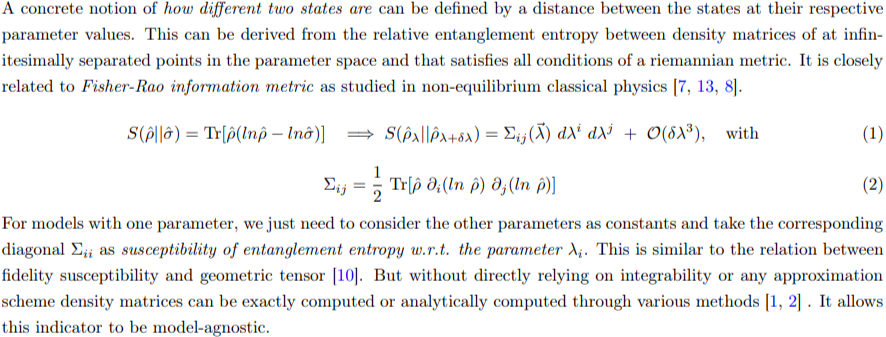
For our context, we work with the simplest case, i.e. the single-site reduced density matrix which takes a simple form (Eq. 6) and only requires to compute the expectation value of operator only, at each points in the parameter space.
z
σ

This gives a simple formula for susceptibility of entanglement entropy here for any system size

Computations
Computations
1. (h,N) & (h,N) Eq. 7 & Fig. 12. (h, γ = 1) & (h = 0, γ) Eq. 9 & Fig. 2, 3, 5 3. Roots of & Fig. 4 4. Maxima of & Fig. 6Abbr.: FMDS = for more detail see ( in the paper susceptibility of entanglement entropy )
m
z
m
z
Σ
h
Σ
γ
Σ
h
Σ
γ
Σ
h
Σ
γ
Transverse field Ising model in 1D (γ = 1 and h varies)
Transverse field Ising model in 1D (γ = 1 and h varies)
Calculation of for an integrable model requires only to make an O (size) sum as the desired reduced density matrix of the model only requires this one correlation function - FMDS : Sec . 4
<>
z
σ
FiniteSizeσExp[h_,n_?IntegerQ]:=Module{k,step,sum},table=*Tablek,k,-,;resultTable=Table+,{k,table};*Total[resultTable]
2π
n
n-1
2
n-1
2
(h-Cos[k])
2
(h-Cos[k])
2
Sin[k]
1
n
Using a simple analytical expression, the susceptibility of entanglement entropy can be computed for any finite system to determine the finite size scaling properties of this quantity - FMDS : Sec . 4 & 5
TFIMSuscept[h_,n_]:=Module{},SysSize=n;(*NeedstobeEven*)TFIMρ0=({{1,0},{0,1}}+FiniteSizeσExp[h0,SysSize]*{{1,0},{0,-1}});MatrixLogOfρ={{Log[TFIMρ0[[1]][[1]]],0},{0,Log[TFIMρ0[[2]][[2]]]}};DhLogρ0=D[MatrixLogOfρ,h0];Matrix0=TFIMρ0.DhLogρ0.DhLogρ0;Tr[Matrix0]/.h0->h
1
2
1
2
Evaluates the local maxima of (h) for every even sized spin chain in Periodic Boundary Condition and starts with =1.01 which is later used to determine its scaling w . r . t . the system size
Σ
h
h
init
TFIMSizeVsPeakLocation[n_]:=Module{},SysSize=n;(*NeedstobeEven*)TFIMρ0=({{1,0},{0,1}}+FiniteSizeσExp[h,SysSize]*{{1,0},{0,-1}});MatrixLogOfρ={{Log[TFIMρ0[[1]][[1]]],0},{0,Log[TFIMρ0[[2]][[2]]]}};DhLogρ0=D[MatrixLogOfρ,h];Matrix0=TFIMρ0.DhLogρ0.DhLogρ0;G11=Tr[Matrix0];hCritical=FindMaximum[G11,{h,1.01},WorkingPrecision->50,AccuracyGoal->24][[2]];h/.hCritical
1
2
1
2
Evaluates the global maxima of (h) for every even sized spin chain in Periodic Boundary Condition and evaluates its value at the turning point which is later used to determine its scaling w . r . t . the system size
Σ
h
TFIMSizeVsPeakHeight[n_]:=Module{},SysSize=n;(*NeedstobeEven*)TFIMρ0=({{1,0},{0,1}}+FiniteSizeσExp[h,SysSize]*{{1,0},{0,-1}});MatrixLogOfρ={{Log[TFIMρ0[[1]][[1]]],0},{0,Log[TFIMρ0[[2]][[2]]]}};DhLogρ0=D[MatrixLogOfρ,h];Matrix0=TFIMρ0.DhLogρ0.DhLogρ0;G11=Tr[Matrix0];hCritical=FindMaximum[G11,{h,1.01},WorkingPrecision->50,AccuracyGoal->24][[2]];hCrit=h/.hCritical;SusceptPeakVal=G11/.h->hCritTFIMSizeVsPeakDistanceFromCriticality[n_]:=TFIMSizeVsPeakLocation[n]-1
1
2
1
2
To visualize the susceptibility for any even sized spinc chain with their turning points and global maxima values : already indicates thermodynamic criticality in very small systems
For the computation of the roots and maxima values the evaluation is parallelized across 4 CPU cores
The list of system sizes are defined to compute the roots of susceptibility at those system sizes
Evaluated Parallely
Immediate plot without annotation
Details of the linear fit, of the data in log - log scale
In the similar way the maxima values of the susceptibility is computed parallely
Plot of the susceptibility of entanglement entropy for some small systems sizes to demonstrate the trend towards thermodynamic criticality for Transverse Field Ising model
Asymptotics
Asymptotics
The expression for the susceptibility of entanglement entropy is first derived and then defined for faster evaluation of its roots and maximas
Function to compute the turning points with high WorkingPrecision and AccyraryGoal
Turning points of this asymptotic result are evaluated similarly, running the evaluation parallely accross many CPU cores
XY model in 1D (h = 0 and γ varies)
XY model in 1D (h = 0 and γ varies)
Every step is same here just as Transverse Field Ising chain, except only two small details
CITE THIS NOTEBOOK
CITE THIS NOTEBOOK
Susceptibility of entanglement entropy: a universal indicator of quantum criticality
by Pritam Sarkar
Wolfram Community, STAFF PICKS, December 18, 2024
https://community.wolfram.com/groups/-/m/t/3342258
by Pritam Sarkar
Wolfram Community, STAFF PICKS, December 18, 2024
https://community.wolfram.com/groups/-/m/t/3342258