ABSTRACT (original article): A pseudo-edge graph of a convex polyhedron is a 3-connected embedded graph in whose vertices coincide with those of , whose edges are distance minimizing geodesics, and whose faces are convex. We construct a convex polyhedron in Euclidean 3-space with a pseudo-edge graph with respect to which K is not unfoldable. The proof is based on a result of Pogorelov on convex caps with prescribed curvature, and an unfoldability obstruction for almost flat convex caps due to Tarasov. Our example, which has 340 vertices, significantly simplifies an earlier construction by Tarasov, and confirms that Dürer’s conjecture does not hold for pseudo-edge unfoldings. CITATION (original article): Barvinok, N., Ghomi, M. Pseudo-Edge Unfoldings of Convex Polyhedra. Discrete Comput Geom 64, 671–689 (2020). https://doi.org/10.1007/s00454-019-00082-1
K
K
K
K
Here we give the coordinates for the convex subdivision of the equilateral triangle discussed in Section 5 of our paper, and verify some basic properties of it.
The Coordinates
The Coordinates
Figures
Figures
Basic figures
Basic figures
edges=Table[edge[i],{i,1,144}];Graphics[PrependTo[edges,RGBColor[0.35,0.5,0.78]],AspectRatioAutomatic]
edges=Table[edge[i],{i,1,135}];Graphics[PrependTo[edges,RGBColor[0.35,0.5,0.78]],AspectRatioAutomatic]
Labels
Labels
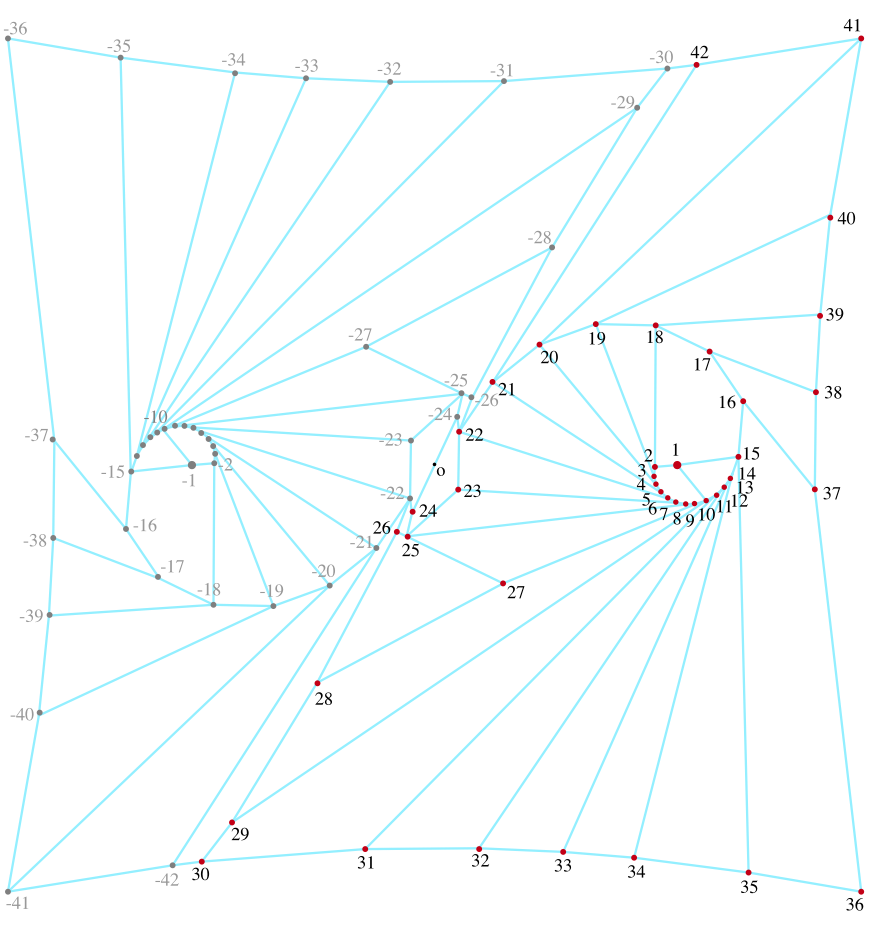
Computations (Proofs of Lemmas 5.2, 5.3)
Computations (Proofs of Lemmas 5.2, 5.3)
Basic Formulas
Basic Formulas
Angles
angle[x_,y_,z_]:=ArcCos*;
(p[x]-p[y]).(p[z]-p[y])
Norm[p[x]-p[y]]Norm[p[z]-p[y]]
180
π
Obtuseness
obtuse[x_,y_,z_]=angle[x,y,z]-90;
Proof of Lemma 5.2
Proof of Lemma 5.2
Using the “obtuse” function defined above we check that for each vertex of the proposed subpath, is the only adjacent vertex of such that the angle spanned by , , and is greater than or equal to π/2.
v
i
v
i+1
v
i
v
i+1
v
i
p
1
Note that or p[2] has only two adjacent vertices: p[3] and p[18]. So we compute that:
p
2
{obtuse[1,2,3],obtuse[1,2,18]}
{2.38594,-2.77307}
Thus the only possible choice for the successor of p[2] into our path is p[3]. Next we check vertices that are adjacent to p[3], and continue this procedure until we reach p[-41]. Then the last computation shows that the path must leave the square.
{obtuse[1,3,4],obtuse[1,3,19]}
{13.3136,-3.32091}
{obtuse[1,4,5],obtuse[1,4,20]}
{6.79788,-3.74739}
{obtuse[1,5,6],obtuse[1,5,21]}
{7.98332,-4.20512}
Rest of vertices
Rest of vertices
Proof of Lemma 5.3
Proof of Lemma 5.3
We follows the same general procedure described in the proof of Lemma 5.2.
p[o]={0,0};
{obtuse[o,24,25],obtuse[o,24,-22]}
{78.7933,-57.7029}
{obtuse[o,25,27],obtuse[o,25,26]}
{4.74045,-3.30413}
{obtuse[o,27,9],obtuse[o,27,28]}
{7.76125,-1.61334}
{obtuse[o,9,10],obtuse[o,9,27],obtuse[o,9,8]}
{63.3187,-59.3735,-76.0431}
{obtuse[o,10,11],obtuse[o,10,29]}
{53.5484,-48.359}
{obtuse[o,11,12],obtuse[o,11,31]}
{46.9183,-38.4005}
{obtuse[o,12,13],obtuse[o,12,32]}
{31.9493,-29.2577}
{obtuse[o,13,14],obtuse[o,13,33]}
{25.71,-20.6315}
{obtuse[o,14,15],obtuse[o,14,34]}
{17.793,-12.6559}
CITE THIS NOTEBOOK
CITE THIS NOTEBOOK
Pseudo-edge unfoldings of convex polyhedra
by Nicholas Barvinok and Mohammad Ghomi
Wolfram Community, STAFF PICKS, January 29, 2025
https://community.wolfram.com/groups/-/m/t/3367059
by Nicholas Barvinok and Mohammad Ghomi
Wolfram Community, STAFF PICKS, January 29, 2025
https://community.wolfram.com/groups/-/m/t/3367059