Based on the post: https://x.com/yaroslavvb/status/1873240407406199004
Eigenvalues of matrices don’t like to be next to each other. Similar behavior underlies behavior of primes, energy levels and tree rings, see https://www.americanscientist.org/article/the-spectrum-of-riemannium
Below is a simple visualization of repelling behavior -- take a random matrix, and visualize what happens with eigenvalues as we rotate this matrix.
d=40;mat=RandomVariate[NormalDistribution[],{d,d}]
d
+.1IdentityMatrix[d]I;rotate[theta_]:=(blocks=Table[R[i]->RotationMatrix[theta],{i,d/2}];mat.ArrayFlatten[DiagonalMatrix[Array[R,d/2]]/.blocks]);Animate[ComplexListPlot[Eigenvalues[rotate[p]],Axes->None,PlotRange->{-1-I,1+I}],{p,0,2Pi,0.05}]Out[]=
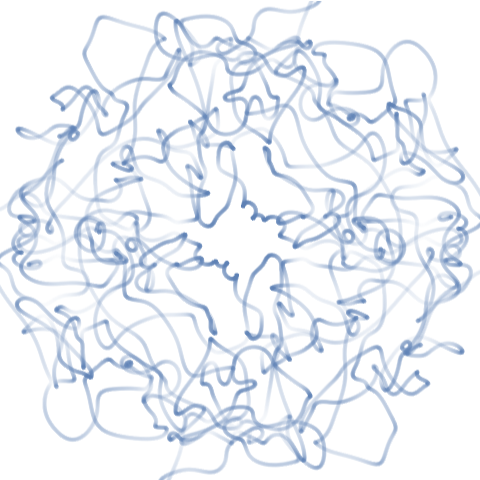
We can visualize the trajectories
evals=Table[Eigenvalues[rotate[p]],{p,0,2Pi,.001}];ListPlot[ReIm@Flatten@evals,PlotStyle->Directive[PointSize[.01],Opacity[.01]],PlotRange->{{-1,1},{-1,1}},AspectRatio->1,Axes->None]
Out[]=
CITE THIS NOTEBOOK
CITE THIS NOTEBOOK
Visualize repelling behavior of eigenvalues
by Yaroslav Bulatov
Wolfram Community, STAFF PICKS, December 29, 2024
https://community.wolfram.com/groups/-/m/t/3346215
by Yaroslav Bulatov
Wolfram Community, STAFF PICKS, December 29, 2024
https://community.wolfram.com/groups/-/m/t/3346215