This course is designed to teach learners the basic math you will need in order to be successful in almost any math course and was created for students who have basic math skills but may not have taken algebra or pre-calculus. The project introduces the core math with no extra complexity, introducing unfamiliar ideas and math symbols one-at-a-time.
Sets
A set is a collection of things. A set is made up of elements.
For example
A{1,2,-3,7}
The cardinality (size) of a set A is the number of elements in it.
|A|4
Interesection
Interesection
In[]:=
ResourceFunction["VennDiagram"][(A&&B)]
Out[]=
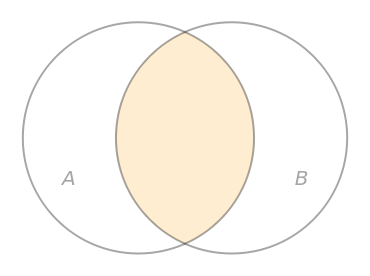
A⋂B{x:x∈Aandx∈B}
In[]:=
a={1,2,-3,7}
Out[]=
{1,2,-3,7}
In[]:=
Length[a]
Out[]=
4
In[]:=
b={2,8,-3,10}
Out[]=
{2,8,-3,10}
In[]:=
d={5,10}
Out[]=
{5,10}
In[]:=
Intersection[a,b]
Out[]=
{-3,2}
In[]:=
Intersection[b,d]
Out[]=
{10}
In[]:=
Intersection[a,d]
Out[]=
{}
Union
Union
In[]:=
ResourceFunction["VennDiagram"][A∨B]
Out[]=
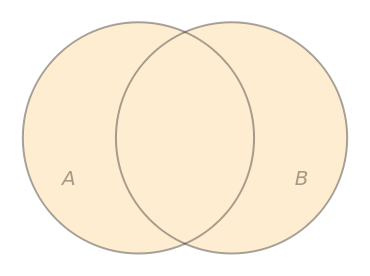
A⋃B{x:x∈Aorx∈B}
In[]:=
Union[a,b]
Out[]=
{-3,1,2,7,8,10}
In[]:=
Union[a,d]
Out[]=
{-3,1,2,5,7,10}
The infinite world of Real numbers
The Real Number Line
The Real Number Line
NumberLinePlot[Interval[{-Infinity,Infinity}]]
Out[]=

In[]:=
a={1,2,-3,7}
Out[]=
{1,2,-3,7}
Now we are going to select the positive number of the set A and then positive real numbers
In[]:=
Select[a,Positive]
Out[]=
{1,2,7}
In[]:=
Select[{-Infinity,Infinity},Positive]
Out[]=
{∞}
Abs [] command gives the absolute value of the real numbers
In[]:=
Abs[-Infinity]
Out[]=
∞
In[]:=
Abs[8.7]
Out[]=
8.7
Numbers- Inequalities - Less than - Greater than - Unequal
Numbers- Inequalities - Less than - Greater than - Unequal
In[]:=
2<3.1
Out[]=
True
In[]:=
40<102
Out[]=
True
In[]:=
-11.78>=0
Out[]=
False
In[]:=
-1.<=0
Out[]=
True
In[]:=
3.89312==3.893121
Out[]=
False
In[]:=
3!=3.
Out[]=
False
In[]:=
3(-4)<2(-2)
Out[]=
True
In[]:=
3(-4)!=2(-2)
Out[]=
True
Numbers - Algebra With Inequalities
Numbers - Algebra With Inequalities
In[]:=
Solve[x+3==10,x]
Out[]=
{{x7}}
In[]:=
Solve[x+5==10,x]
Out[]=
{{x5}}
In[]:=
Reduce[x+2>5,x]
Out[]=
x>3
In[]:=
Reduce[x+2>=-15,x,Reals]
Out[]=
x≥-17
In[]:=
Reduce[{2x+4!=2},x,Reals]
Out[]=
x<-1||x>-1
In[]:=
Reduce[{1<=x+5<=10},x,Reals]
Out[]=
-4≤x≤5
Sigma Notation
We often use for sigma this big Greek letter, sigma, which kind of looks like a big pointy . And as always in these lectures, the point is not necessarily to bombard you with computations or to judge you on right or wrong answers . But simply to demystify and explain notation, which would otherwise be mystifying . So what we' re going to do in this lecture is work through three examples . Each one of them an example of sigma notation, each one of these things here .
∑
We ought to think about this is equal to sum .
In[]:=
Sum[i^2,{i,4}]
Just like we did before . So we do that up here,
We' re also going to break the idea that you have to use i .
But now we' re going to give you a different problem, which when you think about it is not going to be too different .
Mean
Mean
So t his is the mean of z . Sort of an average .
Now we are going to another example
Graphs
Plotting points in the plane
Plotting points in the plane
We divide the Cartesian plane into four separate regions, and these we call quadrants .
Distance Formula
Distance Formula
OK, let' s work some examples .
Lines in the plane
Lines in the plane
Example 1
Example 1
Given the following two points we are going to plot the line
Example 2
Example 2
To find the x - intercept
To find the y - intercept
The graph with the intercept points highlighted :
Functions
Graphing in the Cartesian Plane
Graphing in the Cartesian Plane
and the line
This is a nice visual picture.
Increasing and Decreasing Functions
Increasing and Decreasing Functions
The following function is neither increasing nor decreasing :
Composition
Composition
Example
Example
References
References
◼
“Basic Mathematics” by Serge Lang
◼
“Algebra: Structure and Method, Book 1” by Richard G. Brown
◼
“Data Science Math Skills” by Paul Bendich and Daniel Egger , Duke University