ORIGINAL ARTICLE: Babilio, E.; Rapuano, S. The Complex Architecture of the Vault System of an Early Medieval Church. Heritage 2023, 6(8), 5779-5804.
DOI: https://doi.org/10.3390/heritage6080304
DOI: https://doi.org/10.3390/heritage6080304
Article Abstract: The present work focuses on the solid modeling of the church of Santa Sofia in Benevento, Italy, and is related to a multidisciplinary research project that involved methods typical to both the humanities and mathematical engineering. Starting from the history of the church and its current configuration, a twofold objective is pursued: to give a brief account of the methodology used to analyze and virtualize the main phases of Santa Sofia and to report on the problem of modeling the church vault complex. Indeed, the 3D modeling of the church presented different levels of difficulty with some parts very easy to draw and others calling for specific geometrical analysis. In particular, to reconstruct the complex system of vaults of the church, a home-made code based on remapping Coons patches was written. The resulting 3D models of the different archeological and architectural phases of Santa Sofia are an example of virtual heritage and, being a digital content, allow for immediate sharing both to the scientific community and to a general and nonexpert audience, keeping in mind that knowledge is the means used to ensure the enhancement and preservation of cultural heritage.
The present notebooks is the companion of the paper “The Complex Architecture of the Vault System of an Early Medieval Church” and it is aimed at detailing about the virtual reconstruction of surfaces by using bicubically blended Coons patches by exploiting a few basic Mathematica commands.
Introduction
Introduction
The use of virtual models is widespread in many fields, from architecture to mechanical and aeronautical engineering to documentation, enhancement and protection of cultural heritage.Virtual reconstructions are among the digital processes that have become standard in the cultural heritage sector of the humanities, being both a method of visualization accepted in the education and knowledge transfer fields, and a research tool.
Often, in buildings of architectural and archaeological interest, there are domes and vaults, sometimes perfectly preserved, sometimes less if not completely lost. It is therefore necessary to document such surfaces, and virtual reconstruction of vaults and domes is indeed an active research field. The objective of many studies is to find the approximating surface in a restricted space of choices, as for instance determining the nondegenerate real quadric surface that best fits a given point cloud.
The paper “The Complex Architecture of the Vault System of an Early Medieval Church” available at https://doi.org/10.3390/heritage6080304, of which this notebook is the companion, has a twofold objective: to give a brief account of the methodology used to analyze and virtualize the major phases of the early medieval churh of Santa Sofia, located in Benevento, a small town in Southern Italy, situated about 200 km south of Rome and 60 km east of Naples, and to report on the specific problem of modeling the church vault complex. Indeed, the vault surface reconstruction of the 22 vaults covering the ambulacra of the church of Santa Sofia (see Section 2.2 “The Architecture of the Church in Its Current Configuration” of the paper for details) was complicated by the fact that none of them can be approximated with basic geometric shapes. Therefore, the bicubically blended Coons surfaces were selected as approximating functions. In doing this, Matheamtica proved to be very effective allowing to obtain quite general shapes with very few lines of code.
A rendered view of the church, the square, the fountain and the bell tower is reported in Fig. 1(a). The current layout of the church is shown in Fig. 1(b). The current configuration is the result of the mid-20th-century restoration and some other minor interventions at the turn of the last quarter of the 20th century and the first decade of the 21st century, the last of which was aimed at inclusion on the UNESCO World Heritage List. The interior is show in two rendered views in Fig, 2(a,b).
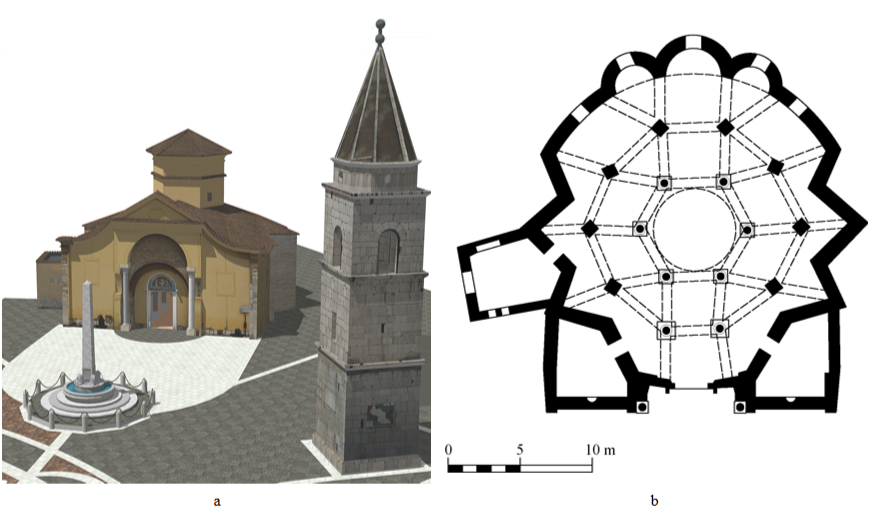
Fig. 1: A rendered view of the church, the square, the fountain and the bell tower (a). Rendering by S. Rapuano. The layout of the church (b) .
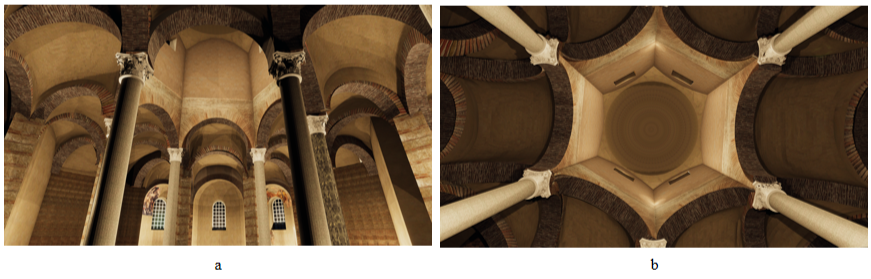
Fig. 2: Two rendered views of the iterior of the church (rendering by S. Rapuano). The complex srtucture of the vaults covering the two ambulacra (a) and the tiburium and its ellipsoidal dome, taken from below (b).
What follows basically describes Sect. 4.2 “Surface Approximation” and Sect. 4.3 “Patch Construction on the Unit Square Domain” of the main paper.
Bicubically blended Coons surface on a unit square
Bicubically blended Coons surface on a unit square
From the “real” platform to the unit square
From the “real” platform to the unit square
Let us assume we have a certain quadrilateral vault (or a portion of it), whose projection on the floor, which we call the platform , is a general quandrangle.
Let us draw a grid on , as shown in Fig. 3(a), made of an assigned number of lines:
Let us draw a grid on , as shown in Fig. 3(a), made of an assigned number of lines:
mesh=15;
lat us also assume that the coordinates of the generic point (x,y) are expressed in terms of parameters (u,v), such that u∈[0,1] and v∈[0,1]
x=2u+v-uv;y=4v-uv;
1
2
3
2
1
3
1
6
that allows building a bijective mapping between the platform and the unit square, Fig. 3(b).
text[a_]:=SimplifyWhich[ax,"x",au,"u",ay,"y",av,"v"],Assumptions0≤u≤1&&v>0&&v≤1&&u≠&&u≠&&u≠&&u≠&&u≠vplatform[ξ_,η_]:=Show[ParametricPlot[{ξ,η},{u,0,1},{v,0,1},PlotStyleLightGray,MeshStyleGray,Meshmesh,BoundaryStyle{Thick,Black}],Graphics[Arrow[{{ξ,η},{ξ+1.5,η}}//.{u0,v0}]],Graphics[Arrow[{{ξ,η},{ξ,η+1.5}}//.{u0,v0}]],Graphics[Text[Style[ToString[text[ξ]],Medium,Italic,FontFamily"Times"],{1.55,0}]],Graphics[Text[Style[ToString[text[η]],Medium,Italic,FontFamily"Times"],{0,1.55}]],AxesFalse,PlotRange{{-0.1,1.6},{-0.085,1.6}},ImageSize250,FrameFalse]Grid[{{platform[x,y],platform[u,v]},{Text[Style["a",Small,FontFamily"Times"]],Text[Style["b",Small,FontFamily"Times"]]}}]
2
3
30v
36-25v
24v
18+v
2v
4-3v
a | b |
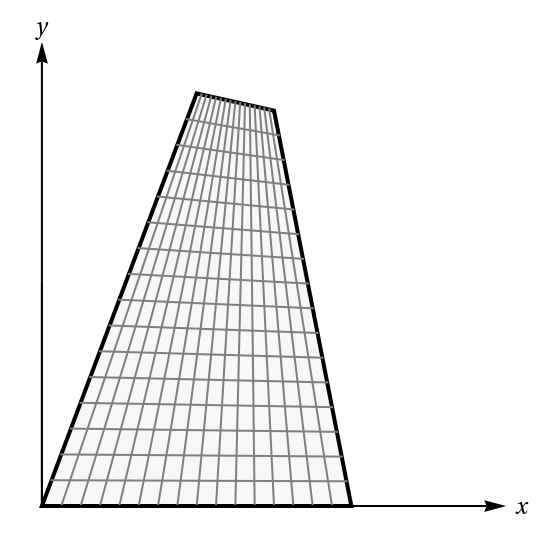
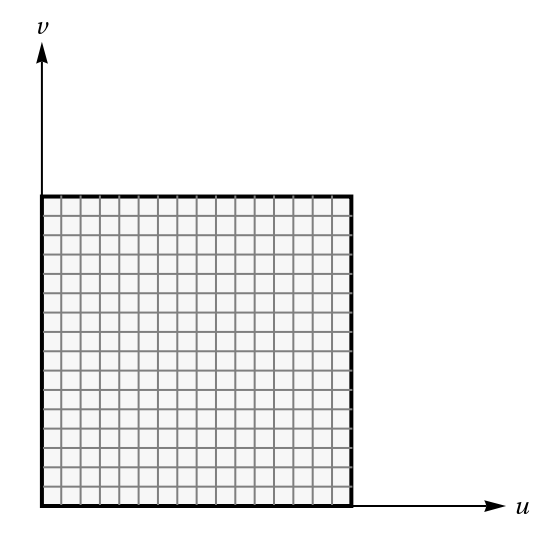
Fig. 3: Reference grids: on the platform of the real vault (a) and on the unit square (b).
Hermite polynomials
Hermite polynomials
Now, all that is needed to reconstruct the surface is the height of the vault at each corner and the slopes along the two sides incident on each of those corners.
Assume that such data are available and, for each side of the platform, we write a vector as
Assume that such data are available and, for each side of the platform, we write a vector as
pars[h0_,h1_,s0_,s1_]:={h0,h1,s0,s1};
The function corresponding to the vault boundary on that side can be set in terms of a scalar product between that vector and another, to be defined appropriately. The boundary is then given by
boundary[{h0_,h1_,s0_,s1_}][t_]:=pars[h0,h1,s0,s1].Fvec[t];
t being a dummy variable such that t∈[0,1]. The components of Fvec[t], which is written as
Fvec[t_]:={poly1[t],poly1[-t+1],poly2[t],-poly2[-t+1]};
are cubic Hermite polynomials defined as
poly1[t_]:=(1+2t);poly2[t_]:=t;
2
(1-t)
2
(1-t)
Their graphs are shown in Fig. 4.
hermite=Plot[Evaluate[Fvec[t]],{t,0,1},PlotStyle{{Black,Thick},{Blue,Thick},{Gray,Thick},{Red,Thick}},AspectRatio1,FrameTrue,FrameStyleDirective[FontFamily"Times",10],FrameLabel{Text[Style["t",Medium,FontSlantItalic,FontFamily"Times"]],Text[Style["H(t)",Medium,FontSlantItalic,FontFamily"Times"]]},AxesFalse,ImageSize250]
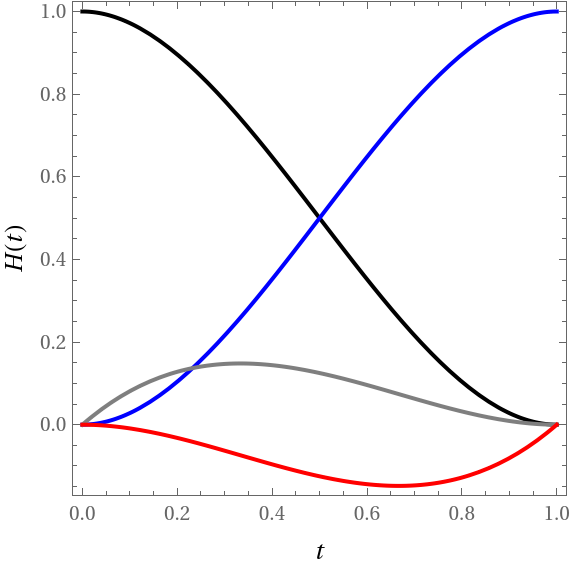
Fig. 4: Hermite functions (t) (black), (t) (blue), (t) (gray), (t) (red). Note that (t) = Fvec[t]〚i〛.
H
1
H
2
H
3
H
4
H
i
The patch
The patch
Collecting the values, the slopes and the second mixed derivatives at the corners of the desided surface in a matrix Pmat defined as
the pacht is get as
Fig. 5: Superimposition of section lines to the triangulated vaults, showing the slicing adopted in the main paper, to which we refer for further details. Since any “rectangular” strip is remappend to the unit squar domain, each vault is reconstructed by means of a number of patches.
Three simple examples
Three simple examples
In this section, we consider three simple examples of surfaces, namely a sail vault, a saddle and a tapered vault. In order to plot the results, some delayed functions are conveniently defined first.
Rules for graphics
Rules for graphics
Sail vault
Sail vault
Fig. 6: The first example.
Saddle
Saddle
Fig. 7: The second example.
Tapered vault
Tapered vault
Fig. 8: The third example.
Conclusions
Conclusions
The present notebook describes how bicubically blended Coons patches can be constructed by explointin a few basic Mathematica commands. Some simple examples are considered, while it has been stressed that the reconstruction of actual existing vault may require using a certain number of patches to achieve the desired level of accuracy. We refer to the main paper for further details.
CITE THIS NOTEBOOK
CITE THIS NOTEBOOK
The Complex Architecture of the Vault System of an Early Medieval Church
by Enrico Babilio and Silvana Rapuano
Wolfram Community, STAFF PICKS, August 28, 2023
https://community.wolfram.com/groups/-/m/t/3000765
by Enrico Babilio and Silvana Rapuano
Wolfram Community, STAFF PICKS, August 28, 2023
https://community.wolfram.com/groups/-/m/t/3000765