Introduction
Introduction
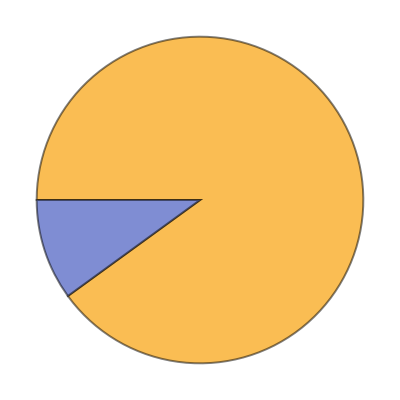
The preference of one hand is common in humans, with 10% of the population being left handed. But does this also apply to animals, and if so, what are the parameters that affect “handedness” in different species?
Handedness, the preference for the use of one hand, is dependent on the lateralization of brain function, the tendency for neural functions to be specialized to one side of the brain. An established lateralization is that of Broca’s and Wernicke’s areas of the brain, which correspond to handedness and are found on the left hemisphere.
Handedness, the preference for the use of one hand, is dependent on the lateralization of brain function, the tendency for neural functions to be specialized to one side of the brain. An established lateralization is that of Broca’s and Wernicke’s areas of the brain, which correspond to handedness and are found on the left hemisphere.
In[]:=
PieChart[{9,1},ChartLegends->{"Right handed people","Left handed people"}]
Out[]=


Some parameters that were established for each type of animal was the age, sex, and whether or not they were neutered. The participants in this study were 15 dogs, 5 cats, 5 canaries and 7 tarantulas. Simple tests were done to determine the handedness in terms of preference, and percentage.
The percentage of handedness was calculated by running each test multiple times and evaluating how many of the times the animal “chose” a specific dominant side, no matter if it was the left or the right. Therefore, a percentage of 50% or close indicates no preference, because it means that an animal chose the right side the same amount of times as the left side. For each animal, the average of the percentages of each test were calculated to indicate the final percentage of “handedness”. This percentage indicates if, and how much the animal tends to show preference, not which side it prefers. Therefore, the percentage of handedness can either mean a percentage of left handedness or a percentage of right handedness. It is evident that the percentage for the dominant side is presented because a 60% right handedness means 40% left handedness in an animal, so in the results we only refer to the dominant side. If an animal has a percentage of handedness greater than 50% for the right side, it is deemed right “handed”, and vice versa for the left side.
For cats and dogs the tests include which leg they use first when they walk, which leg they tend when asked to, which leg they use to grab an object etc. For insects, the results are obtained by testing which side of their body they use to catch prey. For birds, a hypothesis was formed that preference may show in the use of different feet when landing onto branches or similar conditions, but results showed great coordination of the two sides and no preference indicated.
Handedness in dogs
Handedness in dogs
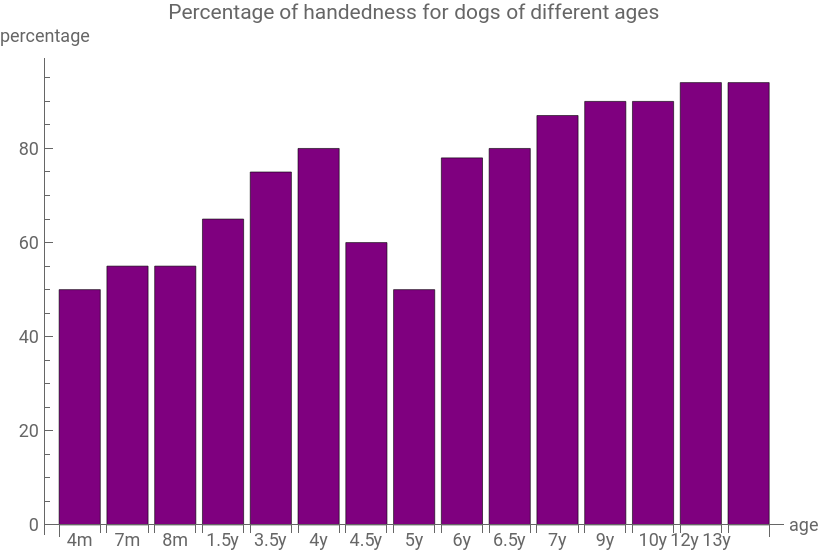
The following graph shows the percentage of handedness for dogs of different ages:
In[]:=
BarChart[{50,55,55,65,75,80,60,50,78,80,87,90,90,94,94},ChartLabels->{"4m","7m","8m","1.5y","3.5y","4y","4.5y","5y","6y","6.5y","7y","9y","10y","12y""13y"},AxesLabel->{"age","percentage"},ChartStyle->Purple,PlotLabel->"Percentage of handedness for dogs of different ages"]
Out[]=
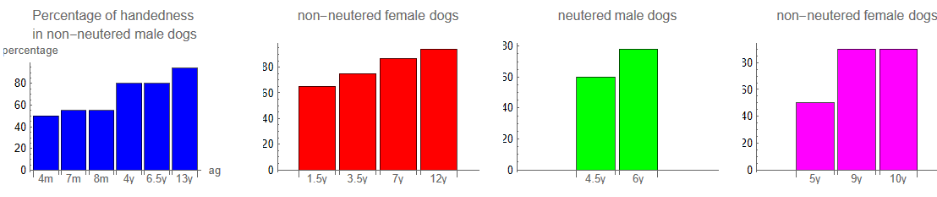
The following charts show the percentage of handedness (for any of the two sides) for non-neutered male dogs (Blue), non-neutered female dogs (Red), neutered male dogs (Green) and neutered female dogs (Pink)
In[]:=
chart1=BarChart[{50,55,55,80,80,94},ChartStyle->Blue,ChartLabels->{"4m","7m","8m","4y","6.5y","13y"},AxesLabel->{"age","percentage"},PlotLabel->"Percentage of handedness in non-neutered male dogs"]
In[]:=
chart2=BarChart[{65,75,87,94},ChartStyle->Red,ChartLabels->{"1.5y","3.5y","7y","12y"},PlotLabel->"non-neutered female dogs"]
In[]:=
chart3=BarChart[{60,78},ChartStyle->Green,ChartLabels->{"4.5y","6y"},PlotLabel->"neutered male dogs"]
In[]:=
chart4=BarChart[{50,90,90},ChartStyle->Magenta,ChartLabels->{"5y","9y","10y"},PlotLabel->"non-neutered female dogs"]
In[]:=
GraphicsRow[{chart1,chart2,chart3,chart4}]
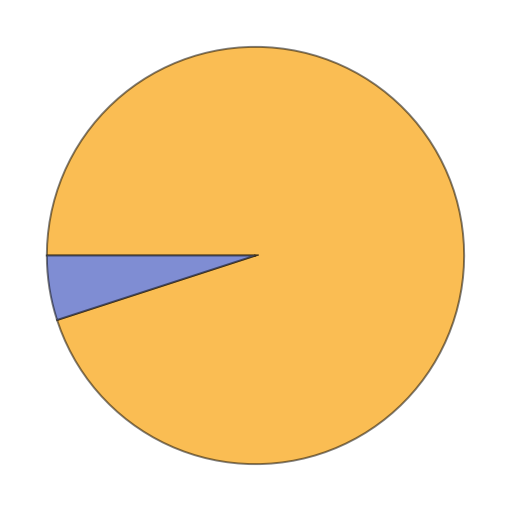
Results showed that only 5% of dogs were left “handed”, so only 5% of the dogs that had a percentage of handedness greater than 50%, chose the left side. The rest indicated right handedness.
In[]:=
PieChart[{95,5},ChartLegends->{"Right 'handed' dogs","Left 'handed' dogs"}]
Out[]=
Handedness in cats
Handedness in cats
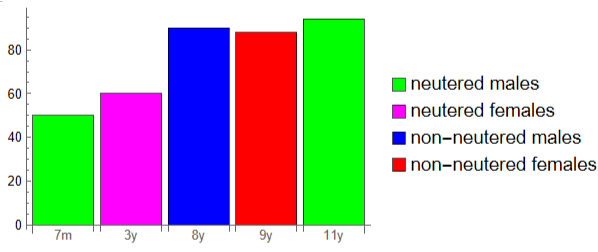
The following graph shows the percentage of handedness for cats of different ages, sexes and neutering status. Left “handedness” was not indicated by this sample, all the percentages refer to a right handedness percentage.
In[]:=
BarChart[{50,60,90,88,94},ChartLabels->{"7m","3y","8y","9y","11y"},ChartStyle->{Green,Magenta,Blue,Red},ChartLegends->{"neutered males","neutered females","non-neutered males","non-neutered females"}]
Handedness in tarantulas
Handedness in tarantulas
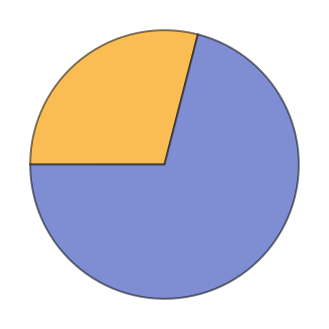
7 female tarantulas of the species Brachypelma Emilia were tested, indicating the following curious results for left “handedness”:
In[]:=
PieChart[{29,71},ChartLegends->{"Right 'handed'","Left 'handed'"}]
Out[]=
Conclusion
Conclusion
Overall, the conclusion is that handedness is a phenomenon that exist among different animal species. It was concluded that:
◼
Older cats and dogs show preference for one “hand” more often
◼
Neutered cats and dogs showed preference less often
◼
A small percentage of the sample of dogs indicated left “handedness”
◼
Tarantulas were mostly left “handed”
These results are significant, because they indicate that apart from humans, other species also indicate a preference for a dominant side in common activities.
References
References
◼
Pfannkuche, K. A., Bouma, A., & Groothuis, G. G. (2009). Does testosterone affect lateralization of brain and behaviour? A meta-analysis in humans and other animal species. Philosophical Transactions of the Royal Society B: Biological Sciences, 364(1519), 929-942. https://doi.org/10.1098/rstb.2008.0282
CITE THIS NOTEBOOK
CITE THIS NOTEBOOK
Can Animals be Left- Handed?
by Myrto Terpsiadou
Wolfram Community, STAFF PICKS, March 10, 2024
https://community.wolfram.com/groups/-/m/t/3138682
by Myrto Terpsiadou
Wolfram Community, STAFF PICKS, March 10, 2024
https://community.wolfram.com/groups/-/m/t/3138682