Approximations for calculating pH & their qualitative meaning
by Rauan kaldybaev
by Rauan kaldybaev
Introduction
Introduction
Out[]=
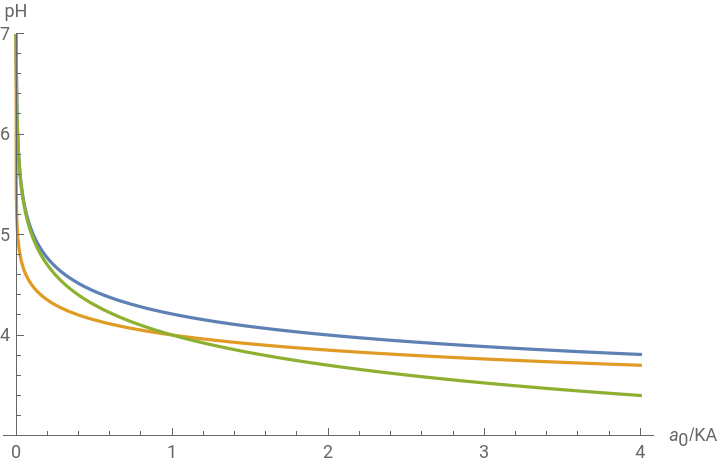


As a physicist learning chemistry, one thing that bothered me about how we calculate the pH of a solution is that we usually don’t account for the dissociation of water. It is true that in most practical applications, dissociation of water can be neglected. Still, conceptually it somehow seems wrong to not take water into account. If there are two chemical reactions going on in a solution, it is only proper to think of both of them and only neglect one of them when it’s completely clear that it can be neglected. In addition, the “standard formula” for acid in water problems predicts that the of neutral water is infinite, which is of course not true. The current computational essay looks at several approximations for the calculation of . For each approximation, it computes the error and shows that indeed, the approximations are usually very accurate. The essay then compares the predictions of these approximations to what we get directly from the chemical equilibrium equation and uses these comparison to draw qualitative conclusions about the process of dissociation of acid.
pH
pH
Deriving the equation of chemical equilibrium of acid in water
Deriving the equation of chemical equilibrium of acid in water
Consider a solution containing a small amount of acid. For definiteness, let’s restrict the discussion to monoprotic acids, which can only donate one ion - like . A generic monoprotic acid dissociates as O+HA↔+ - for example, dissociates as O+HCl↔+. The corresponding chemical equilibrium equation is
+
H
HCl
H
2
H
3
+
O
-
A
HCl
H
2
H
3
+
O
-
Cl
[][]
H
3
+
O
-
A
[HA]
K
a
(
1
) Because nothing enters or leaves the solution and the radical isn’t created or destroyed, the total amount of in the solution is preserved. Mathematically, , where is some constant:
-
A
-
A
[HA]+[]=
-
A
a
0
a
0
[HA]+[]=
-
A
a
0
(
2
) Apart from the dissociation of acid, another process that goes on in the solution is the dissociation of water, . For this reaction, the equilibrium equation is
2O↔+
H
2
H
3
+
O
-
OH
[][]=
H
3
+
O
-
OH
K
w
(
3
) The ion is formed either from the reaction or from O+HA↔+. The hydroxide ion is formed only from the dissociation of water. Denoting the molar concentration of water that has undergone dissociation as , we obtain
H
3
+
O
2O↔+
H
2
H
3
+
O
-
OH
H
2
H
3
+
O
-
A
[]
-
OH
d
[]=[]+d[]=d
H
3
+
O
-
A
-
OH
(
4
) Combining the two previous equations, we arrive at the formula for the concentration of :
H
3
+
O
[]=
H
3
+
O
a++4
2
a
K
w
2
(
5
) Here, denotes the amount of acid that has undergone dissociation. is then given by
a≡[]
-
A
pH≡-Lg[]
H
3
+
O
pH=-Log10
a++4
2
a
K
w
2
(
6
) If no acid dissociates, , and the concentration of becomes equal to ≈1·. The is then equal to 7, which is the acidity of pure water. If is much larger than , the formula can be approximated as - in other words, almost all ions present in the solution are due to the dissociation of acid. If we combine this formula with the equations (1) and (2), we arrive at an equation that allows us to determine the amount of acid that has undergone dissociation given the initial concentration :
a=0
H
3
+
O
K
w
-7
10
pH
a
K
w
[]≈a
H
3
+
O
H
3
+
O
a
a
0
K
w
2
K
a
2
a
0
a
K
a
a
0
(
7
) This equation follows directly from the chemical equilibrium equations for the dissociation of acid and water (1), (3) and from the molar equations (2), (4). So far, it does not involve any approximations. And although it could be solved exactly using Cardano’s formula, the latter is far too complicated to give much quantitative insights into the problem and too bulky for hand calculations. Luckily, the answer to (7) can be, to a good degree of precision, found using several simple approximations discussed in the next sections.
Kw≈0 approximation
K
w
In most practical applications, the quantities , , , and are either very large or very small compared to each other - for instance, for weak acids, the amount of dissociated acid is much smaller than the total amount of acid . To make use of this fact, let us write the equation (7) as
a
a
0
K
a
K
w
a
a
0
K
w
2
a
a
0
2
K
a
2
1-
a
a
0
K
a
a
0
a
a
0
2
a
a
0
(
8
) For 0, we can simplify (8) as . From here, . This formula is valid when the amount of released after the dissociation of acid is much larger than the amount of due to the dissociation of water:
K
w
0=+a-
2
a
K
a
K
a
a
0
a≈+4-
2
K
a
a
0
K
a
K
a
2
H
3
+
O
H
3
+
O
a≈+4-<<+4-
2
K
a
a
0
K
a
K
a
2
K
w
2
K
a
a
0
K
a
K
a
2
(
9
)pH
K
a
a
0
a≈
a
0
K
a
a
0
K
a
a≈
a
0
a[]
a
0
a
0
a
0
pH
a
0
pH
[]
H
3
+
O
pH≡-Log10[]
H
3
+
O
a
0
a
[]
H
3
+
O
a
[]
H
3
+
O
[]
H
3
+
O
pH≡-Log10[]
H
3
+
O
Out[]=
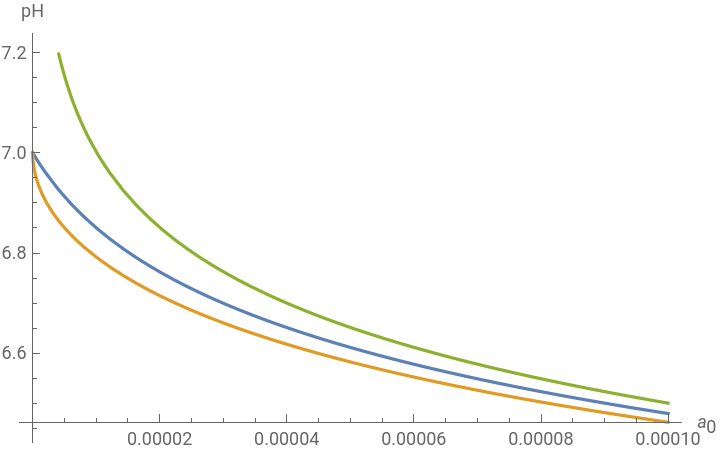
We can see that as increases, the error of the approximations decreases. But how quickly does it decrease, exactly? We can answer this question by looking at the chemical equilibrium equation (7). In the approximation ≈0, the equation (7) is solved as if the left-hand side were zero. If the left-hand side was instead some small number, we would expect to be equal to the previous estimate plus some small correction: , with and being our estimate for ≈0 (given by the formula 9). Substituting this into (7) and using the fact that is the solution to (7) with =0, we obtain
a
0
K
w
a
a=(1-ε)
a
approx
ε<<1
a
approx
K
w
a
approx
K
w
ε≈
-2-+(4+)
a
0
K
a
K
a
a
0
K
a
-4+-5+3(4+)-4+-+(4+)+2
2
a
0
K
a
a
0
2
K
a
K
a
K
a
a
0
K
a
K
w
K
a
K
a
a
0
K
a
2
K
a
K
w
K
w
The formula can be significantly simplified if >>>>:
a
0
K
a
K
w
ε≈
K
w
2
a
0
K
a
(
10
) Substituting this into the formula (6) for , we get that for >>>>, the difference between the actual calculated from the chemical equilibrium equation (7) and the approximate formula (9) is given by
pH
a
0
K
a
K
w
pH
ΔpH≈
1
2Log[10]
K
w
a
0
K
a
(
11
)Out[]=
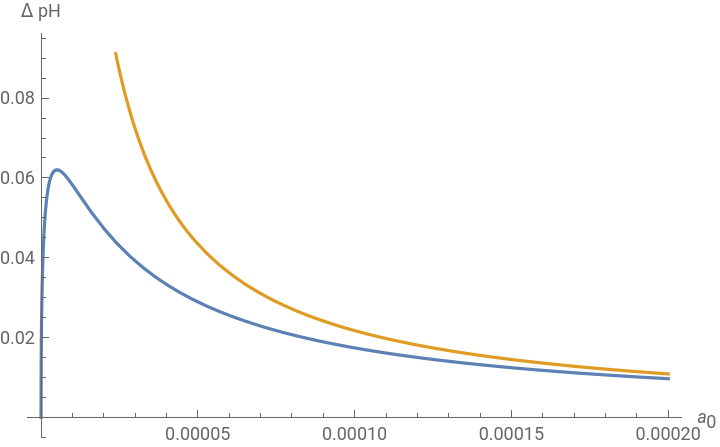
As you can see, error decreases as , which means that the more acid is added into the solution, the more accurate the approximate formula (9) becomes. This makes sense - the more acid we add, the more is released after its dissociation, and the more negligible the amount of contributed by water’s dissociation gets. Let’s look at the example problem from the introduction, where we needed to compute the of a M solution of acetic acid with =1.8·. Substituting these numbers into the formula (11), we get that the error in is roughly . This is an incredibly small error that we probably won’t even be able to measure in an experiment. This shows that in most experiments it is appropriate to neglect the dissociation of water. In order for the error in (11) to be significant, must be of order . Experimentally, this can be achieved with very weak acids, like boric acid with =5.4·. The concentration at which the error (11) would become significant would be about moles per liter, which is a very small concentration. This shows that for most practical purposes, the error in obtained using the approximate formula (9) is effectively zero. Still, it would be good to improve on the accuracy of (9). Since we know pretty accurately what the error of the approximate formula (8) is, we can actually subtract it from our initial estimate to get a more precise formula:
1/
a
0
H
3
+
O
H
3
+
O
pH
0.005
K
a
-5
10
pH
2.4·
-8
10
pH
a
0
K
a
-14
10
H
3
BO
3
K
a
-10
10
-4
10
pH
Supplemental code
Supplemental code
Strong acids and weak acids
Strong acids and weak acids
Supplemental code
Supplemental code