Conic Section
Conic Section


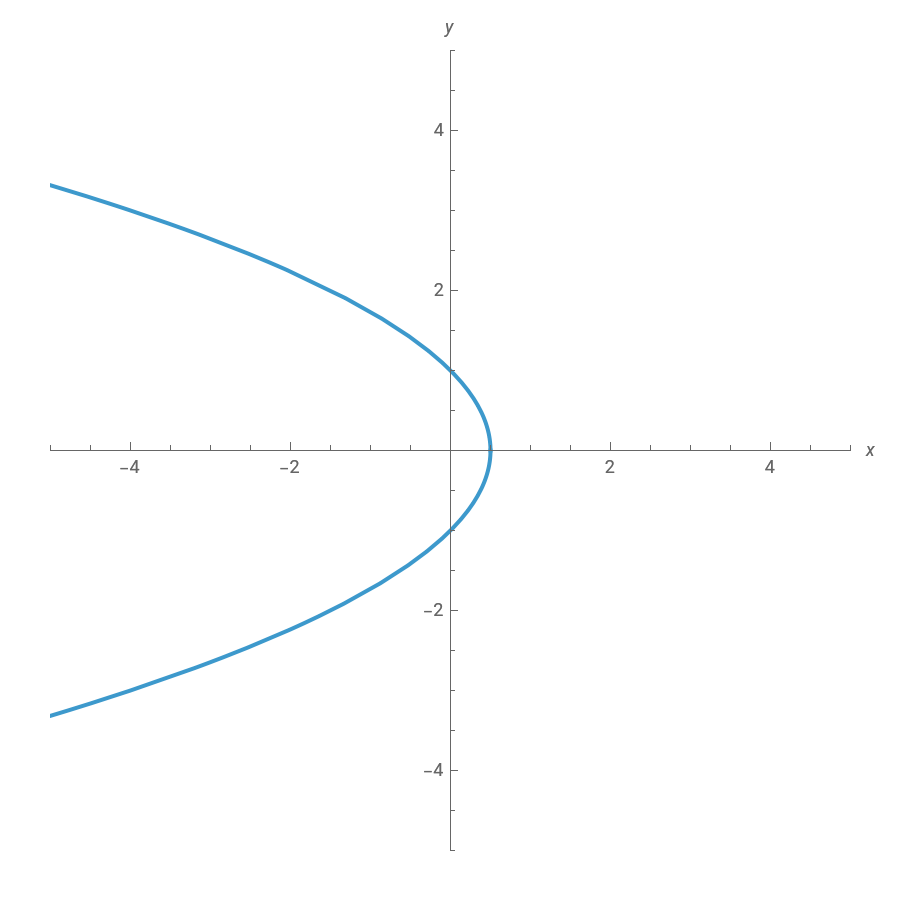
A conic section is a curve obtained by intersecting a cone (more precisely, a circular conical surface) with a plane. The three type of conics are the hyperbola, ellipse, and parabola. (The circle is a special case of the ellipse, and there are degenerate cases like a pair of intersecting lines, a point, a double line, etc.) In polar coordinates, a conic section with one focus at the origin and the other focus (if any) on the axis, is given by the equation
x
r=
p
1+ecos(θ)
where is the eccentricity and is the semilatus rectum. As above, for , we have a circle, for , we obtain a ellipse, for a parabola, and for a hyperbola.
e
p
e=0
0<e<1
e=1
e>1
Conic sections are important in astronomy: the orbits of two massive objects that interact according to Newton's law of universal gravitation are conic sections if their common center of mass is considered to be at rest.
External Links
External Links
Permanent Citation
Permanent Citation
Roberto Contrisciani
"Conic Section"
http://demonstrations.wolfram.com/ConicSection/
Wolfram Demonstrations Project
Published: March 7, 2011