Summary of the Project
Summary of the Project
This project is based on research on “Epidemiological Factors of Malaria: A Case Study of Mubarakpur, District Bahawalpur, Pakistan”. There are several determinants of malaria, including increasing poverty, environmental deterioration, poor housing conditions and inefficient health facilities which may be considered as the major contributing factors for the spread of this disease. Mubarakpur is an agricultural area, and the majority of the population of Union Council Mubarakpur is poor. The data for this research was collected by two sources, a primary source and a secondary source. Primary data was collected through a questionnaire and direct interviews with local community members. A random sampling method was used to collect primary data. The secondary data was collected from the District Health Office, Bahawalpur, Communicable Disease Control Branch of District Health Office Bahawalpur, Bahawalpur Victoria Hospital, Civil Hospital, Population Census Report (1998) and Rural Health Center of Union Council Mubarakpur.
Data Visualization
Chapter 1: Agent Factors
Chapter 1: Agent Factors
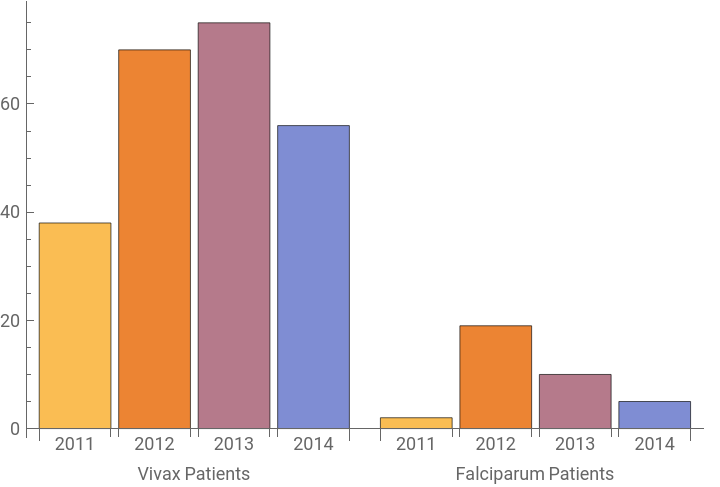
In agent factors the type of plasmodium parasite is an important agent factor. The frequency of malaria is studied relative to different plasmodium types. The parasites plasmodium vivax, plasmodium falciparum, plasmodium malaria, and plasmodium ovale kind are examples of common agent factors.
<|"Vivax"-><||>,"Falciparum"-><||>|>
data...
data...
In[]:=
ClearAll[rulify]rulify[data_List]:=AssociationThread,,,->data
In[]:=
plasmodiumVivaxPatients=rulify[{38,70,75,56}];plasmodiumFalciparumPatients=rulify[{2,19,10,5}];
In[]:=
patientdata=<|"VivaxPatients"->plasmodiumVivaxPatients,"FalciparumPatients"->plasmodiumFalciparumPatients|>
Out[]=
VivaxPatients38,70,75,56,FalciparumPatients2,19,10,5
In[]:=
DateListPlot[patientdata]
Out[]=
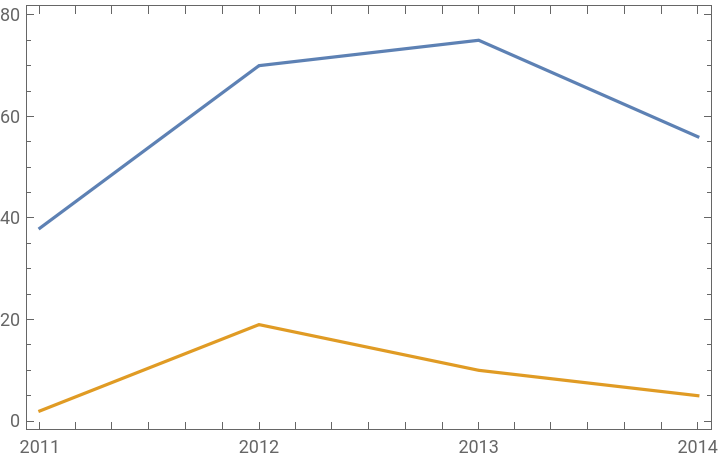


In Pakistan, both plasmodium vivax and plasmodium falciparum are prevalent. Most malaria cases are caused by plasmodium vivax in Pakistan, although the prevalence of plasmodium falciparum is on the rise. About 17% of malaria diagnosed cases are now being caused by plasmodium falciparum. In Mubarakpur where this study was carried out, Plasmodium vivax is more than Plasmodium falciparum
In[]:=
BarChart[patientdata,ChartLabels{{"Vivax Patients","Falciparum Patients"},{"2011","2012","2013","2014"}}]
Out[]=
Chapter 2: Host Factors
Chapter 2: Host Factors
This section describes population, age, sex, education level, occupation, household income, habits and housing conditions in the study area. High level of education and family income and better housing conditions can reduce the spread of malaria in any region. People living in low socio-economic and poor environmental conditions are more susceptible to malaria transmission as compared to those living in developed socio-economic and sustainable environmental conditions.
SectionA | Population Increase
SectionA | Population Increase
In[]:=
populationdata=rulify[{42879.69,44185.5,45531.5,46917.8}]
Out[]=
rulify[{42879.7,44185.5,45531.5,46917.8}]
DateListPlot[populationdata,PlotMarkers->Automatic,PlotLabel->"Population in study area",Frame{{True,False},{True,False}},FrameLabel{"","Population In Thousands"}]
Out[]=
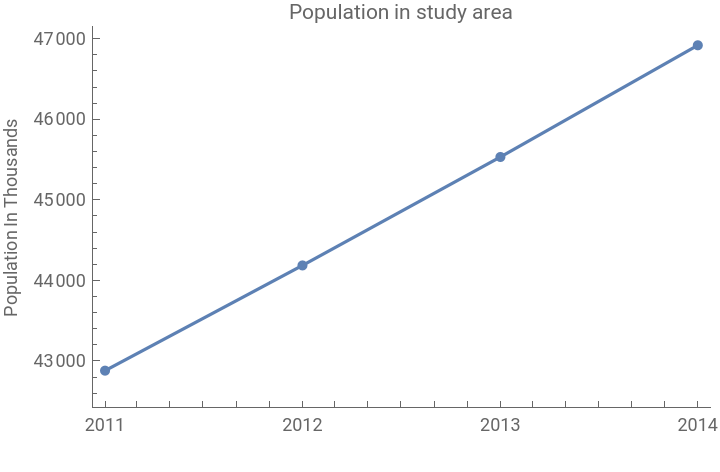
In the study area, the population has been increasing, causing overcrowding, water pollution, soil pollution, unemployment and increasing waste production. It is a commonly understood that in less developed countries, overpopulation is responsible for intensifying the occurrence of communicable diseases such as malaria, and this is particularly true in economically-deprived areas.
SectionB | Age-wise malaria cases distribution
SectionB | Age-wise malaria cases distribution
First, we find the Chart that might adequately display the age/sex differences. PairedBarChart seems to be the standard layout for these kinds of things.
In[]:=
?*Chart
Out[]=
Generate the keys for each age group
In[]:=
ageGroupKeys=Map[StringRiffle[#,"to"]&]@Partition[Range[0,65,5],2,1]
Out[]=
{0to5,5to10,10to15,15to20,20to25,25to30,30to35,35to40,40to45,45to50,50to55,55to60,60to65}
Thread the data with
ageGroupKeys
In[]:=
femaleMalariaCases=AssociationThread[ageGroupKeys->{3,1,2,4,3,1,2,3,2,2,3,2,3}]
Out[]=
0to53,5to101,10to152,15to204,20to253,25to301,30to352,35to403,40to452,45to502,50to553,55to602,60to653
In[]:=
maleMalariaCases=AssociationThread[ageGroupKeys->{2,2,1,1,3,2,4,4,1,1,1,1,1}]
Out[]=
0to52,5to102,10to151,15to201,20to253,25to302,30to354,35to404,40to451,45to501,50to551,55to601,60to651
Create an Association for data management convenience
In[]:=
confirmedMalariaCases=<|"Male"->femaleMalariaCases,"Female"->maleMalariaCases|>
Out[]=
Male0to53,5to101,10to152,15to204,20to253,25to301,30to352,35to403,40to452,45to502,50to553,55to602,60to653,Female0to52,5to102,10to151,15to201,20to253,25to302,30to354,35to404,40to451,45to501,50to551,55to601,60to651
Create the PairedBarChart of confirmed malaria cases
In[]:=
PairedBarChart[(*Datatocompare*)confirmedMalariaCases["Male"],confirmedMalariaCases["Female"],(*StylingOptions*)ChartStyle->"Pastel",ChartLabels{{"Male","Female"},None,ageGroupKeys},PlotLabel->"Malaria Cases for Various Age Groups"]
Out[]=
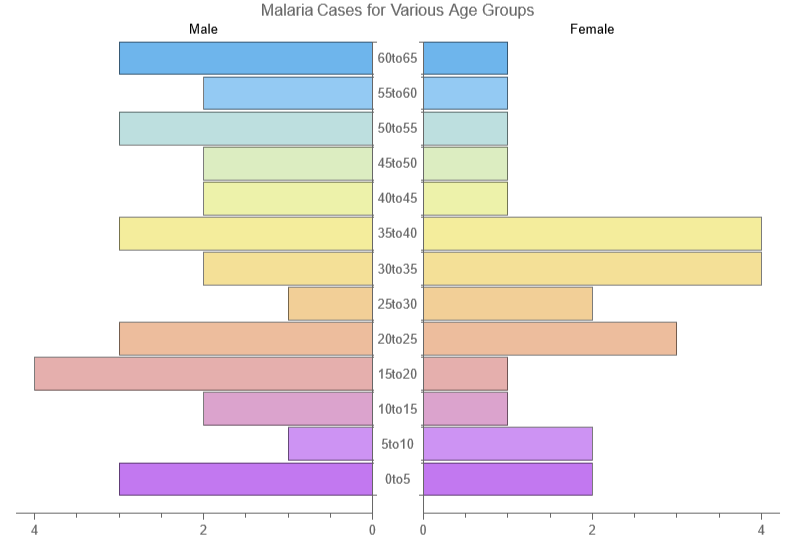
All age groups of both sexes are affected by malaria infection, but it is more prominent in females as compared to males. Pregnant women are also susceptible to malaria. On the other hand, from the current data it is also concluded that the parasitic incidence rate is high in males as compared to females only in age groups 5-10 and 26-40. This could be because of the higher frequency of time spent doing outdoor activities by this group, making this group more vulnerable to parasite attack.
SectionC | Occupation and Malaria
SectionC | Occupation and Malaria
Create the BarChart
A huge majority of the people in the study area belong to the labor class. All of them belong to the low income group. This low income level affects the whole structure of the study area; economy and politics override all else. The spread of a disease in an area is also based on the activities people are engaged in to earn their livelihood. The economic activities in which the people of the study area are engaged also contribute partially to the risk of malaria. Analysis indicates that the incidence of malaria in labor is high as compared to other occupational structure. Because this group of people have low incomes, poor housing conditions, low literacy rates and unawareness about their health issues like malaria, the incidence of malaria is high.
Chapter 3: Spatial + Temporal Distribution
Chapter 3: Spatial + Temporal Distribution
◼
Consider using TableForm or Grid
Time series analysis of malaria case is called temporal analysis.Time series investigation of malaria can be suitable for etiological identification of disease especially climatic factors, which can ultimately be used for preventing measures of disease in the study area.The data taken for temporal analysis was conducted on the data showing annual frequency of suspected and diagnosed malaria cases in Union Council Mubarakpur.The data was taken from District Health Office Bahawalpur since 20011 - 2014. These were the cases which were registered at Bahawalpur Victoria Hospital, Basic Health Unit Private Hospitals and Rural Health Units of the study area during above mentioned years
Chapter 4: Climatic Factors of Malaria
Chapter 4: Climatic Factors of Malaria
Climatic factors have been considered important factors in the spreading of malaria because they influence both vectors and malaria parasites, directly or indirectly. Moreover, other issues such as any change in land-dwelling forms and construction of water control can have considerable effects on malaria transmission (Devi & Jauhari, 2013).
Association Between Suspected Malaria Cases and Rainfall in 2014
Although malaria cases were found throughout the year, their frequency was high in they rainy and summer seasons as compared to the winter season because rainy and summer seasons are favorable for the survival of mosquitoes. Further analysis shows that the rainfall plays an important role in malaria epidemiology because water not only provides the medium for aquatic stages of mosquito life but also increases the relative humidity .