Equivalence of Three Catalan Number Interpretations
Equivalence of Three Catalan Number Interpretations


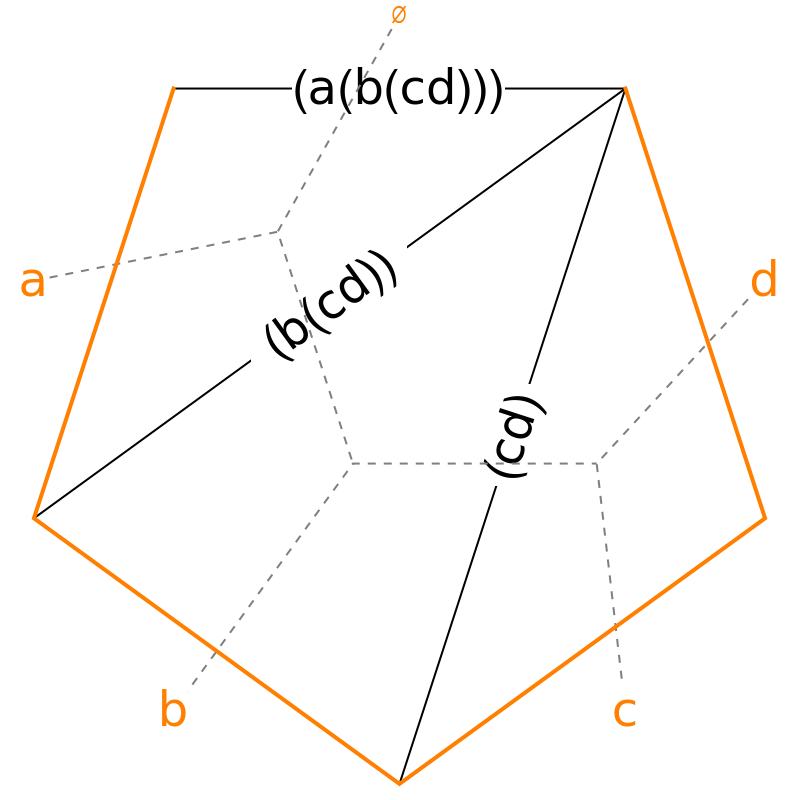
The Catalan numbers count:
• the ways a polygon with sides can be cut into triangles;
n+2
n
• the ways to parenthesize a sequence of factors to be multiplied, two at a time;
n+1
• the planted trivalent trees with leaves.
n+1
This Demonstration shows the equivalence of the three interpretations by optionally labeling each polygon triangulation with the corresponding parenthesized expression, tree, or both.
Details
Details
Snapshots 1, 2: The correspondence is built up by labeling the sides of a polygon. In the parenthesized expression, the innermost pair or pairs of items being multiplied correspond to a new edge drawn from the "beginning" (proceeding counterclockwise) of one polygon side to the "end" of the other: edge (bc) in Snapshot 1 and (ab) in Snapshot 2. Another edge is then drawn based on products involving the original pairs: in Snapshot 1, beginning of side a to end of edge (bc), resulting in (a(bc)); in Snapshot 2, beginning of edge (ab) to end of side c, resulting in ((ab)c).
Snapshot 3: the process is repeated until no products remain in the parenthesized expression, at which point the parenthesized expression corresponding to the triangulation appears at the top side of the polygon
Snapshot 4: in the tree corresponding to a triangulation, each fork connects two terms in each multiplication
M. Gardner, Chapter 20, Time Travel and Other Mathematical Bewilderments, New York: W. H. Freeman, 1988.
External Links
External Links
Permanent Citation
Permanent Citation
Robert Dickau
"Equivalence of Three Catalan Number Interpretations"
http://demonstrations.wolfram.com/EquivalenceOfThreeCatalanNumberInterpretations/
Wolfram Demonstrations Project
Published: March 7, 2011