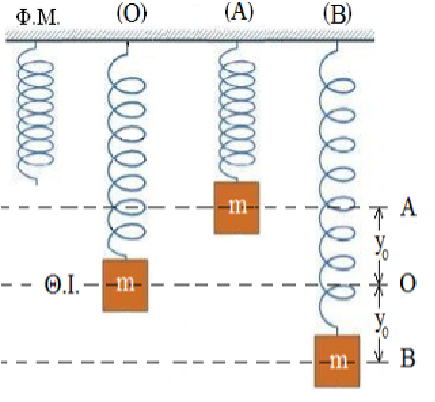
A spring with natural length (N . L .) hangs from the ceiling . A mass is placed on the spring and is in equilibrium at position O (E . P . -Equilibrium Position), at a distance of 1 meter from the floor . The mass oscillates, starting from position O, executing oscillation between the two extreme positions A and B, which are a fixed distance apart equal to meters . The distance of the mass (in meters) from the floor, as a function of time (in seconds), is given by :
m
2
y
0
y(t)1+0.2sint
π
2
1
. Find and then find the distance between the two extreme positions A and B of the oscillation .
y
0
2
. Find the period of the oscillation .
3
. Plot the function for in the interval [0, 4] .
t
4
. Find at what times the distance of the mass from the floor will be equal to 1.1 meters, for in the interval [0, 2] .
t
Solution
Solution
Solution
1
. The trigonometric function , where has maximum , minimum and period
f(x)ρ·sin(ωx)
ρ,ω>0
ρ
-ρ
T
2π
ω
y
0
In[]:=
r=0.2;
The function has maximum
y(t)
In[]:=
max=1+r
Out[]=
1.2
and minimun
In[]:=
min=1-r
Out[]=
0.8
The distance between the two extreme positions A and B is
In[]:=
Abs[max-min]
Out[]=
0.4
2
.The period of the function is
y(t)
In[]:=
T=2Pi/(Pi/2)
Out[]=
4
3
.
In[]:=
y[t_]=1+0.2Sin[Pi/2t]
Out[]=
1+0.2Sin
πt
2
In[]:=
table=Table[{t,y[t]},{t,0,4}];
In[]:=
TableForm[table,TableHeadings->{None,{"t","y(t)"}}]
Out[]//TableForm=
t | y(t) |
0 | 1. |
1 | 1.2 |
2 | 1. |
3 | 0.8 |
4 | 1. |
In[]:=
Plot[y[t],{t,0,4},PlotStyle->{Green,Thick},PlotRange->{{0,4},{0,Automatic}},PlotLabels->Automatic,AxesLabel->{"x","y"}]
Out[]=
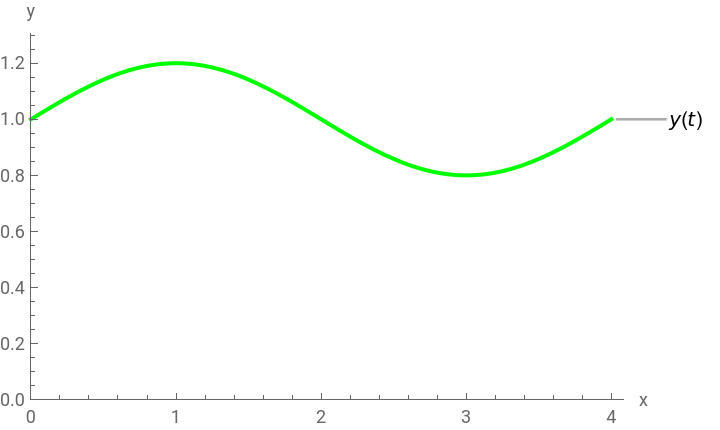
4
.
Essentially, we are asking to find the time moment when .
t∈[0,2]
y(t)1.1
In[]:=
Reduce[{0<=t<=2,y[t]==1.1},t]

Out[]=
t0.333333||t1.66667
So and .
t
1
3
t
5
3