At any time in mid-March of 2025, go outside after sunset and look to the west. Venus is very bright in the western evening skies, weather permitting, but the brightness is changing leading up to inferior conjunction when it hides in the glow of the Sun. Let’s explore what inferior conjunction means. Venus, as observed from Earth, goes through phases like our Moon due to Venus being on an orbit that is interior to the Earth orbit around the Sun. This means that at various times Venus will appear further from the Sun or nearer to the Sun depending on where it is in its orbit compared to Earth.
Greatest Eastern Elongation
Greatest Eastern Elongation
Venus appears furthest from the Sun (in angular distance) when it is either at its greatest point to the East or to the West of the Sun along the ecliptic plane. At greatest eastern elongation, Venus appears furthest from the Sun at sunset and so is typically higher in the sky.
In[]:=
greatestEasternElongation=FindAstroEvent"GreatestEasternElongation",,TimeDirection->-1
Out[]=
In[]:=
AstroGraphics[AstroReferenceFrame->Sunset[DateObject[{2025,1,10}]],AstroRange->All]
Out[]=
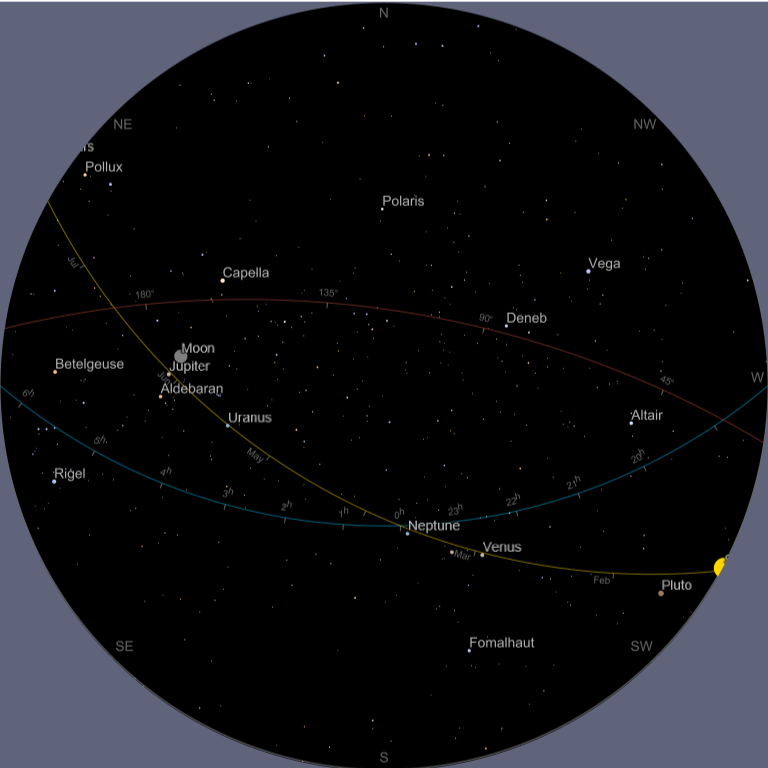
The above shows the visual appearance of the separation of Venus and the Sun at sunset on the day of greatest eastern elongation. For a quantitative approach, the angular separation between the Sun and Venus can be computed as follows:
In[]:=
AstroAngularSeparation,,Sunset[DateObject[{2025,1,10}]]
Out[]=
At sunset on that day, Venus is nearly 36° above the horizon.
In[]:=
AstroPosition,Sunset[DateObject[{2025,1,10}]]["Altitude"]
Out[]=
35.9442
The 3D geometry of the situation can be explored with SolarSystemPlot3D.
In[]:=
position3D[entity_,date_]:=AstroPositionentity,"MeanEcliptic",date,,"Cartesian"["Data"]
In[]:=
conjunctionPlot[date_,opts:OptionsPattern[Graphics3D]]:=ResourceFunction["SolarSystemPlot3D"]Red,Sphere,.01,Blue,Sphere,.01,date,"IncludeSun"->True,"SunStyle"->{Hue[.14],Lighting->{AmbientLight[GrayLevel[.3]],DirectionalLight[White,ImageScaled[{0,0,1}]]},Sphere[{0,0,0},.05]},opts,PlotRange->1.05,SphericalRegion->True,ViewAngle->Pi6,Boxed->False,ViewVector->3position3D,date+{0,0,1},{0,0,0},Method->{"ShrinkWrap"->True},ImageSize->600
From this vantage point, Venus can be found to the left of the Sun from the Earth’s point of view.
In[]:=
conjunctionPlot[greatestEasternElongation]
Out[]=
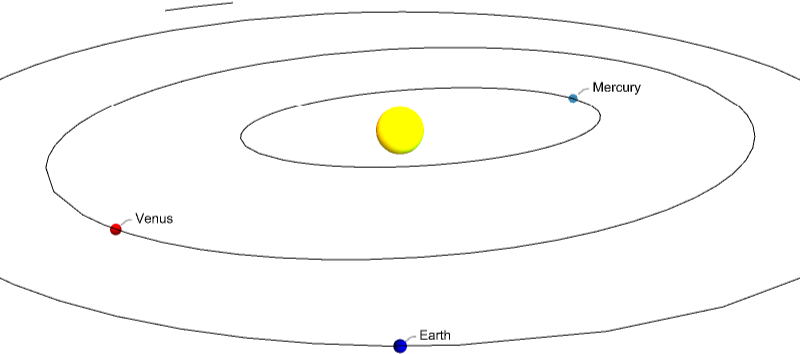
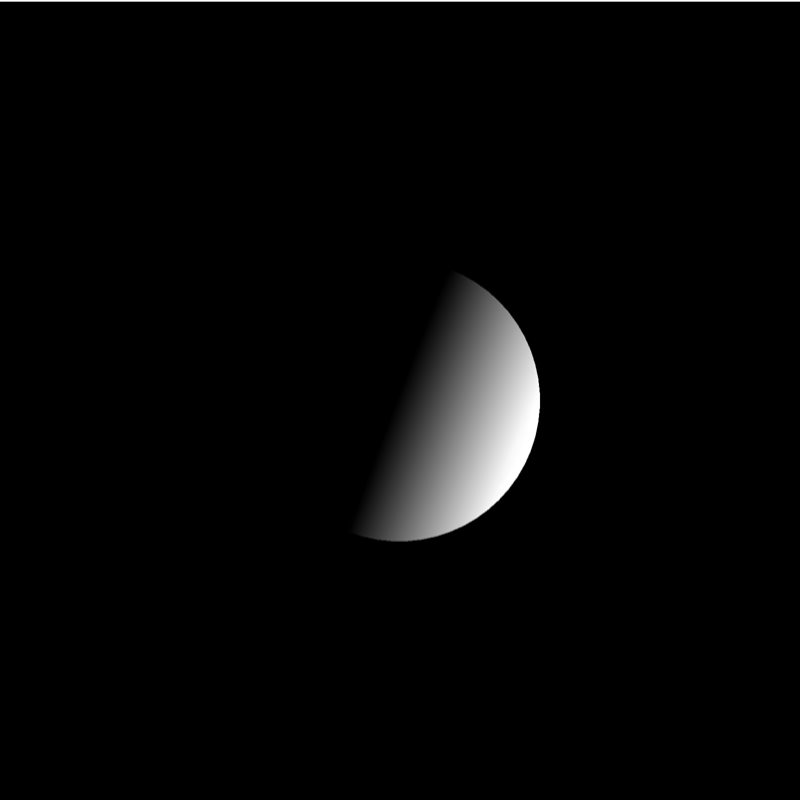
Through a telescope on Earth, Venus appears to be half-illuminated.
In[]:=
ResourceFunction["TelescopeView3D"],DateObject[{2025,1,10,19,0,0},TimeZone->"America/Chicago"],ViewVertical->{0,0,1},"FieldWidth"->Quantity[70,"Arcseconds"],ImageSize->600
Out[]=
Inferior Conjunction
Inferior Conjunction
On March 22, 2025, Venus continues along its orbit bringing it closer to the Sun from Earth’s point of view and reaches inferior conjunction.
In[]:=
inferiorConjunction=FindAstroEvent"InferiorConjunction",
Out[]=
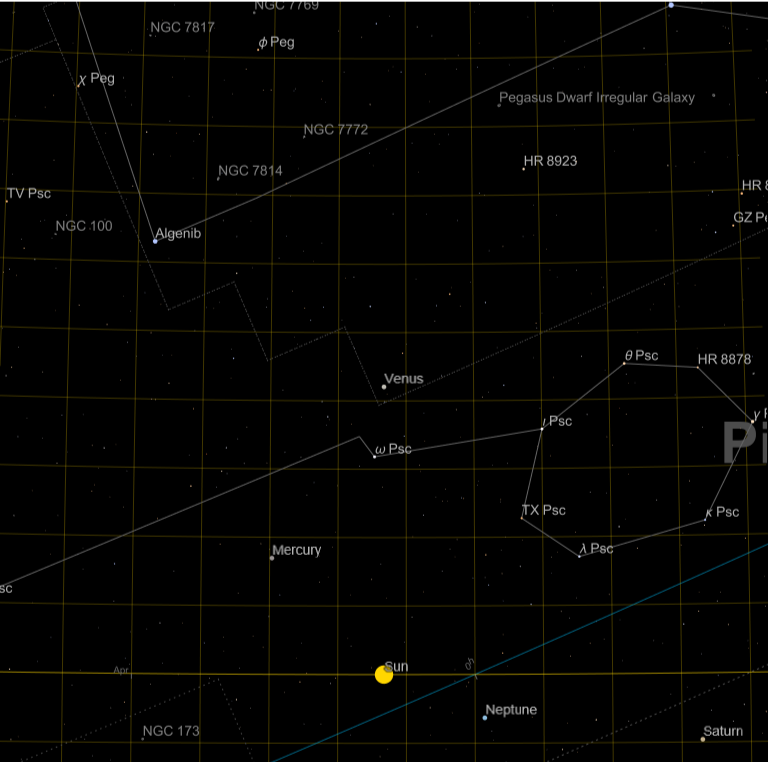
From the point of view on the surface of Earth, Venus and the Sun are near each other so its difficult to observe Venus due to daylight. AstroGraphics can simulate the view in ecliptic coordinates which shows that Venus and the Sun have the same ecliptic longitude, the definition of conjunction.
In[]:=
AstroGraphics,AstroReferenceFrame->{"Ecliptic",inferiorConjunction},AstroGridLines->Automatic
Out[]=
From the same solar system point of view shown earlier, Venus appears in line with the Sun.
In[]:=
conjunctionPlot[inferiorConjunction]
Out[]=
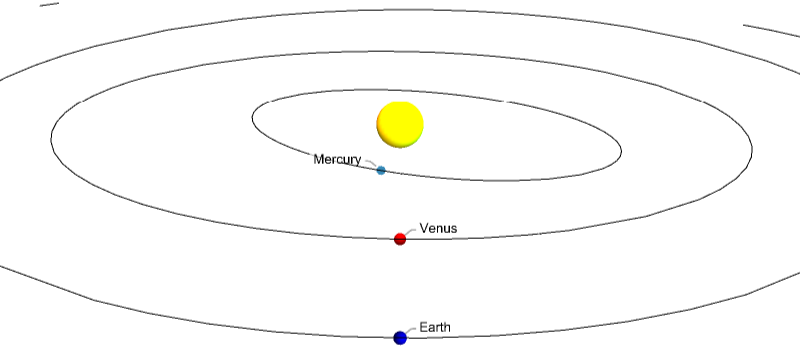
But if the view point is tilted so that its in the Earth’s orbital, Venus appears above the Sun due to its tiled orbit. This explains the view seen in the previous AstroGraphics result, with Venus above the Sun. The solar system plot just exaggerates the sizes of the objects for clarity.
At this time, an observer on Earth is essentially observing Venus from behind, with its illuminated face away from Earth. All that can be seen is a razor thin crescent and that is during daylight so making it nearly impossible to observe from Earth.
As Venus gets closer to the Sun in angular distance, the planet will start to hide in the Sun’s glare.
An animated telescopic view starting at greatest eastern elongation and ending at inferior conjunction shows how the apparent phase of Venus changes for an observer on Earth and its size gets larger in the telescope as its getting closer to Earth.
CITE THIS NOTEBOOK
CITE THIS NOTEBOOK
Venus inferior conjunction March 2025: phases & solar alignment dynamics
by Jeffrey Bryant
Wolfram Community, STAFF PICKS, March 14, 2025
https://community.wolfram.com/groups/-/m/t/3416978
by Jeffrey Bryant
Wolfram Community, STAFF PICKS, March 14, 2025
https://community.wolfram.com/groups/-/m/t/3416978