Introduction to QFT
Introduction to QFT
Quantum Field Theory (QFT) is the fundamental framework used in physics to describe particles and their interactions. Instead of treating particles as primary objects, QFT considers fields as the fundamental entities. The fundamental quantities are fields, and particles are excitations.
Definition in Mathematics
Definition in Mathematics
◼
A field is written as:
ϕ(x,t)And dynamically interpreted by the Lagrangian form:L(t)= L (,) with L being the Lagrangian density (or simply Lagrangian)
∫x
3
d
φ
α
∂
μ
φ
α
◼
It is also important to note the general Klein-Gordon Equation considering the Lagrangian with arbitrary potential V(φ):ϕ+=0
∂
μ
μ
∂
∂V
∂ϕ
Wolfram Model Correlation
Wolfram Model Correlation
Let’s make a Hypergraph of the Wolfram Model Final state plot for some initial conditions. The goal is to later connect the nodes of the graph with the fields that are described in this theory.
In[]:=
ResourceFunction["WolframModel"]
Out[]=
In[]:=
wm=ResourceFunction["WolframModel"][{{x,y},{x,z}}->{{x,z},{x,w},{y,w},{z,w}},{{0,0},{0,0}},10,"FinalStatePlot"]
Out[]=
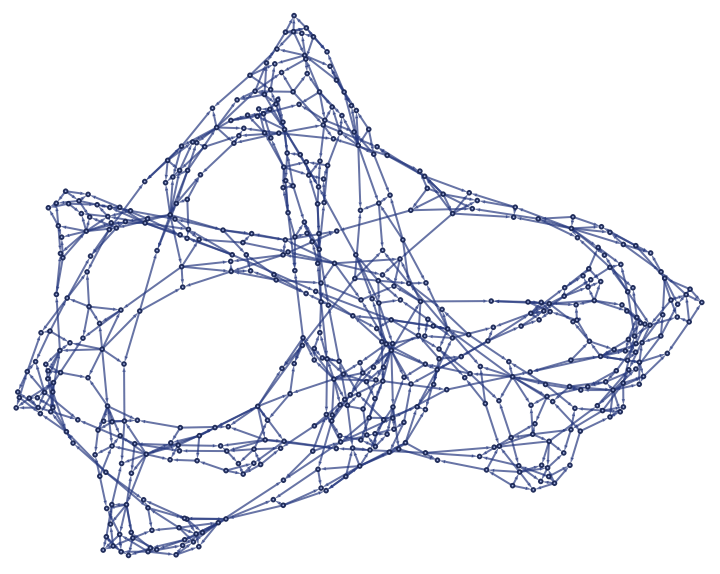
The final state plot of the Hypergraph can be used to associate nodes with QF excitations.
Bibliography
Bibliography
[1] Tong, D. (2006). Lectures on quantum field theory. University of Cambridge. https://www.damtp.cam.ac.uk/user/tong/qft/qft.pdf
[2] Tong, D. (n.d.). What is quantum field theory? (Video)
CITE THIS NOTEBOOK
CITE THIS NOTEBOOK
Quantum field theory and the Wolfram model- theoretical framework and introduction
by Myrto Terpsiadou
Wolfram Community, April 11, 2026
https://community.wolfram.com/groups/-/m/t/3682254
by Myrto Terpsiadou
Wolfram Community, April 11, 2026
https://community.wolfram.com/groups/-/m/t/3682254