Discretization of a Non-Abelian SU(2) Gauge Theory
Omar Medina Rosales
Institut de Física Corpuscular (IFIC) - Universitat de València (UV)
Omar Medina Rosales
Institut de Física Corpuscular (IFIC) - Universitat de València (UV)
We obtained the discrete version of a (non-Abelian) gauge theory, by considering its definition as the SU(2) Hopf bundle. From the graphical structure of the base space, the bundle doesn’t seem to lose the original topological structure in the discretization process. Furthermore, we attempted to compute the second Chern class number, intending to prove that the connection preserves the topological structure of the fiber bundle.
7
S
Introduction
Introduction
There’s one principle that has majorly guided physicists in the search of describing the intriguing and exciting phenomena that take place in Nature, that principle is symmetry [1,2].Especially in the realm of fundamental particle physics, the search for knowledge about the most basic components of the Universe has led to theories, such as the highly successful Standard Model, that are essentially based on symmetry principles. In the XXth century, a particular type of symmetries was recognized to be prominent and powerful when applied in the context of particle interactions. Clearly, we are referring to gauge theories, whose principles are bases on the Glasgow-Weinberg-Salam (GWS) Model or Quantum Chromodynamics (QCD) which together describe with amazing accuracy the elector-weak and strong nuclear interactions as quantum field theories. The fairly novel approach to fundamental physics that is being proposed and developed by Wolfram S. and many of his collaborators (The Wolfram Physics Project) is based on simple evolution rules of hypergraphs that are intended to describe the Universe (as a discrete entity) itself. These so-called Wolfram Models have hinted at great capabilities in describing gravitational phenomena and also foundational properties of quantum mechanical theories. Nevertheless, given the success that quantum field theory has gotten in describing dynamics of fundamental particles if the Wolfram Models actually intend to describe and even predict fundamental particle phenomena, it’s imperative that in some limiting case of these models gauge symmetries emerge in a natural way.
Background
Background
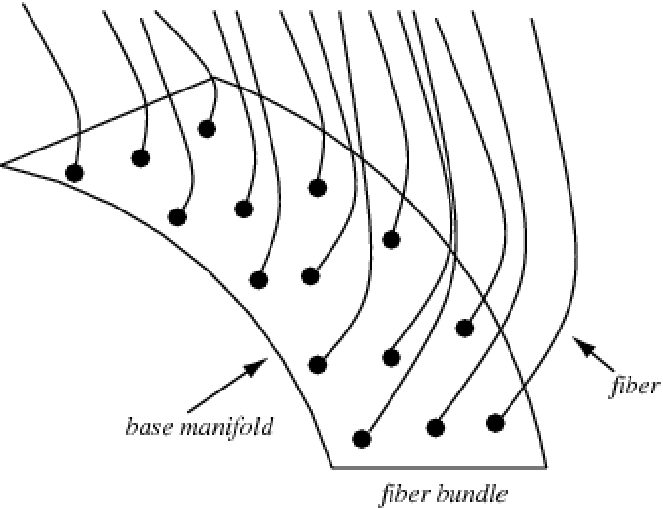
The Standard Model’s Lagrangian is defined by its invariance under the Gauge group which includes three different Lie groups. These types of transformation groups consist of elements that can be specified by continuous parameters. It has been well studied that these groups can be identified with differential manifolds. Through this correspondence, Lie group gauge theories can be deeply understood using the mathematical tools developed for principal (fiber) bundles [4,6].
SU⊗⊗U
(3)
C
SU(2)
L
(1)
Y
Rationale
Rationale
We followed the discretization of the Hopf bundle as described in detail by N.S. Manton [5]. In this referenced work, the author doesn’t obtain the topological equivalence between the discrete bundle and the continuous one, since he wasn’t able to compute the (topological invariant) second Chern number. Nevertheless, he hints at a possible way of computing this quantity, in principle that’s the reason that leads us to try to tackle this problem. Roughly speaking the steps we followed in this construction are listed below
7
S
◼
Consider the 7-sphere () which is locally undistinguishable from ×, this manifold can be embedded in . Thus one can choose to parametrize it with two quaternionic coordinates ). This is convenient since quaternions have a natural utility when describing 3-dimensional rotations using simple scalar (quaternion) multiplication.
7
S
4
S
3
S
8
(,
q
1
q
2
◼
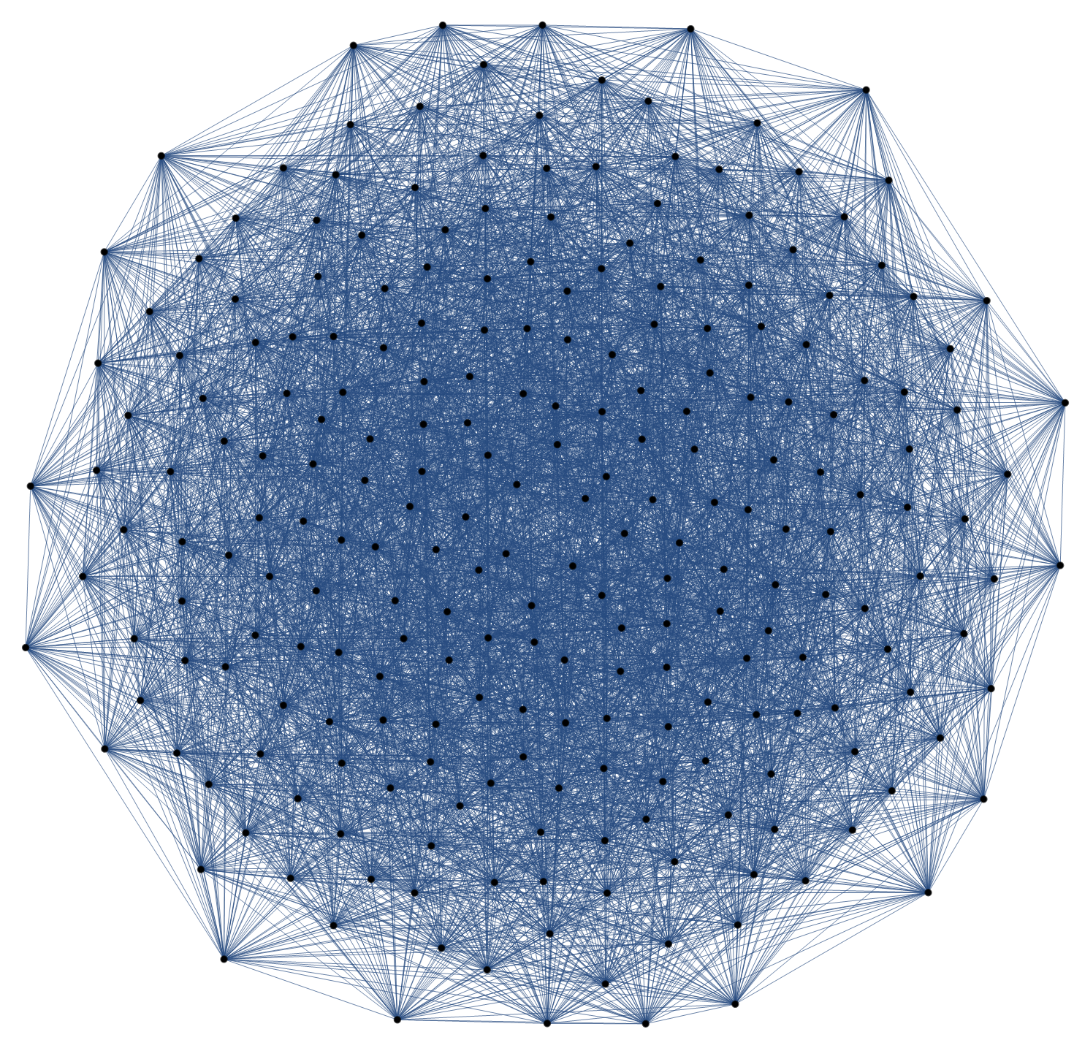
To describe the discretized version of the principle bundle () it’s necessary to consider a polytope which is 8-dimensional. The examined possibility is the semiregular (uniform) polytope with 240 vertices and 6720 edges.
7
S
4
21
◼
Using the quaternion coordinates one can easily identify the (discretized) SU(2) () structure inside the bundle, and to characterize the fibers of the bundle.
3
S
◼
A discrete connection can be defined and we attempted to compute the second Chern number using the holonomy of the discrete connection around loops in the base space . Carrying out this computation successfully would complete the analogy between the continuous Hopf bundle and the discrete one presented.
The Discretization of 7S
The Discretization of
7
S
To describe the 7-sphere in terms of coordinates, we embed it in the flat eight-dimensional space , to parametrize a point in this space, eight degrees of freedom are necessary. Therefore two quaternions (with four degrees of freedom each) in an ordered pair of the form can do the job. Certainly, the points that belong to are given by the sphere equation in 8-dimensions,
8
q(,)
q
1
q
2
7
S
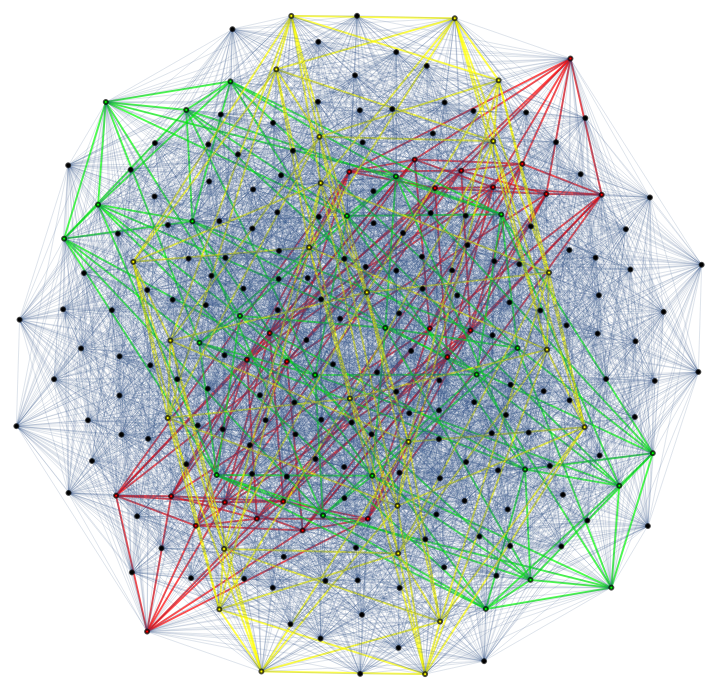
We use the semiregular (uniform) polytope with 240 vertices and 6720 edges. This polytope can be displayed as the graph below in a fairly simple way using the quaternion coordinates [5].
4
21
The Interesting Question
The Interesting Question
The vertices of the graph displayed above represent the points that belong to the 7-sphere. Nevertheless, the important question arises ¿Does this discrete manifold holds the same topological properties that does? To try to answer this question we try to obtain the structure of the SU(2) Hopf principal bundle, where each fiber must resemble the properties of a subgroup of the SU(2) topological (discretized) space. To obtain the precise location of the fibers in the discrete 7-sphere we used the Hurwitz group of unit quaternions which consists of the following twenty-four elements
7
S
H±1,±i,±j,±k,(±1±i±j±k),
1
2
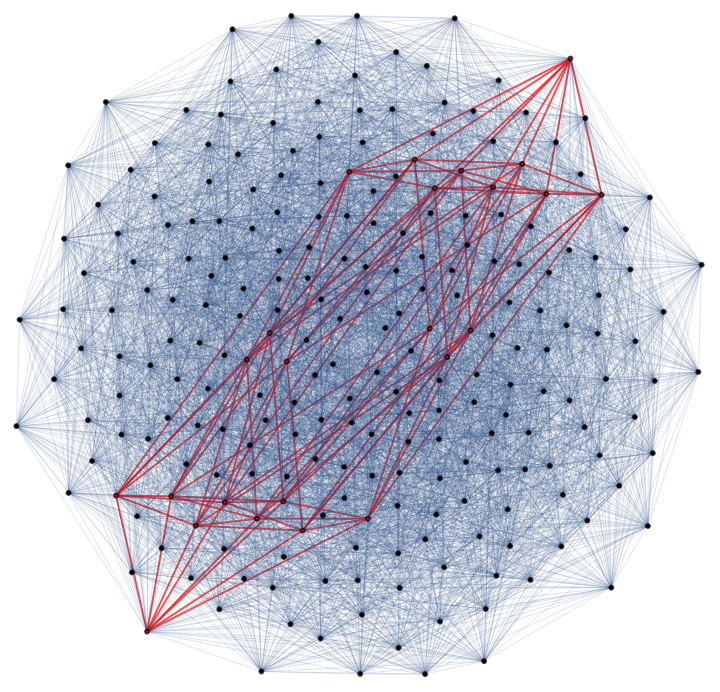
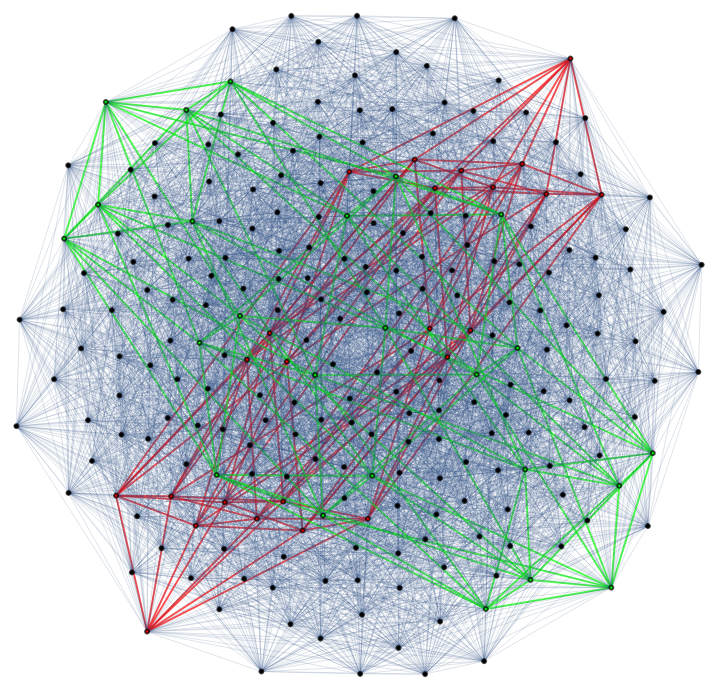
This is a discrete subgroup of the SU(2) with 24 elements, this illustrates very clearly the advantages of using quaternion coordinates since the action of H on the coordinates of is simply a scalar (non-commutative ) product. The action of the elements of H over the points of the is simply mapping the 240 points onto themselves [5]. Furthermore, one can construct the orbits of the group by applying the whole set of transformations to the points in the manifold and “tracing” their trajectory under the action of the group. We display below the subset of the bundle that conforms a fiber in the color red, and similarly for another two fibers.
7
S
7
S
Analyzing The Discrete Bundle
Analyzing The Discrete Bundle
The particular set of 10 points we selected to conform the base space are the following, each point in the base space belongs to one fiber.
When we render the graph of the base space alone some interesting result emerges.
A Topological Invariant Quantity
A Topological Invariant Quantity
Conclusion
Conclusion
Keywords
Keywords
◼
Non-Abelian gauge symmetry
◼
Fibre bundle
◼
Principal bundle
◼
Hopf SU(2) bundle
Acknowledgment
Acknowledgment
Mentor: Tobías Canavesi
I’d like to thank my mentor Tobías for supporting me during the Winter School, giving me valuable advice and enthusiasm. Also, I’m very great full with the Wolfram Physics Project staff for their guidance and interesting discussions during the school, especially with Stephen Wolfram, Jonathan, Xerxes, and Erin. Thanks for the opportunity. Thanks a lot!
References
References
◼
[1] S. Weinberg, “The making of the standard model,” The European Physical Journal C-
Particles and Fields, vol. 34, no. 1, pp. 5–13, 2004.
Particles and Fields, vol. 34, no. 1, pp. 5–13, 2004.
◼
[2] S. Weinberg, The quantum theory of fields. Vol. 1: Foundations. Cambridge University Press, 1995.
◼
[3] L. H. Ryder, Quantum field theory. Cambridge university press, 1996.
◼
[4] M. Nakahara, Geometry, topology and physics. CRC Press, 2003.
◼
[5] N. Manton, “Connections on discrete fibre bundles,” Communications in mathematical physics, vol. 113, no. 2, pp. 341–351, 1987.
◼
[6] Rowland, Todd. “Fiber Bundle.” From MathWorld--A Wolfram Web Resource, created by Eric W. Weisstein. https://mathworld.wolfram.com/FiberBundle.html