The following is ported from GLSL, learned/made with gemini/shadertoy.
I hope the implementation is interesting.
I would be very happy to explain how it works.
I hope the implementation is interesting.
I would be very happy to explain how it works.
In[]:=
(*1.×2DRotationMatrixHelper*)Rot2D[a_]:={{Cos[a],-Sin[a]},{Sin[a],Cos[a]}};(*2.HelperFunctions*)SmoothStep[min_,max_,x_]:=Module[{t=Clip[(x-min)/(max-min),{0,1}]},t*t*(3-2*t)];Mix[a_,b_,t_]:=(1-t)*a+t*b;(*3.Vectorized5DGenerator*)Generate5DBarnsley[numPoints_Integer]:=Module[{qXY={0.0,0.0},qZWV={0.0,0.0,0.0},r,nxy,nzwv},Drop[Table[r=RandomReal[];If[r<0.01,qXY={0.0,0.16*qXY[[2]]};qZWV={0.0,0.0,0.0};,If[r<0.86,nxy={0.85*qXY[[1]]+0.04*qXY[[2]]-0.02*qZWV[[1]],-0.04*qXY[[1]]+0.85*qXY[[2]]+1.6};nzwv={0.02*qXY[[1]]+0.85*qZWV[[1]]+0.05*qZWV[[2]],0.85*qZWV[[2]]-0.05*qZWV[[1]]+0.03*qZWV[[3]]+0.1,0.85*qZWV[[3]]-0.03*qZWV[[2]]};qXY=nxy;qZWV=nzwv;,If[r<0.93,nxy={0.20*qXY[[1]]-0.26*qXY[[2]]+0.12*qZWV[[1]],0.23*qXY[[1]]+0.22*qXY[[2]]+1.6};nzwv={-0.12*qXY[[1]]+0.22*qZWV[[1]]+0.15*qZWV[[2]],0.22*qZWV[[2]]-0.15*qZWV[[1]]+0.20*qZWV[[3]]+0.2,0.22*qZWV[[3]]+0.15*qZWV[[2]]+0.25};qXY=nxy;qZWV=nzwv;,nxy={-0.15*qXY[[1]]+0.28*qXY[[2]]-0.12*qZWV[[1]],0.26*qXY[[1]]+0.24*qXY[[2]]+0.44};nzwv={0.12*qXY[[1]]+0.24*qZWV[[1]]-0.15*qZWV[[2]],0.24*qZWV[[2]]+0.15*qZWV[[1]]-0.20*qZWV[[3]]-0.2,0.24*qZWV[[3]]-0.15*qZWV[[2]]-0.25};qXY=nxy;qZWV=nzwv;]]];Join[qXY,qZWV],{numPoints}],20]];(*4.OptimizedTransformation&ColorVectorization*)ProjectAndColor[pts5D_,yaw_,pitch_,zwRoll_,wvRoll_,spinePos_,camPos_]:=Module[{rotZW=Rot2D[zwRoll],rotWV=Rot2D[wvRoll],rotXZ=Rot2D[yaw],rotYZ=Rot2D[pitch],deepStem={0.01,0.18,0.05},brightTip={0.30,0.95,0.20},hyper5D={0.85,0.40,1.00}},(*Transformcoordinatesaspackedarrays*)Transpose[Map[Function[pt,Module[{qXY=pt[[1;;2]],qZWV=pt[[3;;5]],hyperZW,hyperWV,offset,worldXYZ,col,yHeight,vVal},hyperZW=rotZW.{qZWV[[1]],qZWV[[2]]};hyperWV=rotWV.{qZWV[[2]],qZWV[[3]]};offset={qXY[[1]],qXY[[2]]-spinePos,hyperZW[[1]]+hyperWV[[1]]*0.5};offset[[{1,3}]]=rotXZ.offset[[{1,3}]];offset[[{2,3}]]=rotYZ.offset[[{2,3}]];worldXYZ=(offset-{camPos[[1]],camPos[[2]],0.0})*0.25;yHeight=qXY[[2]];vVal=qZWV[[3]];col=Mix[deepStem,brightTip,Clip[yHeight/10.0,{0,1}]];col=Mix[col,hyper5D,Clip[Abs[vVal]*1.2,{0,1}]];{worldXYZ,RGBColor@@col}]],pts5D]]];(*5.OptimizedCloudManipulate*)Manipulate[Module[{pts5D,coords,colors},pts5D=Generate5DBarnsley[pointCount];{coords,colors}=ProjectAndColor[pts5D,yaw,pitch,zwRoll,wvRoll,spinePos,{camX,camY,camZ}];Graphics3D[{PointSize[0.003*fov],Point[coords,VertexColors->colors]},Axes->False,Boxed->False,Background->RGBColor[0.002,0.003,0.007],ViewVector->{{0,0,camZ},{0,0,0}},ViewAngle->(30.0/fov)*Degree,ImageSize->Medium]],{{yaw,0.0,"Yaw"},-Pi,Pi,0.1},{{pitch,0.0,"Pitch"},-1.55,1.55,0.1},{{zwRoll,0.45,"ZW-Roll"},-Pi,Pi,0.1},{{wvRoll,0.25,"WV-Roll"},-Pi,Pi,0.1},{{spinePos,5.0,"Spine Base"},0.0,10.0,0.2},{{camX,0.0,"Cam X"},-2.0,2.0,0.1},{{camY,0.0,"Cam Y"},-2.0,2.0,0.1},{{camZ,2.5,"Cam Z"},0.5,10.0,0.2},{{fov,1.0,"FOV Zoom"},0.2,3.0,0.1},{{pointCount,15000,"Point Density"},2000,40000,2000,TrackingFunction->(pointCount=#;&)}]
Out[]=


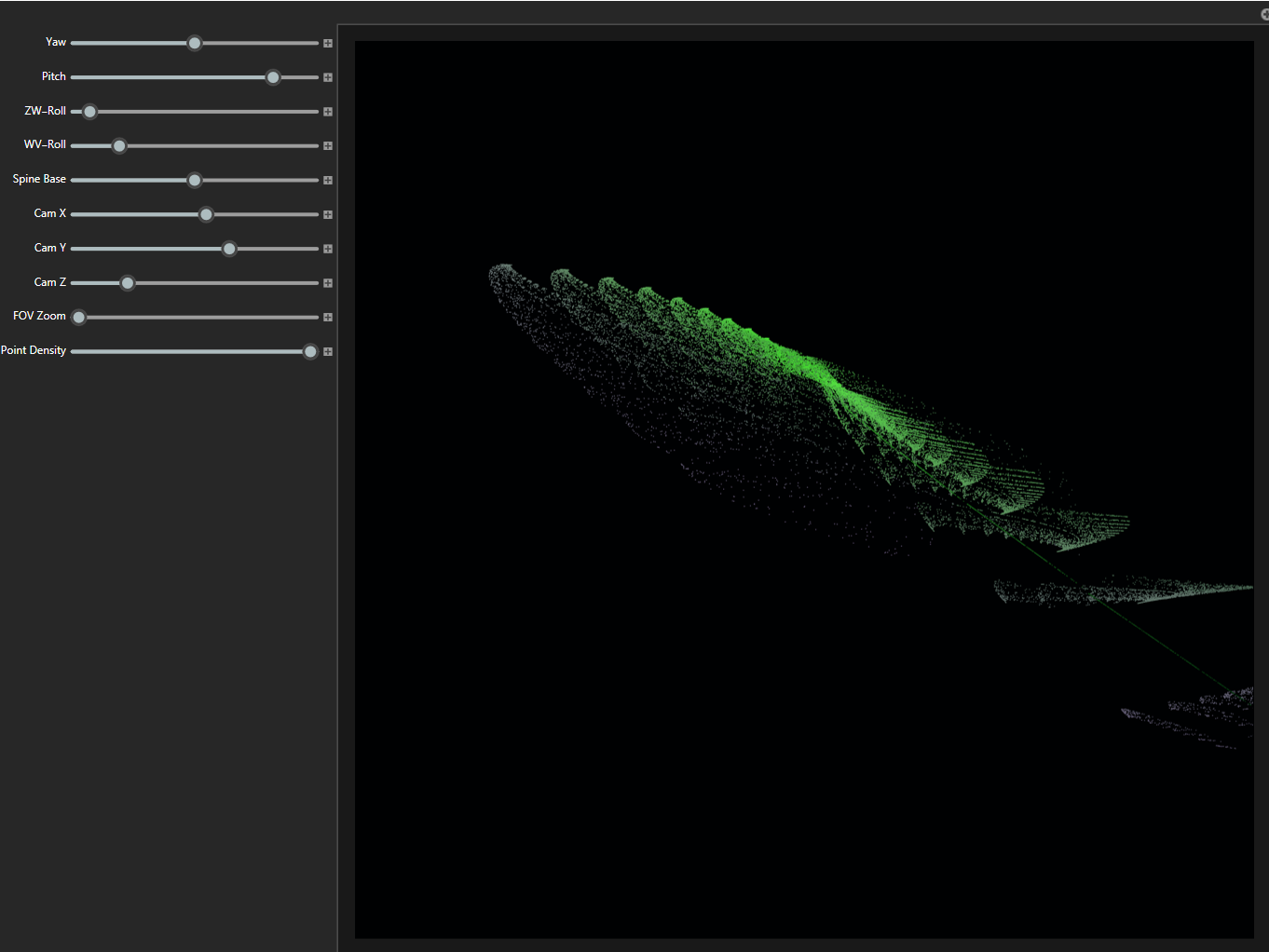
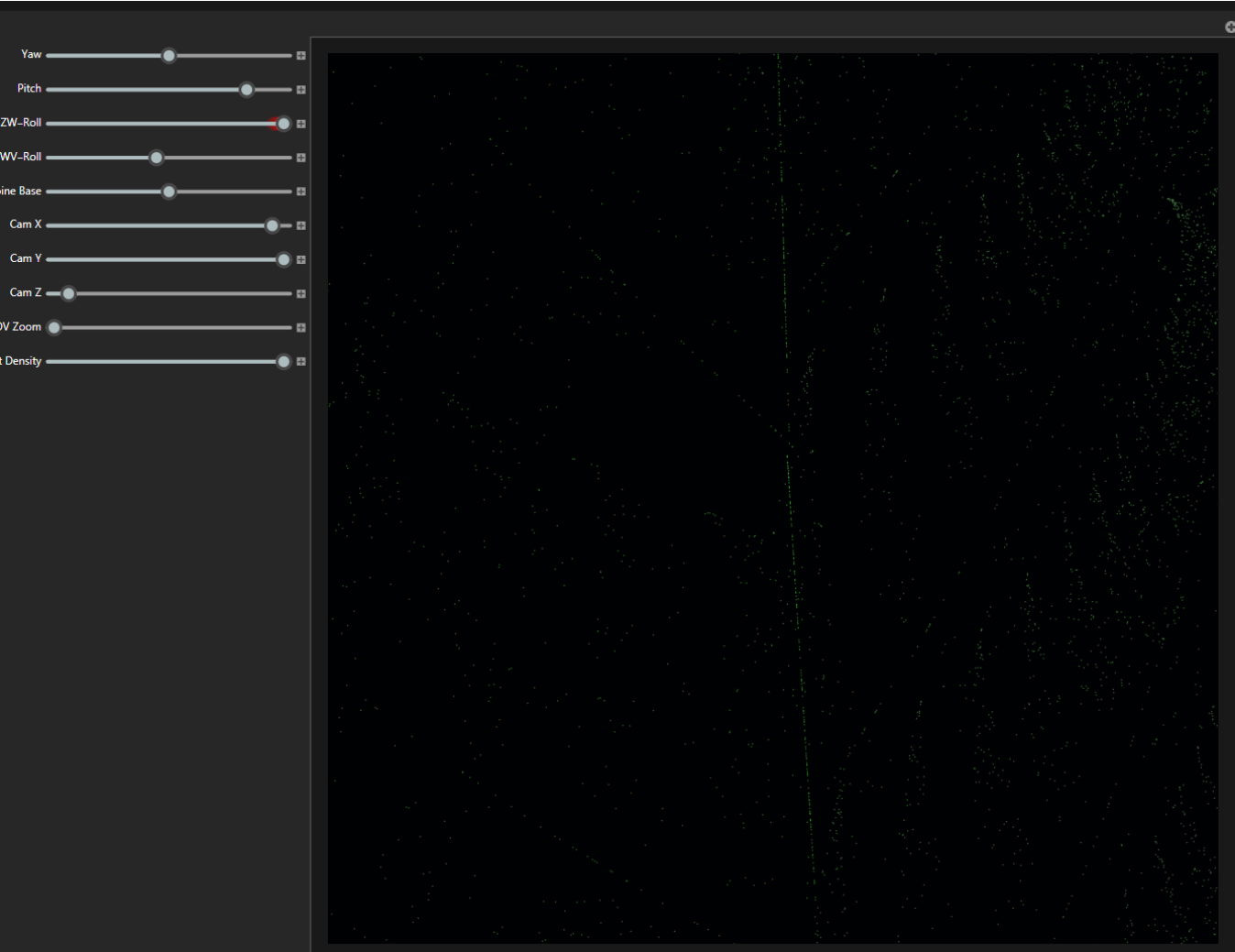
I hope this is an interesting mathematica demo! I would love to answer questions, if they are worth asking.
The following is an AI generated technical summary of the mathematica 15 implementation, from the same (ish) session:
**5D Barnsley Hyper-Plane Attractor & Bulk Array Pipeline**
This system implements a 5-dimensional stochastic Iterated Function System (IFS) mapped into $\mathbb{R}^3$ space via a hybrid Givens projection chain and a bulk graphics array pipeline.
* **1. Sub-Plane Rotators (`Rot2D`):** Instantiates $2 \times 2$ Givens rotation matrices to execute planar transformations across higher-dimensional sub-planes ($ZW$ and $WV$) and camera viewing axes ($XZ$ and $YZ$).
* **2. Spatial & Hyper-Dimensional Interpolators:** Employs polynomial `SmoothStep` and linear `Mix` functions to construct a dual-parameter color mapping driven by spatial height ($y$) and hyper-dimensional variance ($v$).
* **3. Stochastic 5D Attractor Engine (`Generate5DBarnsley`):** Executes a 5-variable Markov chain using a 4-affine transformation system. Generates an $N \times 5$ state trajectory in $\mathbb{R}^5$ and discards the initial 20 transient steps to constrain points to the strange attractor manifold.
* **4. Dimensional Reduction ($\mathbb{R}^5 \to \mathbb{R}^3$) & Packed Buffer Sync:** Collapses hyper-coordinates into 3D world space via linear superposition of rotated sub-planes, then applies camera Givens rotations. Synchronizes coordinate matrices and `RGBColor` vectors into paired packed arrays via `Transpose`, dispatching a single bulk `Point[coords, VertexColors -> colors]` primitive directly to the GPU to eliminate graphics object allocation overhead.
* **5. Interactive Viewport & Density Management:** Integrates the iteration generator directly into the `Manipulate` reactive loop. Leverages a `TrackingFunction` on the density slider to regulate point updates ($2,000$ to $40,000$ points) without triggering secondary UI evaluation cascades.
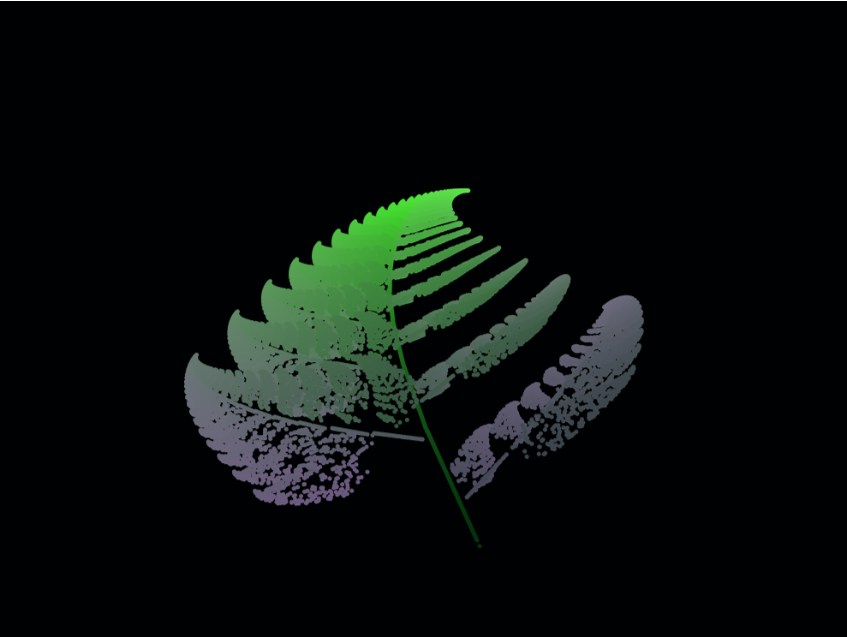
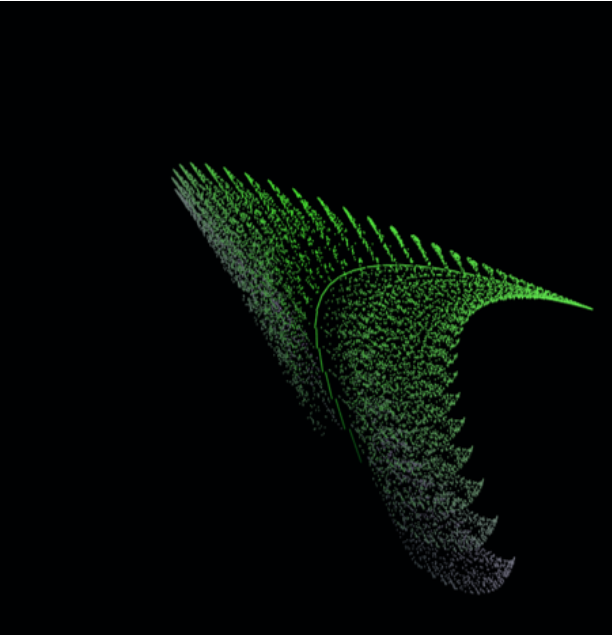
As this was ported from glsl, here are a few high resolution captures, same affine transform engine. Do note there are slight ray marching ghosts, but that’s just poor implementation. I’m fairly certain this ,and the mathematica15 implementation, can be pushed much further.
As this was ported from glsl, here are a few high resolution captures, same affine transform engine. Do note there are slight ray marching ghosts, but that’s just poor implementation. I’m fairly certain this ,and the mathematica15 implementation, can be pushed much further.
I would love for someone to point to this elsewhere! I used AI for the *entire* coding process, but the ideas were mine, of course.
Ok, before I post, I wanted to try a barebones CPU port. managed to get gemini to output this
Ok, before I post, I wanted to try a barebones CPU port. managed to get gemini to output this
This is an untuned output. This is where I just need to hand things off, I hope...