Fully programmed by Claude (Anthropic) using wolframscript. Some guidance by me.
This notebook presents a pure-Wolfram-Language implementation of Blackjack. It ships as two packages: Blackjack` contains the game engine (deck, dealer policy, scoring, payout, Hi-Lo counting, a Hit/Stand basic-strategy oracle, and a Monte-Carlo EV estimator), and BlackjackGame` wraps everything in a DynamicModule front-end with a full casino ruleset — bankroll, chip-based betting, 3:2 natural-blackjack payout, double-down, and splitting pairs (including the split-aces special case). Beyond the playable game, the notebook develops the probability theory of Blackjack: the chance of a natural ( ≈ 4.83%), the dealer's final-total distribution for each upcard, the Bellman formulation of the player's decision problem, the resulting basic-strategy table, and the Hi-Lo card counting system with its linear EV model and the Kelly betting criterion. Every figure in the document is produced by the same code that powers the game; the game itself can be launched from the cell at the end.
P(BJ)
1. What is Blackjack?
1. What is Blackjack?
Blackjack is a heads-up card game between a player and the house (the dealer). Both parties are dealt two cards from a shared shoe of one or more 52-card decks. The player's cards are face up; one of the dealer's cards is face-up (the upcard) and the other is face-down (the hole card). The goal is to assemble a hand that beats the dealer's total without exceeding 21. Cards count at face value; J, Q, K count 10; an Ace counts 1 or 11, whichever gives a better total.
The player acts first, repeatedly choosing one of five actions:
Hit take another card;
Stand end the player's turn with the current total;
Double down double the bet, take exactly one more card, then stand automatically;
Split when the two initial cards have equal point value, split them into two hands with equal bets; split aces receive one more card each and cannot be hit further;
Surrender (not in this implementation) forfeit half the bet without playing.
Once the player stands or busts on every hand, the dealer turns up the hole card and plays a rigid policy: hit until the total is at least 17. Casinos differ on whether the dealer also hits a soft 17 ("H17") or stands on it ("S17"); both rules are supported here via a checkbox in the Options opener. A natural blackjack — an ace plus any ten-valued card on the initial deal — pays 3 : 2; other wins pay 1 : 1; equal totals push (0); the player loses the bet on any bust regardless of the dealer's outcome.
2. Cards and visual representation
2. Cards and visual representation
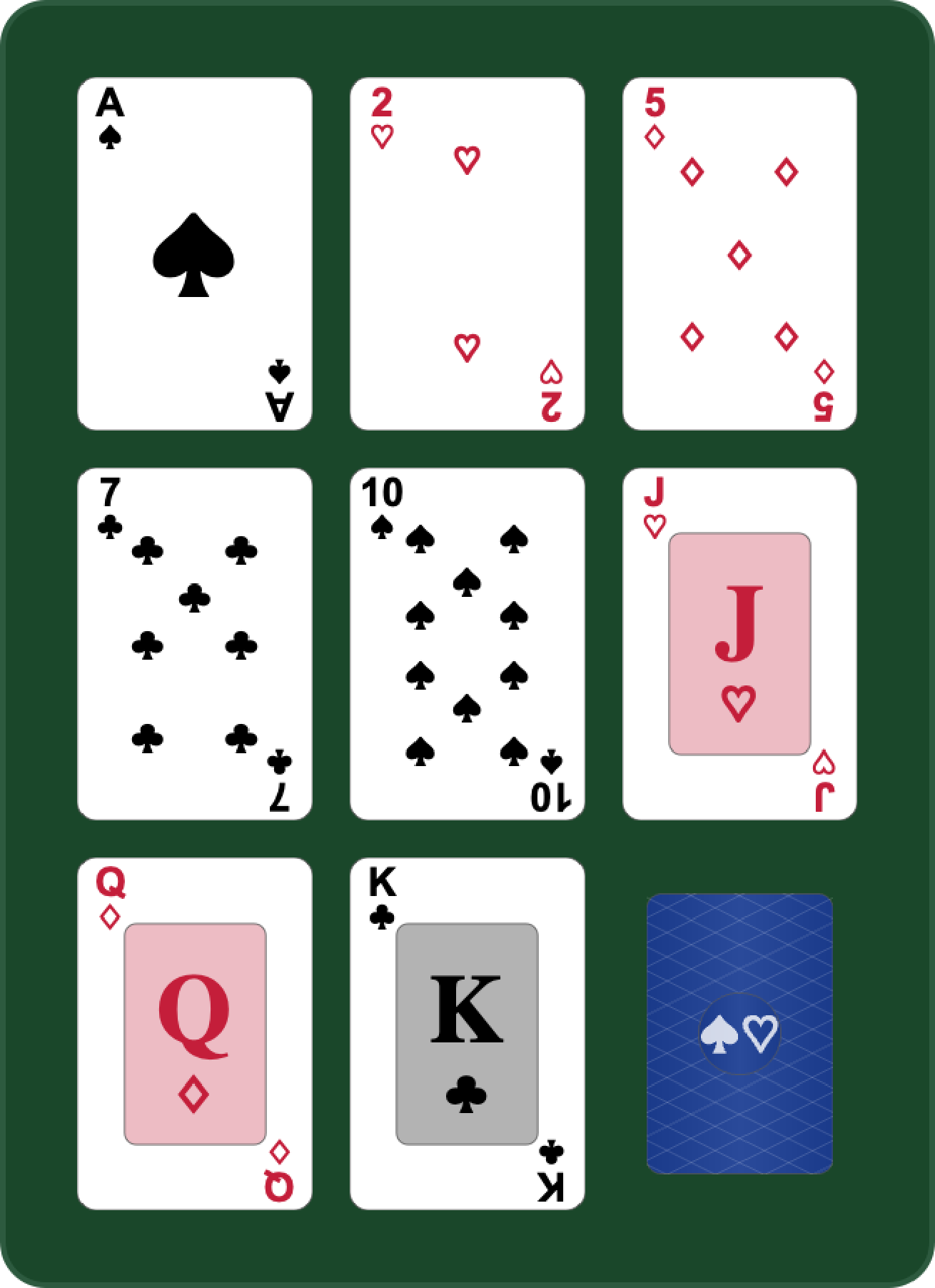
Each card is stored as a plain association with two keys: "value" (one of "A", "2", …, "10", "J", "Q", "K") and "suit" (one of the four Unicode suit glyphs). A fresh shoe is built by CreateShoe[n], which cross-products ranks and suits times and applies RandomSample for a uniform shuffle. Each face is rendered with pure Graphics primitives: a white rounded rectangle, rank+suit in the two opposite corners, and a per-rank pip layout for 2–10, a stylised letter for J / Q / K, and one large suit pip for the Ace. The back shows a blue crosshatch with a small central medallion.
n
3. The mathematics of Blackjack
3. The mathematics of Blackjack
3.1 Probability of a natural blackjack
3.1 Probability of a natural blackjack
From a single freshly-shuffled deck of 52 cards, the probability that the player's initial two cards form a natural blackjack is
P(BJ)=2··≈0.0483
4
52
16
51
(four aces, sixteen ten-valued cards, and the order doesn't matter so we multiply by two). Blackjack's 3 : 2 payout on this outcome contributes roughly +2.3% to the player's expected return per hand, which is the single largest positive term in the house-edge calculation; take it away (some casinos now pay 6 : 5) and the edge roughly doubles against the player.
3.2 Dealer bust probability
3.2 Dealer bust probability
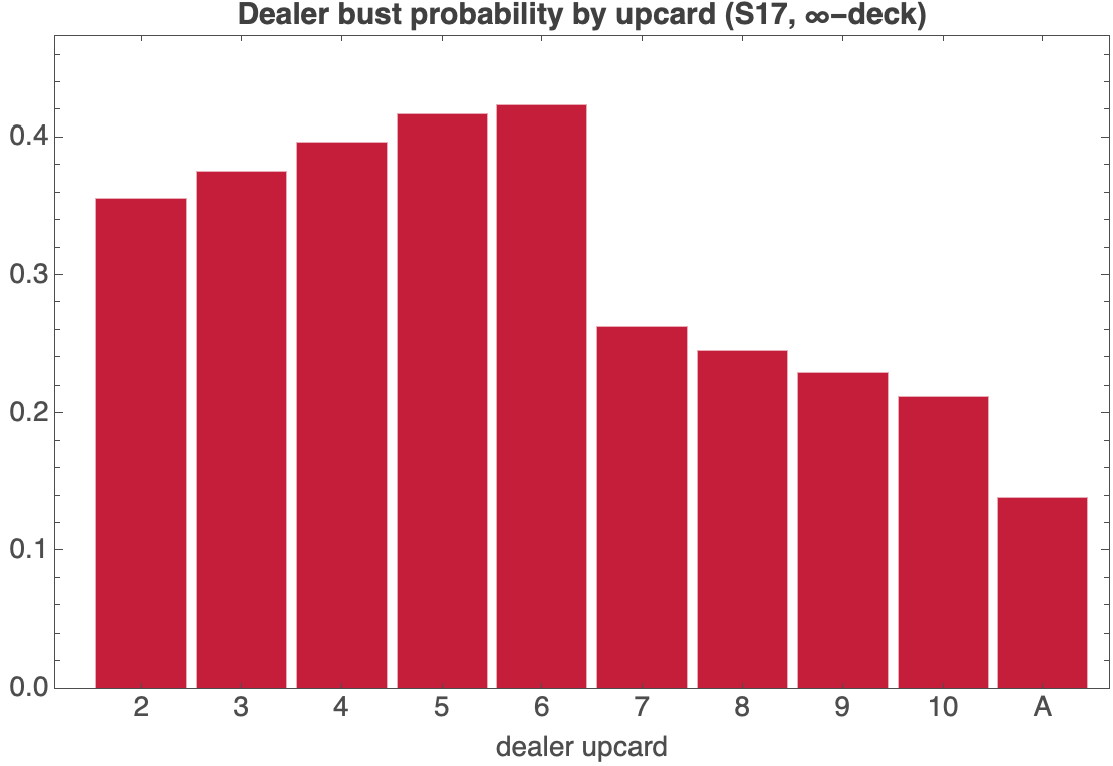
Because the dealer's policy is fixed, the distribution of the dealer's final total depends only on the upcard. In the infinite-deck approximation (cards drawn with replacement from a full rank distribution) the dealer's hand is a Markov chain on (hard total, soft?)-pairs, which we can enumerate exactly by recursion:
P()=
T
n+1
T
n
p
card
The probability of finishing from each starting upcard is plotted below. It is roughly U-shaped — the dealer is most dangerous showing 7, 8, 9, 10, or A (where bust probability is ~22–25%), and most vulnerable showing 4, 5 or 6 (bust probability ~40%). This single curve drives almost every asymmetry in basic strategy: the player should stand on otherwise-weak totals when the dealer is likely to bust, and press the action when the dealer is strong.
bust
3.3 Player decisions: the Bellman equation
3.3 Player decisions: the Bellman equation
From the player's seat, each state is (hand, bet, dealer upcard, remaining deck). The optimal value function satisfies the Bellman equation
*
V
max
a
*
V
3.4 The house edge
3.4 The house edge
The house edge is the negative of the optimal player's expected return, computed per unit bet over a uniform distribution of starting hands:
with standard Las Vegas rules (6 decks, S17, 3 : 2 blackjack, double-on-anything, split to four hands, late surrender allowed). Our implementation omits surrender and caps splits at four hands; these restrictions push the edge up to roughly 0.6-0.8% for a perfect player. Notable rule variations:
H17 instead of S17: +0.22% against the player.
6 : 5 blackjack payout: +1.39%.
Single-deck vs six-deck: ~0.4% in the player's favour.
No double after split: +0.14%.
6 : 5 blackjack payout: +1.39%.
Single-deck vs six-deck: ~0.4% in the player's favour.
No double after split: +0.14%.
4. Basic strategy
4. Basic strategy
Basic strategy is the action that maximises the Bellman value under the infinite-deck assumption, tabulated by (player total, dealer upcard). It is the correct play in the absence of any information about the shoe composition, and is within ~0.03% of perfect composition-dependent play. Because this implementation does not expose double/split in the Monte-Carlo EV routine, the basic-strategy oracle returns H or S only; double and split are still available to the human player via the buttons (and the strategy chart shows which 2-card starting hands benefit from them).
Two salient patterns in the chart: (a) the player stands on hard 12-16 exactly when the dealer upcard is 4, 5, or 6 (the valley in Figure 3); (b) soft 18 is a stand against dealer 2-8 but a hit against 9, 10, or A — the strong upcards force the player to improve even though 18 is "normally" enough.
5. Monte-Carlo expected value
5. Monte-Carlo expected value
For any game state the package can estimate EV(Hit) and EV(Stand) by Monte-Carlo simulation. The unseen-card pool is the remaining deck plus the dealer's hole card (since the player doesn't know it); each trial draws from this pool, plays the dealer under the current S17/H17 rule, and — for Hit — continues the player under basic strategy after the mandatory first extra card. The estimator is exposed as
Rendering EV(Hit) - EV(Stand) over the player-total / dealer-upcard grid reproduces the shape of the basic-strategy chart as a continuous surface:
6. Card counting
6. Card counting
Basic strategy assumes every card in the shoe is equally likely to be the next drawn. As a real shoe is played out, that assumption degrades: the composition at the bottom of a six-deck shoe can look very different from a fresh shuffle. A card-counting system tracks a scalar running count that correlates with the player's edge. The simplest and most widespread system is Hi-Lo, which assigns +1 to low cards (2-6), 0 to neutral cards (7-9), and -1 to high cards (10, J, Q, K, A). When many high cards remain, the dealer is more likely to bust (Figure 3) and the player is more likely to draw a natural — both in the player's favour.
The running count RC is converted to a true count TC by dividing by the number of decks remaining in the shoe,
which normalises the edge signal across different shoe penetrations. The player's expected return is close to affine in TC,
for typical six-deck rules (the slope ~0.5% per true count is an empirical regression coefficient). A classical counting bettor sizes the wager proportionally to the edge via the Kelly criterion,
capped at a practical table maximum. The game displays the live running and true counts in the Shoe & card count opener, and the cumulative bankroll over all rounds in the Session plot — so a curious player can watch their edge swing with the count over a sufficiently long session.
7. Package architecture
7. Package architecture
The code is split into two paclet-style files:
Blackjack.wl — pure game logic, no UI. Exposes Suits, Ranks, MakeCard, CreateShoe, DrawCard, HandScore, IsSoft, IsBlackjack, IsBust, DealerShouldHit, PlayDealer, ResolveRound, Payout, CanDouble, CanSplit, HiLoValue, TrueCount, BasicStrategy, EstimateEV.
BlackjackGame.wl — the DynamicModule front-end. Holds all reactive state (deck, multi-hand player, dealer hand, bankroll, bet, session history, running count, coach cache), all handlers (doHit, doStand, doDouble, doSplit, startRound, advanceHand, playoutDealerAndSettle), and all widgets (cards, badges, chip buttons, openers, session plot).
The only non-obvious idiom is that all handler functions are declared in the DynamicModule's local-variables list. That puts their DownValues in the same persistent dynamic context as the state symbols they mutate; otherwise Button actions silently no-op after the first click because the front-end holds stale references to temporary Module symbols that have been garbage-collected.
8. Play the game
8. Play the game
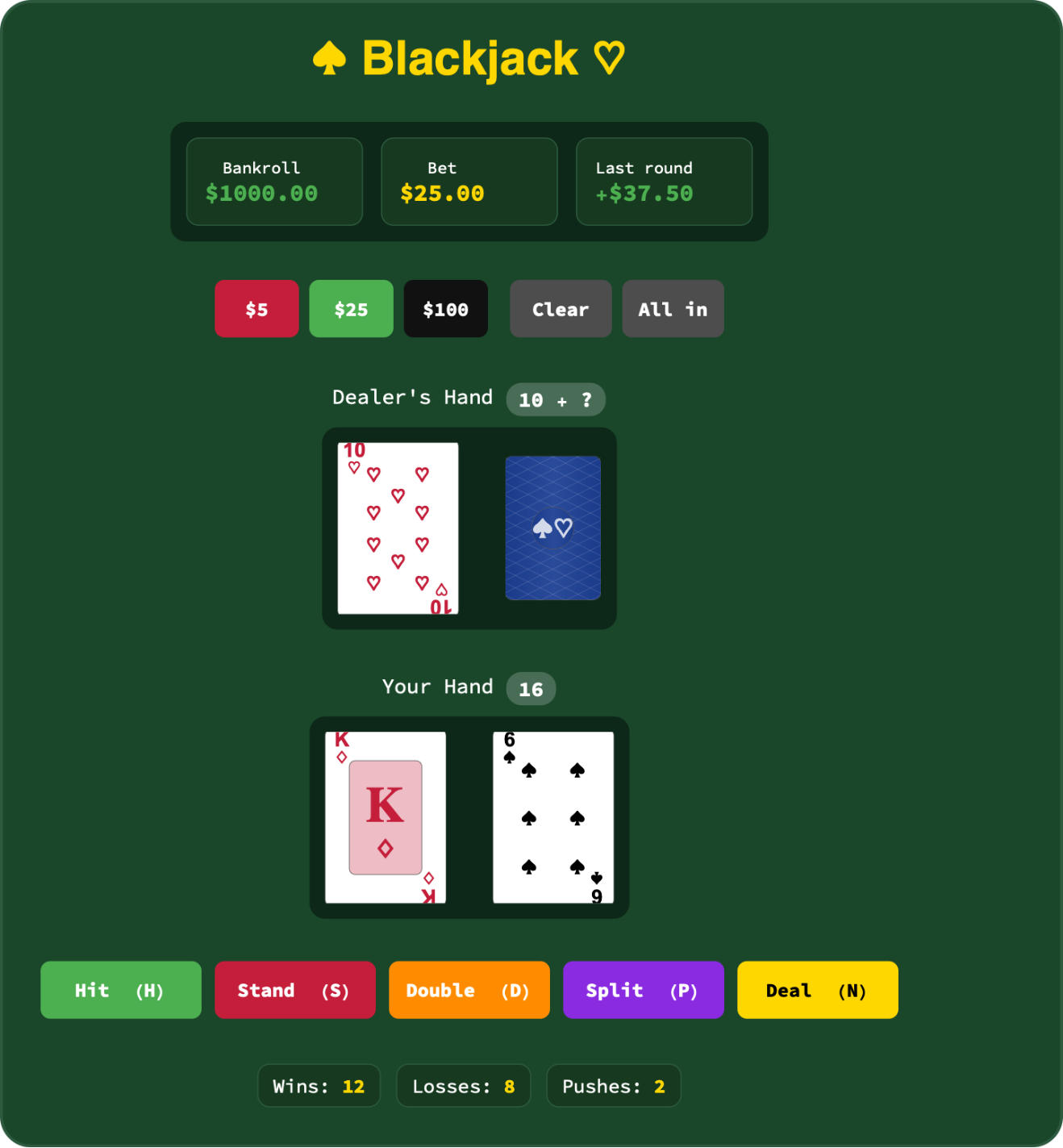
A still from a recorded round is shown below. The animated preview at the top of the post illustrates the full flow; for the full-fidelity recording, download blackjack_demo.gif (7.4 MB) or blackjack_demo.mp4 (788 KB) from the post's attachments.
The notebook loads the two packages from the parent directory of its own folder (that is, the directory containing Blackjack.wl and BlackjackGame.wl). Evaluate the cell below; a live playable game will appear underneath.
How to play:
• Adjust the bet using the $5 / $25 / $100 chip buttons, or Clear / All in.
• Click Deal (or press N) to start a round. The dealer shows one card; the other is face-down until you stand.
• On your hand, choose one of:
Hit (H) — take another card;
Stand (S) — end your turn;
Double (D) — available on the first two cards; doubles the bet and deals one card;
Split (P) — available on any pair of equal-value cards; creates a sister hand with an equal bet.
• When every hand has stood or busted, the dealer plays and the round settles. A natural blackjack pays 3 : 2; any other win pays 1 : 1; push returns the bet; bust or loss forfeits the bet.
• The Options opener lets you toggle H17 / S17, set the number of decks (1 / 2 / 4 / 6 / 8), adjust the cut-card penetration and the dealer-draw animation speed.
• Open Coach to see the basic-strategy recommendation and request a Monte-Carlo EV estimate for the current state.
• Open Shoe & card count for the live Hi-Lo running / true count.
• Open Session for a cumulative bankroll plot.
9. Standalone use (without the notebook)
9. Standalone use (without the notebook)
The game runs equally well outside this notebook, in any Wolfram Front End that supports DynamicModule. Clone the repository (or just download the two .wl files from the Wolfram/ folder) and evaluate:
Or, from a shell (requires wolframscript and a Wolfram Front End):
which opens a notebook window with the game embedded. The tests.wls file in the same folder runs a 66-assertion suite covering deck construction, ace-aware scoring (including a permutation-invariance property), bust/blackjack/soft predicates, S17 and H17 dealer policy, PlayDealer termination (random trials), round resolution, double/split eligibility, payout math, Hi-Lo count, basic-strategy spot checks, and Monte-Carlo EV ordering on two known positions.
10. References
10. References
• E. Thorp, Beat the Dealer, Vintage, 1966. The original card-counting book; introduced the first ten-count system.
• R. Baldwin, W. Cantey, H. Maisel & J. McDermott, "The Optimum Strategy in Blackjack", Journal of the American Statistical Association 51(275), 429-439 (1956). The basic-strategy table, derived by hand at Aberdeen Proving Ground.
• P. Griffin, The Theory of Blackjack, Huntington Press, 6th ed., 1999. The canonical modern reference on rule variations and composition-dependent strategy.
• J. L. Kelly, "A New Interpretation of Information Rate", Bell System Technical Journal 35(4), 917-926 (1956). Optimal betting under a known edge.
• Repository (source, tests, math write-up, HTML twin): github.com/mthiel74/blackjack.
CITE THIS NOTEBOOK
CITE THIS NOTEBOOK
Blackjack: A complete casino game, a basic-strategy coach, & Monte-Carlo expected-value estimator
by Marco Thiel
Wolfram Community, STAFF PICKS, April 23, 2026
https://community.wolfram.com/groups/-/m/t/3701271
by Marco Thiel
Wolfram Community, STAFF PICKS, April 23, 2026
https://community.wolfram.com/groups/-/m/t/3701271