With the anniversary of the first crewed lunar landing coming up on July 20, I thought it might be a fun exploration to see how far Neil Armstrong traveled from his place of birth to his footprint on the Moon. Of course this is a contrived exploration since Neil Armstrong likely traveled all over the Earth, but the Moon was the furthest point away from his place of birth so I’ll focus on that instant. How do we quantify this?
First we can visually locate the location of his birth:
In[]:=
Withcity=["BirthPlace"],GeoListPlot[city,GeoProjection->"Orthographic",GeoRange->All,GeoCenter->city]
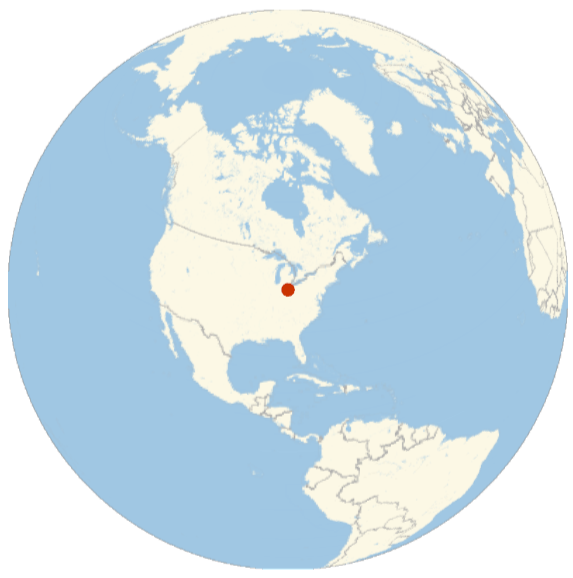
The location and date of his birth can be retrieved using EntityValue:
In[]:=
{birthpos,bdate}=[{"BirthPlace","BirthDate"}]
Out[]=
,
We can also visualize the location of the Apollo 11 landing site:
In[]:=
GeoListPlot,GeoProjection->"Orthographic",GeoRange->All
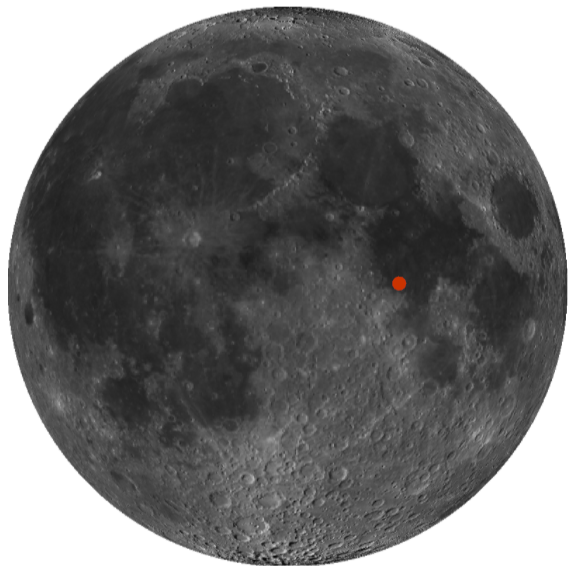
And the location and date of the Apollo 11 landing can be retrieved from EntityValue using:
In[]:=
{apollopos,adate}=[{"Position","LunarLandingDate"}]
Out[]=
GeoPosition{0.6741,23.47},,
The distance between a position on the Earth and a position on the Moon changes with time in a non-trivial way. Not only is the Moon orbiting on an elliptical orbit, and so its speed changes, but the Earth rotates underneath the Moon. As a result, the Moon appears to “wobble” as it orbits the Earth. The following shows the view of the Moon as observed from Armstrong’s birth city over the course of one orbit of the Moon. Not only does the lighting angle change as the Moon goes through its phases, but each point on the Moon “wobbles”.
frames=With{start=DateObject[{2024,1,1,0,0,0}]},,[EntityProperty["PlanetaryMoon","MaximalAltitudeTime",{"Location"birthpos,"Date"#1}]],birthpos,"FieldWidth"Quantity[.6,"AngularDegrees"],"PointsOfInterest","PointsOfInterestStyle"{"Point",Red,PointSize[.02]},ViewVertical{0,0,1}&/@DateRangestart,start+,Quantity[12,"Hours"];
In[]:=
SlideShowVideo[frames]
Out[]=
As a result of the circumstances mentioned previously, if we compute the distance from a point on Earth to a point on the surface of the Moon, the value “wobbles” in a non-trivial way. Here, I show how much the distance changes from the time Neil Armstrong was born until the date of the Apollo 11 Moon landing:
In[]:=
dist=TimeSeries[Table[{date,AstroDistance[birthpos,Dated[apollopos,date]]},{date,bdate,adate,Quantity[1,"Days"]}]]
Out[]=
TimeSeries


We can visualize how much the distance between Armstrong’s birth place and the Apollo 11 landing site varied from the date of his birth to the date on the Moon landing:
In[]:=
DateListPlot[dist,TargetUnits->"Kilometers",ImageSize->650,AspectRatio->.3,PlotStyle->Thickness[0]]
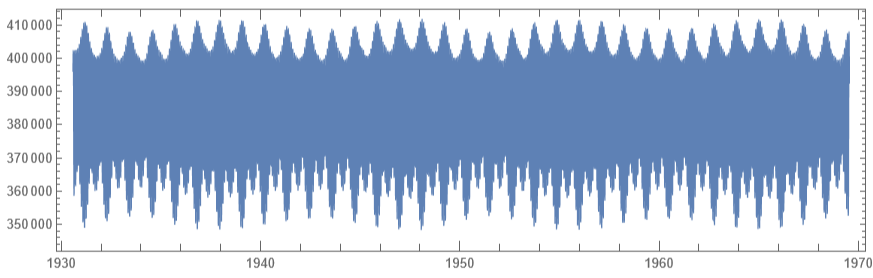
From a quantitative point of view, the distance between Armstrong’s birth place and the Apollo 11 landing site ranged from about 349,000 km and 411,000 km:
In[]:=
UnitConvert[MinMax[dist],"Kilometers"]
Out[]=
,
Of course at the instant of the landing, the distance was at a fixed value:
In[]:=
UnitConvert[AstroDistance[birthpos,Dated[apollopos,adate]],"Kilometers"]
Out[]=
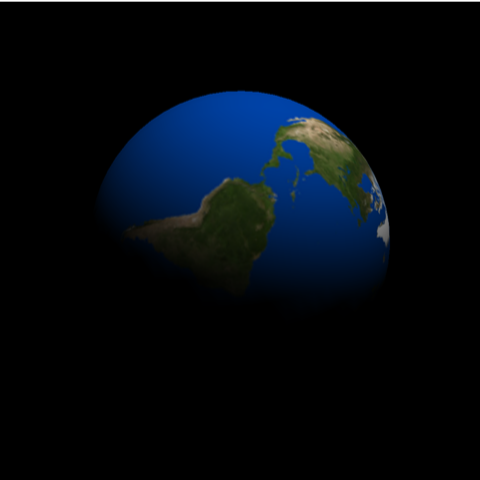
The view of the Earth from the Apollo 11 landing site at the time of the landing would have been something like the following. Since his place of birth was in Ohio in the Unites States, he would have been able to see his place of birth from the Moon.
In[]:=
Out[]=
CITE THIS NOTEBOOK
CITE THIS NOTEBOOK
How far was Neil Armstrong from his birth place when on the Moon?
by Jeffrey Bryant
Wolfram Community, STAFF PICKS, July 12, 2024
https://community.wolfram.com/groups/-/m/t/3219302
by Jeffrey Bryant
Wolfram Community, STAFF PICKS, July 12, 2024
https://community.wolfram.com/groups/-/m/t/3219302