Congratulations to Calcea Johnson and Ne’Kiya Jackson for discovering another inspirational way to prove the Pythagorean theorem using series and the law of sines. What’s truly beautiful here is that these young students have ingeniously combined geometry and algebra in a way that was not expected. To help demonstrate their work, I utilized the Wolfram Language to create a visual representation of the original proof’s diagram and calculate the infinite sum using its built-in features. Scientific American spotlight.
Visualization technique
Visualization technique
My construction mainly follows this detailed YouTube video:
Out[]=
Without loss of generality, we fix and let . Here we have be strictly less than 2. Pick a random value of to visualize the iteration:
b=2
0<a<2
a
a
In[]:=
b=2;a=1.45;
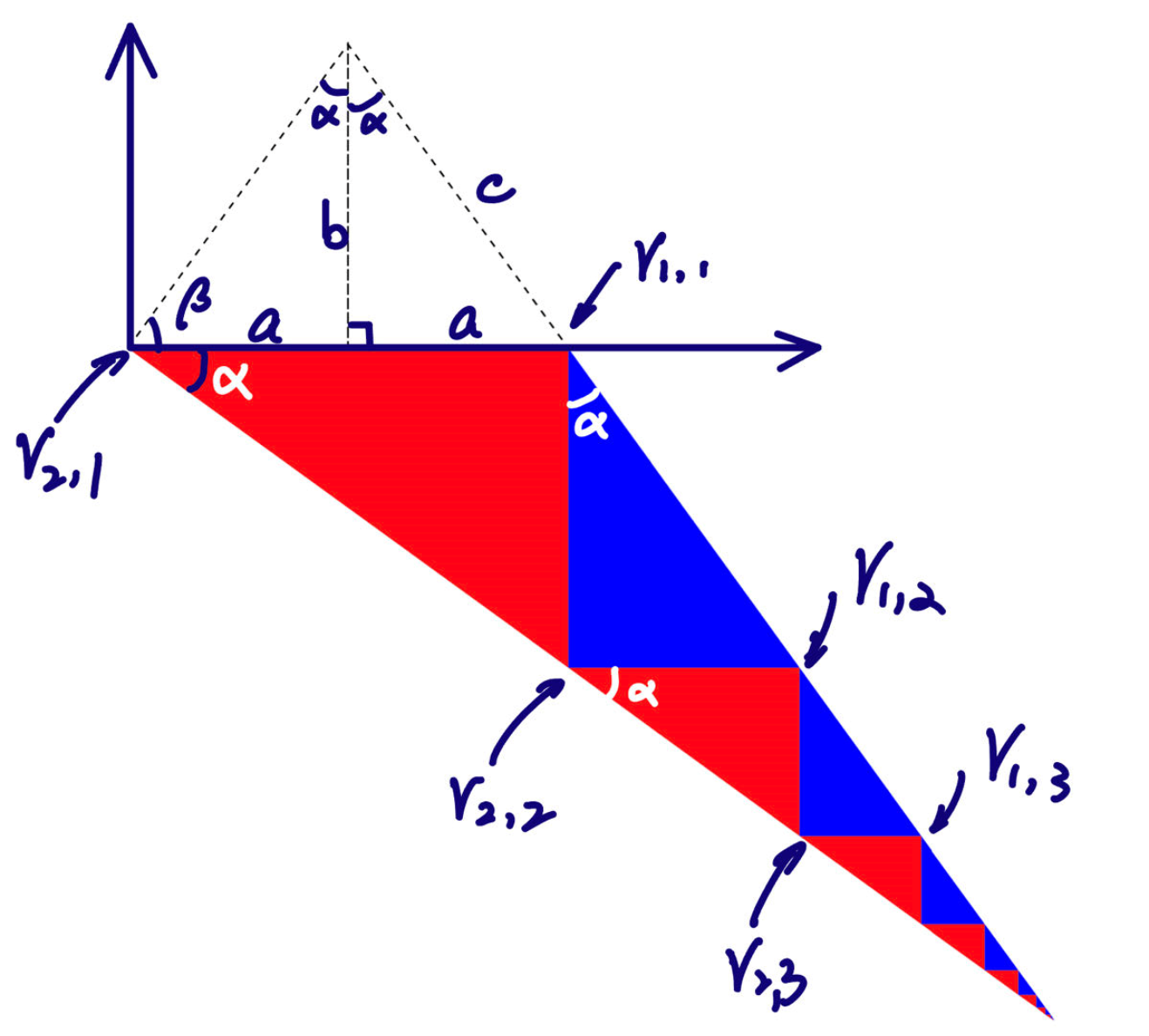
By carefully choose the left most point of the diagram to be zero will make our life easier:
In[]:=
initTri=Triangle[{{0,0},{a,0},{a,b}}];reflection=Triangle[{{a,0},{a,b},{2a,0}}];
To faithfully create demo based on the proof, we can only generate smaller triangle using similarity and some obvious parallel relation. Using base similarity relation from the video, the common ratio is /:
2
a
2
b
In[]:=
r=a^2/b^2;
Assume we have 9 iterations:
In[]:=
n=9;
◼
Choose all vertices along the blue hypotenuse extension line as
vert1List
In[]:=
vert1X=Accumulate[(2*a)*r^Range[0,n]];vert1Y=Prepend[-Accumulate[(2*/b)*r^Range[0,n-1]],0];vert1List=Transpose[{vert1X,vert1Y}];
2
a
◼
Choose all vertices along the red hypotenuse extension line as
vert2List
In[]:=
vert2X=Prepend[Most@vert1X,0];vert2Y=vert1Y;vert2List=Transpose[{vert2X,vert2Y}];
If you have all the relations right and carefully find the right index matching from the two lists, you can create the cascaded triangles just like in the video. The two orientations are also color coded for easy identification:
Graphics[{{Transparent,EdgeForm[Dashed],initTri,reflection},{Red,MapThread[Triangle[#~Join~{#2}]&,{Partition[vert2List,2,1],Most@vert1List}]},{Blue,MapThread[Triangle[#~Join~{#2}]&,{Partition[vert1List,2,1],Rest@vert2List}]}}]
Out[]=
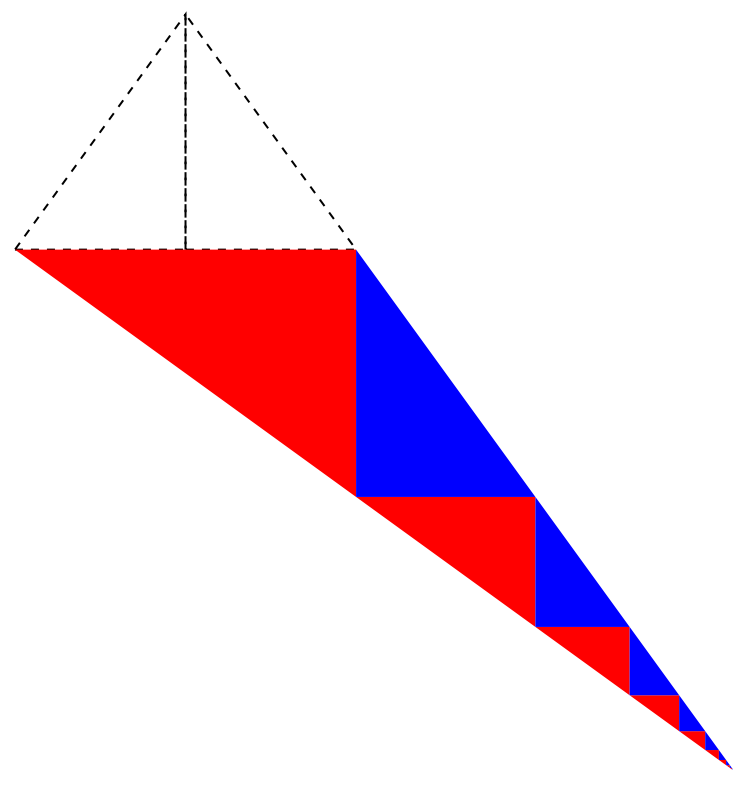
You can change the value of and to have a gallery of such similar triangle tiling.
a
n
Symbolic solution for the limit of the infinite sum
Symbolic solution for the limit of the infinite sum
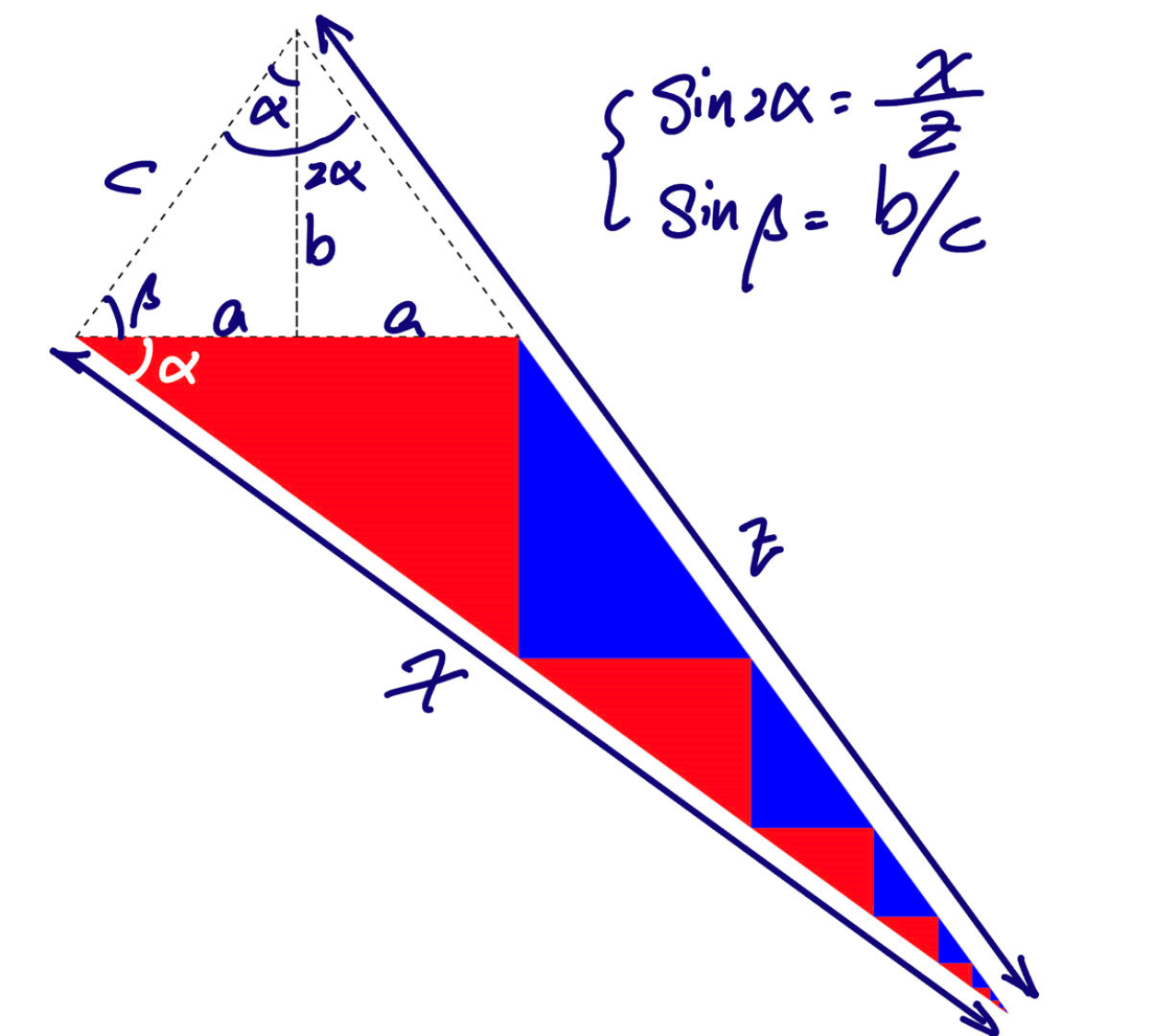
We do not need the actual value of and to find the limit of series in for the total length of blue and hypotenuse as long as we are given . This part is also the algebraic summary of the content in the video at 4:07.
a
b
a<b
In[]:=
Clear[a,b]
Do not forget that the hypotenuse of the large triangle includes the dashed part:
In[]:=
lengthZ=c+*Sum[(a^2/b^2)^k,{k,0,Infinity},Assumptions->0<a<b](*LengthofZ*)
2*a^2*c
b^2
Out[]=
c--
2c
2
a
2
a
2
b
In[]:=
lengthX=*Sum[(a^2/b^2)^k,{k,0,Infinity},Assumptions->0<a<b](*LengthofX*)
2*a*c
b
Out[]=
--
2abc
2
a
2
b
The ratio of the two result above is :
Sin(2α)
In[]:=
Simplify[lengthX/lengthZ]
Out[]=
2ab
2
a
2
b
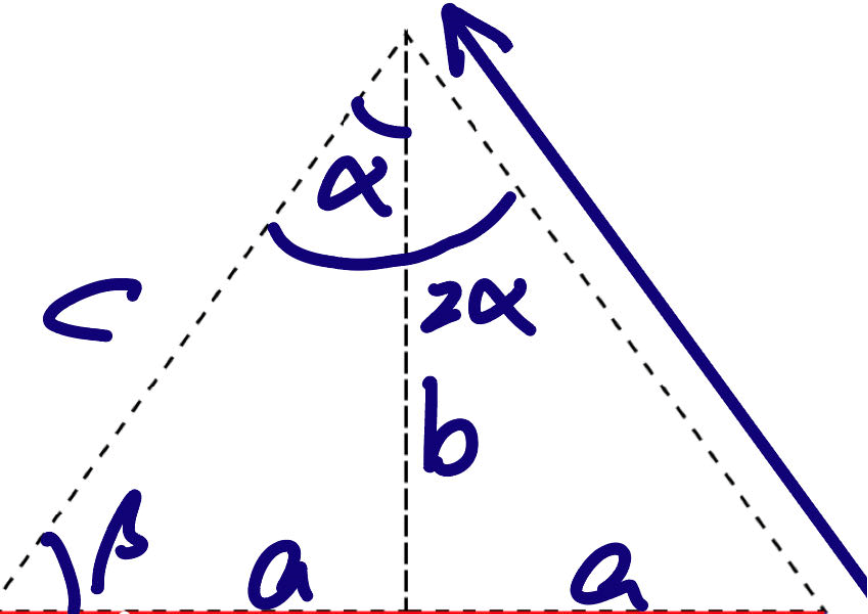
The last part is to use law of sines in the triangles as the union of the two smaller dashed triangles:
In[]:=
Law of Sines
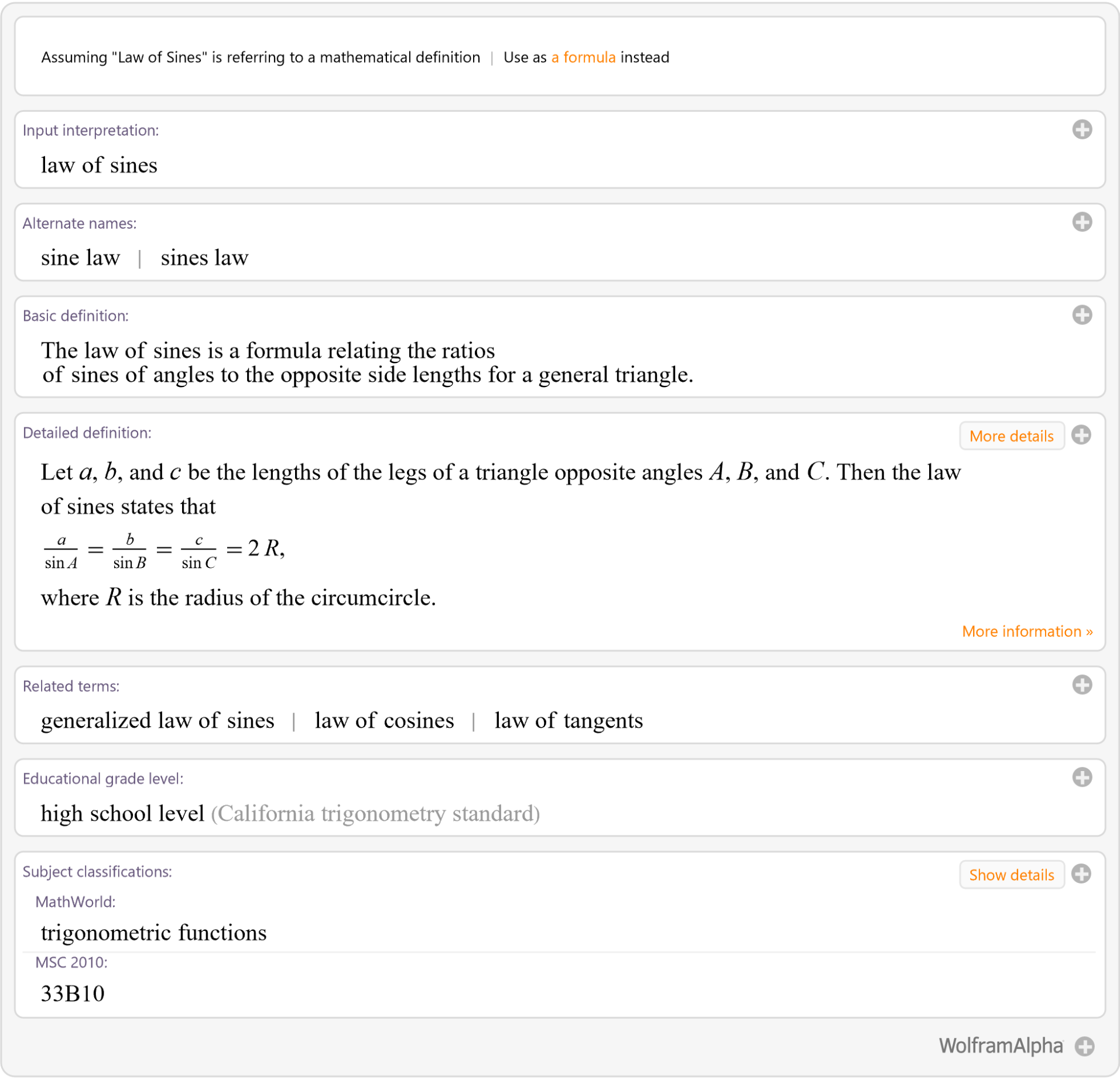
It is also amazing to see how this doubling angle formula is derived purely from the series and above construction. Recall
In[]:=
double angle formula
The corresponding Wolfram language code is
which is the same as the ratio of length of X and Z in the diagram aforementioned.
Special case: 45-90-45 triangle
Special case: 45-90-45 triangle
In this case the infinite sum has common ratio equal to 1. Adjusting the plot function above we shall have this graph, which does not help too much.
Animation
Animation
Further reading: Similar triangle dissections
Further reading: Similar triangle dissections
There is a big difference between the tessellation we discussed in the problem and the other seemly related solution created by Ed Pegg in his wonderful blog: Shattering the Plane with Twelve New Substitution Tilings Using 2, φ, ψ, χ, ρ.
Note that we need countably infinite triangles to cover the right triangle with one angle equal to α. Also the subtriangles are not similar to their union in general (except for 45-90-45 and 30-60-90 cases ). Meanwhile Ed’s solution uses finitely many similar triangles to cover the given triangle, which is also similar to all subtriangles.
Summary
Summary
◼
This proof creatively combines sum of infinity series, geometric construction (using geometric reflection as a technique commonly seen in synthetic solution) and trigonometry
◼
This proof also shows the doubling angle formula for sine independent of trig identity. It offer a geometric interpretation of how this formula is derived
◼
The infinite composition of triangles are not the same thing as Ed’s similar triangle dissection, but it is a inspirational trigger to further study tiling with finite similar triangles
CITE THIS NOTEBOOK
CITE THIS NOTEBOOK
New trigonometric proof of Pythagorean theorem via law of sines
by Shenghui Yang
Wolfram Community, STAFF PICKS, April 11 2023
https://community.wolfram.com/groups/-/m/t/2896079
by Shenghui Yang
Wolfram Community, STAFF PICKS, April 11 2023
https://community.wolfram.com/groups/-/m/t/2896079