There is a lot of media coverage about the upcoming total solar eclipse of 2024, but what may be less known is that while this is happening, there is a relatively bright comet in the sky not too far from the Sun that might be something to try observing during totality. The comet of interest is 12P/Pons-Brooks, a comet known for variable brightness due to active cryovolcanoes on its surface. This makes predicting how bright the comet will be somewhat problematic. “Comets are like cats: they have tails, and they do precisely what they want.”—David H. Levy
To start exploring the event, we need to initialize the date and location of observation:
In[]:=
pos=GeoPosition
Out[]=
GeoPosition[{37.7221,-89.2237}]
In[]:=
date=SolarEclipse[DateObject[{2024,4,8}],{"LocalMaximumEclipseDate",pos}]
Out[]=
These are the equatorial coordinates of the Sun on that date, as observed from that position:
In[]:=
sunpos=AstroPosition,{"Equatorial",date,pos}
Out[]=
AstroPosition

To compute the position of a comet we use EntityValue, getting the date and location dependent equatorial coordinates (right ascension and declination) and then placing them in AstroPosition:
In[]:=
cometAP[date_,pos_]:=AstroPosition[{EntityProperty["Comet","RightAscension",{"Date"->date,"Location"->pos}],EntityProperty["Comet","Declination",{"Date"->date,"Location"->pos}]}],{"Equatorial",date,pos}
In[]:=
cometpos=cometAP[date,pos]
Out[]=
AstroPosition
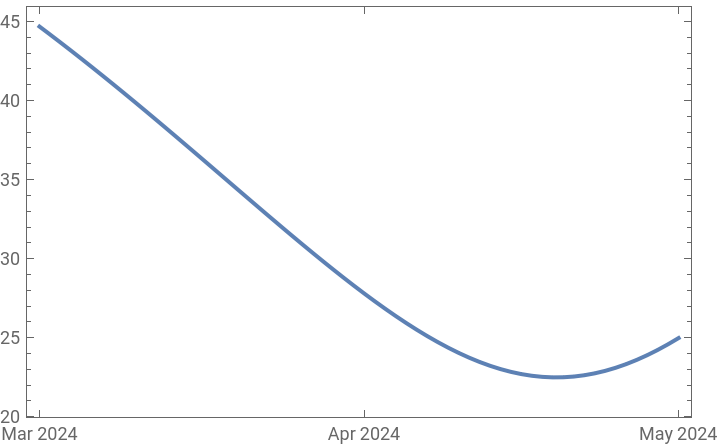
We can compute the angular separation between the Sun and the comet as follows and show they are only about 24° apart!
In[]:=
AstroAngularSeparation[sunpos,cometpos]
Out[]=
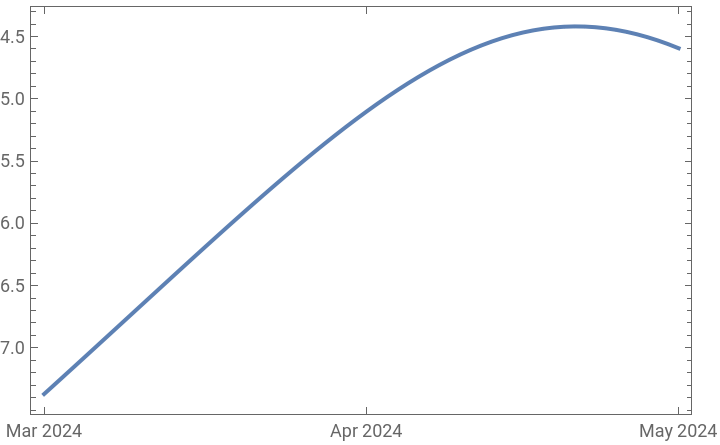
Comets are notoriously difficult to predict concerning their brightness, but based on JPL estimates the comet should technically be a naked-eye object (anything brighter than apparent magnitude 6.5). As we can see below, the comet is predicted to peak at apparent magnitude 4.5 or so in mid to late April. But even on April 8, it is still expected to be around magnitude 5. Still naked eye, but it might benefit from a pair of binoculars, especially since even the eclipsed Sun will still reduce the contrast in the sky making faint fuzzy objects harder to see. But the comet could outperform predictions if some of its cryovolcanoes erupt causing an outburst. Might make for a nice wide-field photograph to show the eclipse and the comet as long as your camera lense is wide enough to span about 25° or more of the sky.
In[]:=
dr=DateRange[DateObject[{2024,3,1,0,0,0}],DateObject[{2024,5,1,0,0,0}]];
In[]:=
DateListPlotTransposedr,[Dated["ApparentMagnitude",#]&/@dr],ScalingFunctions->{None,"Reverse"}
Out[]=
The position of the comet will change with time. The comet is approaching is perihelion so will appear closer and closer to the Sun as time progresses. The minimum angular separation (as with peak brightness) is predicted in mid to late April.
In[]:=
cometposrange=cometAP[#,pos]&/@dr;
In[]:=
sunposrange=AstroPosition,{"Equatorial",#,pos}&/@dr;
In[]:=
DateListPlot[Transpose[{dr,AstroAngularSeparation@@@Transpose[{sunposrange,cometposrange}]}]]
Out[]=
We can see the comet’s position in the solar system as follows:
In[]:=
Withcomet=,ResourceFunction["SolarSystemPlot3D"][{Cyan,Sphere[comet,.05],EdgeForm[],Cone[{1.5comet,comet},.02]},date,PlotRange->1.65,"SunStyle"->{Yellow,Lighting->{{"Ambient",GrayLevel[.3]},{"Directional",White,ImageScaled[{0,0,1}]}},Sphere[{0,0,0},.05]},Boxed->False,Method->{"ShrinkWrap"->True}]
Out[]=

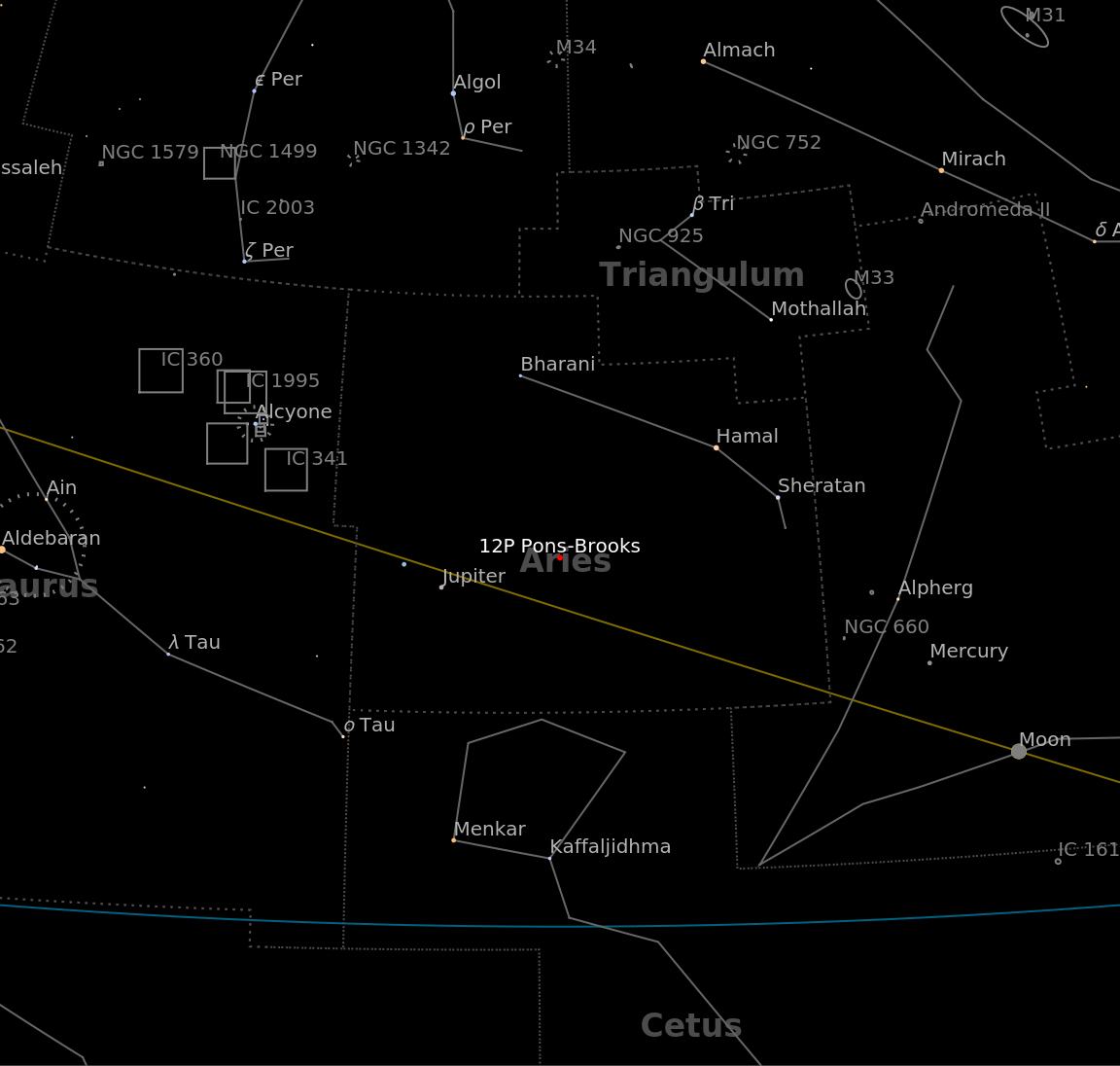
For an Earth-based view, we can observe the sky in an equatorial coordinates reference frame. The following view is centered on the comet with Jupiter below and left of the comet. The eclipsed Sun is about 24° down and to the right of the comet.
In[]:=
AstroGraphics[{Red,Point[cometpos],White,Text["12P Pons-Brooks",cometpos,{0,-1}]},AstroReferenceFrame->{"Equatorial",date,pos},AstroRange->Quantity[25,"AngularDegrees"]]
Out[]=
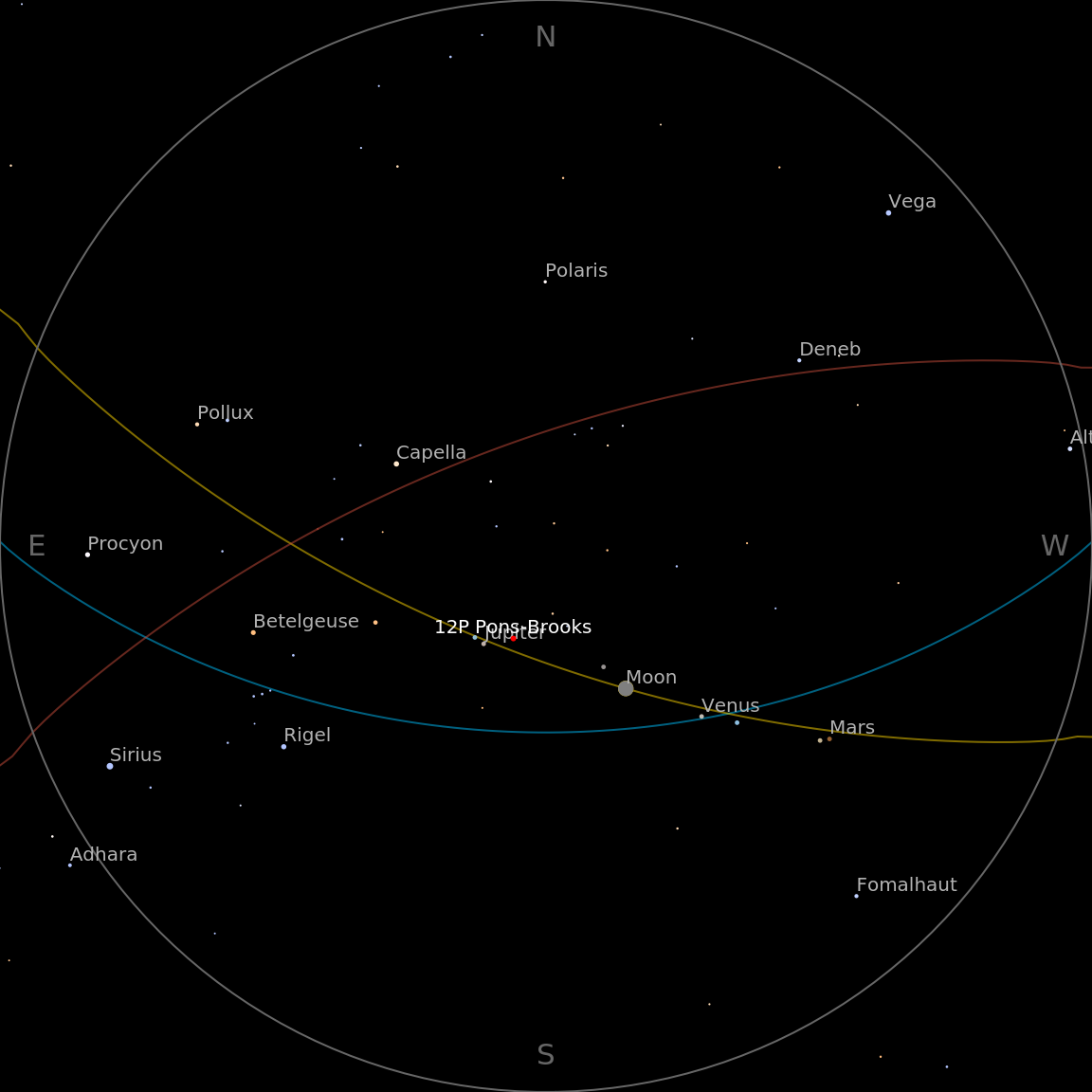
Here’s a different view of the comet in the horizon reference frame (what you would see from a specific location on Earth). Here, the gray circle represents the horizon. The comet, Jupiter, the Sun and Moon, as well as Venus and Mars will all be visible during totality in the same general area of the sky. This is the view from Carbondale, IL.
In[]:=
AstroGraphics[{Red,Point[cometpos],White,Text["12P Pons-Brooks",cometpos,{0,-1}]},AstroReferenceFrame->{"Horizon",date,pos},AstroRange->Full]
Out[]=
CITE THIS NOTEBOOK
CITE THIS NOTEBOOK
A bright comet during the 2024 total solar eclipse
by Jeffrey Bryant
Wolfram Community, STAFF PICKS, March 6, 2024
https://community.wolfram.com/groups/-/m/t/3136423
by Jeffrey Bryant
Wolfram Community, STAFF PICKS, March 6, 2024
https://community.wolfram.com/groups/-/m/t/3136423