Canonical Integrals for Diffraction Catastrophes
Canonical Integrals for Diffraction Catastrophes

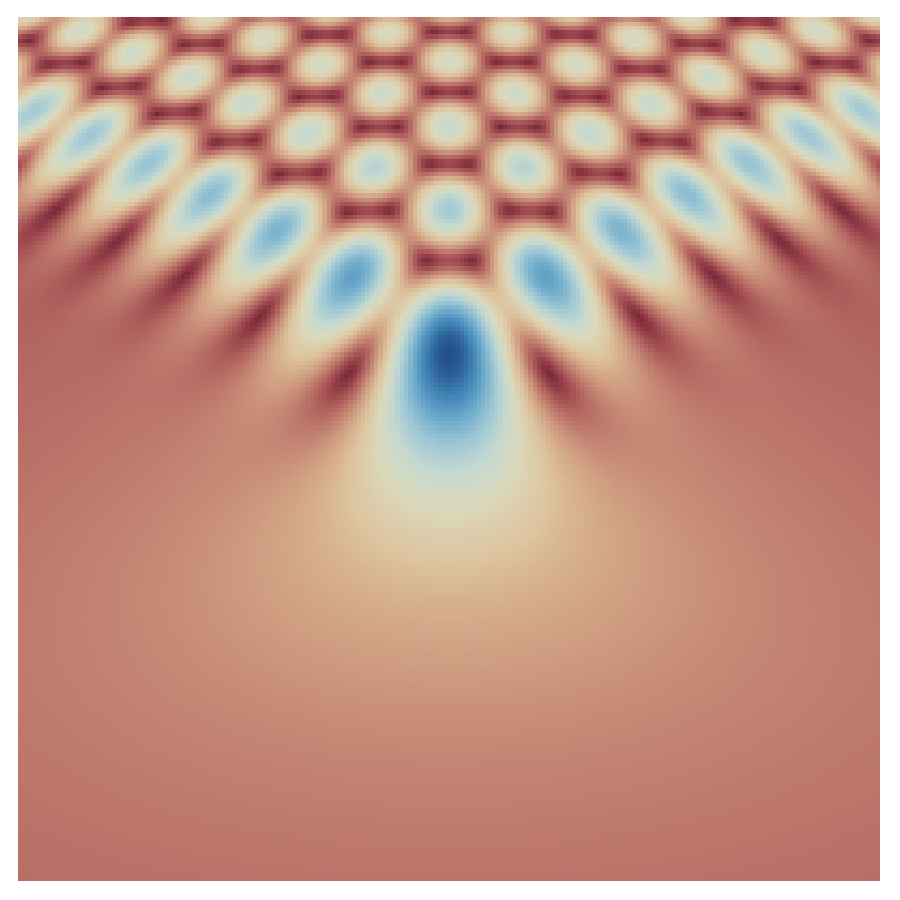
Catastrophe theory was developed in the late 1970s. A catastrophe is a discontinuous change in the behavior of a function that can occur even when its parameters are varied continuously. In diffraction theory, when higher-order catastrophes appear, rapidly oscillating diffraction integrals are required. These integrals represent the light intensity or the quantum-mechanical probability density. When catastrophes occur, classical intensity functions are no longer adequate. The diffraction integrals contain several control parameters (which determine the codimension ) and a set of two-state variables. The curves where intensities accumulate are called caustics.
K
Details
Details
Examples for four of the seven possible types of catastrophe are:
Pearcey integral (cusp catastrophe)
P(x,y)=(X)=expi+x+yudu
Ψ
2
∞
∫
-∞
4
u
2
u
swallowtail
S(x,y,z)=(X)=expi+x+y+zudu
Ψ
3
∞
∫
-∞
5
u
3
u
2
u
elliptic umbilic
(E)
Ψ
∞
∫
-∞
∞
∫
-∞
3
s
2
t
2
s
2
t
hyperbolic umbilic
(H)
Ψ
∞
∫
-∞
∞
∫
-∞
3
s
3
t
References
References
[1] I. S. Gradsteyn and I. M. Ryzhik, Table of Integrals, Series, and Products, 6th ed., San Diego: Academic Press, 2000.
[2] M. Berry, "Why Are Special Functions Special?," Physics Today, 54(4), 2001 pp. 11–12. scitation.aip.org/content/aip/magazine/physicstoday/article/54/4/10.1063/1.1372098.
[3] R. Gilmore, Catastrophe Theory for Scientists and Engineers, New York: Dover Publications, 1993.
[4] M. V. Berry and C. J. Howls. "Chapter 36: Integrals with Coalescing Saddles." Digital Library of Mathematical Functions. Version 1.0.9; Release date 2014-08-29. dlmf.nist.gov/36.
[5] Souichiro-Ikebe. "Special Functions for Catastrophe Theory." Graphics Library of Special Functions (in Japanese). (Nov 7, 2014) math-functions-1.watson.jp/sub1_spec_370.html.
[6] T. Pearcey,"The structure of an Electromagnetic Field in the Neighbourhood of a Cusp of a Caustic," Philosophical Magazine, 37(268), 1946 pp. 311–317. www.tandfonline.com/doi/abs/10.1080/14786444608561335#.VF0IB4e3ZM4.
[6] R. Borghi, "Evaluation of Cuspoid and Umbilic Diffraction Catastrophes of Codimension Four," Journal of the Optical Society of America A, 28(5), 2011 pp. 887–896. doi:10.1364/JOSAA.28.000887.
[7] J. N. L. Connor and C. A. Hobbs, "Numerical Evaluation of Cuspoid and Bessoid Oscillating Integrals for Applications in Chemical Physics," Khimicheskaya Fizika, 23(2), 2004 pp. 13–19.
arxiv.org/ftp/physics/papers/0411/0411015.pdf.
arxiv.org/ftp/physics/papers/0411/0411015.pdf.
[9] J. A. Lock and J. H. Andrews, "Optical Caustics in Natural Phenomena," American Journal of Physics, 60(5), 1992 p. 397. doi:10.1119/1.16891.
External Links
External Links
Permanent Citation
Permanent Citation
Enrique Zeleny
"Canonical Integrals for Diffraction Catastrophes"
http://demonstrations.wolfram.com/CanonicalIntegralsForDiffractionCatastrophes/
Wolfram Demonstrations Project
Published: November 11, 2014