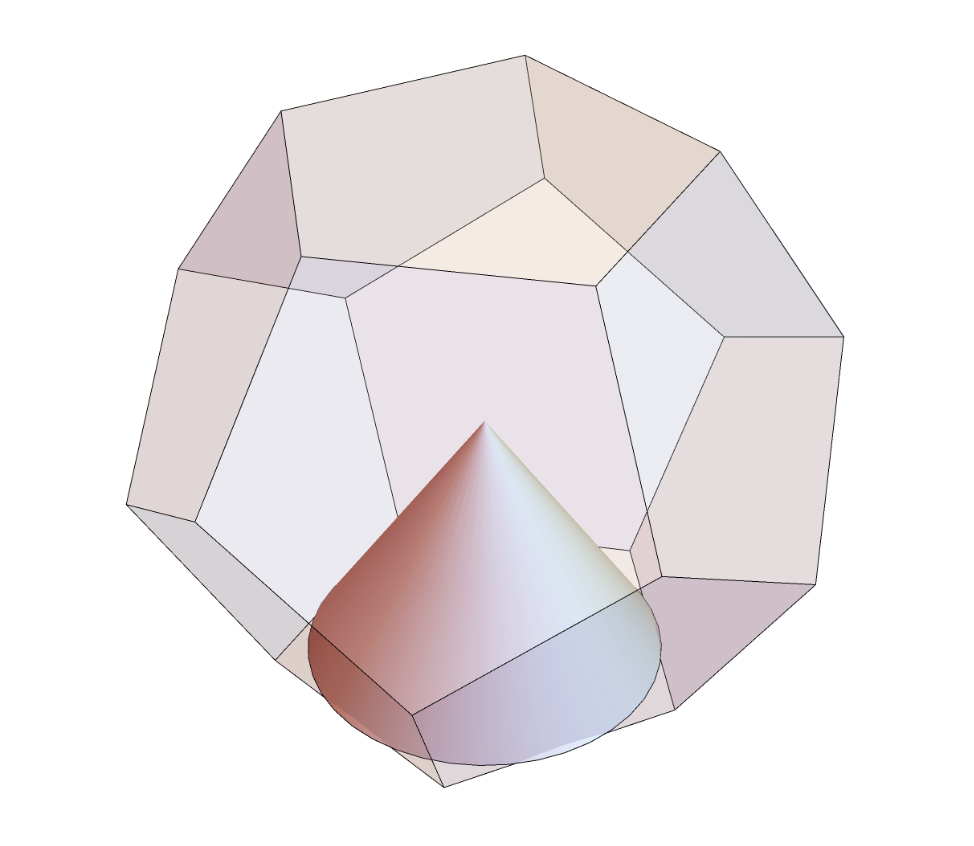
It’s 1/(4π) of the solid angle enclosing a whole sphere. Thus one face of a dodecahedron covers a bit more than one steradian, as viewed from the center.
If three faces of a polyhedron meet at a vertex with planar angles a, b, and c, the solid angle at that vertex is given by each of these five expressions:
In[]:=
solidAngles[a_,b_,c_]:=2ArcTan[Sqrt[1-Cos[a]^2-Cos[b]^2+2Cos[a]Cos[b]Cos[c]-Cos[c]^2]/(1+Cos[a]+Cos[b]+Cos[c])],ArcCos[-1+(1+Cos[a]+Cos[b]+Cos[c])^2/((1+Cos[a])(1+Cos[b])(1+Cos[c]))],2ArcCos[1/4(1+Cos[a]+Cos[b]+Cos[c])Sec[a/2]Sec[b/2]Sec[c/2]],2ArcSin[1/(4Sqrt[2])Sqrt[-1-Cos[2a]-Cos[2b]+4Cos[a]Cos[b]Cos[c]-Cos[2c]]Sec[a/2]Sec[b/2]Sec[c/2]],4ArcTan[√(Tan[1/4(a+b-c)]Tan[1/4(a-b+c)]Tan[1/4(-a+b+c)]Tan[1/4(a+b+c)])]
Major League Trig here! Not even Mathematica can show that these are all equal. Check: for a cube, the corner angles are π/2. So the solid angles are
solidAngles[π/2,π/2,π/2](*fiveanswersagree*)
Out[]=
,,,,
π
2
π
2
π
2
π
2
π
2
because 8 = 4π/(π/2) cubes fit together at a point. How many tetrahedra fit together at a point? Incredibly, nearly 23 (!)
In[]:=
solidAngles[π/3,π/3,π/3]
Out[]=
2ArcTan,ArcCos,2ArcCos,2ArcSin,4ArcTan
2
5
23
27
5
3
3
2
3
3
3/2
(2-
3
)Five different answers! Are they equal?
In[]:=
FullSimplify[Rest@%-First@%]
Out[]=
0,0,0,-2ArcCot+4ArcTan
5
2
3/2
(2-
3
)In[]:=
FullSimplify[%[[4]]/20]
Out[]=
ArcCot2ArcTan
5
2
3/2
(2-
3
)Mathematica can’t show this is 0 (!) Except by approximating:
In[]:=
N@%
Out[]=
True
In[]:=
ContinuedFraction[4π/ArcCos[23/27],22]
Out[]=
{22,1,3,1,6,1,2,3,4,2,1,2,1,1,7,393,4,21,181,92,1,1}
The tetrahedron angles are small enough for 22, but presumably form the wrong shape. So the answer is 20 or 21. This is an interesting question! Blathering Aristotle said it was a whole number. Finally, here’s a neat solid trig solution to the plane trig question:
What is the tetrahedral bond angle? I.e., the angle between two rays to vertices
from the center of a regular tetrahedron?
Call it x. Decompose a regular tetrahedron into four squat ones meeting at the center,
each with a 4π/4 = π steradian apex angle. Then at each squat apex,
What is the tetrahedral bond angle? I.e., the angle between two rays to vertices
from the center of a regular tetrahedron?
Call it x. Decompose a regular tetrahedron into four squat ones meeting at the center,
each with a 4π/4 = π steradian apex angle. Then at each squat apex,
In[]:=
πsolidAngles[x,x,x]2ArcTan[Sqrt[1-3Cos[x]^2+2Cos[x]^3]/(1+3Cos[x])]ArcCos[-1+(1+3Cos[x])^2/(1+Cos[x])^3]2ArcCos[1/4(1+3Cos[x])Sec[x/2]^3]2ArcSin[(Sqrt[-1+4Cos[x]^3-3Cos[2x]]Sec[x/2]^3)/(4Sqrt[2])]4ArcTan[Sqrt[Tan[x/4]^3Tan[(3x)/4]]]
Out[]=
π2ArcTan,ArcCos-1+,2ArcCos(1+3Cos[x]),2ArcSin,4ArcTanTan2ArcTanArcCos-1+2ArcCos(1+3Cos[x])2ArcSin4ArcTanTan
1-3+2
2
Cos[x]
3
Cos[x]
1+3Cos[x]
2
(1+3Cos[x])
3
(1+Cos[x])
1
4
3
Sec
x
2
-1+4-3Cos[2x]
3
Cos[x]
3
Sec
x
2
4
2
3
Tan
x
4
3x
4
1-3+2
2
Cos[x]
3
Cos[x]
1+3Cos[x]
2
(1+3Cos[x])
3
(1+Cos[x])
1
4
3
Sec
x
2
-1+4-3Cos[2x]
3
Cos[x]
3
Sec
x
2
4
2
3
Tan
x
4
3x
4
In[]:=
Solve[{ArcCos[-1+(1+3Cos[x])^2/(1+Cos[x])^3]π,0<x<π}]
Out[]=
xArcCos-
1
3
This is the famous usual angle formed by three consecutive atoms in a molecule.