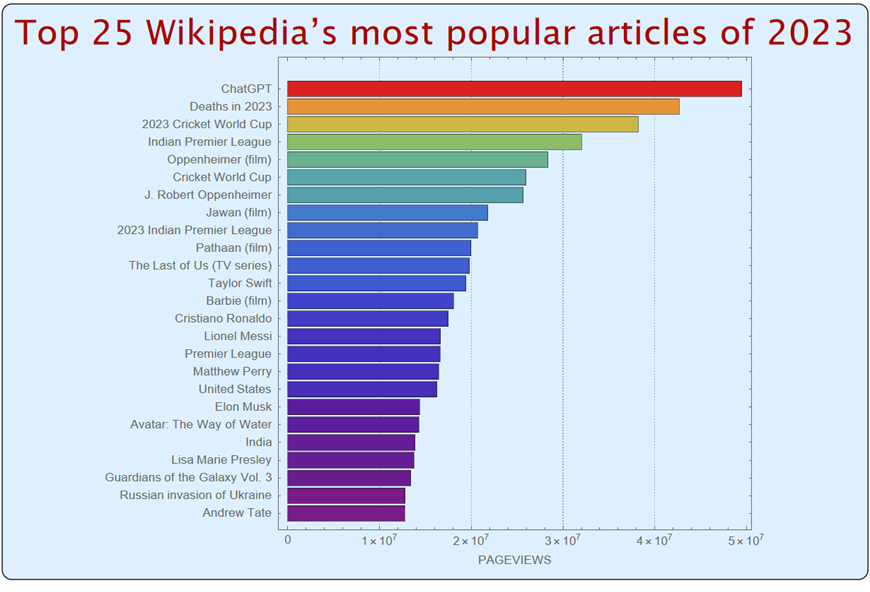
Wikimedia Foundation just announced Wikipedia’s most popular articles of 2023. They published only number and no visualizations, which I intend to do below. Wikimedia Foundation claims in total in 2023 only English Wikipedia received over 84 billion views. Quoting the article: “The most-viewed Wikipedia articles of 2023 tell the story of you and society at large seeking out knowledge about our ever-changing world from the world’s largest encyclopedia.”
The data from the article by Wikimedia Foundation
The data from the article by Wikimedia Foundation
We start by importing raw data from the article page:
url="https://wikimediafoundation.org/news/2023/12/05/announcing-wikipedias-most-popular-articles-of-2023";totalRAW=Import[url,"Data"];
By reading and playing with the data we can easily locate the table for top 25 leading Wikipedia’s pages in 2023. We can clean up the pages names:
In[]:=
pages=StringDelete[StringTake[#,StringPosition[#,","][[1,1]]]&/@totalRAW[[2,5]],","];
And the corresponding numbers for pageviews (note useful StringCases that can help locating numbers in strings with the help of pattern NumberString):
In[]:=
views=ToExpression[StringJoin[StringCases[StringDelete[#,"2023"|"Vol. 3"],NumberString]]]&/@totalRAW[[2,5]];
Here are the data table we cleaned up:
In[]:=
TextGrid[{{"PAGE","VIEWS"}}~Join~Transpose[{pages,views}],FrameAll,FrameStyle->LightGray]
Out[]=
PAGE | VIEWS |
ChatGPT | 49490406 |
Deaths in 2023 | 42666860 |
2023 Cricket World Cup | 38171653 |
Indian Premier League | 32012810 |
Oppenheimer (film) | 28348248 |
Cricket World Cup | 25961417 |
J. Robert Oppenheimer | 25672469 |
Jawan (film) | 21791126 |
2023 Indian Premier League | 20694974 |
Pathaan (film) | 19932509 |
The Last of Us (TV series) | 19791789 |
Taylor Swift | 19418385 |
Barbie (film) | 18051077 |
Cristiano Ronaldo | 17492537 |
Lionel Messi | 16623630 |
Premier League | 16604669 |
Matthew Perry | 16454666 |
United States | 16240461 |
Elon Musk | 14370395 |
Avatar: The Way of Water | 14303116 |
India | 13850178 |
Lisa Marie Presley | 13764007 |
Guardians of the Galaxy Vol. 3 | 13392917 |
Russian invasion of Ukraine | 12798866 |
Andrew Tate | 12728616 |
BarChart is the best simplest choice to visualize such data:
In[]:=
FramedLabeledBarChartReverse@views,ChartLabels->Reverse@pages,BarOrigin->Left,,,
Time series the and mystery of the unmatched data
Time series the and mystery of the unmatched data
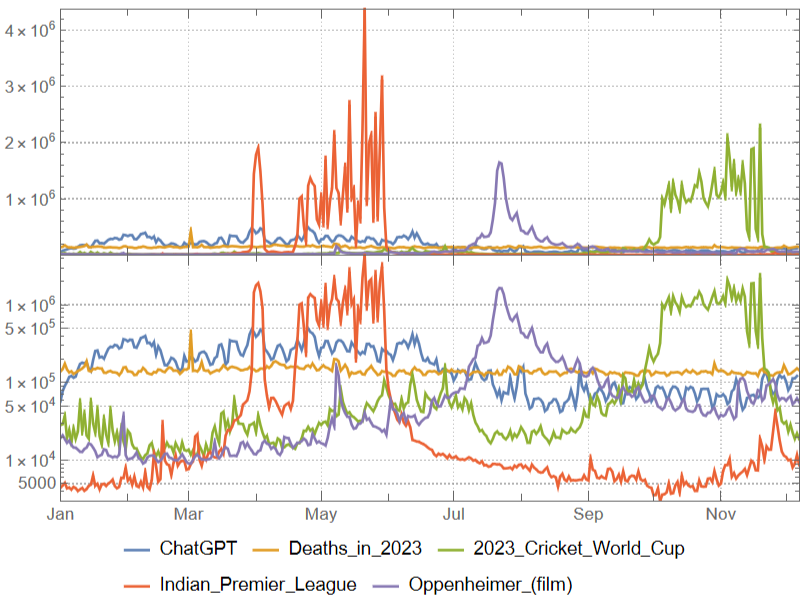
Instead of just looking at the total pageviews in 2023 we could examine the TimeSeries of daily pageviews. Wolfram Language has a special function WikipediaData giving access to such data. We start this time by locating all hyperlinks mentioned in the article:
In[]:=
url="https://wikimediafoundation.org/news/2023/12/05/announcing-wikipedias-most-popular-articles-of-2023";rawLiNKs=Import[url,"Hyperlinks"];
It is easy to locate the hyperlinks relevant to the top 5 articles:
In[]:=
Hyperlink/@rawLiNKs[[16;;20]]//Column
We take the last part of hyperlinks that indicate the exact name of the article in Wikipedia database:
In[]:=
top=StringSplit[rawLiNKs[[16;;20]],"/"][[All,-1]];top//Column
Out[]=
ChatGPT |
Deaths_in_2023 |
2023_Cricket_World_Cup |
Indian_Premier_League |
Oppenheimer_(film) |
Using these names and WikipediaData we get the corresponding TimeSeries and filter out only data for the year 2023:
data=TimeSeriesWindow#,,Today&/@WikipediaData[top,"DailyPageHits"];
Here how the data object looks for the top contender ChatGPT:
data//First
Out[]=
TimeSeries


For better comprehension we plot the TimeSeries in both standard and logarithmic scales:
In[]:=
The most interesting plot, I think, would be slightly different though. Because the Wikimedia Foundation article poses final results as a top-chart of contenders we could use Accumulate to see how the competition and rankings progressed over time:
In[]:=
DateListPlot[MapThread[Callout,{Accumulate/@data[[;;5]],top[[;;5]]}],PlotRange->All,BaseStyle->15,PlotTheme->"Detailed",ImageSize->700,Epilog->{Black,Dashed,InfiniteLine[{{0,49490406},{1,49490406}}]}]
Out[]=
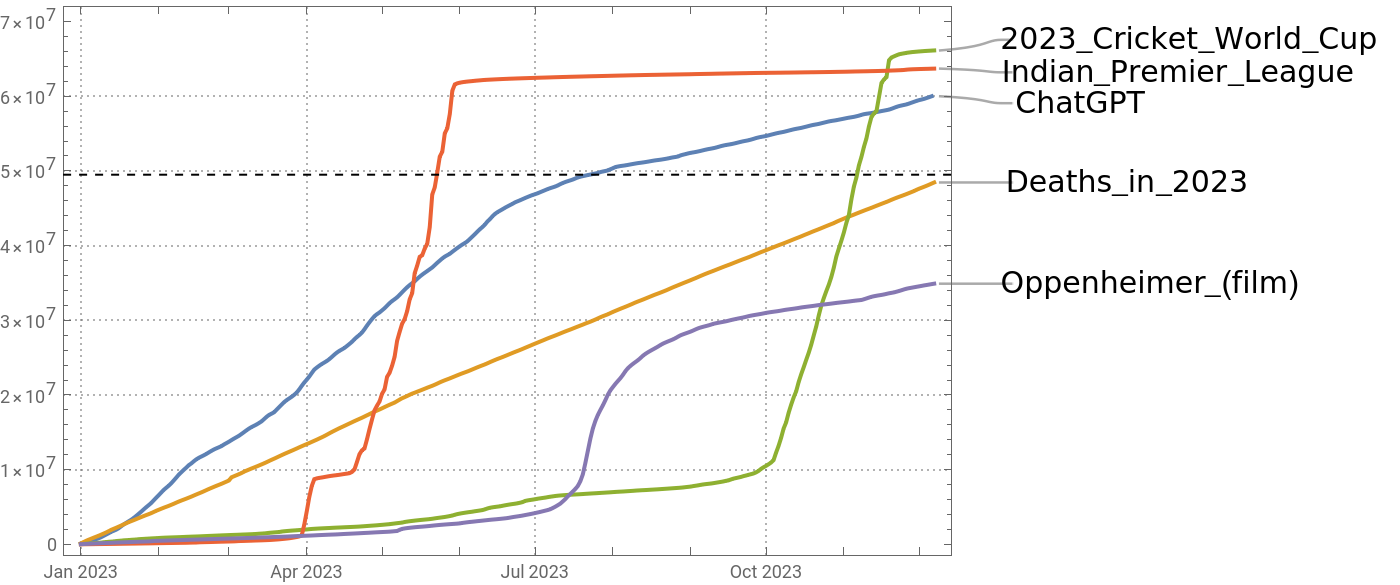
And to my surprise the result does not match the top 5 finalist order as mentioned by the article. Here is what Wikimedia Foundation provided us with (you can also see this from the very top first BarChart above):
So I specifically marked the number 49490406 for ChatGPT (which is supposed to be maximum for 2023) with a horizontal dashed line. So at least we can draw a few possible conclusions here:
◼
Perhaps Wikimedia Foundation article used some past data and the current data reflect a bit different rankings.
◼
At the time when ChatGPT was at total 49490406 pageviews (where dashed line intersects ChatGPT blue line) it indeed dominated all contenders except Indian_Premier_League, which weirdly dominates everything more than half of the year.
◼
All this could happen also because:
◼
Articles get renamed sometimes and get a different URL and Wikimedia Foundation perhaps have counted more data from some other sources;
◼
They have some other method to count pageviews, perhaps consolidating some duplicates or similar.
If you have any thoughts or insight or if you perhaps did your own detective work -- please do share in the comments.
CITE THIS NOTEBOOK
CITE THIS NOTEBOOK
Wikipedia's most popular articles of 2023: help to solve the mystery of the unmatched data
by Vitaliy Kaurov
Wolfram Community, STAFF PICKS, December 8, 2023
https://community.wolfram.com/groups/-/m/t/3080250
by Vitaliy Kaurov
Wolfram Community, STAFF PICKS, December 8, 2023
https://community.wolfram.com/groups/-/m/t/3080250