Sketchy business is a narrative-driven detective interactive game developed in Wolfram Notebooks where the players step into the role of a digital forensic sketch artist. The player will work alongside different AI personas designed to be a witness, players will attempt to reconstruct the suspects identities by interpreting the cryptic descriptions and adjusting facial parameters within the virtual environment. This project combines AI -generated prompts, facial data visualization and user input to create an hands-on experience for the players to figure out the culprit who committed the crime.
Introduction
Introduction
Sketchy Business is a computationally driven narrative game that explores the intersection of human–AI collaboration, facial data encoding, and interactive storytelling. Players take on the role of forensic sketch artists, working with AI personas that act as witnesses. Using only vague and often subjective descriptions, players must reconstruct the appearance of suspects by adjusting facial parameters encoded through Chernoff Faces a method for visualizing multidimensional data. This project was created to explore how visual perception, personality simulation, and human–AI communication can be woven into an interactive, game-based experience. As someone passionate about both storytelling and technology, I wanted to design a system where sketching isn’t just about drawing it becomes a dialogue between the player and an AI-driven persona. The player interprets what the persona “remembers” and responds by manipulating data-driven visuals to close the communication gap. To simulate a believable forensic experience, I experimented with parameters like facial feature distortion, probabilistic scoring, and dynamic persona feedback. The game serves as a testbed for questions such as: How accurately can players interpret natural-language descriptions? How contextually can AI personas like “Sam” respond? And how effectively can educational goals blend with gameplay to create something that’s both fun and insightful? and most importantly how can I make it “fun”? The foundation of Sketchy Business lies in Chernoff Faces, a technique developed in 1973 by statistician Herman Chernoff. This method maps numerical variables to facial features such as ear height, mouth curvature, and nose length. With this method, we are able to leverage the human brain’s innate ability to distinguish faces. I chose this approach because it matches the project’s aesthetic and cognitive goals: translating multidimensional data into intuitive, human-readable form. While modern tools like FaceRecognize exist in Wolfram’s ecosystem,I decided that Chernoff Faces better suited the stylized and abstracted forensic art direction I envisioned. In this system, each sketch becomes a visual expression of multiple underlying parameters. Rather than presenting raw numbers or charts, the game encourages players to rely on instinct and perception—skills we use daily to identify people by face. This not only makes the interaction more immersive, but also invites reflection on how we interpret vague information and how collaborative tools can aid creative reasoning.
ChernoffFace
ChernoffFace
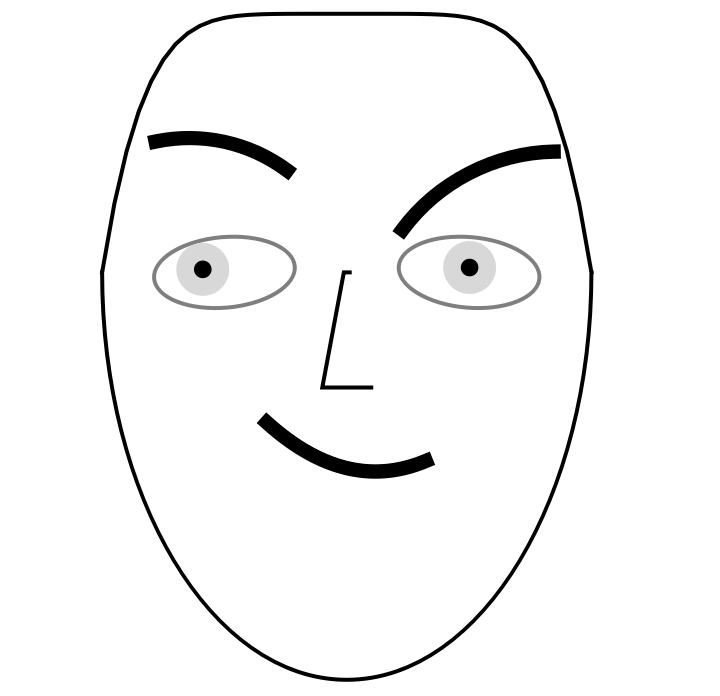
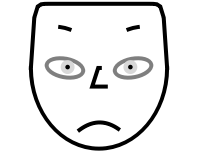
In 1973, Herman Chernoff developed a method for visualizing multidimensional data by mapping numerical variables to facial features. Known as Chernoff Faces, this approach took advantage of our natural ability to recognize subtle differences in faces, using features like face width, ear position, and mouth shape to represent complex data patterns. I chose to incorporate Chernoff Faces into Sketchy Business because this visualization technique uniquely aligns with the project’s goal of turning multidimensional data into something intuitive, playful, and human-readable. Chernoff’s method leverages the human brain’s innate ability to perceive and differentiate facial features a skill we develop naturally and use every day. In sketchy Business, each manipulated sketch is a visual expression of multiple parameters such as eye size, nose length, and face width mapped to facial traits. This method helped allow players to “translate” verbal AI descriptions into visual form using instinct and reasoning. Instead of reading numbers or charts, players recognize features like they would when identifying someone in real life, making the experience more immersive and cognitively natural. The ChernoffFace function is a data visualization tool that maps numerical values to facial features (like eye size, mouth curve, nose length, etc.) to represent multivariate data as human-like faces. It leverages our natural ability to recognize and differentiate facial expressions, making complex data easier to understand at a glance.Why I decided to integrate ChernoffFace function into my game : ■ Visual Encoding of Data: ChernoffFace maps numerical parameters to facial features (like eye size, mouth shape, nose length). This makes abstract data easier to recognize and compare something humans are naturally good at.■ Main Gameplay Mechanic : In the game, players must recreate or identify a face based on AI-provided descriptions. ChernoffFace is the visual output of those descriptions what players draw or select to solve the case.■ Interactivity + Pattern Recognition: The faces add interactivity and make it possible to spot patterns (e.g., “every suspect with a big nose and angry eyebrows gets picked!”), encouraging players to think critically and observe closely.■ Set the tone of the overall theme of the game The ChernoffFace function visualizes multivariate data by mapping numbers to facial features, turning data into expressive, cartoon-like faces. I chose it not only for its ability to represent complex data visually, but also because its quirky, exaggerated style fits the silly and playful aesthetic of my game
Examples of the ChernoffFace used in Mathematica :
Out[]=
RandomGeneratorState
Out[]=
Out[]=
RandomGeneratorState
Out[]=
,

,
,

,

,

,


Game Concept and Mechanics🔍
Game Concept and Mechanics🔍
Game concept
The premise is simple: A crime has occurred. You ! the player are tasked with interviewing AI “witnesses” to sketch what they remember of the suspect. These AI personas vary in age, personality, and tone, which means their descriptions are often vague, silly, biased, or confusing. Based on these accounts, you must adjust the parameters of a Chernoff Face to match what you think the culprit looks like. Each round ends when the player submits their sketch. If your drawing closely matches the actual “culprit” (a randomly generated hidden face), you earn points and move on. Miss the mark too often, and the case gets closed without justice.
Personas | AI characters | Witnesses
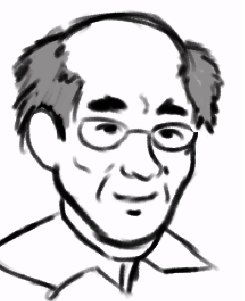
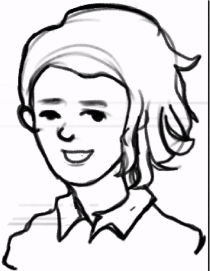
My favourite challenge during this project was developing the persona system, inspired in part by the dynamic AI storytellers from RimWorld. I wanted each character not just to relay data, but to have a distinct voice, emotional tone, and personality like Stephen’s analytical monologue or Sam’s scared but silly storytelling. It was both a creative and technical challenge: I had to ensure each AI could recall the correct face parameters, interpret them meaningfully, and deliver them in a way that reflected their unique character. Getting those voices to feel authentic was one of the most rewarding aspects, even though I know there’s still work to be done. To reach the narrative depth and reactivity of systems like RimWorld’s AI storytellers, I’ll need to push further refining memory, emotional nuance, and adaptive responses. Do this particular layering of the foundation here made the world of Sketchy Business feel more alive. Functions that I may try in the future ChatEvaluate[...] which sends a message to a Wolfram Language LLM chat session, tried it but there was constant delays in the AI response times, but could be used for maintaining ongoing character memory and tone. ChatNotebook[] , Launches an interactive chat session in a notebook interface , which is useful for testing persona prompts live by how will I manage that in an entirely new notebook.Stephen Wolfram | Stephanie Bowyer | SamEach persona gives a unique voice to the AI, making the game more dynamic and emotionally engaging.To diversify suspect descriptions. Using different personas describe the same suspect differently one might be clinical , straight to the point (Stephen), another whimsical (Sam). This encourages interpretation, not just deduction. The reason why I chose this function to prompt the AI was to create a narrative and player immersion. The Personas make the game feel like a real investigation with quirky witnesses, enhancing storytelling and player connection.One of the challenges I enjoyed most was designing the AI “witnesses.” Each persona uses a variant of a Persona function that stores personality traits, language style, and memory of what they’ve said so far. For instance: Stephen is the more logical AI that gives overly technical descriptions, the goal was to have him reference NKS and cellular automata every other hint but seems like he mentions it more frequent than I anticipated. Sam is a nervous little girl with a silly way of speaking and frequent misunderstandings. Stephanie is in a hurry and needs to get to obtain her daily coffee, so I wanted her responses to be more quick, direct and often reference how she needs to hurry.Future plans: To add more personas are planned, including unreliable narrators and dramatic storytellers!These characters respond via ChatEvaluate using their own context and prompts. Part of the fun is figuring out how to extract useful visual information from these wildly different voices. Also to enhance the current AI characters .

Rules
Guess the correct Culprit using the hint button to interact with the selected AI to receive different ways to alter the player’s sketch to match the culprits looks and by moving the manipulation parameters.
Press the submit button once you are sure that is the correct culprit, the player will only have a certain amount of attempts , the AI will give you hints to make sure the player is on the correct track.
If the player’s description is 90% accurate to the culprit’s description, the player will earn 10 points!
Game’s Source Code
Game’s Source Code
Play
Play
Testing
Testing
Prototyping and Testing
Prototyping and Testing
Creating an interactive, narrative-based game mechanic was a lot more trial and error than I initially expected. While I had a clear vision of what I wanted the game to do, translating those ideas into a functional experience meant constantly researching and experimenting with different Wolfram functions to bring the concept in my head to life. This process took a considerable amount of time and effort—especially when it came to designing the AI witnesses. Each one had to feel unique, believable, and able to interact meaningfully with the player. Getting the game’s logic and storytelling to align cohesively was one of the biggest challenges I faced. On top of that, I spent a great deal of time refining the user interface to support the tone of the game, making sure it was playful, clear, and visually consistent. Overall, this project tested me creatively, technically, and logically—and I learned a lot in the process.
During testing, I was able to successfully implement the core mechanics of Sketchy Business, including the Chernoff Face comparisons, scoring logic, and AI persona interactions. I spent a significant amount of time fine-tuning the UI to ensure the game felt intuitive, playful, and visually engaging. From customizing buttons to designing how the sketches and personas were displayed, much of my effort went into creating an experience that balanced clarity with character. The user interface evolved through several iterations based on testing feedback and personal observation, and it became one of the most time-consuming but rewarding aspects of development.
During testing, I was able to successfully implement the core mechanics of Sketchy Business, including the Chernoff Face comparisons, scoring logic, and AI persona interactions. I spent a significant amount of time fine-tuning the UI to ensure the game felt intuitive, playful, and visually engaging. From customizing buttons to designing how the sketches and personas were displayed, much of my effort went into creating an experience that balanced clarity with character. The user interface evolved through several iterations based on testing feedback and personal observation, and it became one of the most time-consuming but rewarding aspects of development.
Future of Sketchy Business
Future of Sketchy Business
Concluding Remarks
Concluding Remarks
The author gives A HUGE thanks their Wolfram Summer School 2025 mentors Daniel Sanchez and Piero Sanchez, for their guidance, support, and encouragement throughout this project. I couldn’t have brought Sketchy Business to life without you. Thank you for believing in my vision. Other contributions were critical to this work, as well as Stephen Wolfram, Program Director Stephanie Bowyer, and ALL of the Wolfram Summer School 2025 Faculty for their support throughout this project.
Anton Antonov Antonov for the ChernoffFace function, a huge part of the game mechanic.
Acknowledgments
Acknowledgments
Daniel Sanchez
Piero Sanchez
Eric Parfitt
Anton Antonov Antonov
Thank so much Stephen Wolfram for allowing to develop a game using Wolfram Language!
Piero Sanchez
Eric Parfitt
Anton Antonov Antonov
Thank so much Stephen Wolfram for allowing to develop a game using Wolfram Language!
References
References
1
.Antonov, A. A. (2025, April 8). Mathematica for prediction algorithms. https://mathematicaforprediction.wordpress.com/author/antononcube/
2
.Morris, C. J., Ebert, D. S., Rheingans, P. L., “Experimental analysis of the effectiveness of features in Chernoff faces.” In: Oliver, W. R. (ed), 28th AIPR Workshop: 3D Visualization for Data Exploration and Decision Making. Proceedings vol. 3905, 12–17, 2000. DOI: 10.1117/12.384865.
CITE THIS NOTEBOOK
CITE THIS NOTEBOOK
Sketchy business : a narrative-driven detective interactive game
by Sha'Necia Holden
Wolfram Community, STAFF PICKS, July 9, 2025
https://community.wolfram.com/groups/-/m/t/3497270
by Sha'Necia Holden
Wolfram Community, STAFF PICKS, July 9, 2025
https://community.wolfram.com/groups/-/m/t/3497270