Adinkras are a way of representing supersymmetry algebras in graph form and are useful in discerning their properties. Each algebra has a corresponding set of matrices describing the mathematical relationships between boson and fermion fields called L-matrices. These L-matrix generators can be constructed by operators known as hopping operators. This project is focused on implementing supermultiplet L-matrices as graph rewriting rules within the WolframModel, and generating adinkra structures from those. We were able to successfully use rewriting rules to reproduce the directed edges of the chiral multiplet adinkra, which we then combined with a graphing tool to correctly style the edges and vertices based on the original L-matrices. This has potential applications for quickly producing large-scale and large-dimension adinkras that would be too laborious to produce by hand, and taking stock of general patterns and properties governing them.
Background
Background
Adinkras are graph representations of supersymmetric GR(d,N) algebras, commonly called Garden Algebras. They encode information relating a set of boson fields to a set of fermion fields into a convenient graphical format.
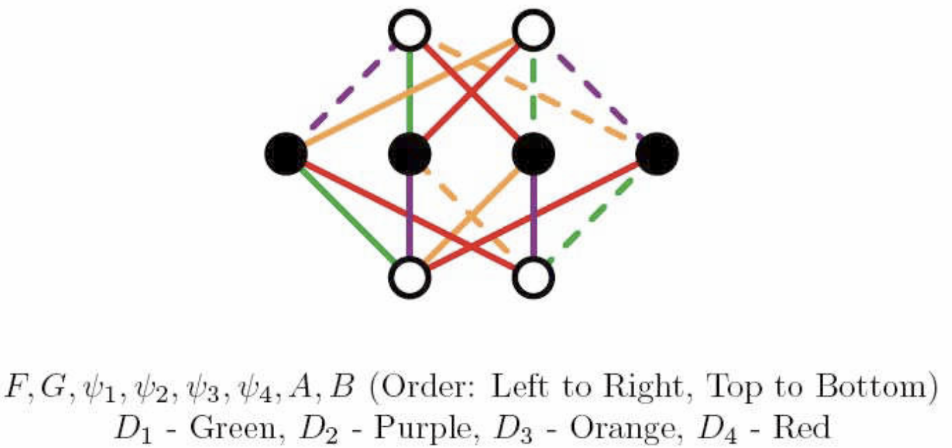
The 4D, N=1 Chiral Multiplet
The 4D, N=1 Chiral Multiplet
The above adinkra corresponds specifically to the supermultiplet known as the 4D, N=1 chiral multiplet. The equations that characterize the chiral multiplet are the following:

A, B, F, G: boson fields
Ψ
1
Ψ
2
Ψ
3
Ψ
4
D
1
D
2
D
3
D
4
This information, relating each boson with each fermion, can be encoded in a set of matrices called L-matrices. Each L-matrix corresponds to a separate covariant derivative.
L
1
1 | 0 | 0 | 0 |
0 | 0 | 0 | -1 |
0 | 1 | 0 | 0 |
0 | 0 | -1 | 0 |
L
2
0 | 1 | 0 | 0 |
0 | 0 | 1 | 0 |
-1 | 0 | 0 | 0 |
0 | 0 | 0 | -1 |
L
3
0 | 0 | 1 | 0 |
0 | -1 | 0 | 0 |
0 | 0 | 0 | -1 |
1 | 0 | 0 | 0 |
L
4
0 | 0 | 0 | 1 |
1 | 0 | 0 | 0 |
0 | 0 | 1 | 0 |
0 | 1 | 0 | 0 |
Rows correspond to bosons, and columns to fermions. The sign of each element indicates whether the corresponding equation contains a minus sign.
Examples
D
2
Ψ
3
L
2
D
3
0
Ψ
4
L
3
In other words, if we redefine the boson fields as

Then the pattern can be written as

Adinkra visual conventions
Adinkra visual conventions
The adinkra encodes the system of equations (and thus the L-matrices) of the supermultiplet.
Each edge color corresponds to a distinct D operator
Dashed edges indicate a minus sign in the equation
White/black vertices indicate boson/fermion fields respectively
Additionally, adinkras are technically directed graphs, which is captured by the layering of vertices. The bottom layer points to the next layer, which points to the layer above, etc.
All vertices on a layer must be of the same color, and layers alternate color.
Producing an adinkra manually
Producing an adinkra manually
Initial inputs
Initial inputs
We first write code to generate a visually accurate adinkra given the following inputs:
List of vertices
{A,B,F,G,,,,}
Ψ
1
Ψ
2
Ψ
3
Ψ
4
List of vertex weights
{1,1,3,3,-2,-2,-2,-2}
Magnitude indicates level of the vertex
Sign (+/−) indicates color of the vertex (white/black)
List of directed edges
{A,B,F,G,A,B,F,G,A,B,F,G,A,B,F,G}
Ψ
2
Ψ
4
Ψ
3
Ψ
1
Ψ
4
Ψ
2
Ψ
1
Ψ
3
Ψ
1
Ψ
3
Ψ
4
Ψ
2
Ψ
3
Ψ
1
Ψ
2
Ψ
4
List of edge weights
{2,-1,4,3,4,-3,-2,-1,1,2,-3,4,3,4,1,-2}
Magnitude indicates color of the edge
Sign (+/−) indicates solid/dashed edge
Association of numbers to colors for edges
1Green,2Purple,3Orange,4Red
For now, these inputs are provided manually, but later we will generate them automatically with the help of rewriting rules.
In[]:=
vertices={A,B,F,G,,,,};vertexweights={1,1,3,3,-2,-2,-2,-2};edges={A,B,F,G,A,B,F,G,A,B,F,G,A,B,F,G};edgeweights={2,-1,4,3,4,-3,-2,-1,1,2,-3,4,3,4,1,-2};colors=<|1->Green,2->Purple,3->Orange,4Red|>;
Ψ
1
Ψ
2
Ψ
3
Ψ
4
Ψ
2
Ψ
4
Ψ
3
Ψ
1
Ψ
4
Ψ
2
Ψ
1
Ψ
3
Ψ
1
Ψ
3
Ψ
4
Ψ
2
Ψ
3
Ψ
1
Ψ
2
Ψ
4
Determining vertex coordinates
Determining vertex coordinates
Each vertex must be placed at its correct level and spread evenly among the other vertices in its row. These functions together output a list of correct coordinates to achieve this.
In[]:=
HorizontalSpacing[n_Integer]:=Range[n]-;
n+1
2
In[]:=
AdinkraVertexCoordinates[vertices_List,vertexweights_List]:=Module[{heights,widths,coords,ids,coordsList},heights=Gather[Norm/@vertexweights];widths=HorizontalSpacing/@Length/@heights;coords=Transpose[Flatten/@{widths,heights}];ids=Flatten[GatherBy[Range[Length[vertices]],vertexweights[[#]]&]];coordsList=vertices[[First[#]]]->Last[#]&/@Transpose[{ids,coords}];Return[coordsList];]
In[]:=
AdinkraVertexCoordinates[vertices,vertexweights]
Out[]=
A-,1,B,1,F-,3,G,3,-,2,-,2,,2,,2
1
2
1
2
1
2
1
2
Ψ
1
3
2
Ψ
2
1
2
Ψ
3
1
2
Ψ
4
3
2
Graphing the adinkra from initial inputs
Graphing the adinkra from initial inputs
Together with the previous helper functions, we can graph a visually accurate adinkra:
In[]:=
AdinkraGraph[vertices_List,vertexweights_List,edges_List,edgeweights_List,colors_Association]:=Graph[Style[vertices[[#]],If[Sign[vertexweights[[#]]]>0,White,Black]]&/@Range[Length[vertices]],Style[edges[[#]],colors[Norm[edgeweights[[#]]]],If[Sign[edgeweights[[#]]]<0,Dashed,Nothing],Thick]&/@Range[Length[edges]],VertexWeightvertexweights,EdgeWeightedgeweights,VertexCoordinates->AdinkraVertexCoordinates[vertices,vertexweights],VertexLabels->"Name",DirectedEdges->False]
In[]:=
AdinkraGraph[vertices,vertexweights,edges,edgeweights,colors]
Out[]=
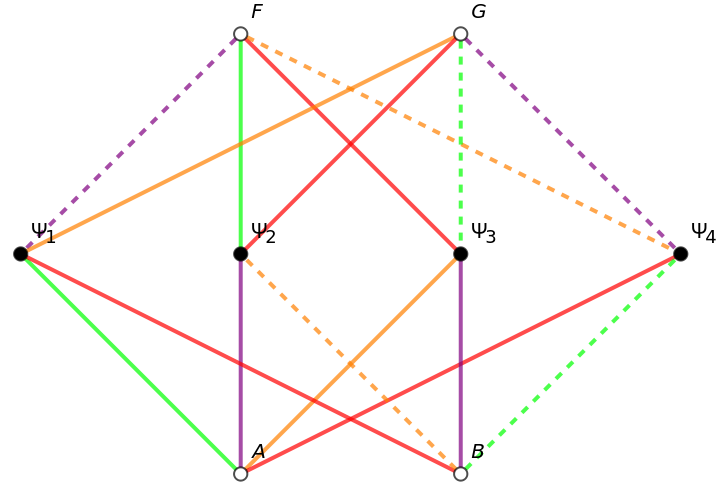
This matches the chiral multiplet adinkra from the literature above.
Using rewriting rules
Using rewriting rules
We now turn to finding a set of WolframModel rewriting rules that can reproduce the correct set of edges as a StatesList starting from just the following three matrices:
L
1
1 | 0 | 0 | 0 |
0 | 0 | 0 | -1 |
0 | 1 | 0 | 0 |
0 | 0 | -1 | 0 |
X
1
0 | 0 | 1 | 0 |
0 | 0 | 0 | -1 |
-1 | 0 | 0 | 0 |
0 | 1 | 0 | 0 |
Y
1
0 | 0 | 0 | 1 |
0 | 0 | 1 | 0 |
0 | -1 | 0 | 0 |
-1 | 0 | 0 | 0 |
All of the L-matrices can be constructed by starting with and successively applying the hopping operators and . Crucially, the hopping operators can be ignored.
L
1
X
1
Y
1
Z
L
1
L
1
L
2
X
1
L
1
L
3
X
2
L
2
Y
1
L
1
L
4
X
3
L
3
X
1
Y
1
L
1
The initial adinkra skeleton
The initial adinkra skeleton
Because of these properties, the matrices can be encoded as WolframModel rewriting rules and used to generate a StatesList resembling an adinkra.
{1, 2, 3, 4} corresponds to , (bosons)
{A,B
F,G}
{x, y, z, w} corresponds to (fermions)
{,,,}
Ψ
1
Ψ
2
Ψ
3
Ψ
4
*Note that minus signs are being ignored.
L1={{1,x},{2,w},{3,y},{4,z}};X1={{1,z},{2,w},{3,x},{4,y}};Y1={{1,w},{2,z},{3,y},{4,x}};
Rule:
{L1->X1~Join~Y1}
Initial condition:
The last iteration in the list is beginning to look like an adinkra skeleton. However, the graph is not directed in the right way.
Brute forcing the correct rewriting rules
Brute forcing the correct rewriting rules
We need to modify the rewriting rules so that they get us a StatesList that produces a graph with edges going in the right directions.
Below is what this StatesList should be like in order to produce the correct graph:
Helper functions
Helper functions
These functions help automate the pair swapping process.
Finding all permutations
Finding all permutations
It turns out there’s one single match!
Intuitively, it seems to be that the pairs that got swapped corresponded to the upper-level bosons (F and G).
Verifying our match
Verifying our match
As we can see, the match we found correctly produces the adinkra graph:
Although this gives the correct directed edges, it doesn’t incorporate any of the visual properties we had previously (vertex levels, colors, dashes). Our final step is to add those features back in.
Adding visual properties to rewriting-rule adinkra
Adding visual properties to rewriting-rule adinkra
Our goal is to write a function that will produce a visually accurate adinkra, with the help of rewriting rules, from the following inputs:
List of L-matrices
List of boson vertices
List of fermion vertices
Association of numbers to colors for edges
Number of rewriting iterations to perform
2 for our case
First, we initialize our list of L-matrices for the chiral multiplet and our bosons and fermions:
Helper functions
Helper functions
We now write helper functions to generate hopping operators, vertex weights, and edge weights, and a StatesList.
Determining hopping operators from L-matrices
Determining hopping operators from L-matrices
This function takes the list of L-matrices as input and outputs a list of all X, Y, and Z hopping operators.
Example usage:
Determining vertex weights
Determining vertex weights
This function outputs a list of vertex weights by checking which layer in the directed graph each vertex is in.
Example usage:
Determining edge weights
Determining edge weights
This function outputs the weight value of an edge by checking which L-matrix encodes it.
Example usage:
Turning matrices into a StatesList
Turning matrices into a StatesList
This series of functions takes L-matrices and hopping operators as inputs and generates the StatesList from WolframModel rewriting rules.
Producing the final adinkra
Producing the final adinkra
Now we’re ready to produce the final adinkra by tying everything together.
Function to generate adinkra
Function to generate adinkra
Result
Result
The adinkra produced is accurate, just like we had at the beginning with manual inputs. This time, however, rewriting rules are being used to determine the directed edges.
Interestingly, running the function for one less iteration produces smaller adinkras that are also accurate (apart from white/black being flipped in the right-hand graph).
Conclusion
Conclusion
We have successfully used WolframModel rewriting rules to automatically and correctly generate the directed edges of an adinkra, and have combined that with other information to visually graph the adinkra within the Wolfram Language.
This functionality is useful in simply visualizing adinkras quickly, as well as exploring the underlying mathematical properties of supersymmetry algebras.
It should be noted that the 4D, N=1 chiral multiplet was the focus of this project.
Future work
Future work
Beyond the chiral multiplet, the next step is to explore other 4D, N=1 supermultiplets, such as the vector multiplet and tensor multiplet. This would hopefully shed light on the underlying relationship between the L-matrices, hopping operators, and WolframModel rewriting rules.
Once more of the underlying relationship is gleaned, it would be possible to extract more of the complete adinkra information from the rewriting rules, namely the edge colors and edge signs. Investigation of how these are embedded in the rewriting rules has started, but was not completed for this project.
A potential evolution of the current strategy would be to implement adinkras using a multiway system setup instead of simple rewriting rules, through the use of a function similar to MultiwayGroup to generate a superalgebra. The non-trivial task would be finding equivalence relations between elements of the superalgebra that conform to adinkra properties, but the outcome would potentially be a more natural way of representing adinkras within the Wolfram Language and the ability to generate adinkras of arbitrarily large N.
Acknowledgments
Acknowledgments
I thank my mentor David Chester for extensive discussions and guidance, and my co-mentor Xerxes Arsiwalla for additional guidance. I also thank Jonathan Gorard for useful Wolfram Language tips, helpful conversations on underlying theory, and suggestions for future development. Finally, I acknowledge Tom Lee and the Gates group at Brown University for collaborating with me pre-Summer School on preliminary results.
References
References