Defect movement in lattice rewriting systems
Keith Patarroyo
Univerisité de Montréal, QC, CA.
Keith Patarroyo
Univerisité de Montréal, QC, CA.
Abstract: The movement of defects plays a crucial role in macroscopic elasticity, in this post we describe a possible path for obtaining large scale elastic phenomena from microscopic rules. For this we investigate rewrite rules on Bravais lattices that move disclination and dislocation defects.This systematic study leads naturally to a discrete description of geometric concepts inside a Bravais Graph, different concepts like curvature, torsion, parallel transport, charts and atlas can all be defined without referencing an embedding space. We hope that this treatment of a “lattice gas of defects” can be used as a possible foundation of elasticity and possibly model complicated phenomena like crack formation or tearing of materials. Finally this framework provides a connection between a mesoscopic description of matter and the spacetime Wolfram model, this might become useful to search for topological defects or quasi-particles inside Wolfram Models.
Motivation
Motivation
Historically the interaction between elasticity and fundamental physics has been very fruitful both theoretically and computationally. In the 1880s Lord Kelvin [1] tried to propose a Quasi-Elastic Body model of the aether with rotating tops to explain the nature of electrical charge and to provide a unified explanation of nature via mechanical means. Although unfruitful it was a framework to study the universe with a mechanical model in mind. In some sense here we do the opposite and use the ideas and methodological breakthroughs coming from the recently announced Wolfram Model [2] to try modeling complicated elastic phenomena from microscopic rules.
In some sense our approach consists in taking an structured graph, e.g hexagonal or a grid, introduce topological defects(dislocations and disclinations) and explore the evolution of this quasi-structured graph via graph re-write rules, in this fashion generate a sort of “lattice gas of defects” modeled by a graph. The idea of a lattice gas of defects was explored in a related physics project of the Wolfram Summer School[3] and proposed independently in the field of meta-material modeling of origami structures[4], in fact we’ll see that the analogy of crumpled paper also provide an analogy of many of the concepts we deal here. In some sense we are filling the void of a elastic view of phenomena in different scales (microscopic, mesoscopic, macroscopic and cosmological ), where there are different models proposed correspondingly (Wolfram Model, <void>, meta-material modeling, General Relativity).
The emerging view of physics is not new and is an idea pursued from many angles by many researchers, in particular cellular automation have provided models of Fluids [5,6], Electrodynamics[7], 2D Condensed Matter [8]. However to the author’s knowledge there is no successful model for Elastic phenomena. We believe that perhaps the methodological change that allowed to simulate arbitrary changing geometry in general relativity[9,10] can provide a clue on how to escape from a structured view of a spacial cellular automata[11]. Moreover the analogy to elastic phenomena can provide fruitful to study the nature of particles in the Wolfram Model, where we model them as topological defects in the graphs[2,3,12], and these geometrical defects can have symmetric properties that account for some of the emerging from the graph[13].
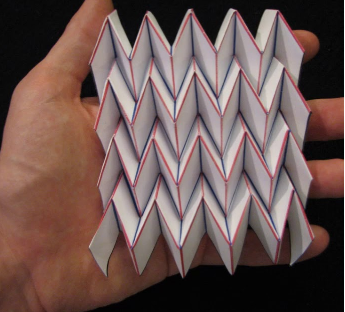
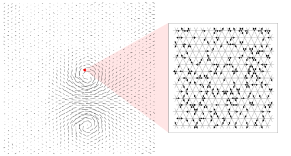
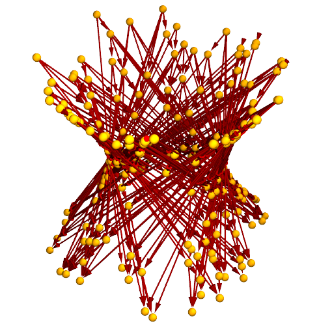
Below: A Miura-ori origami pattern[14], a fluid flow from cellular automation[6] and the Hasse Diagram from the causal graph of sampling a 1+1-dimensional de Sitter spacetime[15].
Topological Defects
Topological Defects
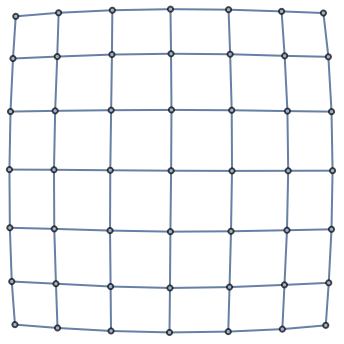
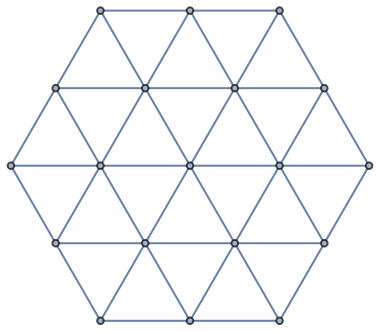
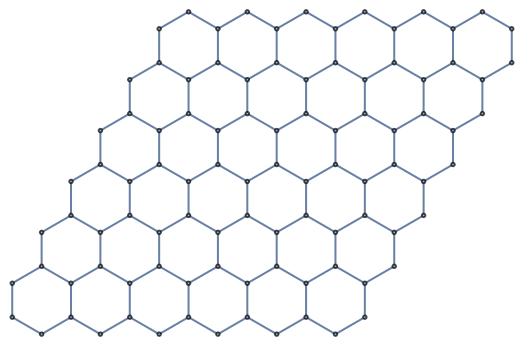
The two topological defects we are going to consider are dislocations and disclinations, in order to understand them properly let’s start with a simple (SquareGrid, TriangleGrid, HexagonalGrid),
,
,
Dislocation
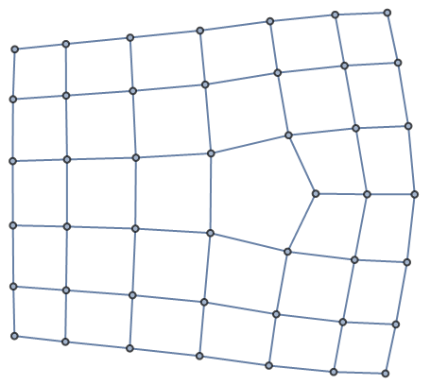
So a dislocation is a defect on a crystal that looks like if we had inserted an additional half plane in the crystal, for the SquareGrid
g34=VertexContract[g4,{ProductVertex[0,1+-1*#]ProductVertex[1,1+-1*#]}&/@Range[n+1]];g35=EdgeDelete[g34,{ProductVertex[0,0]ProductVertex[0,1]}]
Out[]=
Dislclination
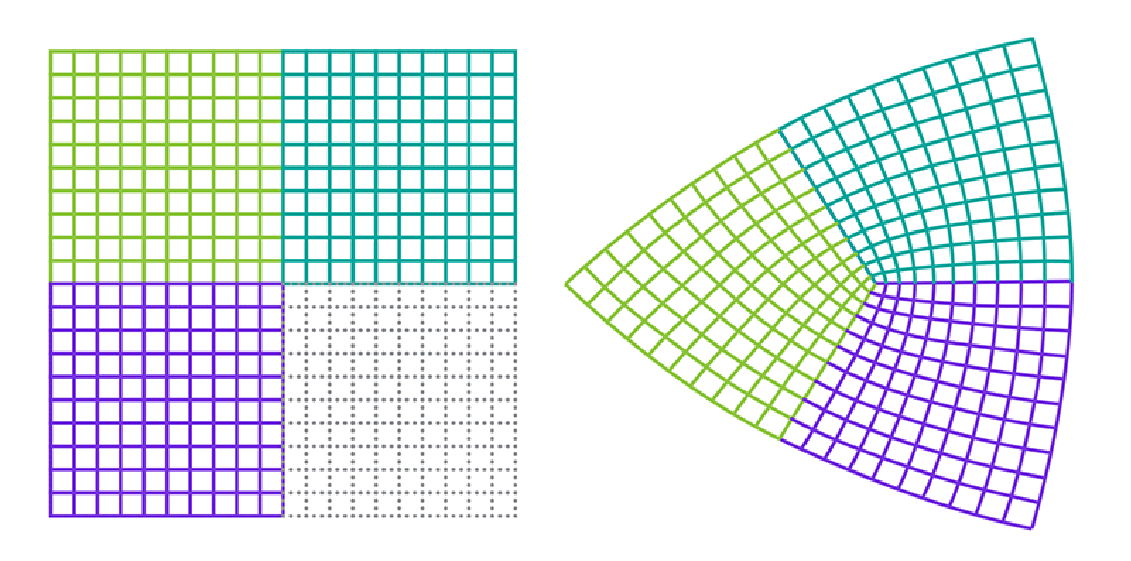
A disclination on the other hand is a singularity where a group of lattices of the same family are joined in a locally consistent way but globally there are points that do not satisfy the symmetry of the original latices. In the following image shows how to construct a disclination for a square lattice, we delete a quadrant of the grid and gluing the boundary of the two quadrants that share a line with the deleted quadrant [16]
In a similar way we can introduce defects in a origami pattern and get different phenomena[4,17], thinking about defects in lattices in terms of origami structures can be very useful, as we’ll see in the following sections
Lattice Primitives
Lattice Primitives
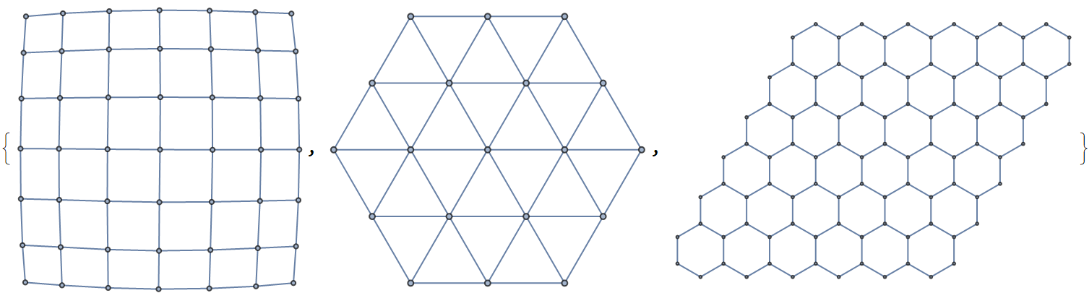
In order to analyse the lattices in the previous section, we introduce a following set of ideas that aim to describe some of the phenomena from the rewriting rules of the graph representing lattices. First consider three different well-structured latices(SquareGrid, TriangleGrid, HexagonalGrid), that in principle are just graphs , there is no spacial information associated to them, however they do have a well defined connectivity structure that we wish to exploit,
In[]:=
h[x_,y_,0]:=Prepend[Table[{Cos[2Pik/6]+x,Sin[2Pik/6]+y},{k,6}],{0,0}];h[x_,y_,n_]:=DeleteDuplicates[Flatten[Table[{Cos[2Pik/6]+#1,Sin[2Pik/6]+#2},{k,6}]&@@@h[x,y,n-1],1]];
{g4,NearestNeighborGraph[h[0,0,1],VertexCoordinatesh[0,0,1]],ResourceFunction["HexagonalGridGraph"][{6,6}]}
Out[]=
Generators
The previous graphs can be described using the notion of generators. Consider a set of generators that represent the possible directions that we can move on the lattice if we are located at a point. Although this structure is natural for the graphs seen before, we want to generate this structure even if the graph is not perfectly symmetrical as we saw in the beginning with the disclinations and dislocations. Also note that the different directions at a point provide a notion of discrete directions Tangent Space, therefore these generators span a discretized tangent space. Next we show an example of the generators for the three previous lattices,
{,,...}
x
1
x
2
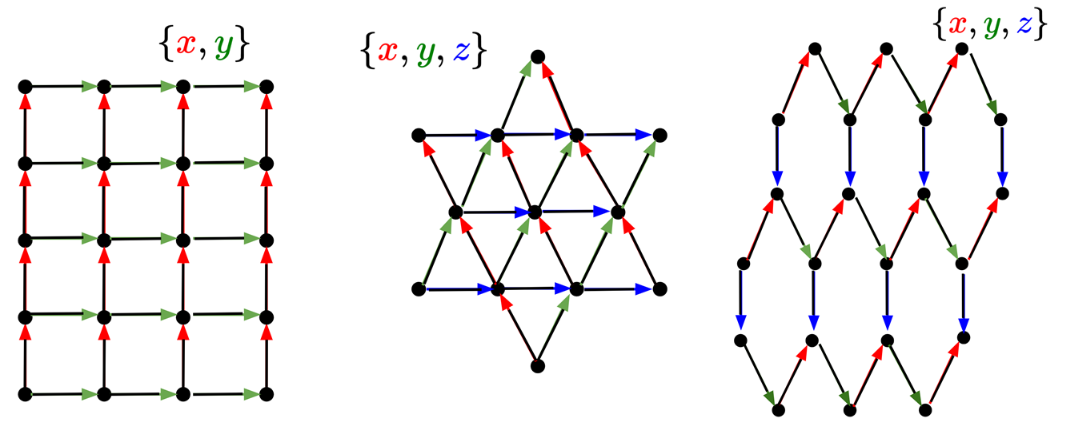
If we are able to generate the previous structure, we’ll be able to compute geometrical quantities in the graph and possibly relate them with some physical meaning. However we must emphasize that we are working in a graph with no extra structure, in some sense we want this generator structure to be on top of the graph.
Charts and Atlas
Charts and Atlas
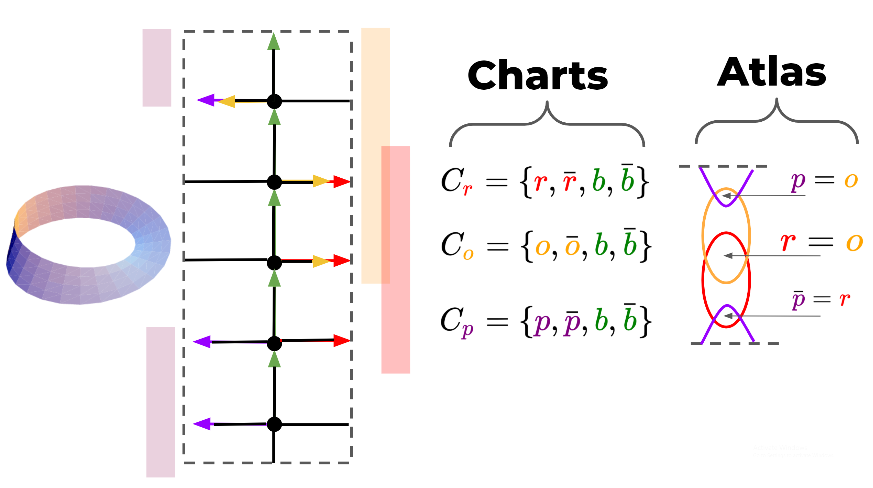
Another quite interesting object that we can define on top of these graphs is the notion of Chart and Atlas. Consider a simple one-dimensional Möbius Strip, we can suppose have defined different generators in dissimilar places in the graph. Each chart is a map between a set of edges to the generators and their inverse, the chart need not to be defined globally and don’t need to be “consistent” though all the graph. The important requirement is that the graph is covered by the union of all of this charts, in order to communicate in the intersecting regions of the charts we have a set of matching rules that allow to jump between Charts, the union of these matching rules is the Atlas.
C
Circuits and Inverses
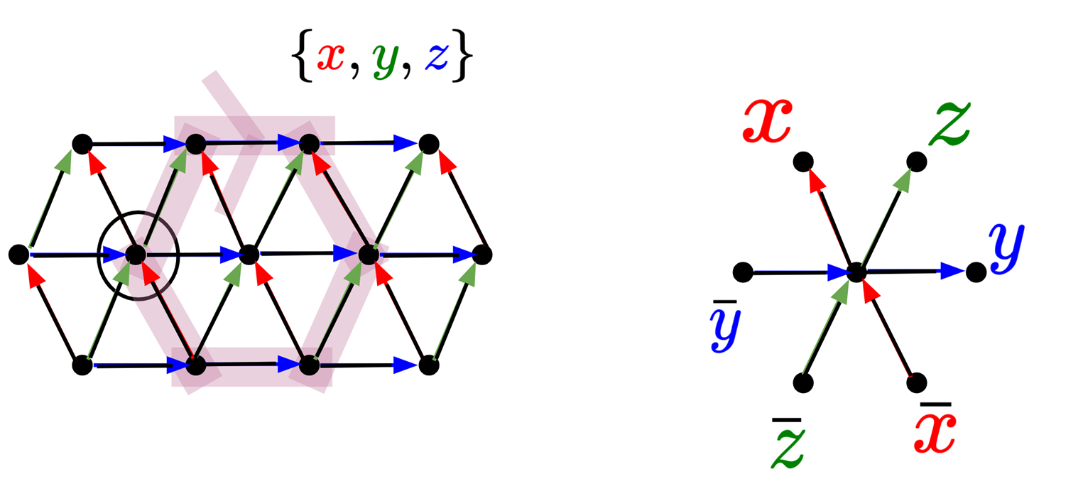
The previous structure allow us to talk about a circuit in a graph, and also the orientation of this circuit. For this reason it is convenient to introduce the set of inverses of generators that permits to traverse the lattice in the opposite direction, with this notation we can talk about the circuit bellow as and this circuit returns to the origin, then we’ll note this as .
{,,...}
x
1
x
2
{zyx}
x
z
y
{zyx}1
x
z
y
Construction, Parallel Transport and Geodesics
Unit Cells
Each of the lattices we’ve analyzed have different identities, this can be shown by computing a unit cell, this is a cell that can be repeated through space and the whole lattice can be generated. This is the classical notion studied in solid state-physics or chemistry of materials[18], in particular shown bellow we have the Wigner–Seitz cell of each of the lattices, this is a unit cell constructed from the Voronoi Region growing from each vertex from the lattice. Although in our problem there is no well-defined spacial notion, we can think of the Wigner–Seitz cell as the dual of our Graph, which its associated differential geometric concept is the Hodge Dual[19].
Curvature and Torsion
Curvature and Torsion
Analogies
In order to analyse what are the effects that defects introduce in a lattice we can think of two analogies, the first comes from the field of origami, and we can think of a disclination as a piece of paper and rolling in a tube form to generate a cone, the singularity of this lattice is the tip of the cone. In a similar way we can take a piece of fabric, cut it and add and additional piece, and form a crochet. The second analogy is based on [12] and interpret disclinations as charged monopoles and dislocations as dipoles, this analogy is an emerging understanding in the field of condensed matter[20], with defects representing different orders of the multiple expansion, but in terms of the Wolfram Physics Project it can provide an interesting idea for looking for charged particles.
Torsion
Curvature
In order to measure the curvature we parallel transport a vector in a closed circuit around the singularity, next we show some examples of positive and negative curved graphs.
Square Grid Lattice
If we glue three and five SquareGrids graphs, the point in common with all the graphs will have positive and negative curvature respectively. Moreover the negative curvature point would also have a torsion associated with it.
Triangle Lattice
Similarly if we glue five and seven TriangleGrids graphs, the point in common with all the graphs will have positive and negative curvature respectively. Moreover the negative curvature point would also have a torsion associated with it.
Dictionary of Discrete and Continuous Geometry
Dictionary of Discrete and Continuous Geometry
With the concepts developed in the previous section we can summarize our constructions in the following translation dictionary between notions of continuous differential geometry and Lattice or Discrete Graph Geometry.
Motion of Defects
Motion of Defects
With the previous concepts defined in the beginning of the document, we can proceed and move the defects and try to interpret their results.
Motion of Dislocations
Let’s start with a SquareGrid with a Dislocation in it,
We can propose the following rule that move the dislocation upwards, The gray lines represent edges that are on both the left and the right of the rule. The red lines are edges that get deleted. The green line represents edges that get added. The ‘3’ indicates vertices that are 3-defects (meaning they have degree 3 rather than the normal 4). The left rule removes the an edge from the original 3-defect, but it creates three new edges for a 3-defects. The right rule deletes three edges and generate a new edge, in summary the left one extends a dislocation away, the right one shrinks it.
Running this rule nine times,
Motion of Disclinations
We can also try to see a rule for the SqureGrid disclinations, to see this consider the following rule. The rule removes the an edge from the original 3-defect, but it creates three new edges for a 3-defects.
We obtain the following resulting graphs(the graphs have the wrong orientation due to the embedding, similarly than the previous graph evolutions),
For the case of a TriangleGrid the disclinations move considering the following rule, The rule removes the an edge from the original 4-defect, but it creates three new edges for a 3-defects.
Again we obtain the following resulting graphs(the graphs have the wrong orientation due to the embedding, similarly than the previous graph evolutions),
Conclusions and Future Directions
Conclusions and Future Directions
The original goal was to build a model of elasticity from microscopic rules. To do this we need to compute physical quantities by automatically build charts on our modified lattices, and use them to calculate torsion and curvature. We also need to search for rules that can modify defects without creating ‘wormholes’. We showed rewrite rules that can move disclinations and dislocations. It is known from Fracton theory[16] that disclinations cannot move without creating or destroying space (e.g. wormholes). Putting two opposite disclinations next to each-other allows the resulting dipole to move. However the dipole implies a dislocation: pairs of dipoles can annihilate with each-other. Other ideas is to model higher multipole moments as its known in the lattice theory[20] or analyse different defects . All of these parts would contribute to generate a model for a “lattice gas of defects”, with this gas one could model different phenomena from condensed matter and macroscopic elasticity or generate statistics of quasi-particles.
The original goal was to build a model of elasticity from microscopic rules. To do this we need to compute physical quantities by automatically build charts on our modified lattices, and use them to calculate torsion and curvature. We also need to search for rules that can modify defects without creating ‘wormholes’. We showed rewrite rules that can move disclinations and dislocations. It is known from Fracton theory[16] that disclinations cannot move without creating or destroying space (e.g. wormholes). Putting two opposite disclinations next to each-other allows the resulting dipole to move. However the dipole implies a dislocation: pairs of dipoles can annihilate with each-other. Other ideas is to model higher multipole moments as its known in the lattice theory[20] or analyse different defects . All of these parts would contribute to generate a model for a “lattice gas of defects”, with this gas one could model different phenomena from condensed matter and macroscopic elasticity or generate statistics of quasi-particles.
Keywords
Keywords
◼
Elasticity
◼
Meta-Material
◼
Elastic Defects
◼
Topological Particles
◼
Elastic Analogies
◼
Graph Rewriting System
◼
Discrete Differential Geometry
Acknowledgment
Acknowledgment
Mentor: Taliesin Beynon
I am deeply grateful for all the help and guidance I received from my project mentor Tali Beynon, Jonathan Gorard, Stephen Wolfram, and to all the Wolfram Winter School for hosting an amazing intellectual experience.
I am deeply grateful for all the help and guidance I received from my project mentor Tali Beynon, Jonathan Gorard, Stephen Wolfram, and to all the Wolfram Winter School for hosting an amazing intellectual experience.
References
References
◼
[1]Sommerfeld, A. Mechanics of deformable bodies: Lectures on Theoretical Physics, Vol. 2. Elsevier. (Jan. 1964). Quasi-Elastic body model of the ether(Section 15)
◼
[2]S. Wolfram, “A Class of Models with the Potential to Represent Fundamental Physics,” Complex Systems, 29(2), 2020 pp. 107–536. DOI: https://doi.org/10.25088/ComplexSystems.29.2.107
◼
[3]Royo Abergo, A. [WSS20] Particles and fields from topological defects in spacetime mesh. Wolfram Community Post. (Jun. 2020). Available at:https://community.wolfram.com/groups/-/m/t/2030734
◼
[4]Assis, M. 2018. Exactly solvable flat-foldable quadrilateral origami tilings. Physical Review E. 98, 3 (Sep. 2018). DOI:https://doi.org/10.1103/physreve.98.032112.
◼
[5]Kruger, T., Kusumaatmaja, H., Kuzmin, A., Shardt, O., Silva, G., Viggen, E. (2017). The Lattice Boltzmann Method Principles and Practice (Graduate Texts in Physics). Springer International Publishing.
◼
[6]Wolfram, S. Cellular automaton fluids 1: Basic theory. J Stat Phys 45, 471–526 (Aug. 1986). DOI: https://doi.org/10.1007/BF01021083
◼
[7]Mendoza, M. and Muñoz, J.D. 2010. Three-dimensional lattice Boltzmann model for electrodynamics. Physical Review E. 82, 5 (Nov. 2010). DOI:https://doi.org/10.1103/physreve.82.056708.
◼
[8]Furtmaier, O. et al. 2015. Rayleigh-Bénard instability in graphene. Physical Review B. 91, 8 (Feb. 2015). DOI:https://doi.org/10.1103/physrevb.91.085401.
◼
[9]Gorard, J. “Some Relativistic and Gravitational Properties of the Wolfram Model,” Complex Systems, 29(2), 2020 pp. 599–654. DOI: https://doi.org/10.25088/ComplexSystems.29.2.599
◼
[10]Beetar, C. [WSS20] A Path to Higher Order Corrections for Einstein’s Equations. Wolfram Community Post. (Jun. 2020). Available at:https://community.wolfram.com/groups/-/m/t/2030275
◼
[11]Velasco, A.M. et al. 2019. Lattice Boltzmann model for the simulation of the wave equation in curvilinear coordinates. Journal of Computational Physics. 376, (Jan. 2019), 76–97. DOI:https://doi.org/10.1016/j.jcp.2018.09.031.
◼
[12]Pretko, M. and Radzihovsky, L. 2018. Fracton-Elasticity Duality. Physical Review Letters. 120, 19 (May 2018). DOI:https://doi.org/10.1103/physrevlett.120.195301.
◼
[13]Van Goffirer, G. [WSS20] Full Discretization of Local Gauge Invariance. Wolfram Community Post. (Jun. 2020). Available at:https://community.wolfram.com/groups/-/m/t/2030337?p_p_auth=UwoUTs0F
◼
[14]Khan, A. Origami robotics: Here’s how to fold your own ‘metamaterial’ at home.(Aug. 2014). Available at:https://www.latimes.com/science/sciencenow/la-sci-sn-origami-robot-miura-ori-metamaterial-20140808-story.html
◼
[15]Gorard, J. “Algorithmic Causal Sets and the Wolfram Model,” . (2020). Arxiv: https://arxiv.org/abs/2011.12174
◼
[16]Slagle, K. “Crystal Defects Mimic Elusive Fractons”. (2018). Available at:https://physics.aps.org/articles/v11/43
◼
[17]Woo, M. “The Atomic Theory of Origami”. (2017). Avialable at: https://www.quantamagazine.org/the-atomic-theory-of-origami-20171031/
◼
[18] Ashcroft, N. W. Solid State Physics. (1976). Cengage Learning.
◼
[19]Crane, K. et al. 2013. Digital geometry processing with discrete exterior calculus. ACM SIGGRAPH 2013 Courses on - SIGGRAPH ‘13 (2013).
◼
[20]Sagui, C., & Desai, R. C. Late-stage kinetics of systems with competing interactions quenched into the hexagonal phase. (1995).Physical Review E, 52(3), 2807–2821. doi:10.1103/physreve.52.2807