The Collatz Problem asks if repeatedly applying the function eventually gives for all positive integers . This post shows how to visualize this problem as a tree using the Wolfram Language.
n
|
1
n
Define the Iterators
Define the Iterators
In its most basic form, we can define the iterator in the Collatz problem as follows:
In[]:=
collatz[n_?EvenQ]:=n/2collatz[n_?OddQ]:=3n+1
We can get a list of the results of applying this iterator several times using the Wolfram Language function NestList:
In[]:=
NestList[collatz,25,10]
Out[]=
{25,76,38,19,58,29,88,44,22,11,34}
In[]:=
NestWhileList[collatz,25,Not@*EqualTo[1]]
Out[]=
{25,76,38,19,58,29,88,44,22,11,34,17,52,26,13,40,20,10,5,16,8,4,2,1}
The Collatz conjecture states that this process will terminate for all positive integers .
n
Since is even whenever is odd, and so will be followed by , we can decrease the number of steps without affecting the Collatz problem as follows:
3n+1
n
3n+1
2
In[]:=
collatz2[n_?EvenQ]:=n/2collatz2[n_?OddQ]:=(3n+1)/2
Now with this iterator, the number of steps to reach is decreased:
1
In[]:=
NestWhileList[collatz2,25,Not@*EqualTo[1]]
Out[]=
{25,38,19,29,44,22,11,17,26,13,20,10,5,8,4,2,1}
We can decrease the number of steps even further by restricting to odd numbers only and repeatedly dividing by as much as possible at each step:
2
In[]:=
collatzOdd[n_?OddQ]:=With[{m=3n+1},m/2^IntegerExponent[m,2]]
With this iterator, all the even numbers in the original sequence are skipped:
In[]:=
NestWhileList[collatzOdd,25,Not@*EqualTo[1]]
Out[]=
{25,19,29,11,17,13,5,1}
Collatz Graph
Collatz Graph
In[]:=
collatzGraph[iterator_:collatz,init_,steps_]:=NestGraph[iterator,init,steps,VertexLabels->Automatic]//LayeredGraph
In[]:=
collatzGraph[12,3]
Out[]=

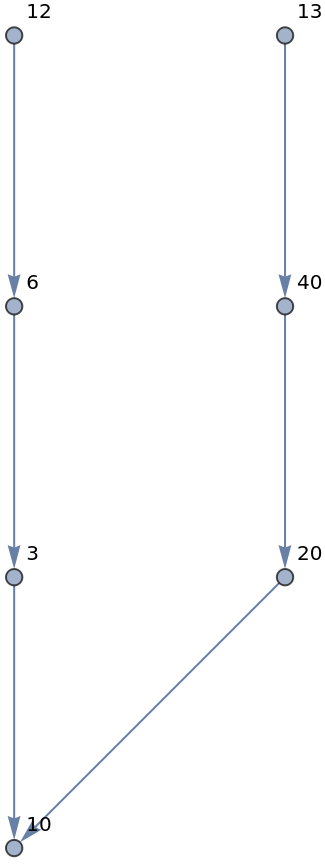
The orbits of the Collatz iterator form a branching structure, since some numbers, like , can be reached in two different ways:
10
In[]:=
collatz[3]
Out[]=
10
In[]:=
collatz[20]
Out[]=
10
This results in two different branches merging together in the graph:
In[]:=
collatzGraph[{12,13},3]
Out[]=
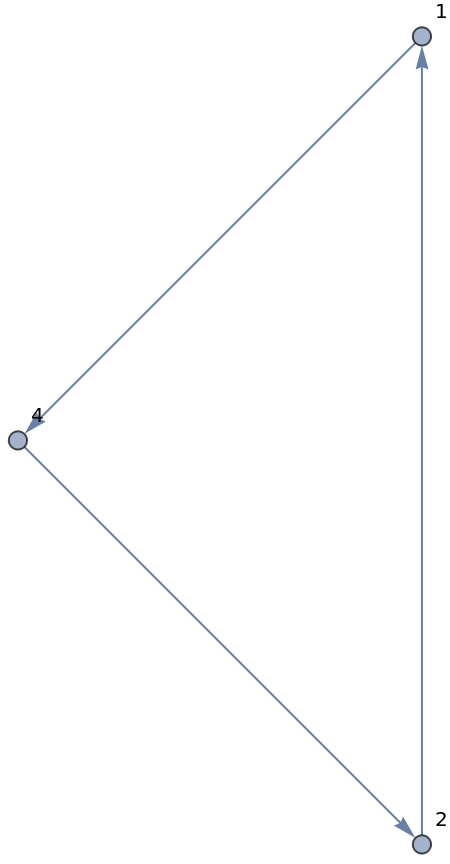
The numbers , , and form a cycle:
4
2
1
In[]:=
collatzGraph[4,3]
Out[]=
If the Collatz conjecture is true, then this is the only such cycle, and all branches eventually merge and lead to this cycle. For example, let’s consider the orbits of , , and . After three steps, the orbits of and merge:
12
13
21
12
13
In[]:=
collatzGraph[{12,13,21},3]
Out[]=
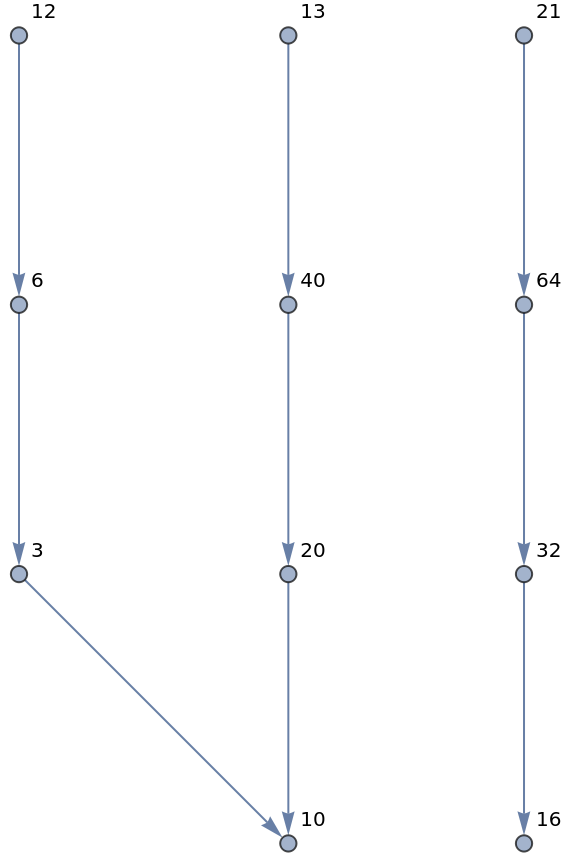
After two more steps, these orbits merge:
In[]:=
collatzGraph[{12,13,21},5]
Here is the graph using the iterator that combines the two steps following odd numbers:
Here is the graph using the iterator restricted to odd numbers:
Collatz Tree
Collatz Tree
We can also perform this process in reverse, starting with a number and at each step producing the immediate predecessors in the Collatz orbits. First, let’s define the inverse iterator:
Let’s do the same with the inverse of the iterator that combines the two steps following odd numbers:
Produce the first two levels of the tree limited to five branches per node:
Interactive Collatz Tree
Interactive Collatz Tree
NestTree expands the branches of a tree up to a given level:
I submitted an interactive version of NestTree to the Wolfram Function Repository that allows branches to be expanded by clicking on the leaves:
The output is reset when the notebook is closed, so to save the output, select the cell and choose the Cell ▶ Convert To ▶ Bitmap menu item.
Interactively explore the full Collatz problem tree:
Interactively explore the tree using the iterator that combines the two steps following odd numbers:
Interactively explore the tree using the iterator restricted to odd numbers:
Acknowledgement
Acknowledgement
CITE THIS NOTEBOOK
CITE THIS NOTEBOOK
Exploring the Collatz Problem Tree
by Ian Ford
Wolfram Community, STAFF PICKS, January 31, 2024
https://community.wolfram.com/groups/-/m/t/3113948
by Ian Ford
Wolfram Community, STAFF PICKS, January 31, 2024
https://community.wolfram.com/groups/-/m/t/3113948