A simple geometric operation - orthic (pedal) triangle construction is considered. It is shown that its iterations lead to interesting results, as well known as not yet studied. It is proposed a generalization of the construction of othic triangle, allowing to see in detail the transition to chaos.
About codebook
About codebook
In order not to get a post too big and normal rendering, here are the results only as text and pictures.
Separate notebook with all the necessary code in structured form is attached to the post.
Separate notebook with all the necessary code in structured form is attached to the post.
Introduction
Introduction
Even simple geometric shapes and their relationships are almost inexhaustible.
The simplest transformations can produce complex, interesting behaviors.
Consider first the very simple, obvious example - excentral triangle.
It is defined for any triangle, so we can build an iteration chain.
Interestingly, starting with any one, even strongly obtuse, we will get more and more like equilateral:
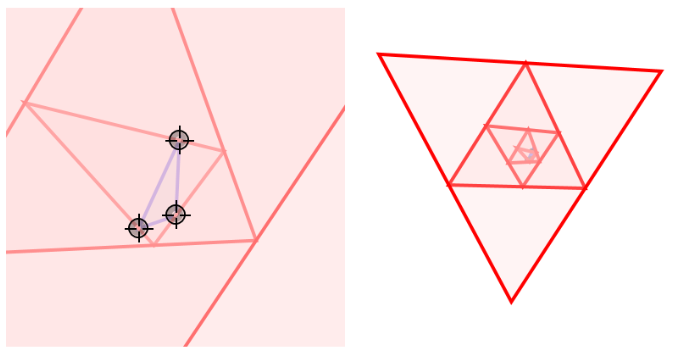
This is easy to see that the excentral triangle angles are expressed through initial angles as follows:ϕ' = (π - ϕ) / 2So = (2π+π-6ϕ)Various similar ideas discussed in this article.
ϕ
n
1
3
n
-
1
2
n
(-2)
Orthic triangles overview
Orthic triangles overview
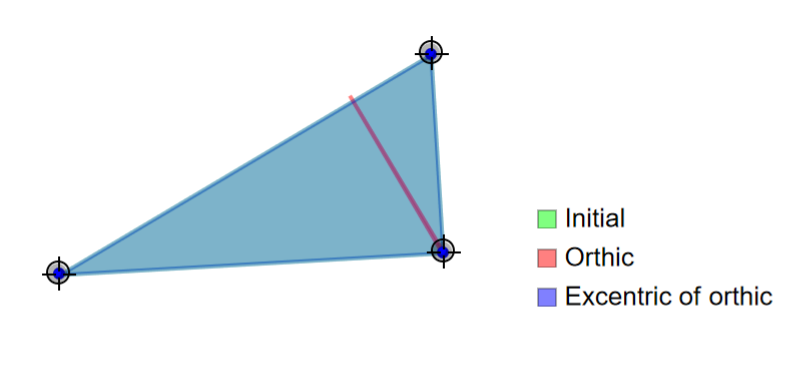
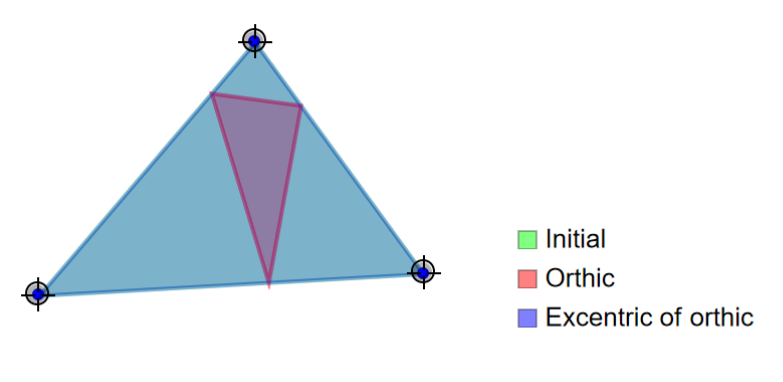
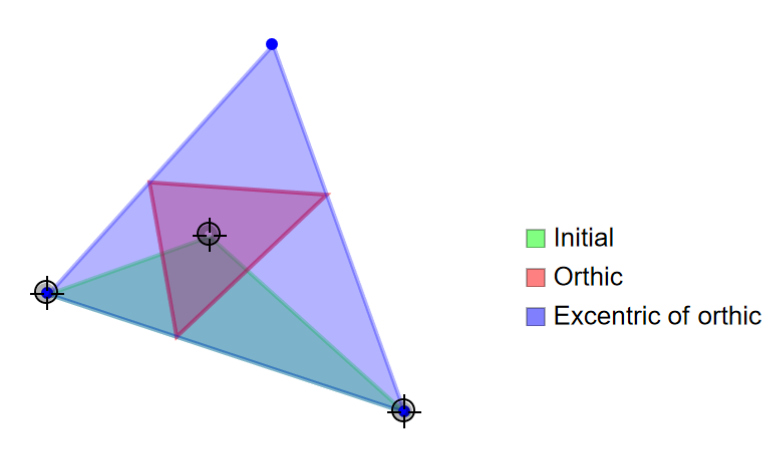
Being familiar with chaos theory, I thought: if some transformation has smoothing properties,inverse one can show unpredictable, even chaotic behavior. For excentral triangle inversion is orthic triangle with the following reservations: For rectangular triangle it's orthic is degenerated (a segment) For acute triangle orthic is inscribed; and excentral triangle of orthic is initial one. For obtuse initial triangle orthic is some normal arbitrary triangle; and excentral triangle of orthic does not match with initial, but has a common side with it.
Iterations overview
Iterations overview
Thus, we may try to construct successive iterations of ortho-triangles for any non-rectangular initial one.

We can see that:
1. The “size” (circumradius) of triangles in sequence very rapidly decreasing
2. Centroid positions are unpredictable, but looks limited
3. Orientation and form of succesive triangles looks totally chaotic
It is proved that:
The circumradius of orthic triangle is exactly half that of initial
The closed discs bounded by it’s circumcircles intersect
So sequence of triangles fastly converges to a fixed point. The properties of the convergence process and the fixed point position will be discussed in the next post.Behavior of forms (angles) of triangles are well studied and discussed, for example in this article.
Here we study the behavior of orientation of ortho-triangles, which has not yet been studied.
Since the transformation does not change the order of vertices,
we can choose an angle between side 1-2 and axis OX as orientation.
Since the transformation does not change the order of vertices,
we can choose an angle between side 1-2 and axis OX as orientation.
Renormalization
Renormalization
As already mentioned, absolute size of iterated triangles decrease very quickly.
For the analysis of the behavior of angles this does not matter, because, the formulas for angles are universal.
For the study of the end point, this is good, because iterations converge in a small number of steps.
For the analysis of the behavior of angles this does not matter, because, the formulas for angles are universal.
For the study of the end point, this is good, because iterations converge in a small number of steps.
But this is bad for orientations study, because after 20-30 iterations float calculations errors occur.To avoid this, we apply renormalization:1. After each iteration we will scale the triangle by factor as it has decreased as a result of the step2. And move it in parallel, so that the center coincides with the previous one.
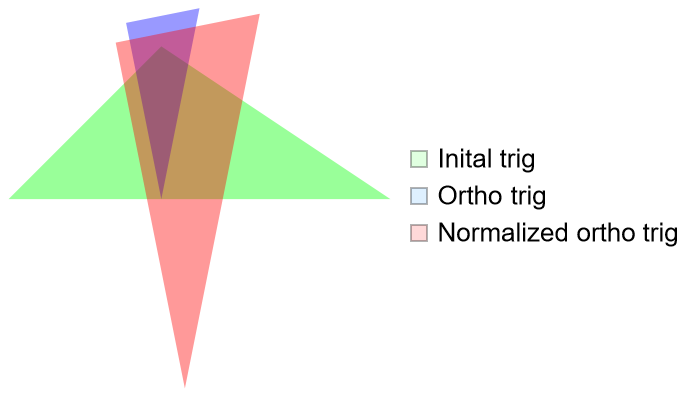
This allows to avoid errors of small floats and focus on the behavior of triangle orientations.
The nature of the process obviously does not change with these transformations.
The nature of the process obviously does not change with these transformations.
The result of iterations is a chaotic structure that I call the Chaos Star.The emerging hexagonal pattern is probably related to a certain correlation between orientation and shape of triangles.
~
2
10
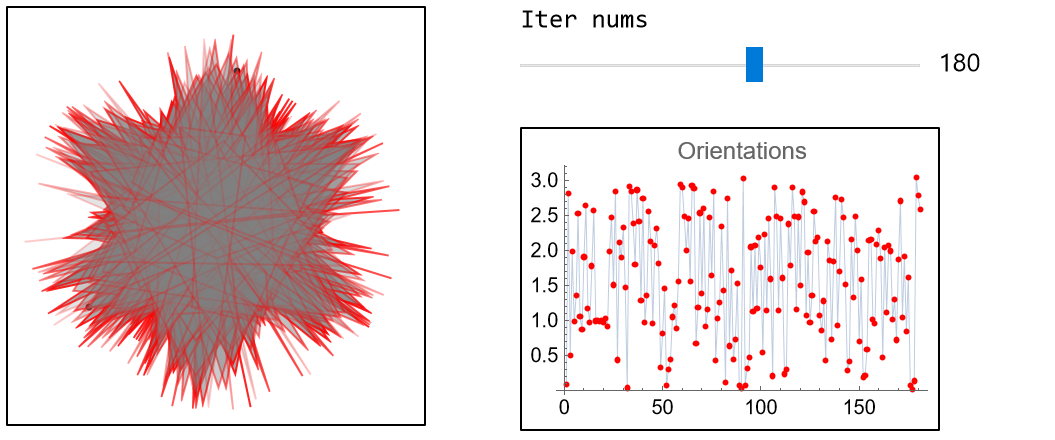
Chaos test
Chaos test
A simple and reliable data randomness test was provided in one of the posts.
Iterations for many randomly selected triangles show,
that their orientations show a high degree of (deterministic) chaos.
Median of test data is close to random reals median (~0.997) while interquartile is even smaller (~0.0044 vs ~0.005).
Iterations for many randomly selected triangles show,
that their orientations show a high degree of (deterministic) chaos.
Median of test data is close to random reals median (~0.997) while interquartile is even smaller (~0.0044 vs ~0.005).
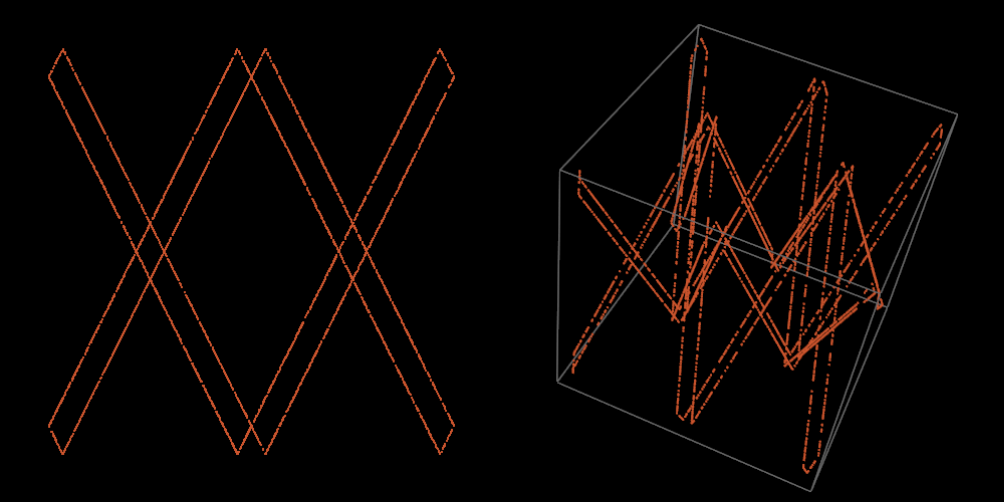
But if we plot on the plane and in the space tuples } , } , then we will see that this is a quasi-chaos, which has a simple geometrical attractor:
{
ϕ
i-1
ϕ
i
{,
ϕ
i-1
ϕ
i
ϕ
i+1
Generalization
Generalization
If we use the classical definition of ortho-triangle, chaos seems to come out of nowhere,
It’s sort of embedded in the nature of iteration.
It’s sort of embedded in the nature of iteration.
I decided to make a generalization of orthic triangle and propose some kind of “degree”.
Enter the parameter 0 ≤τ ≤ 1 and the point D lying on side AB (or continuation) between A and foot H of altitude from C.
For τ = 0 D = A, and for τ = 1 D = H.
Enter the parameter 0 ≤τ ≤ 1 and the point D lying on side AB (or continuation) between A and foot H of altitude from C.
For τ = 0 D = A, and for τ = 1 D = H.
If we construct such points for each vertex (with the same parameter value),
then at τ = 0 we get the original triangle,
when τ = 1 - classic orthic triangle, and at 0 < τ < 1 - some “degree” of orthic.
then at τ = 0 we get the original triangle,
when τ = 1 - classic orthic triangle, and at 0 < τ < 1 - some “degree” of orthic.
Overview transition to chaos
Overview transition to chaos
Already from the qualitative demonstration we can make conclusions:
◼
for small values of the parameter there is a convergence to the degeneration
◼
for several large ones - periodicity
◼
further quasi-periodicity
◼
at some point there is a hypothetical transition to chaos
◼
the area of deterministic chaos
◼
finally, a hypothetical high-frequency noise region
This picture is not dependent on the particular shape of the initial triangle.
Transition to chaos - detailed exploring
Transition to chaos - detailed exploring
The general plot clearly shows that we found what we were looking for!
Conclusion
Conclusion
Such a simple construction as the ortho-triangle surprisingly conceals the world of different types of chaos and fractals,
in which there is still something to learn!
in which there is still something to learn!
Attractors fractal structure
Attractors fractal structure
CITE THIS NOTEBOOK
CITE THIS NOTEBOOK
Transition to chaos in geometric iterations
by Denis Ivanov
Wolfram Community, STAFF PICKS, May 15, 2025
https://community.wolfram.com/groups/-/m/t/3460997
by Denis Ivanov
Wolfram Community, STAFF PICKS, May 15, 2025
https://community.wolfram.com/groups/-/m/t/3460997