The multiplicad is a hypergraph which relates the natural numbers (vertices) via multiplication (edges). The ideas of the multiplicad closely resemble those of Cayley graphs, an idea in group theory. I examined this connection and analyzed differences.
Intro to Multiplicad and Cayley Graphs
Intro to Multiplicad and Cayley Graphs
The Multiplicad
The Multiplicad
The multiplicad was first defined by Stephen Wolfram in a blog post about the Ruliad. In short, it describes a hypergraph where vertices are numbers and directed edges are multiplication. By starting with the number 1, then multiplying it by every natural number, and then multiplying every resulting product by every natural number over and over, the resulting object is the multiplicad.
Out[]=
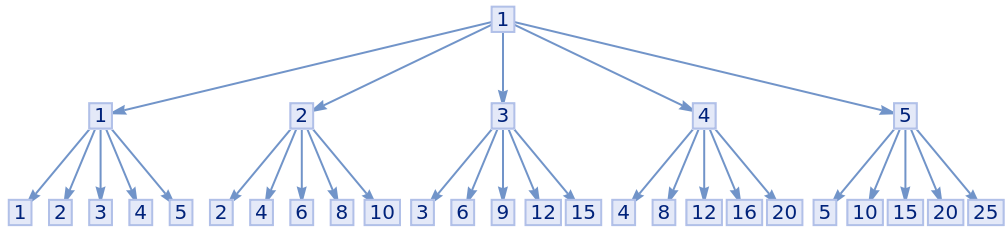
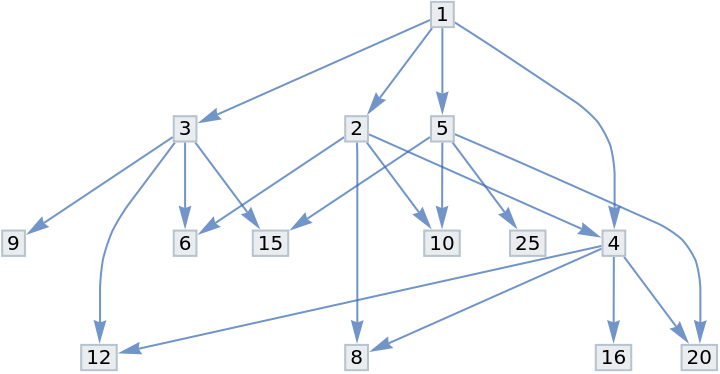
There are many ways to alter this object. Most notably for this project, by deduplicating the graph. That is to force the graph to only generate one vertex for each number. This drastically limits the size of the multiplicad.
Out[]=
Cayley Graphs
Cayley Graphs
Cayley graphs are an idea which arise from group theory. The idea is that you take some algebraic structure, create vertices for each element, and connect the vertices according to the relationships defined by the algebraic structure. Some important things to note about these graphs are that every element appears exactly once, and there is no starting element or reference frame.
By considering that a multiplicad is an algebraic structure, has a generating set, and has edges determined by group actions. We can see that the deduplicated version of the multiplicad is in fact a Cayley graph.
By considering that a multiplicad is an algebraic structure, has a generating set, and has edges determined by group actions. We can see that the deduplicated version of the multiplicad is in fact a Cayley graph.
Differences
Differences
While the deduplicated version of the multiplicad is a Cayley graph, the multiplicad as a whole represents more than just a Cayley graph. Specifically, the non-deduplicated multiplicad Stephen Wolfram said “sometimes the structure we get is richer—if much bigger—when we don’t immediately do deduplication.” in his blog introducing the multiplicad. Furthermore, the multiplicad emphasizes growth whereas a Cayley Graph just visualizes a set of relations.
Structures
Structures
Any structure for which a Cayley graph can be made, can be turned into a multiplicad. The structures I looked at were groups, monoids, semigroups, and rings. As I went through different structures, I only considered a structure which did not meet the requirements for a more specific version. For example, a monoid which is not a group.
Groups
Groups
The properties required to be considered a group are being closed, associative, having inverse elements, and having an identity element. This specific group is the multiplicative group of integers modulo n where n is 30.
Out[]=
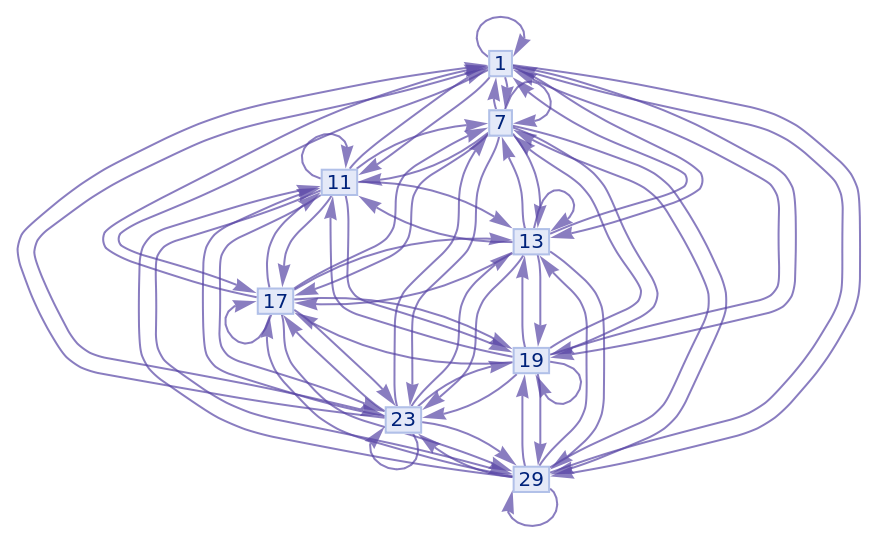
Some things worth noting about the deduplicated graph above are that each vertex has a loop circling back to it. This is because, as a group, it has an identity element. Additionally, that for every directed edge going from one vertex to another, there is another directed edge connecting the same vertices which points the opposite way. This is because each operation is invertible.
Out[]=
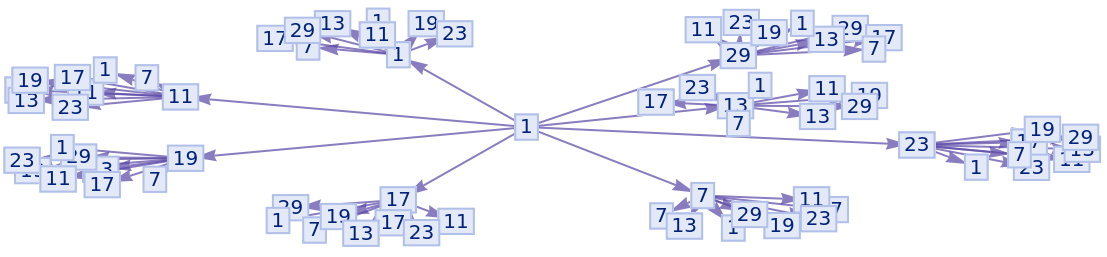
Now, looking at the non-deduplicated graph, we see several branches, and potential for fractal properties. However, there is no clear looping or other such feature.
Monoid
Monoid
A monoid is a more general classification than a group which requires everything a group does besides having inverse elements. The monoid below is the integers under multiplication
Out[]=
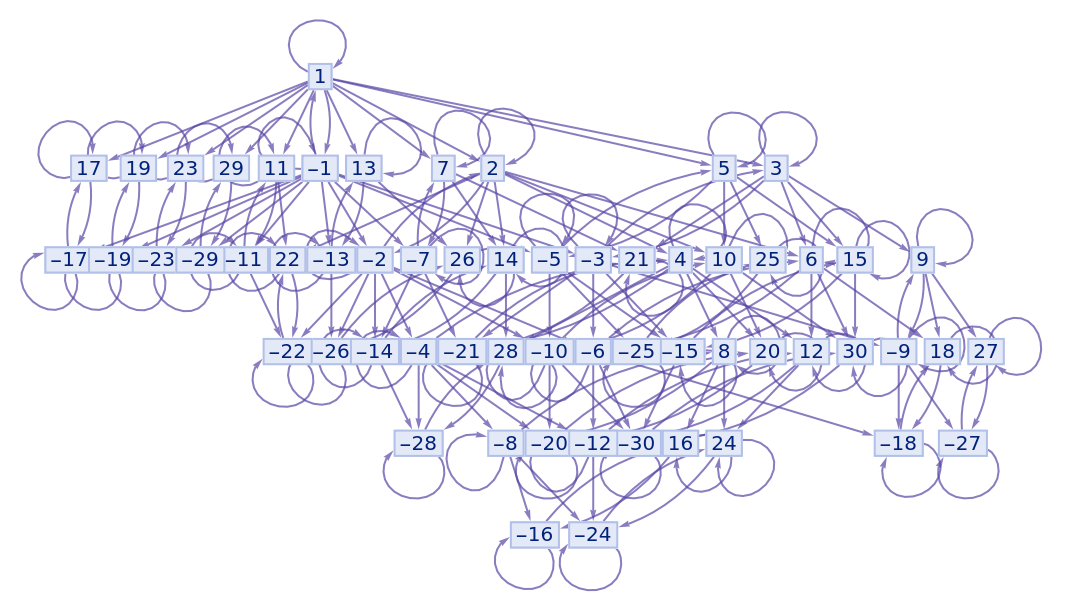
And as we would expect, we no longer see two directed edges for each connection.
Out[]=
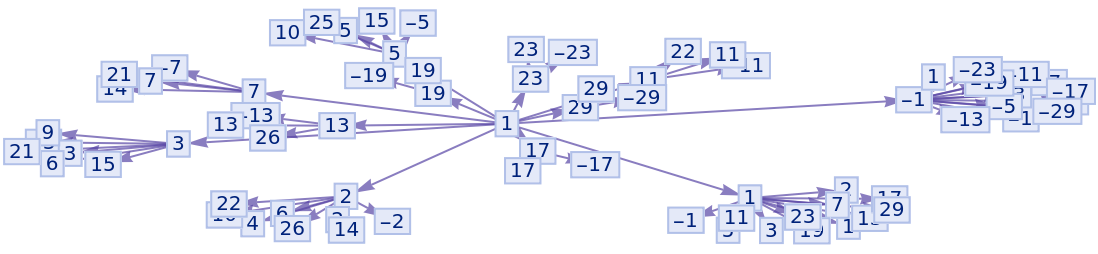
Looking at this non-deduplicated graph, we see much of the same as we saw before. There is no clear change in structure.
Semigroup
Semigroup
Semigroups are a more general structure than monoids. The difference being that semigroups do not require an identity element. As such, the semigroup I used was the positive integers greater than 1 under multiplication. It is worth noting that the multiplicad as introduced in Stephen Wolfram’s blog is a semigroup.
Out[]=
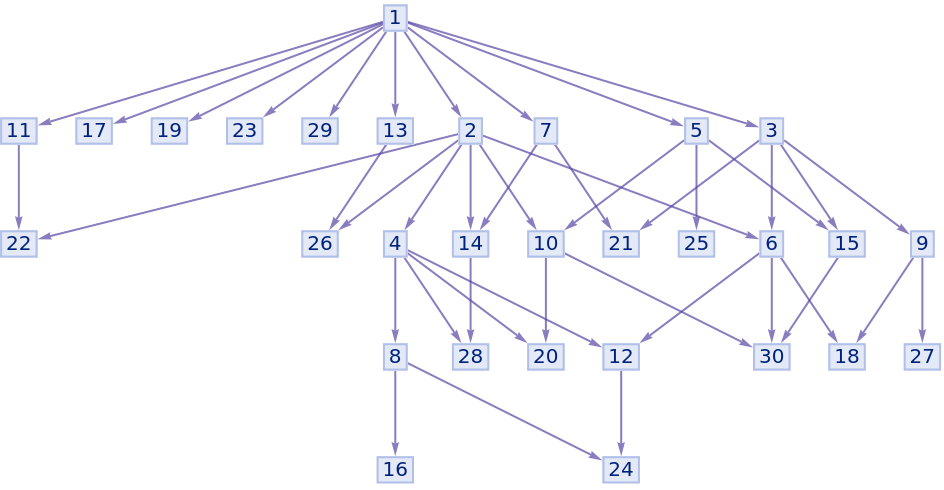
With the removal of an identity element, we do in fact see the loss of the loops around each element.
Out[]=
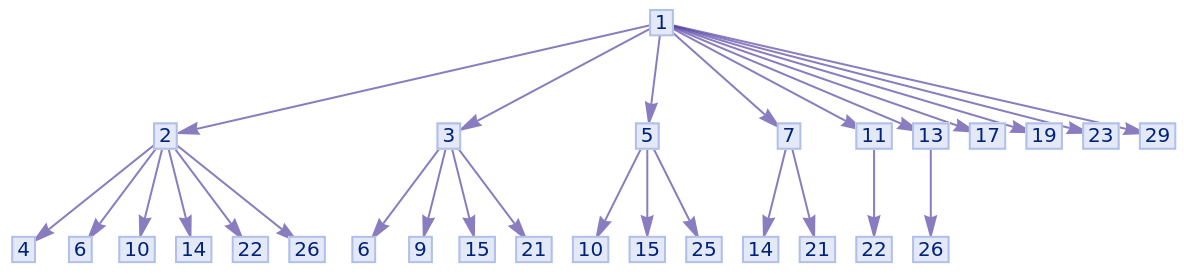
While smaller in this example, the structure of the non-deduplicated graph remains the same.
Rings
Rings
Another mathematical structure is a ring. Rings are more complicated than all the previous structures we’ve looked at so far because they require the definition of two operations. I looked at the integers under addition and multiplication.
Out[]=
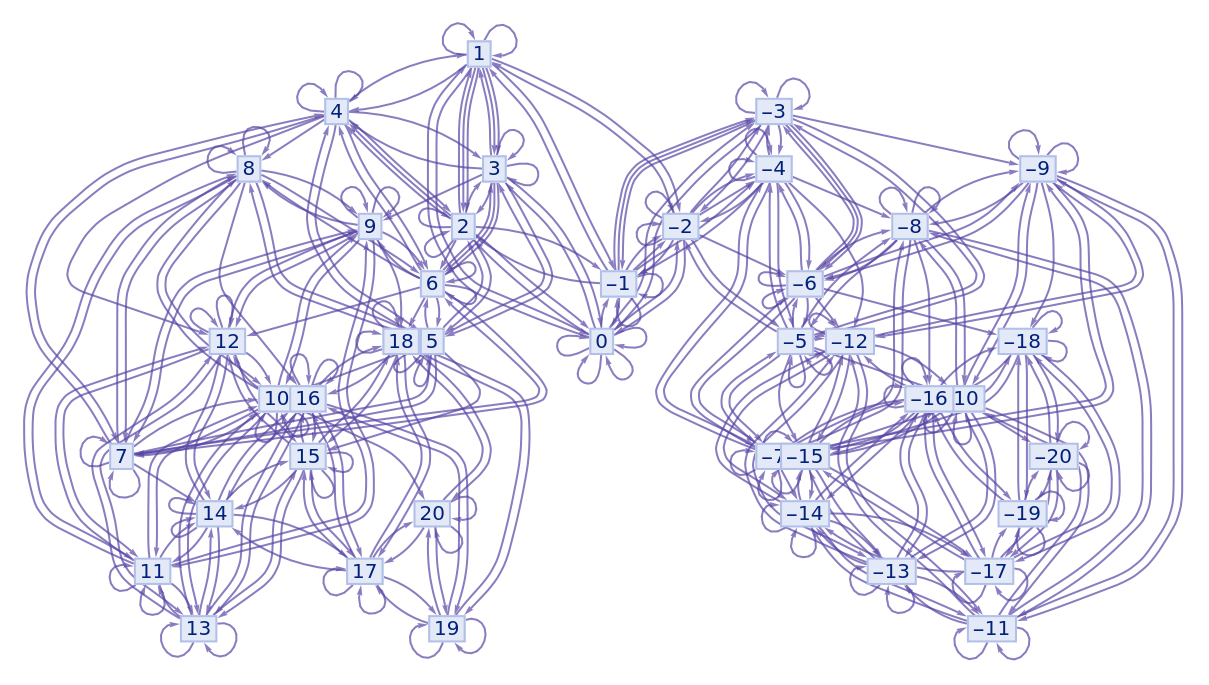
Here we can see that both the loops and directed edges in both directed, which we observed in groups, are visible in the ring. In fact, each vertex has two loops, one corresponding to the identity group action of each operation. This graph looks notable more complicated than the previous ones. Even after substantially limiting the amount of generators and the maximum generated value, this is still the largest deduplicated graph.
Out[]=
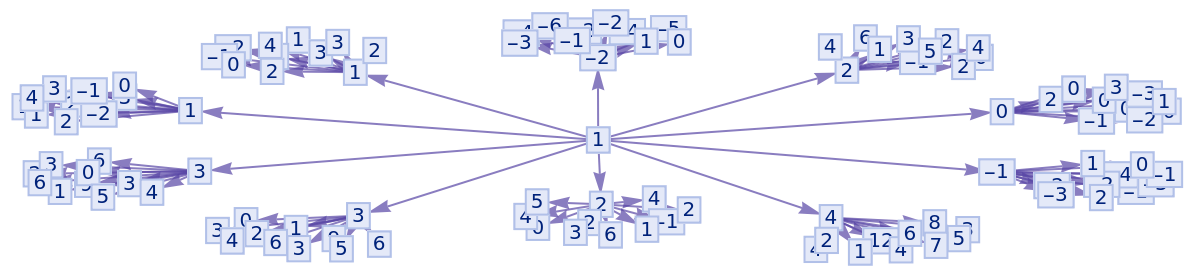
Similarly, the non-deduplicated graph is massive. And yet again, the structure remains indistinguishable, simply a collection of branches.
Benefits of Viewing Cayley Graphs as a Multiplicad
Benefits of Viewing Cayley Graphs as a Multiplicad
Is there any practical use of connecting Cayley graphs to the multiplicad? In all the examples I looked at, the Cayley graphs showed far more distinction of characteristics between structures than the multiplicad graphs did. The reason for this is because Cayley graphs were designed with the intention of showing the relationship between all of the elements. While this is a secondary motivation of the multiplicad, it is not its main intention. The multiplicad shows a form of growth given a structure. Essentially, it designates a part of the Cayley graph as the start, and then iterates. So for objectively analyzing the relationships between all of the elements in no particular ordering, a Cayley graph is a better fit. However, with a different goal, the multiplicad may be a better fit.
Generators
Generators
One concept involved Cayley graphs is the smallest set of elements that can be used to generate the rest of the set. In the original multiplicad, these would be the primes. However, more generally, they are referred to as the set which is irreducible with respect to a generating set. This way of thinking about Cayley graphs is much more in alignment with the multiplicad. Furthermore, I discussed methods in “Evaluating the multiplicad” to compare the importance of each generator given a multiplicad approach.
Rate of Growth
Rate of Growth
In my work above I tried to stick with multiplication as my operation as much as possible because different operations correspond with different features of the multiplicad. One such example is the growth of the multiplicad. If we compare the multiplicative group of integers mod n to the integers under addition, another group, this effect is very noticeable.
Each iteration of generation, given the minimum generating set, the multiplicad can only grow by ±1, whereas in the multiplicative group of integers mod n, large leaps can be made. In this way we are able to describe a difference between the two groups, thus creating greater potential for comparison between them.
Concluding Remarks
Concluding Remarks
Establishing the connection between the multiplicad and Cayley graphs creates a new lens by which we can analyze a variety of algebraic structures. Although the emergent structure of the multiplicad is not clear in comparison to the Cayley graphs, as it remains generally fixed regardless of the algebraic structure it is generated by, there exist other ways of analyzing the multiplicad which show promise.
Acknowledgements
Acknowledgements
Thank you to Stephen Wolfram and my mentor for this project Dugan Hammock for drawing the connection between the Multiplicad and Cayley graphs and advising me to look at the structure of these graphs for various algebraic objects. Further thanks to Dugan for helping me with programming and general guidance.
References
References
Wolfram, S. (2021, November 10). The concept of the Ruliad. Stephen Wolfram Writings. writings.stephenwolfram.com/2021/11/the-concept-of-the-ruliad.
John, C. (2025, July 7). Evaluating the Multiplicad. https://community.wolfram.com/groups/-/m/t/3497488
John, C. (2025, July 7). Evaluating the Multiplicad. https://community.wolfram.com/groups/-/m/t/3497488
CITE THIS NOTEBOOK
CITE THIS NOTEBOOK
The multiplicad as a Cayley graph
by John Cantwell
Wolfram Community, STAFF PICKS, January 15, 2026
https://community.wolfram.com/groups/-/m/t/3607887
by John Cantwell
Wolfram Community, STAFF PICKS, January 15, 2026
https://community.wolfram.com/groups/-/m/t/3607887