The way money is created and managed can have significant impacts on economic growth and financial stability. Understanding how money works is important for making informed decisions about personal finance, investing, and participating in the economy.
Understanding Money, the World’s Most Powerful Tool
Understanding Money, the World’s Most Powerful Tool
Creation of Money
Creation of Money
All money in existence represents outstanding debt
All money in existence represents outstanding debt
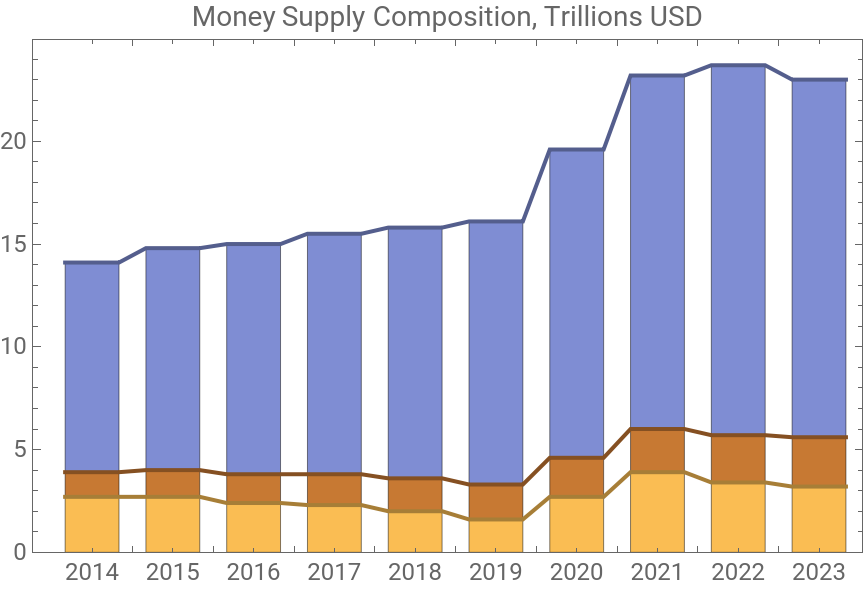
People rely heavily on each other in their quest for progress. Collaboration and collective effort are essential in scientific research, technological development, production, and everyday problem-solving. Money serves as a tool that enables large-scale collaboration between total strangers. When someone provides help or offers something of value, it creates an obligation to reciprocate. In interactions with strangers, this promise of reciprocity needs to be recorded or represented by a token. To be universally trusted and transferable, such promises are typically guaranteed by an authority.However, our belief in a particular currency is not solely based on our trust in the power of the authority, as only a small portion of the money supply in the economy is explicitly guaranteed by that authority. It is also not a form of shared delusion where we trust in currency only because everyone else does. Our trust in a particular currency equates to our trust in the skills and abilities of people using it to build a better future. In modern economies, money is created and guaranteed by central banks and commercial banks, as follows:1. A Trusted Authority (e.g., the government) initiates the economy by borrowing from the collective future and converting this liability into Monetary Base held by the Central Bank. This foundational debt is backed by the government’s authority to collect taxes on the future economic activity.2. The Monetary Base is then placed into Reserve accounts of commercial banks. Reserves are used exclusively for inter-bank transactions.3. Subsequently, commercial banks issue loans to the Public and deposit digital funds into client accounts. These newly created deposits represent a promise of future economic activity by the citizens. 4. Deposits held at different commercial banks are not of equal credit quality, therefore, banks transact with each other using their Reserve balances backed by the Government debt. Moving customer deposits between banks causes banks exchange their reserves.5. Commercial banks cannot print physical currency. Whenever citizens want to withdraw cash from their bank accounts, banks must request the Central Bank to convert digital balances in their Reserve accounts into physical cash. The issuance of physical cash is limited by the amount of Bank Reserves.
In[484]:=
BarChart[moneySupplyComposition={Labeled[{2.7,1.2,10.2},2014],Labeled[{2.7,1.3,10.8},2015],Labeled[{2.4,1.4,11.2},2016],Labeled[{2.3,1.5,11.7},2017],Labeled[{2.0,1.6,12.2},2018],Labeled[{1.6,1.7,12.8},2019],Labeled[{2.7,1.9,15.0},2020],Labeled[{3.9,2.1,17.2},2021],Labeled[{3.4,2.3,18.0},2022],Labeled[{3.2,2.4,17.4},2023]},]
Out[484]=


Money in Motion
Money in Motion
Maximizing economic efficiency: the crucial role of lending
Maximizing economic efficiency: the crucial role of lending
The velocity of money is a key economic concept that measures the rate at which money circulates in an economy. High velocity indicates that each unit of money is being used frequently for transactions, suggesting a high level of economic activity and efficiency. Low velocity suggests that money is being held rather than spent, which could indicate lower economic activity and inefficiencies.
Agent-based models serve as a useful tool for gaining insights into the factors that influence the velocity of money and economic efficiency. The model presented below highlights the crucial role of lending in enabling the full utilization of resources such as labor and capital.
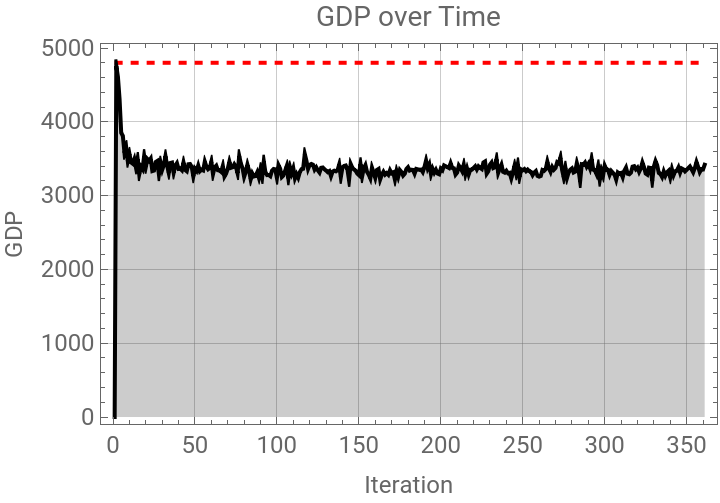
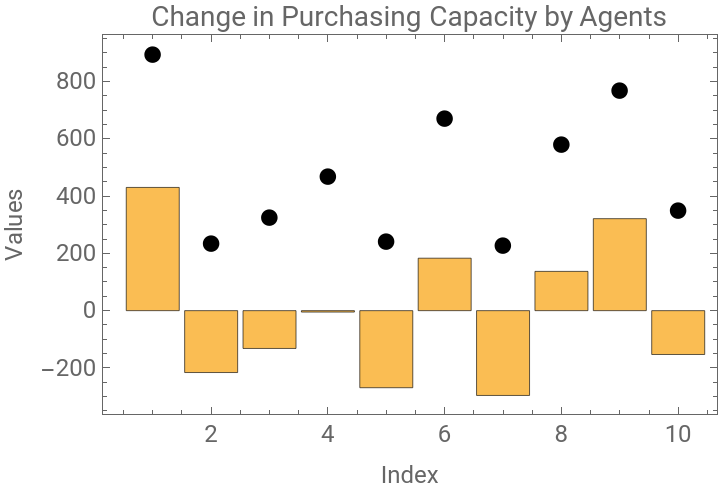
Our model comprises agents (people, companies, countries) characterized by properties such as Purchasing Capacity and Productivity Capacity. The simulation begins by initializing agents with random Purchasing and Productivity Capacities. The model runs for a specified number of iterations, during which agents trade with one another. Over time, the model reaches a point of stabilization. Regardless of the initial distribution, Purchasing Capacity tends to accumulate among high producers, leaving other agents unable to consume their products. This creates a bottleneck, where the economy operates below its potential capacity, with underutilized labor and capital resources.
Economy Agent-based Simulation Code
Economy Agent-based Simulation Code
In[497]:=
SeedRandom[130];simulation=runSimulation[initAgents[10(*numberofagents*),{200,1000}(*productivitycaprange*)],360(*numberofiterations*),0.00001(*scaleproductivity*),False(*Runlendingfacility*)];Grid[{{gdpChart[simulation]},{chartWalletChangeByAgent[simulation]}},Spacings->{2,2},Alignment{{Left},{Center}}]
Out[499]=


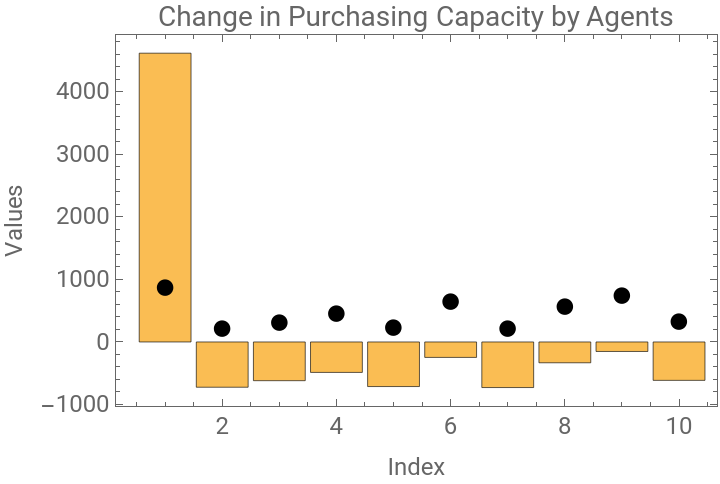

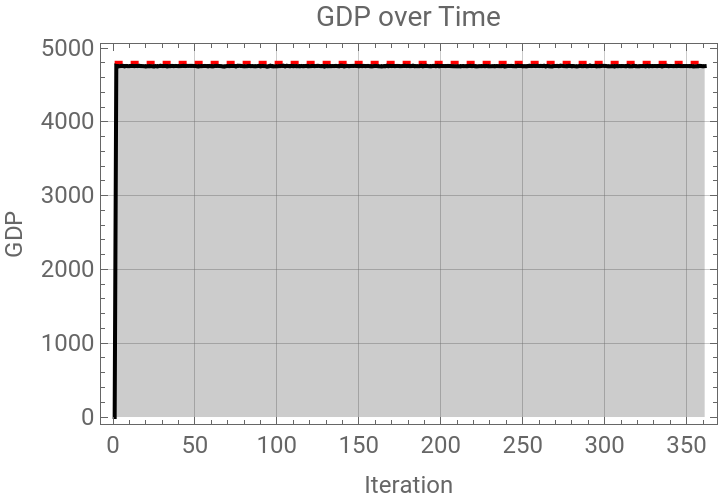
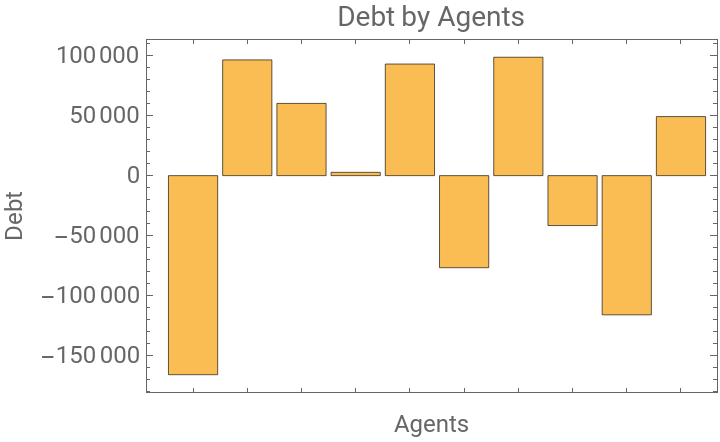
To alleviate this bottleneck, Purchasing Capacity is redistributed from high producers to low producers through lending. This redistribution allows low producers to continue consuming, but they also accumulate debt in the process. The model shows that managing this debt requires increasing the productivity of low producers.
In[500]:=
SeedRandom[130];simulation=runSimulation[initAgents[10(*numberofagents*),{200,1000}(*productivitycaprange*)],360(*numberofiterations*),0.00001(*scaleproductivity*),True(*Runlendingfacility*)];Grid[{{gdpChart[simulation]},{chartWalletChangeByAgent[simulation]},{chartDebtByAgent[simulation]}},Spacings->{2,2},Alignment{{Left},{Center}}]
Out[502]=
Concluding Remarks
Concluding Remarks
This computational exploration shows that wealth is derived from one’s productive capacity and that a smoothly running economy requires the lubrication of lending. The dynamic captured by this model exemplifies, for instance, the economic relationship between the US and China. The US imports Chinese products, leading to a surplus of dollars in China. To sustain continuous consumption, China purchases US Government bonds, effectively sending dollars back to the US. This results in China earning interest while continuing to export products to the US, leading to an increasing US debt to China. To reduce this debt, the US must strive to balance trade. However, this model of economic efficiency raises a philosophical question: is an economic system reliant on continuous consumption truly optimized for human happiness?
This agent-based simulation can be further enhanced by incorporating interest rates. Additionally, a similar approach can be used to study the dynamics of price discovery and address the following questions:
1. How does economic equilibrium arise?
2. Is the economic concept of equilibrium related to the thermodynamic notion of equilibrium?
3. What is the fundamental meaning of prices?
4. Is there an equilibrium price for a market or a unique price for each transaction, determined by the interaction of those directly involved?
Acknowledgments
Acknowledgments
This project was profoundly influenced by Stephen Wolfram, whose visionary ideas, thought-provoking questions about the foundational theory of economics, and encouragement to explore economics as a computational discipline provided the cornerstone for this work.
It was a great pleasure to ponder the concept of money with Steve Allen, whose diverse expertise as an author, financial risk management practitioner, finance professor, mathematician, and philosopher greatly enriched this endeavor.
The development of the agent-based model was a collaborative effort with Igor Frid and was significantly shaped by the discussions and support from the mentors and students of the Wolfram Summer School. Special thanks to Yi Yin, John McNally, Prad Randhawa, Christopher Wolfram, and Christian Pasquel for their valuable insights.
References
References
1
.Graeber, D. (2012). Debt: The First 5,000 Years. Melville House.
2
.Bank for International Settlements (2022). “Annual Economic Report, Chapter III: The Future Monetary System.” Retrieved from https://www.bis.org/publ/arpdf/ar2022e3.htm.
Access the Full Code
Access the Full Code
Cite This Notebook
Cite This Notebook