This is part of live presentation series called Mathematical Games in which we explore a variety of games and puzzles using Wolfram Language. In this episode, we explore games that involve integer sequences.
Watch on YouTube: https://www.youtube.com/watch?v=VcvbYGZp-dU
demonstrations.wolfram.com
demonstrations.wolfram.com
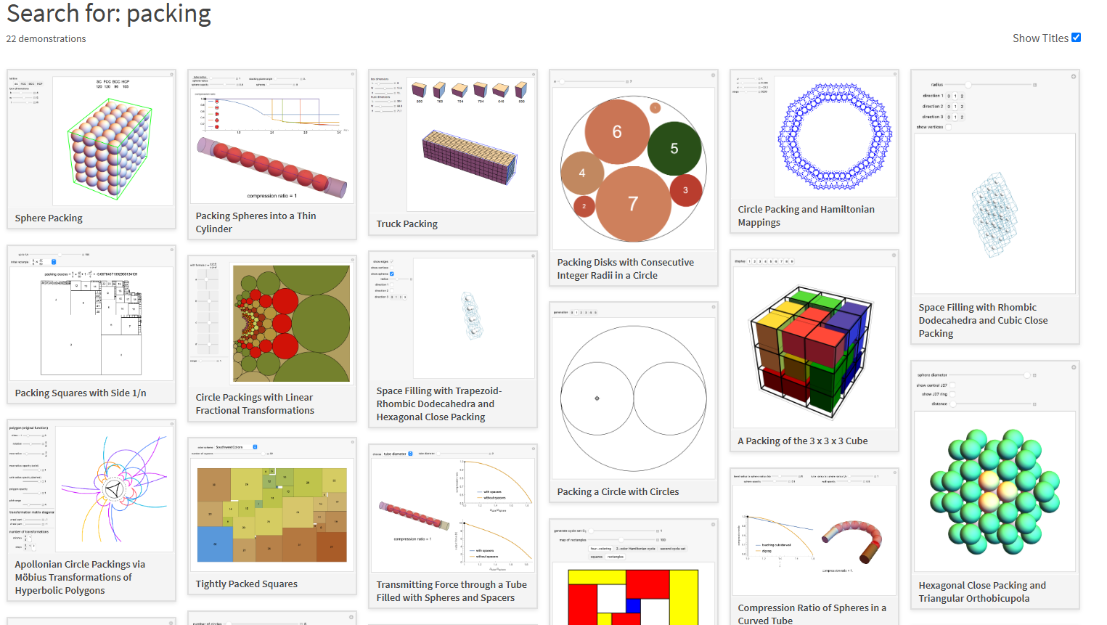
Many Demonstrations cover packing problems.
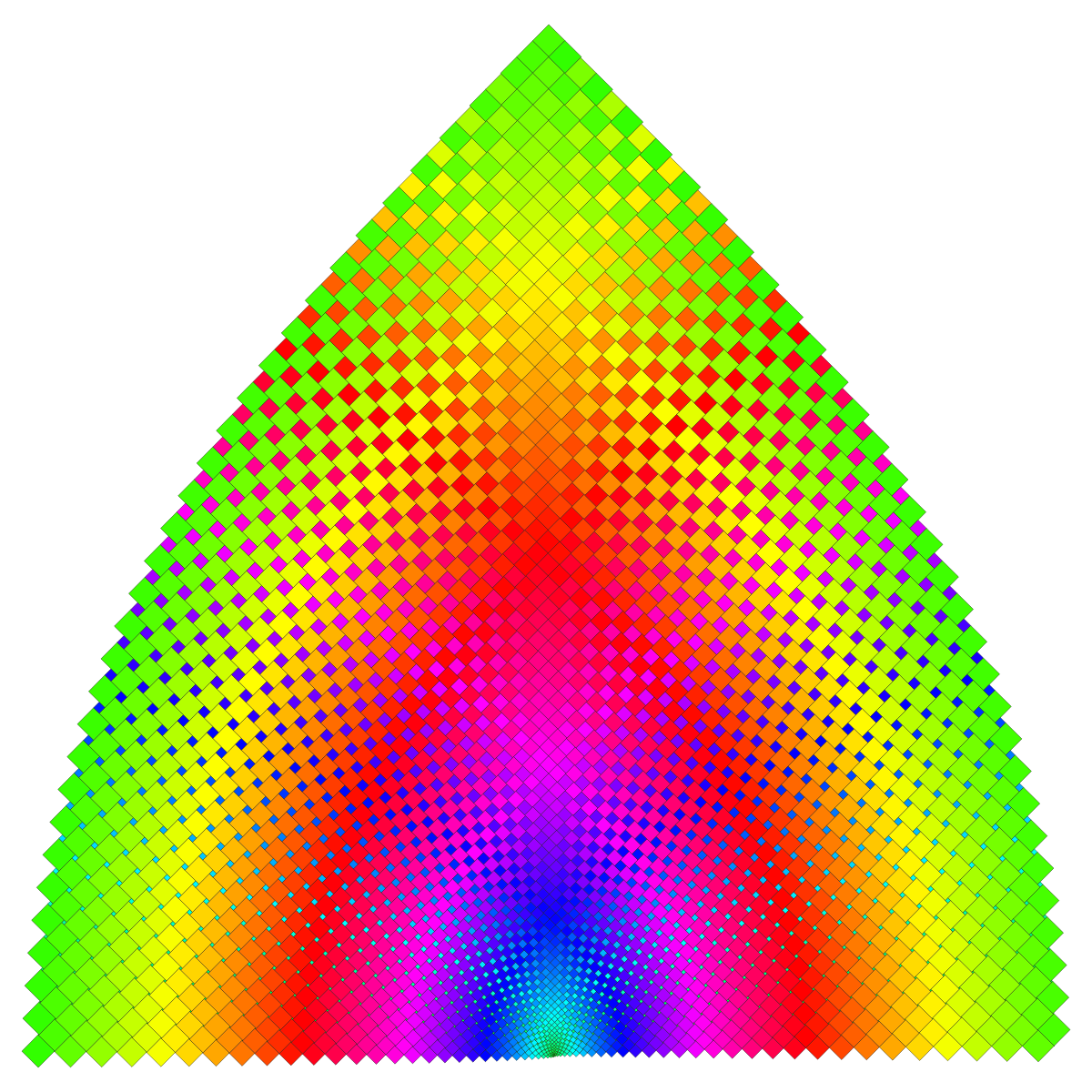
A half lune of all squares
A half lune of all squares
Out[]=
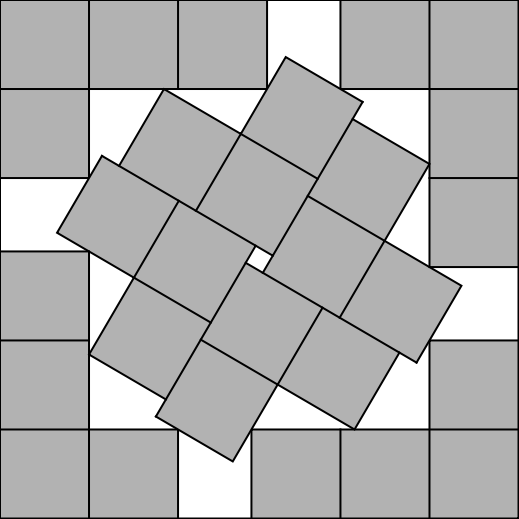
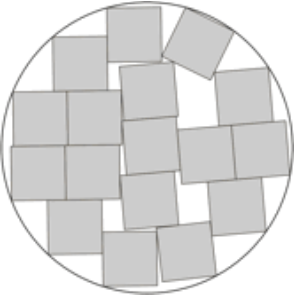
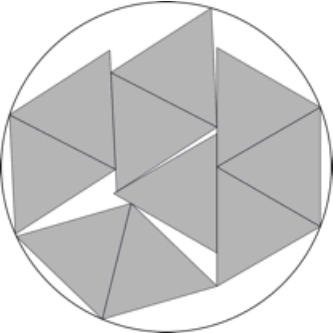
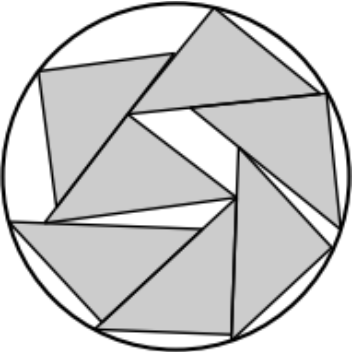
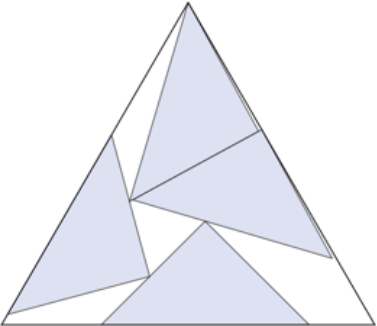
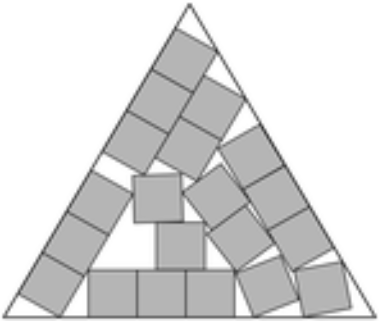
Many recent advances in Packing
Many recent advances in Packing
Found by David Ellsworth
in December 2025, using his modified version of Thomas Schadt’s simulated annealing program, starting from randomness.
in December 2025, using his modified version of Thomas Schadt’s simulated annealing program, starting from randomness.
In[]:=
Root[-1615+882#+1025#^2-812#^3+212#^4-24#^5+#^6&,3]
Out[]=

Out[]=
The Cycle Double Cover Conjecture
The Cycle Double Cover Conjecture
So here’s this talk I started doing on Squared Squares and related items.
Martin Gardner pretty much just used the write-up set to him by William Tutte.
The Cycle Double Cover Conjecture (CDCC) was a signature problem of William Tutte.
In graph theory, a snark is an undirected graph with exactly three edges per vertex whose edges cannot be colored with only three colors.
Martin Gardner is the one who named snarks. The CDCC especially difficult for snarks.
On 11 July 2026, OpenAI announced it had a proof of the CDCC.
Martin Gardner pretty much just used the write-up set to him by William Tutte.
The Cycle Double Cover Conjecture (CDCC) was a signature problem of William Tutte.
In graph theory, a snark is an undirected graph with exactly three edges per vertex whose edges cannot be colored with only three colors.
Martin Gardner is the one who named snarks. The CDCC especially difficult for snarks.
On 11 July 2026, OpenAI announced it had a proof of the CDCC.
In the news: an openAI prompt , an openAI proof of the Cycle Double Cover Conjecture , a Lean verification and a reddit discussion. Above, a graph is given a double cover.
MathWorld: Cycle Double Cover Conjecture.
MathWorld: Cycle Double Cover Conjecture.
I had OpenAI put together code for the algorithm in the paper: Get Snarky: The Cycle Double Cover Conjecture. An AI Proof?
For the 300+ snarks in GraphData, the algorithm seems to work fine.
The Min and Max of the No-3-in-line problem
The Min and Max of the No-3-in-line problem
I had some of this last month, but since then, I have updated many of the solutions and updated OEIS A277433.
For Martin Gardner’s minimum no-3-in-a-line problem, we want the minimal number of lattice points in a region such that adding another point creates 3 points in a line in some direction.
https://oeis.org/A277433 is all slopes version of the sequence: 1, 4, 4, 4, 6, 6, 8, 8, 8, 8, 10, 10.
I have extended the upper bounds for this: 1, 4, 4, 4, 6, 6, 8, 8, 8, 8, 10, 10, 12, 12, 14, 14, 15, 16, 16, 16, 16, 18, 20, 20, 22, 24, 24, 24, 24, 25.
Here are my solutions for the Minimum No-3-in-line problem:
EDIT: These are improved by Dmitry Kamenetsky for values 16, 17 and 21.
EDIT 2: The 2022 paper Geometric Dominating Sets has improvements for values 20, 21, 22 and 30. The last is a modification of a 26-point position found by Bob Hearn.
https://oeis.org/A277433 is all slopes version of the sequence: 1, 4, 4, 4, 6, 6, 8, 8, 8, 8, 10, 10.
I have extended the upper bounds for this: 1, 4, 4, 4, 6, 6, 8, 8, 8, 8, 10, 10, 12, 12, 14, 14, 15, 16, 16, 16, 16, 18, 20, 20, 22, 24, 24, 24, 24, 25.
Here are my solutions for the Minimum No-3-in-line problem:
EDIT: These are improved by Dmitry Kamenetsky for values 16, 17 and 21.
EDIT 2: The 2022 paper Geometric Dominating Sets has improvements for values 20, 21, 22 and 30. The last is a modification of a 26-point position found by Bob Hearn.
For the Maximum No-3-in-line problem, there’s also been recent activity: MathWorld. Uni-bielefeld. Wikipedia.
The number of distinct solutions for n=1, 2, ..., are 1, 1, 4, 5, 11, 22, 57, 51, 156 ... (OEIS A000769).
On 25th June 2026 Marijn Heule found a new solution with record grid size n=72 in the rot4 symmetry class.
The number of distinct solutions for n=1, 2, ..., are 1, 1, 4, 5, 11, 22, 57, 51, 156 ... (OEIS A000769).
On 25th June 2026 Marijn Heule found a new solution with record grid size n=72 in the rot4 symmetry class.
For the minimum no-3-in-line problem, here are 122 point configurations I’ve compiled with assistance from Oswin Aichholzer, Dmitry Kamenetsky and David Eppstein. If an outer border is white, the solution can work on smaller cases as well.
And here’s a version of code that gives coverage lines for each solution:
For the maximum no-3-in-line problem, there’s an existing Demonstration:
The Craik–O’Brien–Cornsweet illusion
The Craik–O’Brien–Cornsweet illusion
In my feed, I saw a copy of a copy of a copy of a copy of an illusion from the 1980’s involving two squares, so I asked an AI to update it. After about 20 iterations, it finally was semi-correct, which renewed my thoughts that AI is rarely the right starting place. Fixed in Photoshop.
Squaring the Square (Martin Gardner, 2nd Book)
Brooks–Smith–Stone–Tutte electrical-network method
Squaring the Square (Martin Gardner, 2nd Book)
Brooks–Smith–Stone–Tutte electrical-network method
Brooks–Smith–Stone–Tutte electrical-network method
Squaring a Rectangle
Squaring a Rectangle
Concept 1: the Smith diagram / normal polar net
Concept 1: the Smith diagram / normal polar net
A squared rectangle is encoded by a planar graph with one distinguished edge, the pole. Vertices represent horizontal levels. Each non-pole edge represents one square or rectangle. Removing the pole gives the electrical network to solve.
Concept 1: Kirchhoff matrix
Concept 1: Kirchhoff matrix
After the pole edge is removed, the source and sink are held at fixed potentials. The Kirchhoff matrix is the conductance Laplacian of the pole-removed graph. Solving the Kirchhoff equations gives vertex potentials and edge currents.
In[]:=
candidateSmith =
SmithDiagramsFromGraph[
candidateEdges,
"Pole" -> candidatePole,
"KeepZeroCurrent" -> False,
"IncludeFailures" -> False
][[1]];
candidateSmith[[{"Pole", "Dimensions", "Order", "SquareSizes", "PerfectQ"}]]
SmithDiagramsFromGraph[
candidateEdges,
"Pole" -> candidatePole,
"KeepZeroCurrent" -> False,
"IncludeFailures" -> False
][[1]];
candidateSmith[[{"Pole", "Dimensions", "Order", "SquareSizes", "PerfectQ"}]]
The current on each edge is a potential difference. Once denominators are cleared, the absolute integer currents are the side lengths of the squares. A zero-current edge would become a zero-size square, so it is rejected or reduced away.
The Kirchhoff potentials recover the intended bottom-to-top vertex order.
In[]:=
candidatePotentialOrder =
First /@ SortBy[Normal[candidateSmith["IntegerPotentials"]], Last];
{candidateVertexOrder, candidatePotentialOrder}
First /@ SortBy[Normal[candidateSmith["IntegerPotentials"]], Last];
{candidateVertexOrder, candidatePotentialOrder}
Concept 2: Squared Rectangle
Concept 2: Squared Rectangle
Draw the squared rectangle produced by the Smith graph.
In[]:=
candidateSquared = SquaredRectangleFromSmithDiagram[candidateSmith];
DrawSquaredRectangle[candidateSquared]
DrawSquaredRectangle[candidateSquared]
Concept 3: Smith Diagram
Concept 3: Smith Diagram
After the squared rectangle has been drawn, its topology can be crushed. The same crushed code can be used in multiple ways.
In[]:=
candidateCrushed = RectanglesToCrushedCode[candidateSquared["Rectangles"]];
candidateCrushed
ShowCrushedRectangles[candidateCrushed]
candidateCrushed
ShowCrushedRectangles[candidateCrushed]
Concept 4. Same Crushed Topology: Square Solve
Concept 4. Same Crushed Topology: Square Solve
The crushed topology can be solved again as a squared rectangle by imposing width == height on every tile. The result is rescaled to primitive integer coordinates before drawing, so the output does not display ugly fractions.
In[]:=
candidateSquaredFromCrushed =
SquaredRectangleFromCrushedRectangles[candidateCrushed];
candidateSquaredFromCrushed[[{"Dimensions", "SquareSizes", "LayoutType"}]]
DrawSquaredRectangle[candidateSquaredFromCrushed]
SquaredRectangleFromCrushedRectangles[candidateCrushed];
candidateSquaredFromCrushed[[{"Dimensions", "SquareSizes", "LayoutType"}]]
DrawSquaredRectangle[candidateSquaredFromCrushed]
Concept 5. Blanche Equal-Area Dissection
Concept 5. Blanche Equal-Area Dissection
Now impose equal area on every tile instead of width == height.
This is the Blanche-list equal-area dissection from the same crushed topology.
Note: not all topologies support both squared rectangles OR equal-area dissections.
This is the Blanche-list equal-area dissection from the same crushed topology.
Note: not all topologies support both squared rectangles OR equal-area dissections.
In[]:=
candidateEqualArea =BlancheDissectionFromCrushedRectangles[candidateCrushed];
DrawBlancheDissection[candidateEqualArea]
DrawBlancheDissection[candidateEqualArea]
Planar Graphs
Planar Graphs
Perfect Squared Square
Perfect Squared Square
The smallest perfect squared squares of orders 21-30:
The largest perfect squared squares of orders 21-30 (The order 21 is unique):
Is it possible to dissect a cube into a finite number of smaller cubes, all different sizes?
Is it possible to dissect a cube into a finite number of smaller cubes, all different sizes?
William Tutte: Is it possible to dissect a cube into a finite number of smaller cubes, all different sizes? No, and a beautiful proof of this is given by the “Important Members” in the fourth entry in the list of references. The proof runs as follows: Imagine that you have before you, resting on a table, a cube cut into smaller cubes, no two the same size. The bottom face of this cube will of course be a squared square.
Within this square will be a smallest square. It is easy to see that this smallest square cannot be touching an edge of the large square that is the cube’s bottom face. Therefore the smallest cube that rests directly on the table top - we will call it cube A - must be surrounded by other cubes.None of the surrounding cubes can be smaller than cube A, therefore it will be surrounded by walls that rise above it.On cube A still smaller cubes will rest. They form a squared square on the top face of cube A. Within this squared square will be a smallest square, calling for a cube B that is the smallest cube resting directly on top of cube A.
The same argument in turn will call for a cube C that is the smallest cube resting on cube B. Thus we are faced with an endless regress of smaller and smaller cubes, like the fleas in Dean Swift’s familiar jingle that have lesser fleas to bite ‘em, and so on ad infinitum. No cube, therefore, can be dissected into a finite number of smaller cubes of different sizes.
Within this square will be a smallest square. It is easy to see that this smallest square cannot be touching an edge of the large square that is the cube’s bottom face. Therefore the smallest cube that rests directly on the table top - we will call it cube A - must be surrounded by other cubes.None of the surrounding cubes can be smaller than cube A, therefore it will be surrounded by walls that rise above it.On cube A still smaller cubes will rest. They form a squared square on the top face of cube A. Within this squared square will be a smallest square, calling for a cube B that is the smallest cube resting directly on top of cube A.
The same argument in turn will call for a cube C that is the smallest cube resting on cube B. Thus we are faced with an endless regress of smaller and smaller cubes, like the fleas in Dean Swift’s familiar jingle that have lesser fleas to bite ‘em, and so on ad infinitum. No cube, therefore, can be dissected into a finite number of smaller cubes of different sizes.
However:
However:
Brian Trial: The consecutive cubes 1×1×1 to 69×69×69 can orthogonally fit inside a cube 186×186×186, for a packing density of 90.6%.
Mrs. Perkins’s Quilts
Mrs. Perkins’s Quilts
"For Christmas, Mrs. Potipher Perkins received a very pretty patchwork quilt constructed of 169 square pieces of silk material. The puzzle is to find the smallest number of square portions of which the quilt could be composed and show how they might be joined together. Or, to put it the reverse way, divide the quilt into as few square portions as possible by merely cutting the stitches." — Henry E. Dudeney
However, it’s a deceptively hard problem. Back in 2013, I took a look at methods for building up Perkins’s quilts from a smaller solution and found sixteen basic methods. Here are record-setters for orders 32 to 41, on top. On the bottom are the core solutions used for building the larger solutions.
No-one has topped or extended my results in 13 years.
No-one has topped or extended my results in 13 years.
https://oeis.org/A089046 1, 2, 2, 2, 3, 3, 4, 5, 6, 8, 10, 14, 18, 24, 30, 40, 54, 71, 92, 121, 155, 210, 266, 360, 476, 642, 833, 1117, 1485, 1967, 2595, 3465, 4534, 5995, 7907, 10293, 13505, 17785, 23239, 31035, 39571
Bouwkamp Construction
Bouwkamp Construction
A sample Bouwkamp format is {12,16,16,3,3,5,5,6,4,6,7,3,1,5,4}.
This means there are 12 squares filling out a 16×16 rectangle,
with the first four squares (3,3,5,5) filling up the left side.
All squares fill the leftmost lowest position until the rectangle is filled completely.
This means there are 12 squares filling out a 16×16 rectangle,
with the first four squares (3,3,5,5) filling up the left side.
All squares fill the leftmost lowest position until the rectangle is filled completely.
Tightly Packed Squares
Tightly Packed Squares
https://oeis.org/A081287 Excess area when consecutive squares of sizes 1 to n are packed into the smallest possible rectangle.
0, 1, 1, 5, 5, 8, 14, 6, 15, 20, 7, 17, 17, 20, 25, 16, 9, 30, 21, 20, 33, 27, 28, 28, 22, 29, 26, 35, 31, 31, 34, 35
0, 1, 1, 5, 5, 8, 14, 6, 15, 20, 7, 17, 17, 20, 25, 16, 9, 30, 21, 20, 33, 27, 28, 28, 22, 29, 26, 35, 31, 31, 34, 35
Possible Counterexamples to the Minimal Squaring Conjecture
Possible Counterexamples to the Minimal Squaring Conjecture
Some of the smaller rectangles presented here are likely not minimal (see Details), and those would not be actual counterexamples, perhaps 30% by the oblong conjecture [1]. It is also very likely that at least one of the examples presented here is a true counterexample. The number of squares and the rectangle dimensions are shown above each figure.
Mondrian Art Problem
Mondrian Art Problem
Divide a square into non-congruent rectangles. If all the sides are integers,
what is the smallest possible difference in area between the largest and smallest rectangles?
This is known as the Mondrian art problem. For example, here’s a division for a square of size n=138. The largest area is 1200, the smallest 1178, with a difference of 22.
what is the smallest possible difference in area between the largest and smallest rectangles?
This is known as the Mondrian art problem. For example, here’s a division for a square of size n=138. The largest area is 1200, the smallest 1178, with a difference of 22.
Mondrian Art Problem
Mondrian Art Problem
Rectangles packed in the same Rectangle
Rectangles packed in the same Rectangle
The Golden ratio has a nice continued fraction:
Classically, if you remove a square from a golden rectangle, you get another golden rectangle:
A4 paper, when folded in half, results in a rectangle similar to the original rectangle.
We can also divide up an area 200 sheet of A4 paper into smaller A4 rectangles.
The supergolden rectangle uses two rectangles and a square.
The plastic constant allows a square to be divided into three similar rectangles. The side length ratios are all the same.
Ponting Square Packing
Ponting Square Packing
Rotating Square Tilings
Rotating Square Tilings
This Demonstration shows the rotation of tilings containing squares of two different sizes.
Grid Packing at an Angle
Grid Packing at an Angle
If a rectangular frame is placed over a grid, what is the maximal number of squares it can contain? Usually, lining up the frame with the grid gives an optimal answer.
Packing Squares with Side 1/n
Packing Squares with Side 1/n
A finite volume of potatoes will fit in a finite sack. This seemingly simple statement leads to a family of very difficult questions, sometimes called potato sack problems.
Oblongs into minimal squares.
Oblongs into minimal squares.
Fibonacci and Padovan
Fibonacci and Padovan
Unsolved
Unsolved
Some of these problems haven’t had a serious analysis for over a decade.
CITE THIS NOTEBOOK
CITE THIS NOTEBOOK
Mathematical Games: square packing
by Ed Pegg
Wolfram Community, STAFF PICKS, July 15, 2026
https://community.wolfram.com/groups/-/m/t/3759587
by Ed Pegg
Wolfram Community, STAFF PICKS, July 15, 2026
https://community.wolfram.com/groups/-/m/t/3759587