CPT theorem claims that one cannot build a Lorentz-invariant quantum field theory with a Hermitian Hamiltonian that violates the combined symmetry of charge-conjugation, parity and time-reversal, which is critical in the Standard Model of particle physics. In Wolfram Models, though continuous Lorentz invariance is maintained, there are very few investigations on such discrete transformations till now. In our project, we confirmed what C, P and T could correspond to in WPP and offered many examples to explain them in different cases. We have also checked the reversibility of all the 947 rules in the registry of Wolfram Model Data. Furthermore, a potential source of Parity and CP violation in Wolfram Model is proposed, which agrees well with the conclusions of SM under certain conditions.
Introduction
Introduction
Invariance and Covariance
Invariance and Covariance
Generally, we have two equivalent views on a transformation group Λ acting on a certain operator Ô. One is transforming the basis and the other one is changing the operator itself, corresponding to different representations of Λ.
U(Λ)Ô(x)(Λ)=(Λ)Ô(Λx)
-1
U
-1
M
where U(Λ) and M(Λ) are the representations of Λ in basis space (Hilbert space) and operator space (spinor space for fermions).
We can define that the operator Ô(x) is Λ invariant if M(Λ) is an identity matrix. The equations which only contains Λ invariant operators will preserve its form under the Λ transformation, which is called covariant. In canonical quantum field framework, as the Lagrange Density ℒ contains all the dynamic information and is a real scalar operator, which means M(Λ) could either be 1 or -1, a QFT is Λ invariant if .
ℒ(x)ℒ(Λx)
Specifically, ℒ is covariant under continuous Lorentz Transformation (3,1). However, a general Lorentz Group should be O(3,1). So, we need to care about the discrete transform. Moreover, if a field theory has global U(1) symmetry, we can get the conserved Noether Current =i(()ϕ-h.c) and integrate it’s first component in all space , where this conserved charge is defined as ElectroMagnetic Charge. If we exchange a field and its complex conjugate, it’ll get a minus symbol and this operation is called charge conjugation. Therefore, if Λ corresponds to time reversal, parity and charge conjugate, we can derive how ℒ transforms according to the rules shown before. And one can show that ℒ doesn’t change under combined CPT transform, which is called CPT theorem. It has deep physical implications and leaves us many open questions.
+
SO
j
μ
∂
μ
*
ϕ
Q=∫x(x)
3
j
0
However, we must be careful while analyzing its phenomenological results. For example, in a specific physical process, an abstract state corresponds to applying the field operator on the vacuum. So, though in canonical QFT only how an operators transforms under Λ group is meaningful, we need to change both of the differential equations and initial/boundary conditions in classical and quantum mechanics. Moreover, because the affined parameter is always set as time instead of intrinsic time under the nonrelativistic approximation, we also need to exchange the initial and final conditions while applying the time-reversal transformation. These are what time reversal (or Λ) invariance means conventionally, and it should be strictly called Λ covariance. In fact, we have different interpretation on symmetry. Invariance means that when we act Λ on a physical system, all the observable quantities do not change. But all we are talking about here is covariance instead of invariance, which just implies that our physical laws are independent of our description methods.
Discrete Groups in Wolfram Model
Discrete Groups in Wolfram Model
Via applying abstract replacement operations on set systems, we can get a discrete space-time formalism called Wolfram Model, which has a strong implication on the fundamental structures of Mathematical Physics. As known, Wolfram model is covariant under continue conformal transformation, so we can derive the basic conclusions of General Relativity like Einstein Equation and Geodesic Equations. However, there is only very limited analysis on the discrete groups in Wolfram Model, especially on parity, time reversal and charge conjugate. So, we made further investigation in this area during WSS2020 and get the following results.
In Wolfram Model, time is the index of causal foliations of hypergraph rewriting. If we choose the time of final states as zero-point, time-reversal corresponds to reversing the updating rules and regarding the final states of a normal process as the initial states of the backward process. We say a system is time-reversal invariant if the reversed process produces states graph isomorphic to the normal process and reversed final states identical to the original initial states. More details and examples are shown in the next section.
Although space is the general limiting structure of basic hypergraph, defined as clearly as time, Wolfram Model has only trivial spatial reflection symmetry. We can construct spatial items with different chirality, which means they can’t be overlapped via rotation and translation in 3D space, but their corresponding hypergraphs are isomorphic, implying identical physical observations. Here is an example.
In[]:=
{Graph3D[{12,23,31,12,1->4,1->4,2->4,3->4,1->5,2->5,3->5}],Graph3D[{12,23,31,12,1->4,2->4,3->4,1->5,1->5,2->5,3->5}]}
Out[]=
 ,

As shown, reversing the layout does not change the graph itself, so that’s not a graph transformation. Otherwise, as U(1) group is still not clear in Wolfram Model, the conserved charge we introduced in the previous subsection is not well-defined. So, the charge conjugation operator is unclear in WPP. However, we can still mathematically define C transform as exchanging a field operator with its complex conjugate, corresponding to some basis transformation in Branchial Space.
Interestingly, if we combine C and P transformation, a deep physical implication emerges. In the Standard Model, we need neutrinos to be left-handed and anti-neutrinos to be right-handed, ignoring their mass and CP violation. It implies that we need to set some unitary structures to label the orientation of our space. Similarly, we can also construct such basic structures by setting proper initial condition. Then, we can define the direction of our spatial hypergraphs according to their relative chirality. In other words, spatial inversion in real physics is only local parity transform of the hypergraph. It means the parity of our space is decided by how we define particles and anti-particles, indicating strict CP conservation. Further examples and the assumed source of CP violation are shown in the following sections.
Interestingly, if we combine C and P transformation, a deep physical implication emerges. In the Standard Model, we need neutrinos to be left-handed and anti-neutrinos to be right-handed, ignoring their mass and CP violation. It implies that we need to set some unitary structures to label the orientation of our space. Similarly, we can also construct such basic structures by setting proper initial condition. Then, we can define the direction of our spatial hypergraphs according to their relative chirality. In other words, spatial inversion in real physics is only local parity transform of the hypergraph. It means the parity of our space is decided by how we define particles and anti-particles, indicating strict CP conservation. Further examples and the assumed source of CP violation are shown in the following sections.
T reversibility
T reversibility
Simple examples
Simple examples
Deterministic Process
Deterministic Process
First of all, we can find time reversal symmetry is obviously maintained in a deterministic process. Here is an example and we can see the isomorphic evolution-events graph, expression-events graph and causal graph.
In[]:=
RulesP={{1,2},{2,4}}{{1,4},{1,3},{4,2}};RulesN=Reverse@RulesP;InitialP={{1,2},{2,4}};InitialN=WolframModel[RulesP,InitialP,5]["FinalState"];
In[]:=
ResourceFunction["MultiwaySystem"]["WolframModel"{RulesP},{InitialP},5,"EvolutionEventsGraph",ImageSize500,VertexSize1]
Out[]=

In[]:=
ResourceFunction["MultiwaySystem"]["WolframModel"{RulesN},{InitialN},5,"EvolutionEventsGraph",ImageSize500,VertexSize1]
Out[]=

In[]:=
{WolframModel[RulesP,InitialP,5]["ExpressionsEventsGraph",ImageSize200,VertexLabelsAutomatic],WolframModel[RulesN,InitialN,5]["ExpressionsEventsGraph",ImageSize200,VertexLabelsAutomatic]}
Out[]=
,
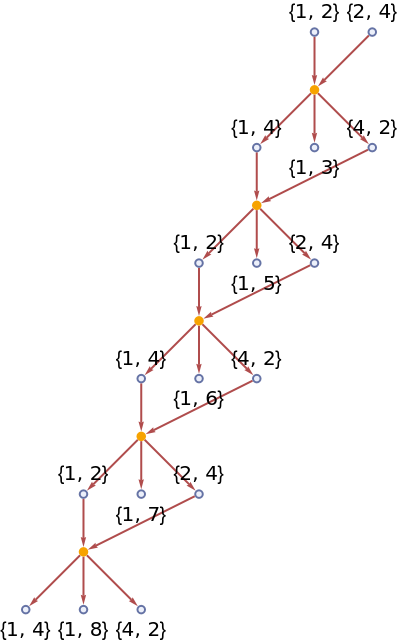
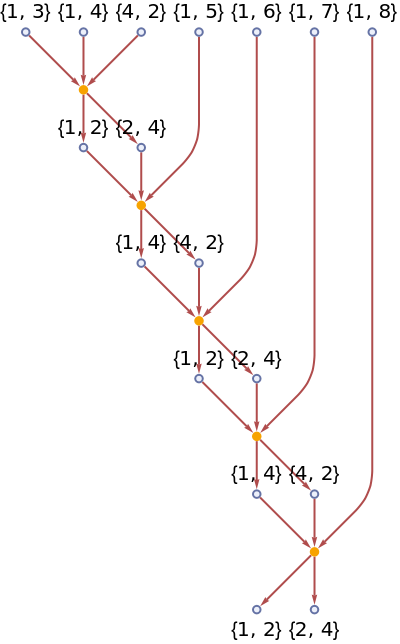
In[]:=
{WolframModel[RulesP,InitialP,5]["CausalGraph",ImageSize200,VertexLabelsAutomatic],WolframModel[RulesN,InitialN,5]["CausalGraph",ImageSize200,VertexLabelsAutomatic]}
Out[]=
,


Global Multiway System
Global Multiway System
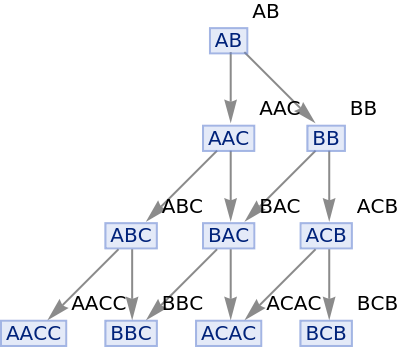
We need multiway system to construct the the basic mathematical structure of quantum mechanics. Here is an example of a time reversible multiway system.
In[]:=
final=ResourceFunction["MultiwaySystem"][{"A""AB","B""AC"},"AB",3]//Last;{ResourceFunction["MultiwaySystem"][{"A""AB","B""AC"},"AB",3,"StatesGraph",ImageSize600,VertexLabelsAutomatic],ResourceFunction["MultiwaySystem"][{"AB""A","AC""B"},final,3,"StatesGraph",ImageSize600,VertexLabelsAutomatic]}
Out[]=
,
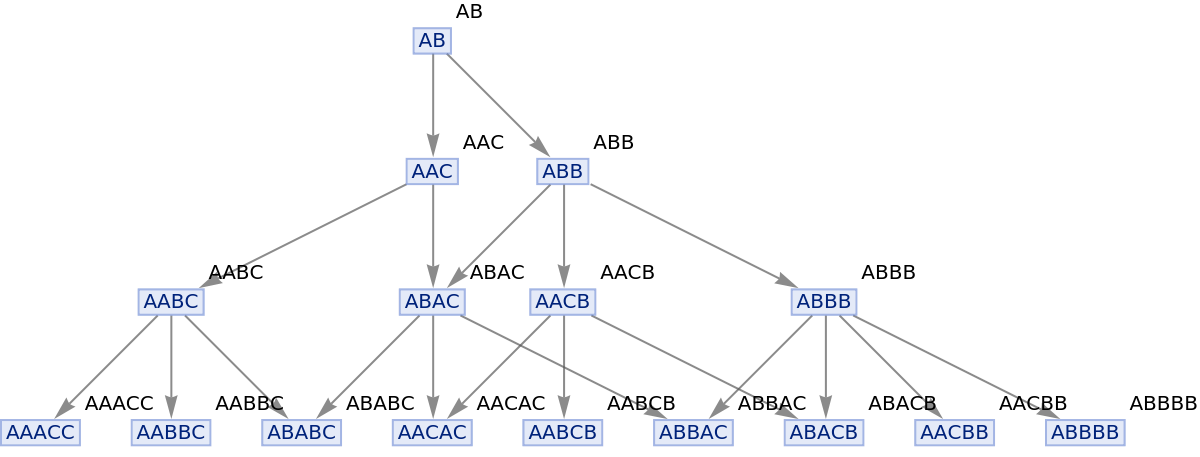
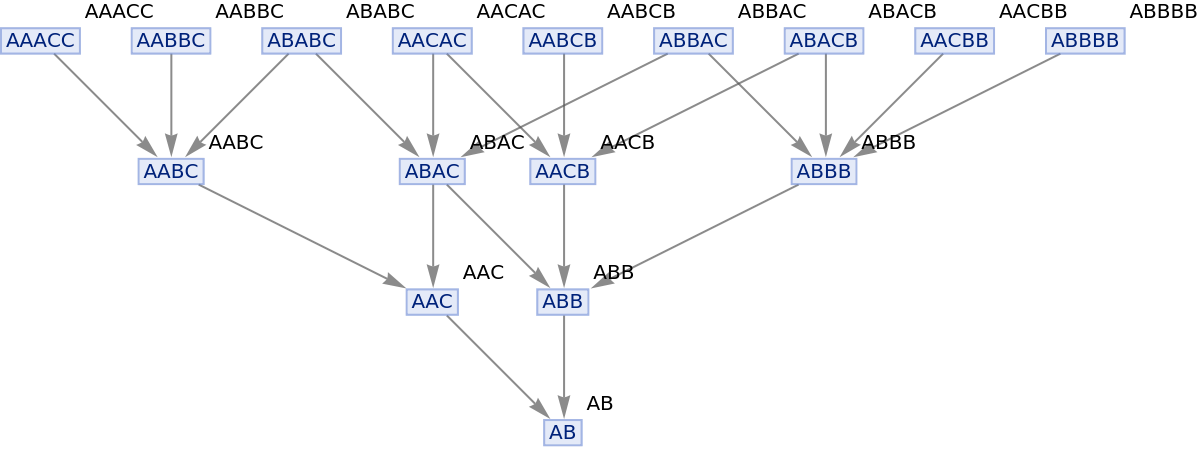
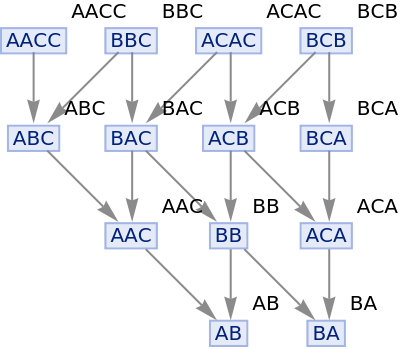
However, not all processes in the multiway system are reversible. Just as in conventional QM framework, an effective Non-Hermitian Operators has a complexed eigenvalue. But the eigenvalue of the reversed process is because T is an antiunitary operator. Therefore, when we reverse back, we in fact recombined the basis of the initial state:
E+iη
E-iη
Σψ
n
ψ
n
η
n
It obviously violates time reversal invariance. Here is another example where the T symmetry is broken.
In[]:=
final=ResourceFunction["MultiwaySystem"][{"A""B","B""AC"},"AB",3]//Last;{ResourceFunction["MultiwaySystem"][{"A""B","B""AC"},"AB",3,"StatesGraph",ImageSize200,VertexLabelsAutomatic],ResourceFunction["MultiwaySystem"][{"B""A","AC""B"},final,3,"StatesGraph",ImageSize200,VertexLabelsAutomatic]}
Out[]=
,
Local Multiway System
Local Multiway System
The previous examples have only shown the structure of the 1st Order Numerical ODEs. However, lot’s of equations for Mathematical Physics like geodesic equation are second order. If we don’t want to construct two coupled evolution process, we have to utilize the local multiway system, where the same update rules can act on two time-like separated states simultaneously. Most of the states graph of the local multiway system is quite complex, but we can construct non-trivial deterministic systems. And here is an example which is T reversal invariant if we interpret the initial and final condition correctly.
Analysis of the registry
Analysis of the registry
We have examined the reversibility of all the update rules in the Registry of Notable Universes. Among all the 947 models, 810 are identified not reversible or just definite process and 30 consume so much time or memory that we have to abort the calculation. Only 107 of the non-trivial rules are reversible after 3 steps. Here are our codes and results.
For practice, we divided the 947 rules into 10 groups to check with only one shown in the code. The multiway models reversible in three steps are:
◼
"wm1167", "wm1194", "wm1362", "wm1491", "wm1594", "wm1637", "wm1653", "wm1743", "wm1885", "wm1888", "wm1941", "wm1956", "wm1978", "wm1979", "wm2139", "wm2166", "wm225", "wm2254", "wm2374", "wm24528", "wm2488", "wm2738", "wm2818", "wm2856", "wm3149", "wm3169", "wm3262", "wm3322", "wm3568", "wm3636", "wm3647", "wm3656", "wm3673", "wm3693", "wm3728", "wm3765", "wm37684", "wm3777", "wm3926", "wm3973", "wm4187", "wm4328", "wm4354", "wm4423", "wm4426", "wm4525", "wm4567", "wm4635", "wm4768", "wm4826", "wm48637", "wm5121", "wm5324", "wm5425", "wm5446", "wm5637", "wm5822", "wm6146", "wm65529", "wm6612", "wm6612i47", "wm6649", "wm6722", "wm6817", "wm6835", "wm686", "wm6967", "wm7145", "wm7157", "wm7232", "wm7357", "wm7358", "wm7396", "wm7581", "wm7612", "wm7641", "wm7742", "wm7834", "wm7862", "wm8151", "wm8267", "wm8269", "wm8287", "wm8327", "wm83678", "wm83678i245", "wm8424", "wm8441", "wm8465", "wm8594", "wm8619", "wm8665", "wm8842", "wm8996", "wm9188", "wm9225", "wm9284", "wm9424", "wm94454", "wm9536", "wm9623", "wm9651", "wm9659", "wm9676", "wm9797", "wm9922", "wm9939"
Here are state graphs of several highly non-trivial reversible rules:
Note that we only checked the models reversible after 3 steps, though the number of the non-trivial reversible rules varies slightly when setting the step to four.
These are the models we didn’t evaluate, they all corresponds to complex rules and we can’t rigidly exclude the possibility.
◼
{"wm2224", "wm1527", "wm18953i625", "wm26268i826", "wm2277i63", "wm28827i826", "wm32583", "wm24459", "wm2821", "wm3655i129", "wm31775i826", "wm37269i826", "wm49989i826", "wm54817", "wm66442", "wm53835i826", "wm61316", "wm67114", "wm66442i625", "wm67114i625", "wm79446", "wm76398", "wm74621i826", "wm83388", "wm79446i625", "wm76398i544", "wm7523", "wm83388i625", "wm99198"}
In conclusion, it is surprising to see only about 10 percent of the rules have the reversibility, suggesting it is pure coincidence that our fundamental interactions are reversible. As we can see later, the discrete symmetry provides very strong constrains on the rules that could finally leads to our universe.
C & P symmetry
C & P symmetry
Example 1
Example 1
As introduced before, we can construct some stable unitary structures and regard them as the label of the orientation of the space. The unitary structures are just like particles, and their chirality conjugation might correspond to anti-particles. This is the initial condition of example1, where the single-edge triangle is clockwise and the double-edge triangle is anti-clockwise.
With the following update rules, we can get a fractal tree. In these structures, we define the single-edge triangle as particle and get the chirality of space by comparing the helicity of the double-edge and single-edge triangles. So, we can get C and P transforms individually.
Original Process
Charge Conjugate
Parity
It is worth mentioning that we just get the parity by naively reversing the direction of the edges. However, a general case should be more complex. For example, when the total number of arrows flowing into a vertex is not equal to that flowing out, we can get completely different structures.
Example 2
Example 2
This is another example, which might be more clear than the previous 3D case. Our background is decided by how we define the particles and the anti-particles, which gives the orientation of our space. The triple self-loop is just to label the zero point of the space, which shows the arrow is moving. We can reverse the coordinate as parity transform, which lead to reversing the arrow’s direction and its velocity. It’s worth to point out that we need to keep the background invariant unless doing C transform, which changes its direction.
Normal Process
Parity
Charge Conjugate
Combined symmetry
Combined symmetry
P violation and CP conservation
P violation and CP conservation
When the unitary structures interact with the spatial structures, the former evolution process will be destroyed. And we can adjust the evolution rules so that it will only happen in space with certain chirality, which means that the parity symmetry is broken. Here is the example, in which the P-transformed system behaves in a different way. The other definitions are the sames as example2 in the last section.
Normal process
Parity Violation
We can see that as the arrow interact with background, the circle is growing, implying parity violation. As follows, if we reverse both the background label and the spatial chirality structure, our hypergraph stays invariant. It gives a strong implication of the CP conservation in conventional physics framework. Just because our space with finite dimension can always be observed in a higher dimension, we can get the conclusion that CP is just an identity transformation.
CP Conservation
CP Broken
CP Broken
However, in Standard Model, CP symmetry is still slightly broken, which means that the particles and anti-particles are not enough to label the chirality of our space. So, we need to add higher order background and interaction rules.
Normal Process
CP Broken
As shown, such evolution will only happen under certain definition of particles and spatial parity, corresponding to CP violation.
CPT Transform
CPT Transform
To get the CPT conservation, we can construct T broken rules4 to cancel the condition leading to CP broken.
Normal Process
CP violation
When we reverse rule4, T symmetry is broken in the background, destroying the necessary condition of CP violation. It’s worthy to mention that such T irreversibility can’t be detected directly.
T violation
CPT Transform
In the shown reversed process, the triple self-loop becomes quadruple self-loop, which only happens backwardly and cancels CP violation. But it is worthy to point that this example is not quite a CPT symmetry because we loose the original triple self-loop. However, as we can only observe in ordinary space, CPT is conserved phenomenologically because the kinematics of the arrow remains invariant, though the background has in fact changed. So, it is a quiet artificial example and only used to explain our idea and method. We haven’t find similar physical implication like CP conservation laws till now.
It’s worthy to point out that the combined discrete symmetry provides stronger constrains on our rules. The background labels should be different with the ordinary space and can only interact with the realities in very limited cases, leading to P and CP broken. It also requires that some background rules violating time reversibility should precisely cancel CP broken, which is to some extent unnatural.
Summary and Potential Topics
Summary and Potential Topics
By principle, Wolfram Model has infinite updating rules and initial conditions and we can construct nearly any group structures in special cases, which implies the possibility to rebuild the conventional physics formalism. However, it is very hard to find a general symmetry structure like conformal invariance here. For example, among the 947 models in the registry of the notable universe, only 107 (11.3 %) multiway processes are reversible in three steps with self-loop initial conditions. As for C and P symmetry, our results only agree with the Standard Model in very special cases. Moreover, we can only derive CP conservation naturally but can' t get a general rule for CPT conservation. Those could be explained in two views. One is the Anthropic Principle. Another view is that there must be some constraints on the updating rules and initial conditions, though we hardly know its explicit mechanism. Therefore, there is a lot of potential future work waiting for people interested in this area. For example, is there any common geometry structures hidden in the 107 potentially non-trivial reversible models? Could we describe the local chirality transformation of hypergraphs with general rules? Does CPT theorem have any deeper physical implications like CP conservation? They all require more investigation and creative ideas.
Keywords
Keywords
◼
symmetry
◼
hypergraph
◼
CP violation
Acknowledgment
Acknowledgment
Mentor: Max Piskunov
The author got a lot of help from Max Piskunov during the project, who spent much time discussing the topic with the author and modifying his codes. Jonathan Gorard and Stephen Wolfram answered the author’s questions, pointed out his misunderstanding and gave helpful advice in their busy schedule. The Mathematica 12.1, SetReplace and MultiwaySystem also helped a lot.
References
References
◼
Weinberg, Steven. The quantum theory of fields. Vol. 2. Cambridge university press, 1995.
◼
Peskin, Michael. An introduction to quantum field theory. CRC press, 2018.
◼
Maggiore, Michele. A modern introduction to quantum field theory. Vol. 12. Oxford university press, 2005.
◼
Landau, L. and Lifchitz, E., 2004. Theoretical physics. Field theory.
◼
Georgi, Howard. Lie algebras in particle physics: from isospin to unified theories. Vol. 54. Westview press, 1999.
◼
◼
Wolfram, S., 2020. A Class of Models with the Potential to Represent Fundamental Physics. arXiv, pp.arXiv-2004.
◼
Gorard, J., 2020. Some Relativistic and Gravitational Properties of the Wolfram Model. arXiv preprint arXiv:2004.14810.
◼