Molecular cages have uses in the fields of medicine, biology, and chemistry. This project explores the structure of molecular cages and their applications. Several analogs with homogenous and heterogenous bridge lengths are modeled and analyzed. The symmetry and energy of the molecules optimized using MMFF are compared to that of the original molecules. The energy and volume of the original molecules are compared to those optimized using CFF. Both force fields are used to calculate the local minimum on the potential energy surface. The convex hull mesh and volume of these cages are computed using their coordinates and compared to the geometry and size of ions commonly seen in medicine. The optimal bridge length of various molecules is calculated to find the length of the bridges that allow for no undue strain. This analysis of hydrocarbon cages provides new insights into the properties and uses of these molecules.
Introduction
Introduction
Molecular cages, commonly seen in biology and chemistry fields, are compounds with an internal chamber that can be used to encase other compounds. These cages can be self-assembled (metal-organic polyhedra) or synthetically formed through covalent bonding (cage-shaped polymers). These cages allow for the enclosed compounds to be transported without being affected by the action of other species and solutions. The encapsulation is based on the size and shape of the guest compounds, causing molecular cages to be selective to the compounds they will hold. Molecular cages are important in medicinal fields and have been used to hold and transport medicinal drugs, such as irinotecan and doxorubicin.In this work, hydrocarbon cages will be analyzed. The hydrocarbon cages analyzed have either homogenous (same-length) or heterogeneous (different-length) bridges between the carbon atoms. Adamantane is a diamondoid and the smallest unit cage structure of the diamond crystal lattice. The compound has homogenous bridges and is used in drug delivery and surface recognition of structures. Twistane is a cycloalkene and an isomer of adamantane. Twistane has heterogenous bridges between carbon atoms.Adamantane and twistane are both molecules and are members of a class of cage compounds.
C
10
H
16
In[]:=
Grid[{{MoleculePlot3D["C1C2CC3CC1CC(C2)C3"],MoleculePlot3D["C1CC2CC3C1CC2CC3"]},{"adamantane","twistane"}}]
Out[]=
 |  |
adamantane | twistane |
Both molecules have four methanetriyl groups () connected by bridges composed of chains of methylene () groups. Methanetriyl is a functional group made from methane by removing three hydrogen atoms. Methylene groups are where two hydrogen atoms are bonded to a carbon atom, with the central carbon atom being bonded to other atoms. Adamantane has six bridges of one methylene each, and twistane has two bridges with chains of length two, two bridges with chains of length one, and two bridges of length zero.
New hydrocarbon cages with different chemical formulas and structures can be modeled to have homogenous or heterogenous bridges of different sizes. Bigger cages with longer bridges can be used to transport larger and more complex molecules, while smaller cages with shorter bridges can be used to efficiently transport smaller ions and molecules. The analysis of molecular cages allows for the discovery of their properties and uses in biology, chemistry, and medicine.
⫶CH
C
H
2
New hydrocarbon cages with different chemical formulas and structures can be modeled to have homogenous or heterogenous bridges of different sizes. Bigger cages with longer bridges can be used to transport larger and more complex molecules, while smaller cages with shorter bridges can be used to efficiently transport smaller ions and molecules. The analysis of molecular cages allows for the discovery of their properties and uses in biology, chemistry, and medicine.
Analogs of Molecular Cages
Analogs of Molecular Cages
An analog can be defined as a substance that is similar to another. There are different types of analogs, such as structural, functional, prodrug, etc. Different analogs can be modeled to have bridges of different lengths. These structures will have unique shapes and volumes and can be used to serve different purposes. Here, bridge length describes the length of the chain between the carbons containing a methanetriyl functional group. Two carbons that each have a methanetriyl group are said to have a bridge length of zero if they are bonded to each other. Molecules with homogenous bridges from length one to length four are displayed here.
MoleculePattern is used to define the bonds and clearly show the path lengths.
CH
2
In[]:=
methylenePattern=MoleculePattern;

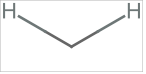
MoleculeDraw and MoleculePlot3D is used to model different analogs with different bridge lengths. The MoleculeName function is used to find the name of the drawn molecule and MoleculePlot3D is used to display a model of the drawn molecule. A function to return a molecule with methylene highlighted can be defined.
In[]:=
ClearAll@methyleneMoleculePlotmethyleneMoleculePlot[mol_,opts:OptionsPattern[]]:=MoleculePlot3D[mol,methylenePattern,opts,ImageSize->Medium]ClearAll@methyleneMoleculeNamePlotmethyleneMoleculeNamePlot[mol_,opts:OptionsPattern[]]:=Column[{methyleneMoleculePlot[mol,opts],MoleculeName[mol]}]
Here, molecules with homogenous bridges are modeled.
Bridge Length 1
Bridge Length 1
In[]:=
methyleneMoleculeNamePlotMolecule

Out[]=
 |
adamantane |
Bridge Length 2
Bridge Length 2
In[]:=
bridgeLength2=Molecule;methyleneMoleculeNamePlot[bridgeLength2]

Out[]=
 |
tricyclo[5.5.2.24,10]hexadecane |
The function indexPlot3D is created to plot a molecule in 3D and label the atom indices.
In[]:=
indexPlot3D[mol_,opts:OptionsPattern[]]:=MoleculePlot3D[mol,AtomLabels"AtomIndex",opts]indexPlot3D[bridgeLength2]
Out[]=

InvertAtom is used to fix the C-H bond pointing into the cage rather than out of it so that the space in the cage is maximized. Atom 4 needs to be inverted to increase interior volume.
In[]:=
invertL2=ResourceFunction["InvertAtom"][bridgeLength2,4];methyleneMoleculePlot[invertL2]
Out[]=
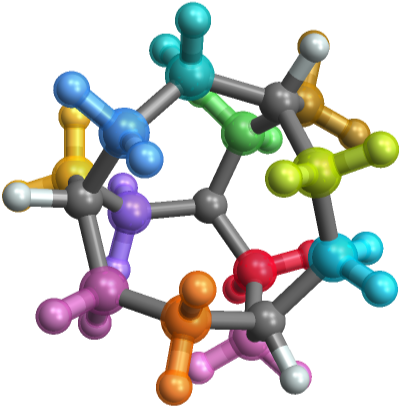
After the atom has been inverted, the interior volume has been increased.
Bridge Length 3
Bridge Length 3
In[]:=
bridgeLength3=Molecule;methyleneMoleculeNamePlot[bridgeLength3]

Out[]=
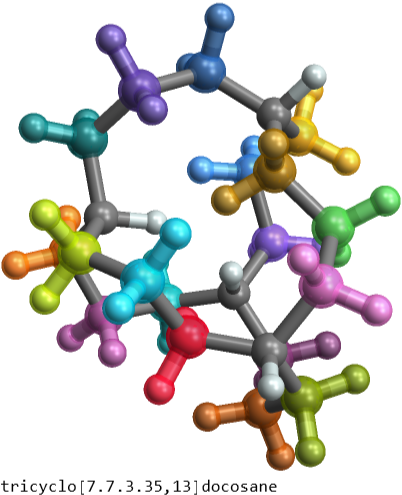
InvertAtom is used here again to fix the C-H bonds pointing into the cage rather than out of it so that the space in the cage is increased.
Atoms 1, 3 and 16 need to be inverted in order to increase interior volume.
After the atoms have been inverted, the interior volume has increased.
Bridge Length 4
Bridge Length 4
InvertAtom is used again to fix the C-H bonds pointing into the cage rather than out of it so that the space in the cage is increased.
Atoms 3, 4, 6, and 27 need to be inverted in order to increase interior volume.
After the four atoms have been inverted, the interior volume will be increased for this molecule.
All four structures above have homogenous bridges. The cages with a longer bridge length are better suited to encapsulate larger molecules, while cages with a shorter bridge length can efficiently encapsulate small ions and atoms. There can also be cages with heterogenous bridges, such as twistane.
A function can be created to change a certain amount of bonds to a different length by adding groups between the methanetriyl carbons.
A function can be created to change a certain amount of bonds to a different length by adding groups between the methanetriyl carbons.
MoleculePattern and PatternReaction can be used to change the bonds to a different length. Here, variables for a single bridge (length one), a double bridge (length two), and a triple bridge (length three) are defined using MoleculePattern. The atoms are kept as a list, and the location of the item on the list is used to model bonds between certain atoms. For example, Bond[{1,3}] model a bond between atoms one and three in the list.
The function methanetriylMoleculePlot takes a molecule and optional parameters and returns the molecule with the methanetriyl carbons and hydrogens highlighted. The function runReaction will take a molecule and apply a given reaction to it. First and ApplyReaction can be used to apply a singular one of these reactions to a certain molecule. Here, one bridge in adamantane is changed from length one to length two.
Here, after an atom is inverted, one bond in tricyclo[5.5.2.24,10]hexadecane is changed from length two to length three using the runReaction function. methanetriylMoleculePlot is used to return the molecule with the methanetriyl carbons and hydrogens highlighted.
Nest can be used to replace a certain number of bridges. This allows for the number of bridges that are changed to be chosen manually instead of only being able to change one of the bridges at once. Here, adamantane is used as the starting molecule. Three bridges of length one are then turned into bridges of length two using runReaction and rxn1to2.
In this example, tricyclo[5.5.2.24,10]hexadecane is used as the starting molecule. After three of the atoms are inverted using InvertAtom, three bridges of length two are then turned into bridges of length three using runReaction and rxn2to3.
A function oneToTwo can be created to take a certain starting molecule and number and change bridges from length one to two accordingly. Here, adamantane is used as the starting molecule, but any hydrocarbon cage can be used.
A function twoToThree can take a starting molecule and number and change bridges from length two to three accordingly. Here, tricyclo[5.5.2.24,10]hexadecane is the starting molecule, but different hydrocarbon cages can also be used.
Both functions can be combined to create the function oneToTwoToThree. This function will take a certain starting molecule and two numbers: the first number will be the number of bridges to be changed from length one to two, and the other will be the number of bridges to be changed from length two to three.
Here, adamantane is used as the starting molecule. Four bridges are changed from length one to two to create an intermediate molecule, and two bridges are changed from length two to three to get the final molecule as the result.
This function can model analogs with bridges up to length three.
All Possible Molecules Generated
All Possible Molecules Generated
All possible cages from a starting molecule (with bridges up to length three) can be created.
The ChemistryFunctions paclet needs to be installed into the environment.
The function oneToTwoToThree is restated here. allPairs is used to to generate the list of sublists where n1 can be from 0 to 6, and n2 has to be less than or equal to n1. The function oneTwoTwoToThree is mapped to allPairs to get all the possible cages. This is stored in the variable results.
MoleculeValue is used to get the SMILES string of the molecules in the results list. noDuplicatesCanonicalSMILES is the same list that deletes any duplicates. The lengths are compared to make sure the original list does not contain duplicates. As shown by the results, the function has not returned any duplicate values, and there are 28 possible cages that can be made with the function.
The list with no duplicates can be partitioned into sublists of length up to three, to allow the final sublist to be shorter if needed.
MoleculeGridPlot3D can be used to display a grid of all possible molecular cages.
An interesting observation in some of the molecule diagrams is that in the structures with bridge lengths greater than one, the methanetriyl and methylene groups point into the molecule. However, in other molecules, all methanetriyl and methylene groups point outwards from the molecule.
These newly modeled molecular analogs with different bridge lengths show how the structural changes to the bridge lengths affect the structures of the molecules. These analogs will have different volumes and sizes that can be used based on how big the guest molecule will be.
These newly modeled molecular analogs with different bridge lengths show how the structural changes to the bridge lengths affect the structures of the molecules. These analogs will have different volumes and sizes that can be used based on how big the guest molecule will be.
Bridges of Length 0
Bridges of Length 0
The adamantane molecule model shows that in adamantane, there are six bridges of one methylene each. The twistane molecule model shows that in twistane, there are two bridges with chains of length two, two bridges with chains of length one, and two bridges of length zero.
methanetriylMoleculePlot can be used to highlight the carbons and hydrogens in adamantane and twistane that are part of a methanetriyl group:
The ConsistentForceField paclet needs to be installed in the Wolfram Language environment.
As shown from the model above, force fields such as CFF are not accurate and suitable for the tetrahedrane molecule. Using information from existing literature, the bond angles and lengths were modified to make it more accurate (although it is still not a fully accurate model). Using color coding, it is shown that all the atoms are highlighted, meaning all the bridges have a length of zero.
Symmetries Found After MMFF Optimization
Symmetries Found After MMFF Optimization
Force fields are computational models that can be used to analyze the forces between atoms and molecules. There are many types of force fields that are sometimes specialized for certain types of molecules. Two commonly used force fields are MMFF and CFF.
Merck molecular force fields, abbreviated as MMFF, are chemistry force fields based on the MM3 force field. MMFF94 and MMFF94s are two of the force fields in the MMFF family. Merck Molecular Force Field can be used to perform optimizations for geometries, bond lengths, angles, etc. MMFF is accurate for a range of organic and drug molecules. MMFF94 has been specified for alkanes, alcohols, phenols, ethers, heteroaromatic compounds, etc. MMFF94 and MMFF94s use the same form to calculate the potential energy, but they have different torsion and out-of-pane bending. MMFF94s is more suitable for a static output. These force fields also take into account electrostatic charges and hydrogen bonds.
Merck molecular force fields, abbreviated as MMFF, are chemistry force fields based on the MM3 force field. MMFF94 and MMFF94s are two of the force fields in the MMFF family. Merck Molecular Force Field can be used to perform optimizations for geometries, bond lengths, angles, etc. MMFF is accurate for a range of organic and drug molecules. MMFF94 has been specified for alkanes, alcohols, phenols, ethers, heteroaromatic compounds, etc. MMFF94 and MMFF94s use the same form to calculate the potential energy, but they have different torsion and out-of-pane bending. MMFF94s is more suitable for a static output. These force fields also take into account electrostatic charges and hydrogen bonds.
Merck molecular force field (MMFF) can be used to optimize the structures of adamantane, twistane, tricyclo[5.5.2.24,10]hexadecane, and tricyclo[7.7.3.35,13]docosane. The energy of the optimized molecules is computed using the MMFF94 force field.
MoleculeSymmetryPlot3D and the energy minimized molecules can be used to visualize the symmetries of the optimized molecules.
As shown above, tricyclo[7.7.3.35,13]docosane has no symmetry, while the other three molecules have different types of symmetry.
“PointGroupSymbol” is used to find the symmetry point group symbol of the original and optimized molecules in the Schoenflies notation. The function MMFF94Optimize takes a molecule and returns a modified molecule with the total force-field energy minimized. pointGroupComparison takes a molecule and gives the point group symmetry symbol of the original and optimized molecules.
As shown by the results above, not all molecules had the same point group symbol for the original and optimized molecules.
ConsistentForceField (CFF) for Optimization and Calculations
ConsistentForceField (CFF) for Optimization and Calculations
Consistent Force Field (CFF) is a force field that can be used to calculate the structures, energies, and vibrational frequencies of molecular structures. CFF is adapted for organic compounds and has force fields for metals, polymers, etc. CFF can be used to study the energy, structure, and vibrations of molecules and crystals. Symmetric molecules usually correspond with stability in the molecular system. The symmetry and volume of optimized, more stable arrangements of molecules can be compared to the symmetry and volume of the unoptimized molecules. The ConsistentForceField paclet provides functions to compute the Ermer-Lifson CFF energy as well as functions for geometry optimization.
The four variables (representing adamantane, twistane, tricyclo[5.5.2.24,10]hexadecane, and tricyclo[7.7.3.35,13]docosane) are used as the original molecules and displayed in a grid here.
CFFOptimizeGeometry is used to optimize the original molecules and display them. New variables were made to hold the optimized molecules.
CFFEnergy is used to calculate and compare the CFF energy in the original and optimized molecules. energyComparison takes the original and optimized molecules and returns the values.
As shown by the results above, the optimized molecules have a lower CFF energy than the original molecules. The coordinates of the optimized and original molecules can also be compared. These coordinates can also be used to calculate the volume difference.
For each molecule, AtomCoordinates is used to get the coordinates of the optimized and unoptimized molecules. Volume and ConvexHullMesh is used to get the volume and convex hull of the difference of these coordinates. Volume and Graphics3D is used to compare optimized and unoptimized molecules. cageDifference takes the original molecule and optimized molecules and returns the numerical volume difference and 3D models of the optimized molecule and the volume difference.
As shown by the results above, the original and optimized molecules do not have the same volume. These results are important because understanding the changes in volume and energy upon optimization can give information about the molecular stability and potential applications of these molecules in science and drug design.
Medicinal Ion Transportation Using Cages
Medicinal Ion Transportation Using Cages
The volume of the ions also needs to be calculated. The data on the ionic radius of ions can be used to calculate the volume. ionVolume takes the radius of the ion and creates a shape modeling it. The ion formula is mapped to the radii and the formula is displayed alongside a graphic of the ion.
Manipulate can be used to allow the specific cages and ions/molecules to be chosen. Graphics3D can be used to visualize how the guest molecule/ion will fit inside the cage.
This information can help create effective drug delivery systems and can be used to make sure that molecules are properly encapsulated and transported efficiently. Information on cage geometry and ion compatibility can be used for biochemical research and to help develop medical treatments.
Bridges Without Strain
Bridges Without Strain
Bond strain is the strain that occurs when a molecule’s structure experiences stress. The bond strain can be calculated as the total energy of the compound analyzed minus the energy of a strain-free reference. A highly strained and energy molecular form will automatically convert to the lower energy molecular state. Bond strain is not optimal because heat will released due to an increase in energy, causing it to be reactive and unstable.
Previously, adamantaneMolOpt was defined as an adamantane molecule with CFF-optimized geometry to minimize the energy. The BondList function can be used with the property “BondLength” to find the length of the C-C bonds.
The same can be done for the twistane, tricyclo[5.5.2.24,10]hexadecane, and tricyclo[7.7.3.35,13]docosane molecules, which also had the CFF optimized molecules defined earlier. The mean of the bond length list can also be calculated.
The optimal C-C bond length varies based on the molecule and bridge length. The bridges will need to be the lengths calculated above for the methanetriyl hydrogens to be on the inside with no undue strain. Molecules with no undue strain help molecular stability by minimizing energy and reducing reactive instability, which allows for the design of more stable chemical compounds with more predictable properties.
Conclusion
Conclusion
Analysis of various hydrocarbon cages, including adamantane and twistane, using computational methods like MMFF and CFF force fields, showed interesting structural and energetic properties of these molecules. For instance, adamantane maintained its symmetry after optimization, while twistane’s symmetry changed. The optimization process affected internal volumes differently: adamantane’s internal volume increased while tricyclo[7.7.3.35,13]docosane’s decreased. In order to maximize internal volume, some atoms needed to be inverted manually. Bond strain analysis showed varying C-C bond lengths, with twistane’s mean length being 1.553 Å and tricyclo[5.5.2.24,10]hexadecane’s mean bridge length being 1.520 Å. Functions were created to model analogs with different bridge lengths, allowing for the selection of cage sizes. The interior volumes of these cages were also compared to common ion sizes. The properties of the cages were used to find their potential and use for molecular transport. This analysis enhances our understanding of molecular cages’ properties and applications in various fields.
Future Directions
Future Directions
In the future, there is more work that can be done. One extension for the project is to take some of the flexible molecules from the set and determine which conformations are stable minima. Using this information, an interconversion pathway/map can be modeled and the energy barrier for each step can be computed using CFF molecular mechanics. Another extension is counting the isomers using methods such as Polya’s enumeration theorem. A “reaction” network that interconnects all the molecules by single steps of adding or removing methylene groups in the bridges can be modeled.
Acknowledgements
Acknowledgements
I would like to thank my mentor, Dr. Jason Sonnenberg, for his support and guidance throughout my project. My project explored areas of chemistry that I had not learnt about before, and Jason was extremely helpful in teaching me important concepts throughout the project. I am also very thankful for everyone else in the program for making this project a good experience.
References
References
CITE THIS NOTEBOOK
CITE THIS NOTEBOOK
Analyzing molecular cages
by Ameya Srinivasan
Wolfram Community, STAFF PICKS, July 11, 2024
https://community.wolfram.com/groups/-/m/t/3217351
by Ameya Srinivasan
Wolfram Community, STAFF PICKS, July 11, 2024
https://community.wolfram.com/groups/-/m/t/3217351